Brazil and Guyana show Q4 crude supply promise
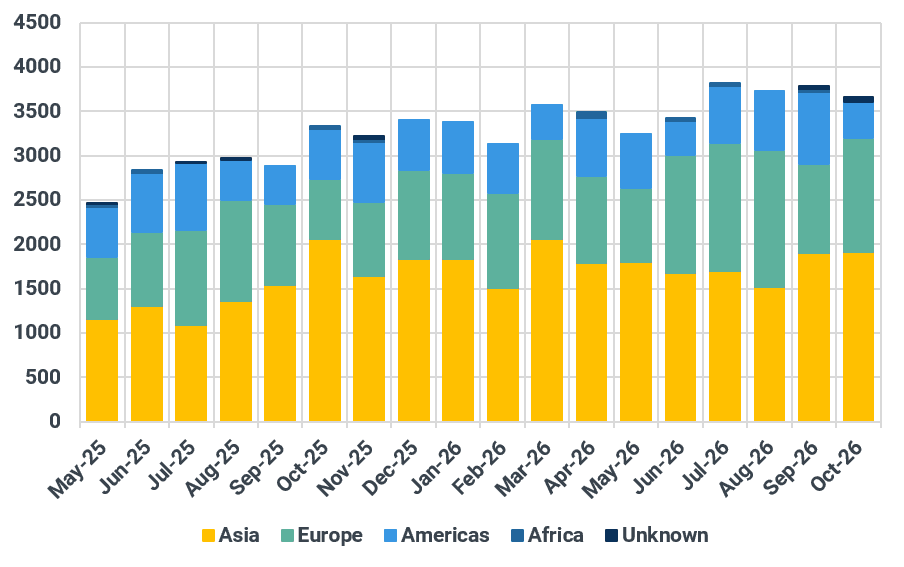
Brazil and Guyana expanded seaborne crude exports by 855 kbd year over year in Q3 2026, with fresh production records on the horizon this quarter.
Key takeaways
- Exports hit record highs: Brazil and Guyana added 855 kbd of seaborne crude exports year over year in Q3 2026 to reach a combined 3.82 mbd, driven by Brazil's record 4.71 mbd crude output in September and Guyana’s accelerating production.
- Quality mismatch distorts differentials: The incoming volumes are light/medium sweet (Guyana) and medium sweet (Brazil pre-salt), which cannot bridge Asia's medium sour deficit caused by OPEC+ producing below quota. The resulting surplus in North-West Europe is eroding sweet differentials and displacing WTI Midland toward Asian tenders.
Recent data out of Brazil shows record crude production, while Guyana is ramping up its new Uaru field, with the first cargoes set to load in December. The export expansion out of Latin America is a result of rapidly increasing supply, finding its way to market at a time when Middle Eastern flows are also resilient.
Brazil set an all-time crude production record of 4.71 mbd in September, 20% up on the year. Pre-salt reservoirs contributed 83% of total extraction, spearheaded by Búzios. Recent FPSO additions drove this performance: P-78 reached its 180 kbd plateau this week, Sepetiba pumped 212 kbd against an initial nameplate design of 180 kbd in September, with Petrobras also seeing some efficiency metrics at their highest levels in nearly eight years.
With limited upside to domestic refining, incremental output is directed overseas, the same dynamic at play for Guyanese crude.
Guyana maintained an export plateau of 902 kbd over Jan–Oct 2026 across its 4 operational FPSOs, up 215 kbd year over year, with monthly swings reflecting cargo scheduling rather than upstream variance. First oil from the 250 kbd Errea Wittu FPSO at Uaru remains guided for this quarter, following offshore mooring in August.
Market chatter suggests that first loadings of Uaru oil are set for mid-December, while the ramp up of this field should take national production above 1 mbd this month. The market is also expecting the 250 kbd Whiptail project on the Jaguar FPSO late next year.
Guyana offshore production fleet & project pipeline
| Development | FPSO | Gross oil capacity (kb/d) | First oil |
|---|---|---|---|
| Liza Phase 1 | Liza Destiny | — | Dec 2019 |
| Liza Phase 2 | Liza Unity | 250 | Feb 2022 |
| Payara | Prosperity | 220 (initial) | Nov 2023 |
| Yellowtail | ONE GUYANA | 250 | Aug 2025 |
| Uaru | Errea Wittu | 250 | Q4 2026 (guided) |
| Whiptail | Jaguar | 250 | 2027 |
| Hammerhead | TBC | 150 | 2029 (sanctioned Sept 2025) |
The commercial sink for these barrels is likely the Atlantic Basin. Europe has absorbed the incremental volume, capturing 64% of Guyanese exports in Q3 2026 (up from 52% in Q4 2025) and doubling Brazilian intake to 751 kbd (a 26% market share). Combined shipments to Europe climbed to 1.33 mbd in Q3 2026 from 840 kbd in Q4 2025. Conversely, East Asian purchases fell by 257 kbd across both suppliers: Guyana recorded zero loadings for East Asia in Q3 2026, while Brazil’s share retreated to 42% (1.20 mbd). Elevated long-haul freight rates and war-risk premiums have disincentivized transatlantic arbitrage into Asia, compelling Chinese refiners to draw domestic stocks.
This influx creates an acute quality mismatch across global refining hubs. Brazilian pre-salt is medium sweet and similar in quality to the new Guyanese stream. Transatlantic flows cannot substitute for remainder of the missing medium-sour barrels from OPEC+ producing below quota. Instead, mounting sweet barrels are saturating North-West Europe, depressing regional sweet differentials and compressing the transatlantic arbitrage for WTI Midland. This dynamic forces US crude eastward into Asian tenders.
Longer term, these volumes present a structural overhang: additional post-conflict Gulf barrels will return to a market where Atlantic sweet crude has already established market share, meaning that the volumes absorbed for stock refills may skew sweeter than the barrels that have been drawn out during the war.
Combined Brazil and Guyana crude exports by destination continent, kbd
Source: Kpler
Market Insights you can trust
Kpler delivers unbiased, expert-driven intelligence that helps you stay ahead of supply, demand, and market shifts.
Trade smarter. Request access to Kpler today.

See why the most successful traders and shipping experts use Kpler