Winter 2026-27 scenarios for the Russian oil industry
Two main scenarios could unfold for the Russian oil industry: an easing of pressure—which could return up to 500 kbd of diesel, 200 kbd of fuel oil, and 100 kbd of naphtha to the market while crude exports remain stable—or continued attacks shifting toward power and heat generation or disrupting light gasoil production to create jet fuel and winter-grade diesel shortages.
Executive summary
Two principal scenarios could unfold for the Russian oil industry. The first is an easing of pressure, accompanied by a shift in the drone campaign from refineries toward power and heat generation. The second scenario involves a continuation of attacks targeting light gasoil production to create shortages of jet fuel or winter-grade diesel.
Under the first scenario, the market could see the return of substantial volumes of refined products. This includes up to 500 kbd of diesel, 200 kbd of fuel oil, and 100 kbd of naphtha. Meanwhile, crude exports would remain broadly stable.
Overview of the situation in Russia’s oil industry
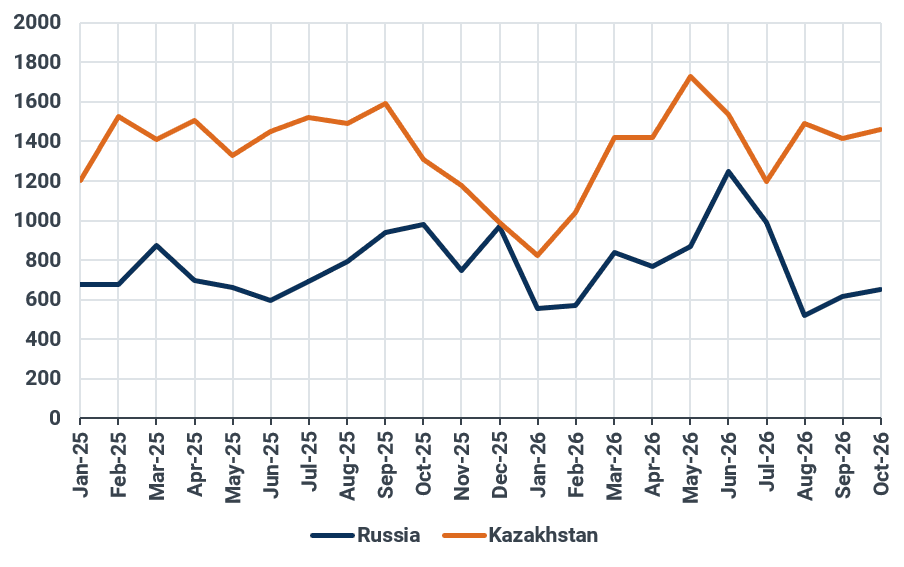
Attacks on refineries continued throughout the summer, with a temporary pause in July as Ukraine redirected its drone campaign toward civilian infrastructure, including wholesale warehouses, and sought to disrupt Black Sea exports. Following a request from the United States, Ukraine shifted its focus from the CPC terminal, which primarily handles Kazakh-origin crude, toward Novorossiysk. This reduced Russian origin crude exports by approximately 350 kbd, with the decline largely translating into direct crude-production cuts in August. At the same time, the pause enabled the Russian refining system to restore approximately 1 mbd of capacity by early August and maintain throughput at broadly 3.8 mbd over the summer.
Black Sea oil exports by origin (kbd)
Source: Kpler
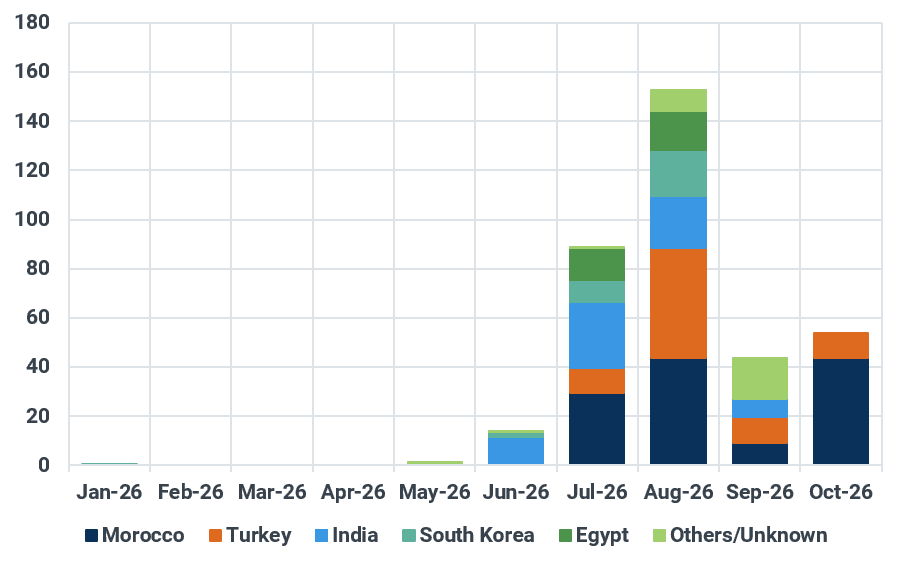
In Q3 2026, Russia began importing petroleum products from India, Türkiye, Korea, Morocco, and Egypt. Most of the estimated 55 kbd of imports consisted of gasoline, with a smaller volume of jet fuel, primarily destined for the Far East. Seaborne gasoline imports were equivalent to approximately 4% of domestic demand during the peak-demand period. Russia also had to reduce gasoline exports significantly to Central Asian countries and Mongolia, while competing with those markets for rail-borne supplies from Belarus.
Russia oil products imports by origin country (kbd)
Source: Kpler
Upstream
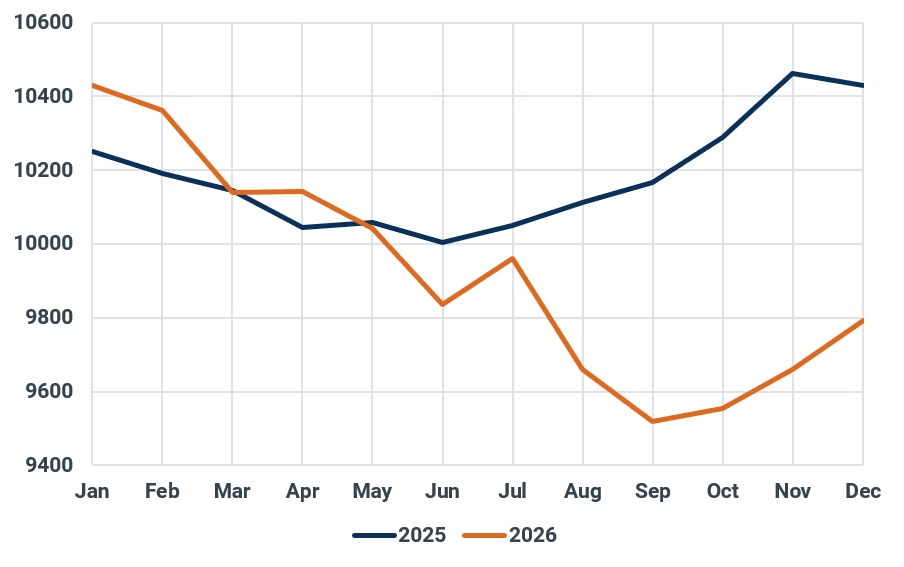
Per our terminal data Russian crude oil and condensate production declined around 900kbd through first ten months of 2026 and is currently seen 9.7mbd in Q4, 700kbd lower on a y/y basis. From March onward, domestic refinery throughput fell while most crude-export outlets were operating close to capacity. As Russia is a net exporter of crude and petroleum products, excess production had to be curtailed because much of its effective storage capacity is underground. The industry therefore appears to retain spare capacity that could be brought back online if additional outlets emerge. A sustained recovery in domestic refinery runs would consequently be expected to support a rebound in crude production.
Russia crude and condensate production (mbd)
Source: Kpler
Refining and the domestic fuel market
Refinery throughput declined by 1.5 mbd between May and September, materially reducing gasoline output to below domestic consumption and prompting intervention by the Russian authorities. The principal response was to relax fuel-quality standards, allowing straight-run naphtha to be incorporated into the gasoline blending pool. This was accompanied by gasoline imports, although importers faced fiscal pressure from the combination of high import costs and regulated domestic prices. By the end of September, the peak domestic-demand season had concluded, improving the gasoline balance.
Current indications as of late October 2026 suggest that Russian refinery runs have recovered to approximately 5 mbd, driven mainly by fewer Ukrainian attacks on refineries during October, particularly in the second half of the month following the announcement of a US–Russia diesel supply agreement. October refinery runs are expected to average approximately 4.3 mbd. This assessment is supported by indications that both gasoline and diesel inventories increased in October, alongside expectations of a strong diesel export program for November. November runs may also remain elevated if attacks on Russian refineries do not resume before the US midterm elections on November 3, or potentially before the trilateral Russia–US–China summit scheduled for November 18–19, 2026, in Shenzhen, China. Another factor to monitor is a trilateral meeting involving Russia, the United States, and Ukraine in the UAE. Together, these developments could allow refinery runs to remain above 5 mbd for at least the first 20 days of November.
Export
Both crude and petroleum-product exports decreased because of Ukraine’s drone attack campaign. The decline in crude exports was mainly driven by disruptions at Novorossiysk, which translated into production cuts because other crude-export outlets in the Baltic Sea were already highly utilized. Crude exports from Baltic sea terminals jumped to close 2 mbd on 4-wMA basis in late August, close to the maximum combined loading capacity of 2.1mbd from Primorsk and Ust-Luga.
Product exports broadly followed domestic refinery throughput, with the most significant implications for global diesel, naphtha, and fuel oil markets: exports fell by 1.1 mbd in Q3 2026 y/y. Elevated refinery runs above 5 mbd in November would return meaningful volumes of summer-grade diesel and fuel oil to the global market. Diesel would likely be directed to established buyers in the Atlantic Basin, including Brazil, African nations, and Türkiye, while fuel oil would primarily move to markets in the East of Suez. Despite the license issued by the US Treasury, it is highly unlikely that material diesel volumes would reach the United States because of persistent financial and legal barriers. In the near term, crude exports may decline because of worsening storm and icing conditions in the Baltic and Black Seas, as well as the time required to restore production. The pace of recovery will depend on whether producers view the rebound in refinery runs as sustainable or temporary.
Implications for the global markets
Based on the limited available information on refinery throughput and average product yields, global markets could receive additional volumes of up to 500 kbd of ultra-low-sulfur diesel, up to 200 kbd of fuel oil, and up to 50 kbd of naphtha, primarily exported through the Baltic Sea. Naphtha availability may be lower if volumes are retained for domestic gasoline blending and inventory replenishment.
Risks and scenarios
Assuming no material change in the current geopolitical or military environment, two scenarios appear most likely. In the first one, Ukraine redirects attacks away from refineries—potentially toward export infrastructure—until a more favorable window emerges in which such action would be less likely to provoke the US administration or could have a greater effect on the Russian domestic market. Such a window could open around March 2027, after the winter diesel season and during the inventory-replenishment period, when Ukraine may again seek to disrupt gasoline stockbuilding ahead of the summer peak-demand season. Under this scenario, Russian refinery throughput would remain within its typical range of 5.0–5.5 mbd from November through Q2 2027. Product exports would recover, easing tightness in distillate and residual-fuel markets, while crude exports would remain broadly stable, around 3.7-3.8mbd for seaborne exports.
In the second scenario, attacks resume and intensify during November, becoming a persistent constraint on Russian refinery operations. Throughput would remain around 4.0–4.5 mbd, making the return of diesel and fuel-oil exports intermittent. The campaign could also shift its focus from gasoline production toward the light-gasoil fraction required to produce winter-grade diesel and jet fuel. Crude production and exports are following availability of outlets to place crude – throughput of refineries and export terminals.
The next days remaining decisive in establishing which one of the two scenarios is more likely.
Market Insights you can trust
Kpler delivers unbiased, expert-driven intelligence that helps you stay ahead of supply, demand, and market shifts.
Trade smarter. Request access to Kpler today.

See why the most successful traders and shipping experts use Kpler