
Iran’s oil on water outside the blockade zone hits zero as Tehran’s trilemma sharpens
Iranian oil on water outside the blockade zone has hit zero as the last cargoes discharged in China earlier this month. Consequently, Iran’s oil revenues could drop to zero by mid-December. With its back against the wall, Tehran’s trilemma sharpens, and escalation remains its least bad option in the short term.
Market & trading calls
- Neutral Dubai structure. With Iranian barrels gone, Asian refiners are competing for prompt Middle Eastern crude. This would normally be bullish Dubai structure unless Hormuz transits stay elevated, in which case there is potential for more bearishness in the structure.
- Slightly bullish Brent near term. Iran is incentivised to keep tensions high before the November 3rd US midterms, raising the risk to Persian Gulf flows.
Key takeaways
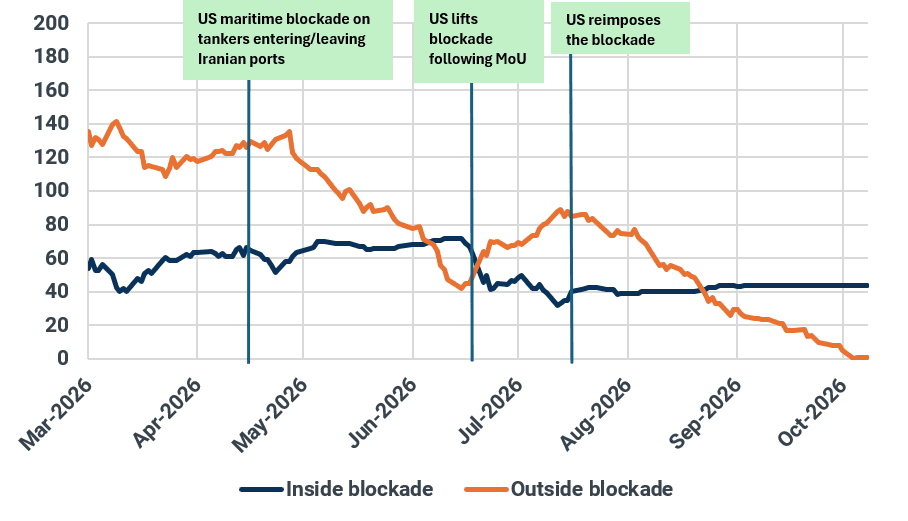
- Iranian oil on water outside the blockade zone fell to zero in mid-October, from a peak of 88.8 Mbbl on 14 July. Around 43 Mbbl remain stranded inside the blockade area.
- Payments lag discharges by around two months, so Iran’s crude and condensate revenues should dry up by mid-December, if Tehran is able to repatriate the associated revenues.
- Tehran faces the trilemma we outlined in August: endure, negotiate or escalate. The first-choice option points towards escalation before the midterms, before a potential strategy change.
- That path carries high risks: a forceful US response, as in July, and a hardening of regional positions against Tehran.
The last barrels have landed
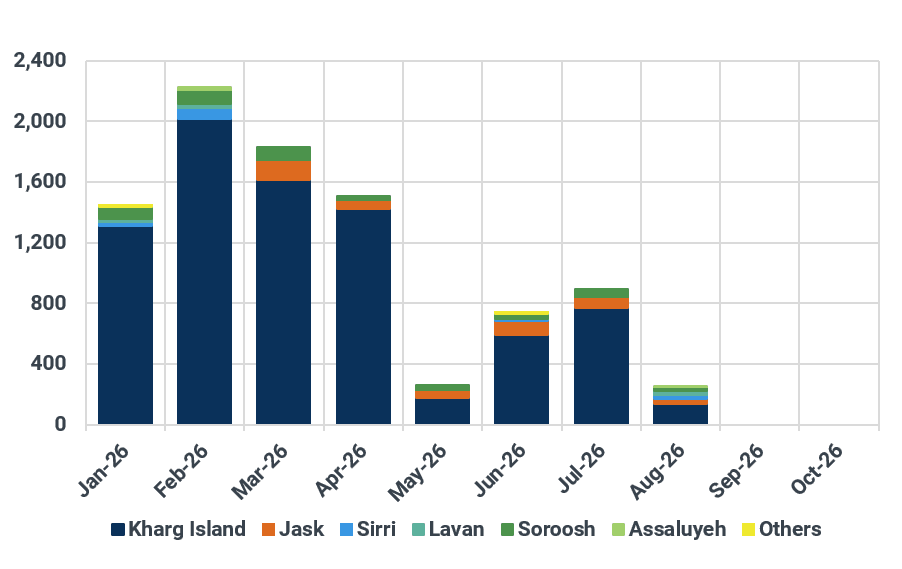
As indicated in our latest Crude Oil Barrel report (see Chart of the Month section), our data shows that Iranian crude and condensate on water outside the blockade zone fell to zero in mid-October. This analyst assessment differs from the figure currently shown on the Kpler platform, which does not yet reflect these discharges and is being updated. At the start of the war, Iran held around 136 Mbbl of oil outside the region, much of it floating off Malaysia and Singapore. That pool allowed it to keep supplying China through two rounds of blockade. It rebuilt to almost 89 Mbbl during the June MoU but has been steadily discharged since the blockade returned in mid-July. Iran has not loaded a crude or condensate cargo since 25 August, and tankers that loaded since mid-July haven’t been able to pass through the blockade line. This has forced NIOC to reduce output to internal needs threshold, decreasing to even under 2 mbd this fall as domestic demand seasonally drops.
Iranian crude and condensate on water (mbbls)
Source: Kpler analyst estimates
Note: This chart reflects our analysts’ assessment of Iranian oil-on-water. It incorporates recent discharges that are still being processed into the oil-on-water data shown on the Kpler platform, so the two may differ for Iranian volumes outside the blockade zone. The platform will be updated to reflect these changes.
Iran crude and condensate loadings by origin port (kbd)
Source: Kpler
Iran oil production (kbd)
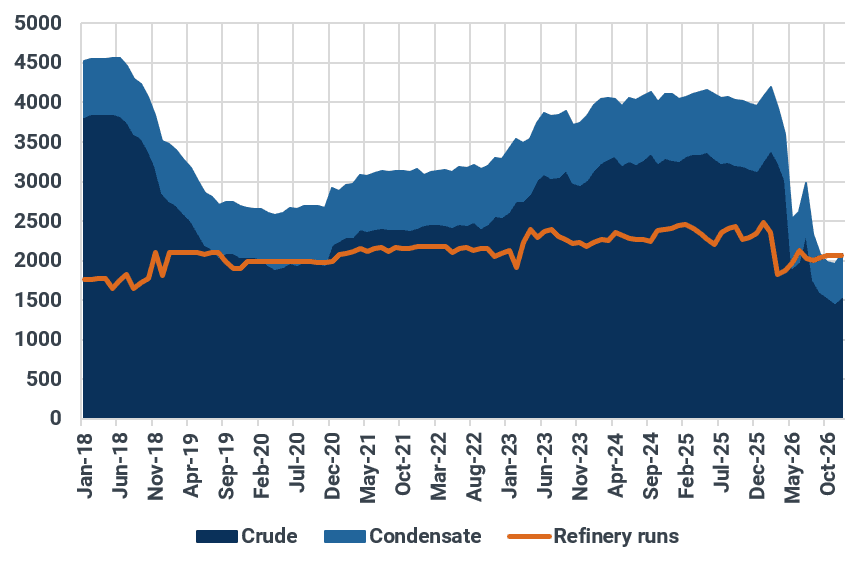
Source: Kpler
The financial hit is yet to come. Chinese buyers typically pay one to two months after discharge, so we expect Iran’s crude and condensate revenues to reach zero by mid-December, for the first time in its history. Oil sales account for around 30–40% of government revenues and are Iran’s largest source of foreign currency. Meanwhile, the currency market is already pricing in their loss. On 22 October, the US dollar hit a record of around 272,000 tomans on the open market, up from 157,000 in mid-June when the MoU was being implemented. The toman has lost about 42% of its value over that period, pushing up the cost of imports and feeding inflation just as the blockade constrains them further.
Endure, negotiate, or escalate
In August, we argued that escalation was likely to become Tehran’s least bad option in the short term, as the blockade made the status quo increasingly costly while its neighbours’ exports recovered. With the oil-on-water cushion now gone, the past week supports that view:
That leaves escalation, and the past week suggests Tehran is leaning that way: only today, the IRGC has claimed to have struck four US-linked tankers in the northern Persian Gulf, and says three more vessels hit mines in the western Strait of Hormuz. UKMTO separately confirmed projectile strikes on tankers near Al Faw and Bukha. The IRGC Navy has warned that US military bases could become targets. Houthi attacks on Saudi Arabia have intensified, prompting Aramco to evacuate its Dhahran headquarters.
Despite this, the volume of crude (excluding Iranian volumes) leaving the region remains above pre-war levels on a 7-DMA basis. However, the increasing number of attacks may reduce transit and loadings in the Gulf over the coming days, although total flows are expected to remain relatively elevated. With US midterms on 3 November, Tehran has every incentive to raise the cost of the war now.
A high-risk bet
July showed the danger. Iranian pressure on shipping triggered a forceful US response that weakened Tehran’s grip on the Strait, and Washington and Israel are reportedly preparing new strikes. Regional positions could also harden further depending on Iranian or Iranian proxy attacks: the UAE halted trade with Iran in August, the UK and France are stepping up defensive support for Saudi Arabia, Egypt has said it would defend Saudi territory if asked. Yesterday, Iraq closed one of its major borders with Iran (Sheeb/Chazabeh border). If Gulf states move from cautious neutrality to open opposition, Tehran could end up more isolated, deepening the economic pressure it is trying to escape.
Market Insights you can trust
Kpler delivers unbiased, expert-driven intelligence that helps you stay ahead of supply, demand, and market shifts.
Trade smarter. Request access to Kpler today.

See why the most successful traders and shipping experts use Kpler