

Global supply outlook and balances: unpacking the assumptions and downside risks behind the assumed 3 mbd surplus in 2027
Global crude supply has recovered to just shy of pre-war levels, led by returning Middle Eastern output and robust non-OPEC growth. This growth has recently outpaced demand, lifting the global balance into a stronger surplus, a trend we expect to continue in 2027 with the balance averaging at a roughly 3 mbd surplus. However, escalations in the Middle East, the timing of when, if at all, Iranian volumes return, and stronger Chinese demand and restocking could all narrow the surplus to parity, or even into sporadic deficits.
Key takeaways:
- Three factors will largely shape the 2027 balance: China's demand recovery, potential Middle Eastern supply losses and the pace of restocking.
- The market is back in surplus: the global crude and condensate balance turned positive in September (about +0,3 mbd) and averaged +2,6 mbd in October. We expect the surplus to average around 3 mbd across 2027.
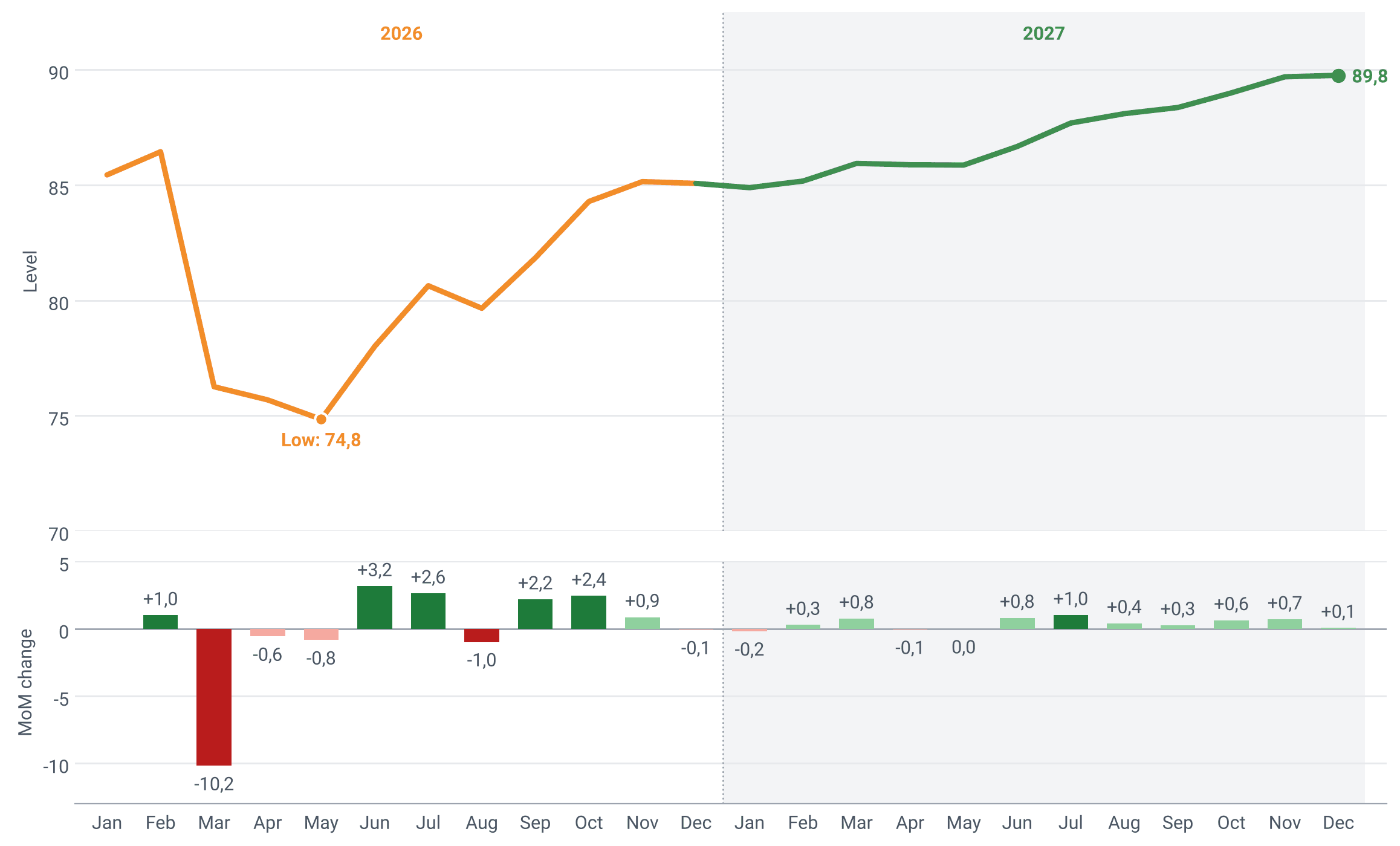
- Supply has nearly recovered to pre-war levels: global supply is heading to 85,2 mbd in November, just below January’s 85,4 mbd, after adding about 9,4 mbd between June and October. We expect output to reach 89,8 mbd by December 2027.
- Middle East risk is the main downside to supply: a US-Iran escalation hitting Fujairah or Ras Tanura, or a strike on Yanbu’s (current) 3 mbd of exports, could push the market back into deficit (assuming all other metrics remain constant).
- Our base case assumes Iranian volumes back to normal: we assume a Middle East resolution in H2 2027 and about 1,7 mbd of Iranian supply returning from Q2 onwards. Without it, the H2 surplus halves. This is also the lowest confidence assumption we make and may flip the balance materially, if it does not materialize.
- Upside demand risk is China: our base case has Chinese refinery runs averaging 15,2 mbd in 2027 (+1,1 mbd on 2026), below the 15,7 mbd early-Q1 2026 pace. If runs return to 15,7 mbd from March 2027 onwards, ahead of expectations, global demand is about 0,4 mbd higher and the average surplus falls below 3 mbd (assuming all other metrics remain constant).
- Restocking is the biggest swing factor: stock rebuilds, in the US and China in particular, could cut the implied 2027 balance by ~1 mbd (if restocking begins in early 2027). This supports a constructive crude price view, despite an expected balance surplus, with Dated Brent around $80/bbl for most of next year, with risk premium supporting H1 2027 prices.
Global crude and condensate supply has nearly returned to pre-war levels, fueled by accelerated growth since June. This has been corroborated by global seaborne crude and condensate exports, which hit a record high of 47.6 mbd in October.
Between June and October, global crude and condensate output increased by roughly 9.4 mbd, with supply rising by an average of about 2 mbd per month over this period (see chart below).
After hitting a low of 74.8 mbd in May, global crude and condensate supply is projected to reach 85.2 mbd in November, just below January’s (2026) 85.4 mbd. Thereafter, expansion is expected to slow, with output reaching 89.8 mbd by December 2027.
Global crude and condensate supply, Mbd
Source: Kpler
The recent supply recovery has been largely driven by returning Middle Eastern production, with major producers, such as Saudi Arabia and Iraq, already operating near pre-war levels, while the UAE (+600 kbd) and Oman (+100 kbd) have surpassed their pre-war benchmarks.
Outside the Middle East, non-OPEC growth remains resilient. US crude output stays on an upward trajectory underpinned by robust Permian Basin activity (see Americas section), while Brazilian production is expected to hold near record highs of almost 5 mbd.
Meanwhile, Argentina, Canada, and Guyana are set to maintain strong upward momentum through 2027, with activity in the latter country supported in the near term by the mid-November start-up of Guyana’s Uaru FPSO, which will add 250 kbd of supply.
Average supply growth 2026 versus 2027 by region, Mbd

Source: Kpler
We estimate that rising global supply has pushed the crude market back into a mild surplus in September at roughly 0.3 mbd, expanding to an average of 2.6 mbd in October. This shift ends six consecutive months of deficits between March and August, during which the shortfall deepened to -4.4 mbd in May.
Looking ahead, the surplus is projected to widen to around +3.1 mbd in November and average 3.3 mbd throughout 2027, peaking above the 5 mbd mark in October (peak autumn maintenance season) before moderating to just under 3 mbd by year-end, in our books.
Global crude and condensate balance, Mbd

Source: Kpler
While a 3.3 mbd surplus implies an oversupplied market, significant Middle Eastern risks cloud our supply outlook.
Renewed US-Iran escalation could target major regional terminals, such as Fujairah—echoing early wartime strikes—or Ras Tanura, where vessel activity remains elevated amid STS operations, resulting in rapid supply losses. Meanwhile, intensifying Houthi-Saudi hostilities threaten Saudi Arabia’s western coast; another strike crippling Yanbu’s 3 mbd exports could single-handedly push the market back into deficit.
Furthermore, our base case continues to anticipate a resolution in the Middle East over the second half of next year, paving the way for Iranian volumes to return. We project roughly 1.7 mbd of Iranian supply to re-enter the market from Q2 2027 onwards, primarily impacting H2 balances. Without these barrels, the market would narrow to only a modest surplus over the second half of the year.
Factoring in restocking (discussed more thoroughly below), which will add additional demand (not included in our demand numbers, where demand is seen as refinery intake), alongside potentially lower output from other Middle Eastern producers (under a scenario where tensions escalate), the global crude balance could fall back to parity, or even into sporadic deficits, during H2 2027.
Monthly supply change by region, Mbd

Source: Kpler
Upside demand risks could also materially tighten the market balance.
A stronger-than-expected demand recovery remains possible if crude and landed prices fall faster than our base case—via a US–Iran deal unwinding the remaining paper war-risk premium, a full normalization of Hormuz flows and elevated freight rates, and deeper Middle Eastern OSP cuts. Cheaper delivered crude would boost margins, incentivizing price-sensitive Asian refiners and stockholders to raise runs and restock more aggressively.
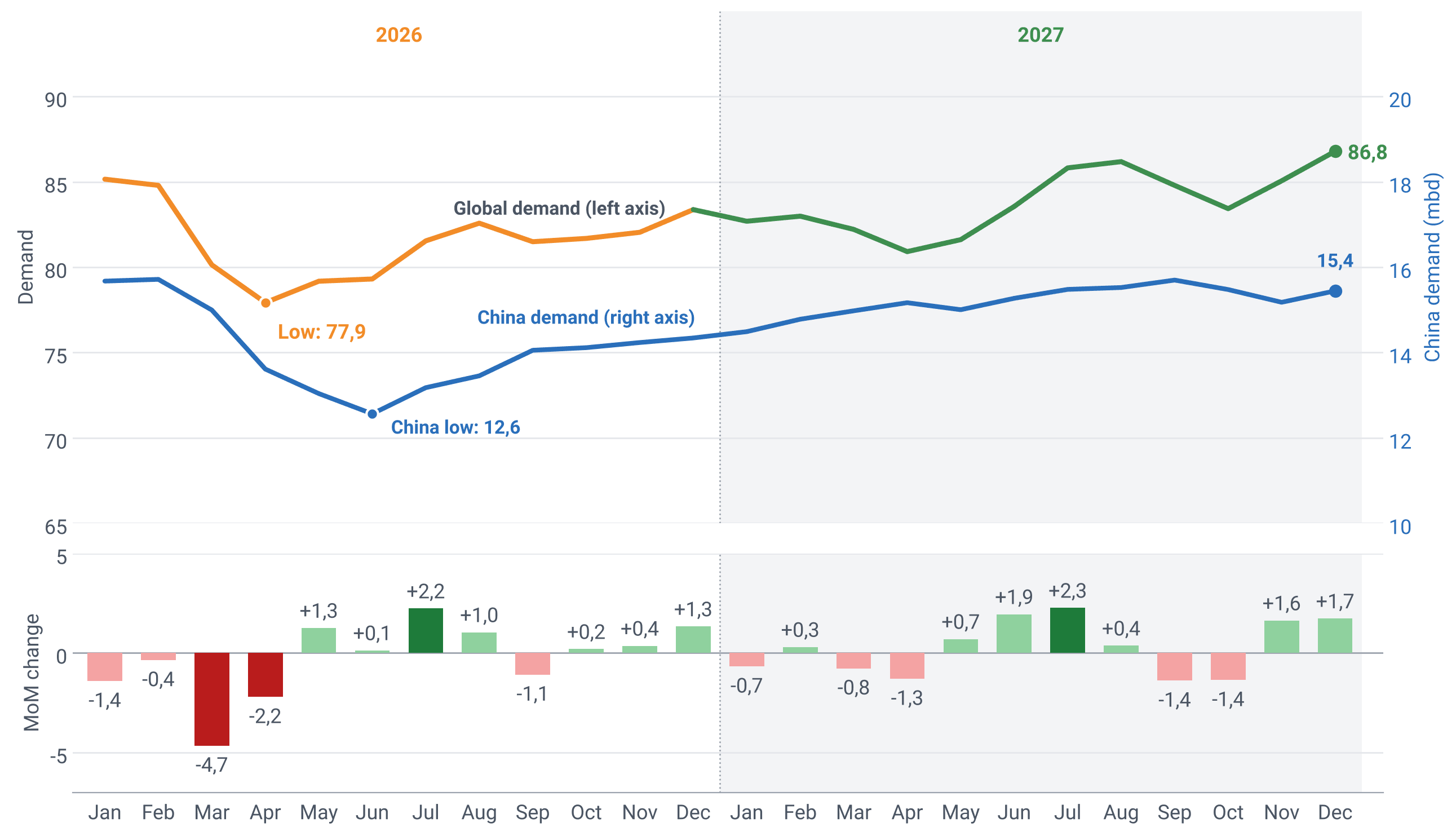
Specifically, our baseline S&D assumes Chinese refinery runs recover in 2027 to average roughly 15.2 mbd—up 1.1 mbd (+8%) from 14.1 mbd in 2026, but fall short of the 15.7 mbd pre-war pace seen in early 2026 (see chart below).
This builds on Kpler’s September analysis of China’s road-fuel displacement. Gasoline and diesel demand are set to fall by around 440 kbd in 2026 (gasoline -210 kbd, diesel -230 kbd), half of China’s total liquids demand decline, while technology displaces around 1.3 mbd: roughly 650 kbd of gasoline through electric cars and 680 kbd of diesel through LNG and electric trucks.
Chinese NEVs averaged 64% of passenger car sales in January-July (83% in July), and EVs are expected to reach 22% of the car fleet in 2027. With gasoline demand falling a further 70 kbd and diesel recovering only 64 kbd, road fuels stay broadly flat in 2027, so the rebound in runs must largely come from petrochemicals and feedstock flows.
However, should this structural erosion prove slower than expected (ie, a weaker EV uptake than assumed), or should refiners restock more aggressively after Chinese onshore crude inventories fell to roughly 1,120 Mbbls in October (rising to 1,140 Mbbls in November), more resilient Chinese imports could lift the implied global crude demand above expectations and materially erode a large portion of the projected surplus for next year.
For instance, if Chinese refinery runs were to return to their January-February 2026 average of around 15,7 mbd from March 2027 onwards, global demand would be about 0,4 mbd higher on average over March to December than in our base case, pushing the 2027 average surplus below 3 mbd.
Global and Chinese (right scale) crude demand, Mbd
Source: Kpler
Furthermore, we anticipate strong global demand for stock replenishment, including in the US and China, which will absorb substantial excess supply. A longer market balance is essential to facilitate this restocking, allowing surplus barrels to flow into storage facilities worldwide.
Adding this restocking appetite to our forecasted demand figures introduces meaningful consumption volume, reducing next year’s implied global crude balance by at least 1 mbd. This alone will push the 'implied' global crude to around 2 Mbd.
Potential restocking could also exceed expectations for some regions, including the US, where the EIA already projects a net 2027 SPR rebuild of 264 kbd (96.2 Mbbls), driven by 561 kbd of second-half inflows as exchange barrels return, while still leaving year-end stocks of 344.7 Mbbls nearly 70 Mbbls below pre-conflict levels.
This keeps a constructive view on crude prices, despite the expected surplus in crude markets next year, with Dated Brent forecasted to average around $85/bbl for most of next year. This is particularly true as we expect risk premium due to the ongoing war to remain elevated over H1 2027.
Market Insights you can trust
Kpler delivers unbiased, expert-driven intelligence that helps you stay ahead of supply, demand, and market shifts.
Trade smarter. Request access to Kpler today.

See why the most successful traders and shipping experts use Kpler