‘No peace, no war’ limbo an unsustainable status quo for crude market
The market feels slightly uneasy with the current ‘no peace, no war’ status quo, and this is likely to shift, especially with 2027 on the horizon. A combination of widespread Houthi attacks, a ‘wait-and-see’ approach from Washington and Asian buying needs leads to a world where something has to give.
Key takeaways:
- ICE Brent fell 22% from its late-October peak as global balances swung to a 2.6 mbd prompt surplus. Yet Total Hormuz Clearance sits at just 9.4 mbd—55% of pre-war levels.
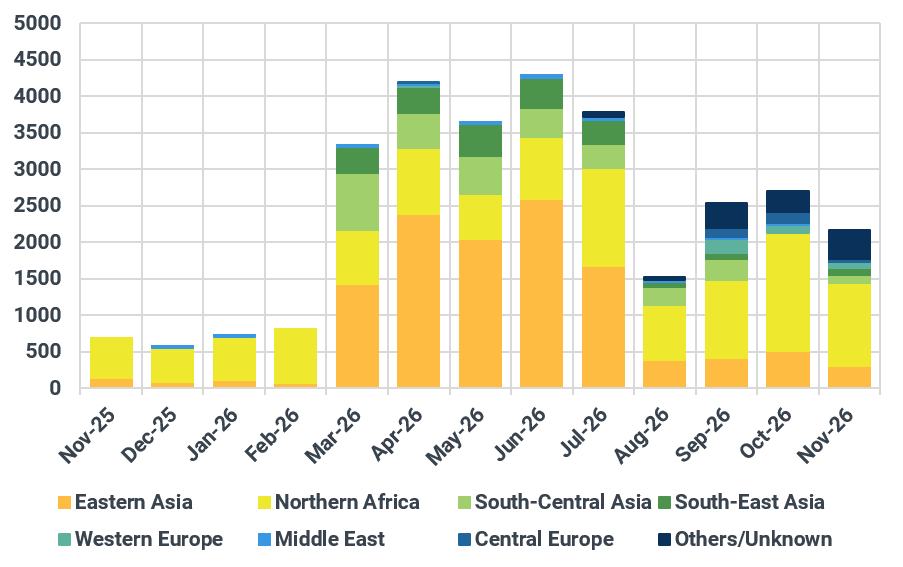
- Saudi Arabia’s Yanbu terminal is loading under 3 mbd, making the East-West Petroline a single point of failure whose outage would flip Kpler’s 2027 surplus into deficit.
- Washington’s “no war, no deal” stance looks set to extend into the new year. Key to this is the US naval blockade. This has proved effective so far, though reports of Iranian oil breaking the stronghold are emerging.
- Asian refiners are paying large premiums for Atlantic Basin crude and chasing 2027 QatarEnergy and ADNOC term deals, seeking out Middle Eastern buyers that may have more sway in reliably getting barrels out of the region.
Paper crude markets are unwinding geopolitical risk that physical vessel flows have not resolved. Futures prices have shown sharp declines, unwinding some geopolitical risk and pricing in a ‘no peace, no war’ world. The equilibrium for this is fragile and difficult to price.
Supply growth gave the market an impetus for the recent price downturn: Global crude and condensate output is tracking 85.2 mbd in November, lifting Kpler’s global balance from a 4.4 mbd deficit in May to a 3 mbd surplus this month.
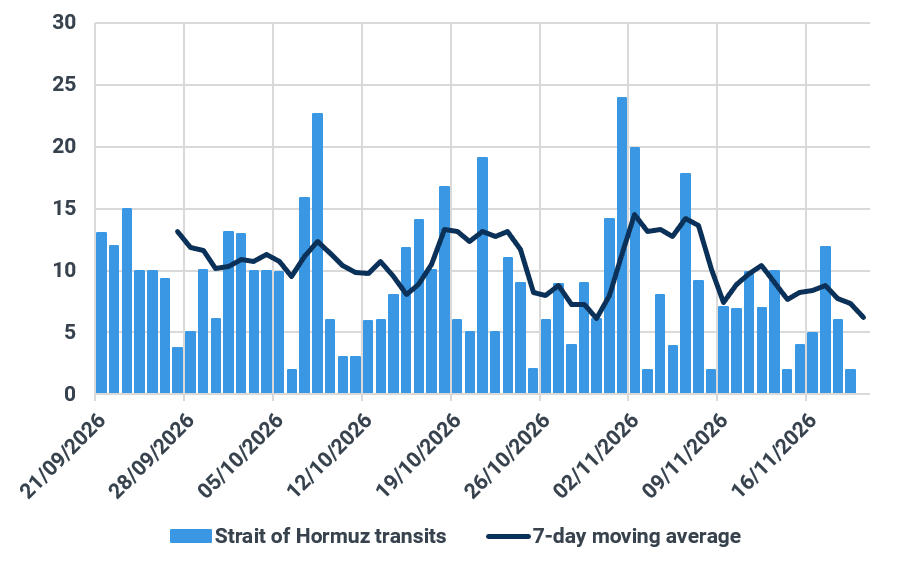
However, physical tracking reveals that Middle Eastern exports are declining, with a ramp up in hostilities. Kpler’s Middle East Flows dashboard shows Total Hormuz Clearance—Strait transits excluding Iranian barrels plus Gulf of Oman STS net exports—averaged just 9.4 mbd over the 7 days to 18 November, or 55% of the 17.1 mbd pre-war baseline.
Total Hormuz Clearance, mbd
Source: Kpler
While Middle East seaborne exports reached 19.1 mbd in October, around 3.4 mbd comprised unattributed Gulf of Oman STS barrels. The sustainability of such operations remains in question longer-term, especially if Iran chooses to ramp up attacks on vessels involved in this operation.
More widely, Houthi escalation is moving towards Saudi mid-stream energy assets again. Following a claimed 17 November strike on the East-West Petroline, Houthi forces claimed hits on Jubail’s Sadaf complex this week.
West coast Saudi Arabia crude oil loadings, kbd
Source: Kpler
A Houthi spokesperson has today stated that all Saudi ports along the Red Sea are targets. Kpler’s 2027 balance identifies Yanbu, Fujairah, and Ras Tanura as the 3 terminals whose loss flips the market back into deficit. With Houthis overlooking Bab el-Mandeb as well, the market now seems to be under-pricing the risks of attacks on Saudi oil infrastructure that could rapidly tighten balances.
Simultaneously, Washington’s “no war, no deal” posture seems to be deferring an Iran decision into 2027, at least according to President Trump’s latest statements. This stance is reliant on the US naval blockade on Iran holding. It has been extremely effective thus far, but reports this week suggest Iranian vessels have started to break through, carrying crude.
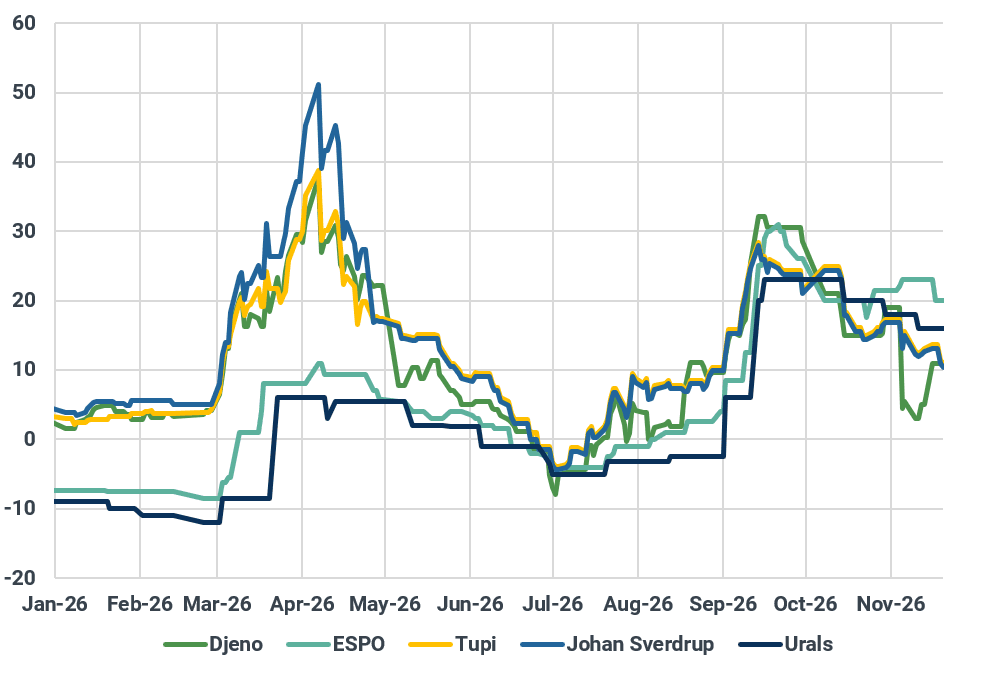
With Strait access rationed, Asian buyers are already diversifying: Middle East crude fell to 52% of Asia’s seaborne imports in October, from 59% in 2025. Taiwan’s CPC bought WTI and Medanito at double-digit premia this week, as USGC–China VLCC rates fell. Additionally, trading houses are bidding for 2027 QatarEnergy and Adnoc term deals, specifically targeting these companies, with the assumption that their status in the current war will allow them to move barrels out of the region more reliably than their neighbours.
Selected crude diffs vs ICE Brent, DES China basis, $/bbl
Source: Argus Media
Putting this all together, it leaves the market in a bit of a tangle. Current crude surpluses are not triggering mass restocking due to high landed costs in Asia. Landed costs are high, due in part to the lingering uncertainties around attacks and safe vessel passage in the Middle East. The US seems unlikely to move the needle in the war until the new year. This leaves crude buyers seeking alternatives, or trying to strike deals to ensure the crude they need can leave the Middle East.
The rise in bilateral safe-passage understandings risk entrenching a two-tier Gulf market, and perhaps are already acting as an informal ‘toll’. In a cloud of uncertainty, it seems that the crude market will struggle to live with the status quo.
This means either higher prices following continued attacks and truncated Hormuz flows, or more ‘agreements’ for vessels to leave the region, meaning that a makeshift solution to the Hormuz problem may have already been found.
Market Insights you can trust
Kpler delivers unbiased, expert-driven intelligence that helps you stay ahead of supply, demand, and market shifts.
Trade smarter. Request access to Kpler today.

See why the most successful traders and shipping experts use Kpler