Iran’s long reach: Saudi's east–west pipeline under fire
A suspected Iraq-based attack on Saudi Arabia’s East–West Pipeline shows the growing reach of Iran and its aligned groups, from Yemen to Iraq, as conflict engulfs the region. The strike shuts down a critical bypass for Hormuz and brings the fighting another step closer to producing assets.
Iran’s Long Reach: The East–West Pipeline Under Fire
Twenty-five years after the World Trade Center towers fell and the United States declared a war on terror, America once again finds itself deeply entangled in the Middle East. The attack on Saudi Arabia’s East–West Pipeline marks another escalation in a conflict the global oil market cannot absorb indefinitely.
I was recently reminded of a warning made in 2019 by Abolfazl Shekarchi, the senior spokesperson for Iran’s Armed Forces: “If the enemy, especially America and its allies in the region, make the military mistake of shooting the powder keg on which America’s interests lie, the region will be set on fire.”
Industry sources confirmed to Kpler that the September 10 attack struck the East–West Pipeline at multiple locations, causing significant damage to at least one pumping station. The Saudi Energy Ministry subsequently confirmed that the pipeline—Saudi Arabia’s principal escape route from a constrained Strait of Hormuz—had been shut down as a precaution.
Saudi Aramco has repaired this system quickly before, with attacks earlier this year resulting in relatively short-lived disruptions. Initial indications suggest the latest damage may be more serious. How much capacity can be restored—and how quickly—remains unclear.
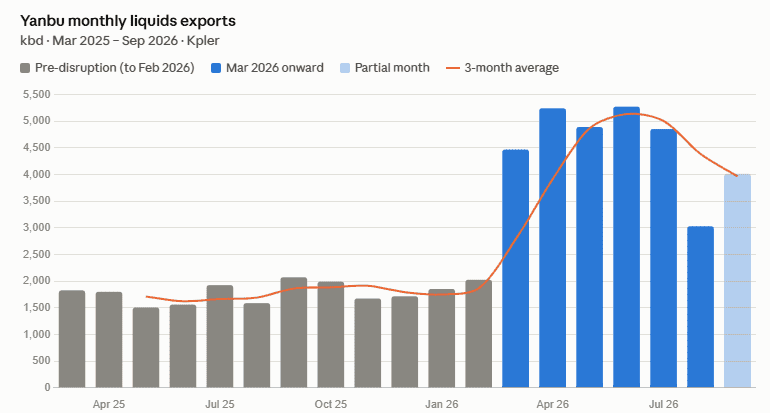
The East–West Pipeline carries crude roughly 1,200 kilometers from Saudi Arabia’s eastern producing regions across the desert to Yanbu on the Red Sea. With nameplate capacity of around 7 million bpd, it has effectively become a lifeline for Saudi crude exports during the conflict—the infrastructure designed to keep Saudi barrels moving when the Strait of Hormuz cannot.
Pumping stations along Petroline maintain the pressure required to move millions of barrels per day across changes in distance and elevation. Damage to a critical station can therefore have consequences far beyond the physical section that was struck. Depending on which station was damaged and the ability to modify operations around it, throughput could fall sharply even if much of the pipeline itself remains intact.
Since the conflict began, Aramco has predominantly filled the system with lighter crude grades, helping maximize achievable flow rates and preserve export capacity. A prolonged outage would remove that flexibility, leaving Saudi Arabia with few alternatives. Kpler estimates that without the East–West Pipeline, Saudi crude exports could ultimately fall by roughly 3.5–4 million bpd, depending on the severity and duration of the disruption.
Throughout the conflict, Saudi Aramco has continued to meet customer commitments without declaring force majeure, drawing on storage facilities around the world when necessary. Maintaining its reputation as one of the world’s most dependable suppliers remains a priority, and Aramco plans to continue using its global inventory network while Petroline is repaired.
What is Moving Now?
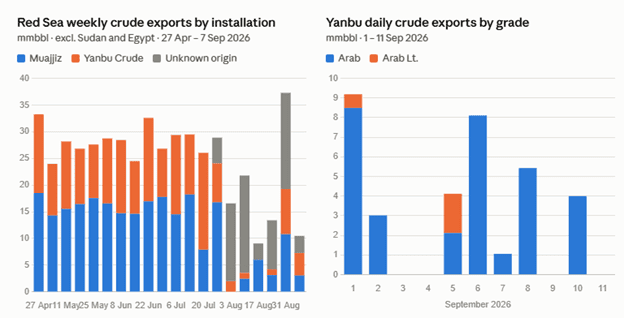
Kpler satellite imagery confirms that two VLCCs were loading on the Saudi west coast as of September 10: Sea Leopard at Muajjiz Terminal and Yasa Hercules at Yanbu Crude Terminal. Recent market reports obtained by Kpler indicate another five tankers—four VLCCs and one Aframax—were expected to load.
Visibility has become increasingly difficult as vessels switch off AIS while loading at Saudi west coast terminals, as they increasingly do in the Middle East Gulf. Where continuous AIS, satellite imagery or direct port intelligence are unavailable, Kpler therefore combines confirmed Yanbu loadings with potential Saudi cargoes classified more broadly under the Red Sea.
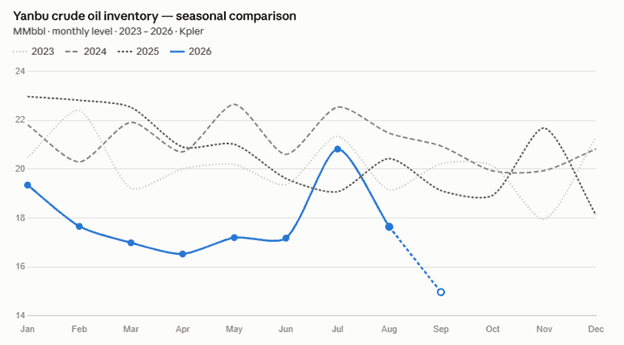
The inventory picture provides another clue. Kpler estimates crude inventories at Yanbu at less than 15 million barrels, near lows last seen in 2018. Stocks have already fallen by nearly 6 million barrels over the past two months, from almost 21 million barrels in July.
That leaves Saudi Arabia with less of a cushion if fresh crude cannot reach the west coast. At 3.5 million bpd, 15 million barrels represents little more than four days of theoretical supply. Not every barrel in storage is operationally available, and exports would not simply continue unchanged until tanks reached zero.
The economic consequences are already visible. Brent closed Friday above $105 per barrel, while U.S. diesel has crossed $6 per gallon and gasoline is now around $4.30 per gallon. Further disruption to Saudi exports would hit a market already carrying the cost of constrained Middle Eastern supply.
Yemen or Iraq?
Saudi Arabia has now said that the drones targeting Petroline originated from Iraq. That does not mean the Iraqi government ordered or conducted the attack, but it does put Iraq back into the center of a conflict Baghdad has been trying to avoid.
For now, Riyadh is showing restraint. Saudi Arabia said Friday that it would not retaliate “at this stage,” following a request from the Iraqi prime minister to give Baghdad an opportunity to prevent further attacks from Iraqi territory. But the kingdom also explicitly reserved its right to respond.
The United States and Saudi Arabia have already demonstrated that they are willing to strike Iran-aligned militias inside Iraq. They did so in July after earlier drone attacks against Saudi oil infrastructure. Another round of strikes would pull Washington deeper into military operations in Iraq and expand the conflict into another major oil-producing country.
Yemen presents a different version of the same problem. Escalating against the Houthis means intensifying military operations around the Red Sea and Bab el-Mandeb, just as the Saudi west coast becomes even more important as an alternative export route. Direct escalation against Iran risks further disruption around Hormuz.
As the conflict escalates, the risk is moving upstream. Much of the energy infrastructure targeted so far has been downstream or logistical—refineries, ports, vessels, pipelines and pumping stations. Petroline brings the conflict closer to the region’s producing system. The next escalation could be far more consequential: crude processing facilities such as Abqaiq, or the producing fields themselves.
The region has not experienced disruption on that scale since the Gulf War. As Iraqi forces withdrew from Kuwait in 1991, they ignited more than 750 oil wells across eight fields. At the peak, more than 600 were burning, releasing an estimated 4–6 million barrels of crude per day. The fires began in January and February; the last well was not capped until November 6, more than eight months after Kuwait was liberated.
The circumstances today are very different. But Kuwait remains a reminder of what happens when producing infrastructure becomes part of the battlefield.
Iran warned years ago that the region was a powder keg. For much of this conflict, the damage to the oil system has remained relatively contained. Petroline brings the conflict closer to the producing assets the global market can least afford to lose.
The global oil market cannot absorb that progression indefinitely. Either escalation produces an off-ramp, or it produces a larger supply shock that finally forces one.

See why the most successful traders and shipping experts use Kpler