
Shadow fleet sanctions relief won't solve the tanker crisis
The Trump administration is reportedly considering easing sanctions on shadow fleet tankers linked to Russia, Iran, and Venezuela in an attempt to reduce record freight rates. According to reports, the proposal would allow sanctioned vessels to transport legally traded oil, subject to approval from the US Treasury Department. The objective is to increase tanker availability, particularly for crude exports from the Middle East Gulf, while avoiding any direct increase in sanctioned Russian or Iranian oil exports. Kpler expects the measure to have virtually no impact on the current tanker crisis. The proposal assumes that removing sanctions will translate into additional commercially available capacity. In practice, the relationship is far more complicated.
Key takeaways
- Sanctions relief will do little to ease record tanker rates. The current crisis is driven primarily by heightened war risk in the Middle East, rather than a shortage of vessels alone.
- The shadow fleet is not a readily available source of compliant capacity. Aging vessels, uncertain seaworthiness, and unresolved insurance, crewing, and management arrangements will restrict their commercial appeal.
- Iran-linked VLCCs offer the only plausible near-term benefit but their operational suitability remains questionable.
- The geopolitical costs could outweigh the freight benefits. Relaxing sanctions risks undermining years of pressure on Iran and Russia without materially improving tanker availability.
The immediate pressure is concentrated in the VLCC market in the Middle East Gulf, where the conflict has disrupted vessel movements, reduced fleet efficiency, and sharply increased the risks associated with operating in the region and beyond.
While the changes in export operations have reduced overall fleet efficiency, VLCC supply in the Gulf of Oman is sufficient relative to current exports. The surge in freight rates is not simply a function of vessel availability. War risk is a dominant factor pushing rates to record levels. Shipowners are demanding substantial compensation for exposing their vessels, crews, and assets to the dangers associated with operating in and around the Strait of Hormuz.
In addition, there is a relatively small number of owners willing to cross the Strait, giving them outsized negotiating power. Removing sanctions will not compel these vessels to take the same risks.
Adding vessels to the theoretical supply pool does little to address that underlying risk premium.
Un-sanctioned does not mean commercially available
While details over a potential easing of sanctions have yet to be disclosed, as the measure sits in the discussion phase, any relief would likely target the VLCC market that currently leads the freight market tightness.
A US decision to ease designations would leave EU, UK and UN listings untouched, so vessels delisted by OFAC could remain off-limits to European insurers, banks and charterers. Global players would still face a patchwork of exposures, and the lowest common denominator, not the most permissive regime, would set how readily these ships could trade.
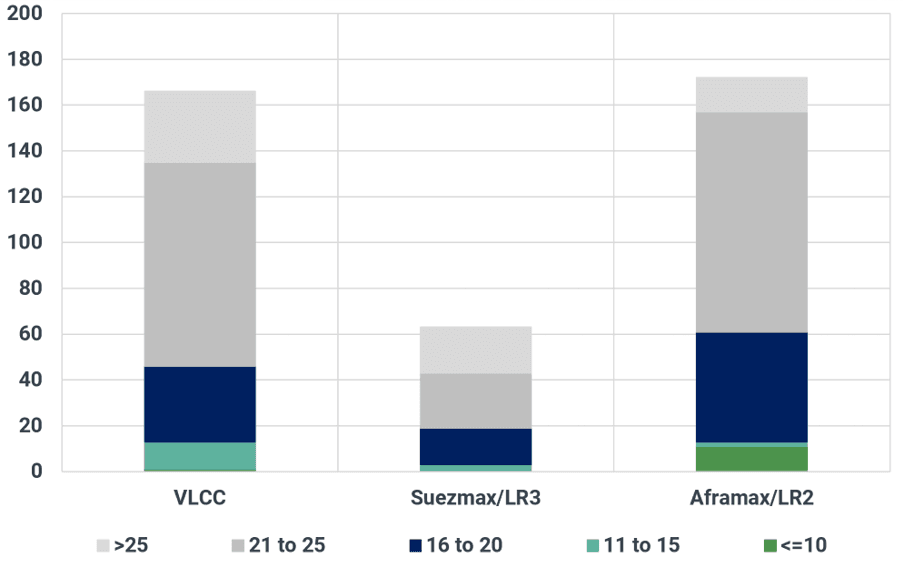
We currently track circa 160 OFAC-sanctioned VLCCs, most of which sit under Iran-related designation lists.
While this headline figure stands for circa 22% of the commercial fleet, its practical contribution to global freight would be severely constrained by age. Kpler data places just 46 or 27% of the OFAC-designated VLCCs below the 20-year age mark, post which, a vessel’s employability drops significantly due to a combination of stricter regulatory compliance, commercial restrictions, and rising operating costs. For shadow vessels, years of poor maintenance and falsified paperwork further mask the ship's actual decay and thus seaworthiness.
As such, although elevated freight rates typically encourage charterers to consider older vessels, much of this fleet falls beyond the age and operational standards that mainstream charterers are prepared to accept.
Age profile of OFAC-sanctioned crude tanker fleet
Source: Kpler, Marine Traffic
Seaworthiness is only part of the problem. Even where vessel-specific sanctions are removed, significant questions remain over how these ships would be crewed, technically managed, insured, and operated within established commercial frameworks.
Furthermore, removing sanctions from a vessel does not automatically remove restrictions on its owner, operator, or associated entities. Resolving these issues could require broader sanctions relief extending well beyond the shipping market.
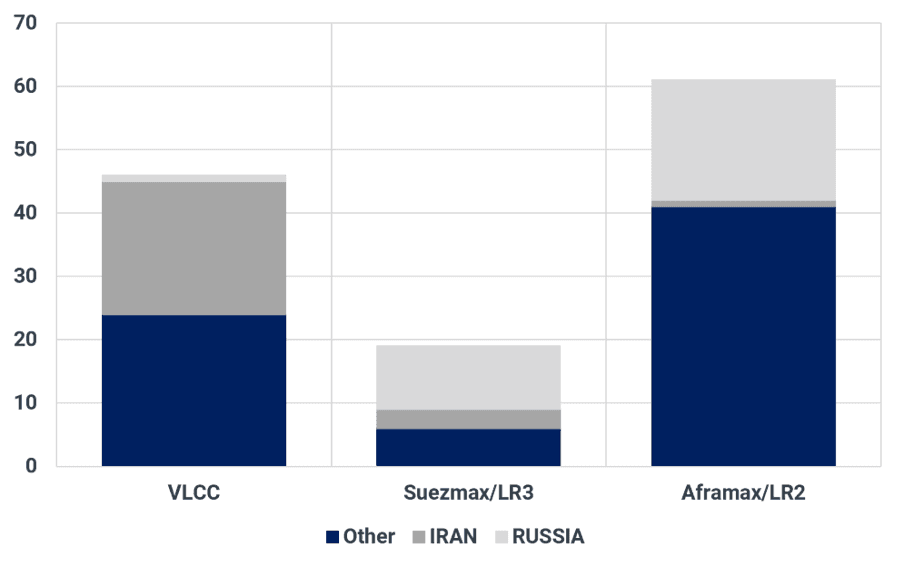
Indeed, a closer look at the ownership of the age-worthy (below 20 years) OFAC-sanctioned VLCC fleet reveals that almost half is owned by Iran’s National Tanker Company (NITC). Chartering these vessels would constitute a transaction with a designated entity, effectively placing them beyond the market’s reach unless exemptions are introduced for dealings with NITC or the vessels are taken over. As a result, the pool of designated VLCCs that could rejoin global trades further drops to circa 24 VLCCs.
Applying the same analysis to mid-size tankers, around 6 of 60 designated Suezmaxes and 41 of 170 designated Aframaxes could potentially rejoin the global fleet. However, given their lower capacity, this additional tonnage is unlikely to meaningfully ease the exceptionally high freight rates, which appear to be driven by riskier VLCC operations in the MEG.
Ownership of OFAC-sanctioned age-worthy (<=20 years) crude tanker fleet
Source: Kpler, Marine Traffic
Limited freight relief, significant political consequences
Even if some Iran-linked vessels became available for mainstream employment, their contribution would likely remain marginal relative to the scale of the current disruption.
A licensing regime run through the US Treasury would add further friction. Counterparties would have to verify that each cargo was “legally traded” and that license conditions were met. Most compliance teams and financial institutions would likely stay cautious until the scope is clear and the risk of reversal has been priced in. In practice, that means mainstream charterers would probably keep treating these vessels as high-risk, which reinforces the limited-uptake view.
More importantly, additional capacity would not eliminate the risks that are driving owners' freight expectations. As long as the conflict continues to threaten shipping in the Middle East Gulf, elevated risk premiums will remain embedded in freight rates.
The proposal also presents a wider policy dilemma. Washington would risk weakening the sanctions framework developed over the past four years to constrain Iranian and Russian trade, potentially in exchange for negligible freight relief.
Easing shadow fleet sanctions would address the headline number of available tankers, not the fundamental drivers of the freight crisis. A sustained decline in rates requires a reduction in regional security risks and a normalization of vessel operations, not simply the removal of ships from sanctions lists.
Market Insights you can trust
Kpler delivers unbiased, expert-driven intelligence that helps you stay ahead of supply, demand, and market shifts.
Trade smarter. Request access to Kpler today.

See why the most successful traders and shipping experts use Kpler