
Simandou iron ore heads to Europe for the first time
Every Simandou cargo in its first year went to China. Now Europe is on the map. Two cargoes totalling 255kt are heading for Dunkerque and Gijón, home to two ArcelorMittal steelworks. Market sources say a third European shipment is being booked. The timing lines up neatly with ArcelorMittal's cut to its 2026 Liberia shipment guidance, from 18Mt to 16Mt.
Morebaya loaded 20.52Mt of iron ore from January to October. Shipments built steadily through the year. Monthly loadings first broke 1Mt in April and passed 5Mt for the first time in October, at a record 5.31Mt. November predictive flows suggest a new high of 5.48Mt, and for the first time not all of it is bound for China. Spain and France account for 255.1kt, or 4.7% of the month.
Europe takes its first slice of Simandou in November (Mt)
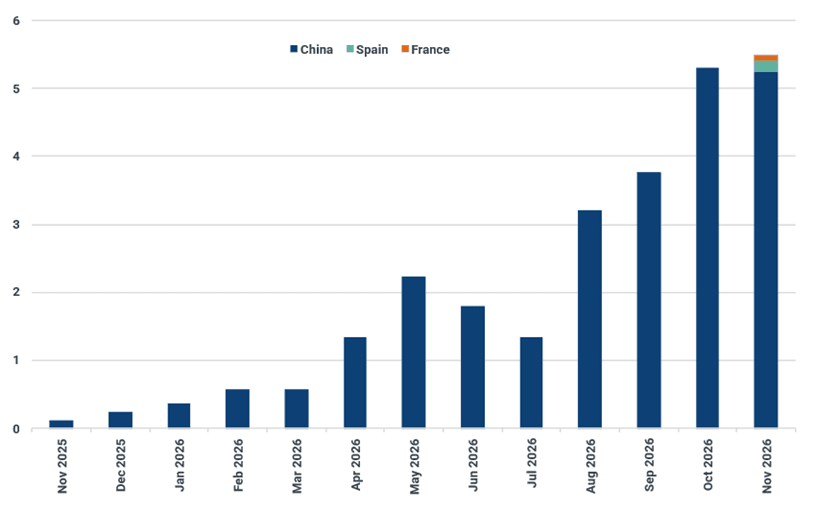
Note: Predictive flows for November 2026, with cargoes not yet assigned a destination allocated to China
Source: Kpler Insight
A Kamsarmax opens the Atlantic door
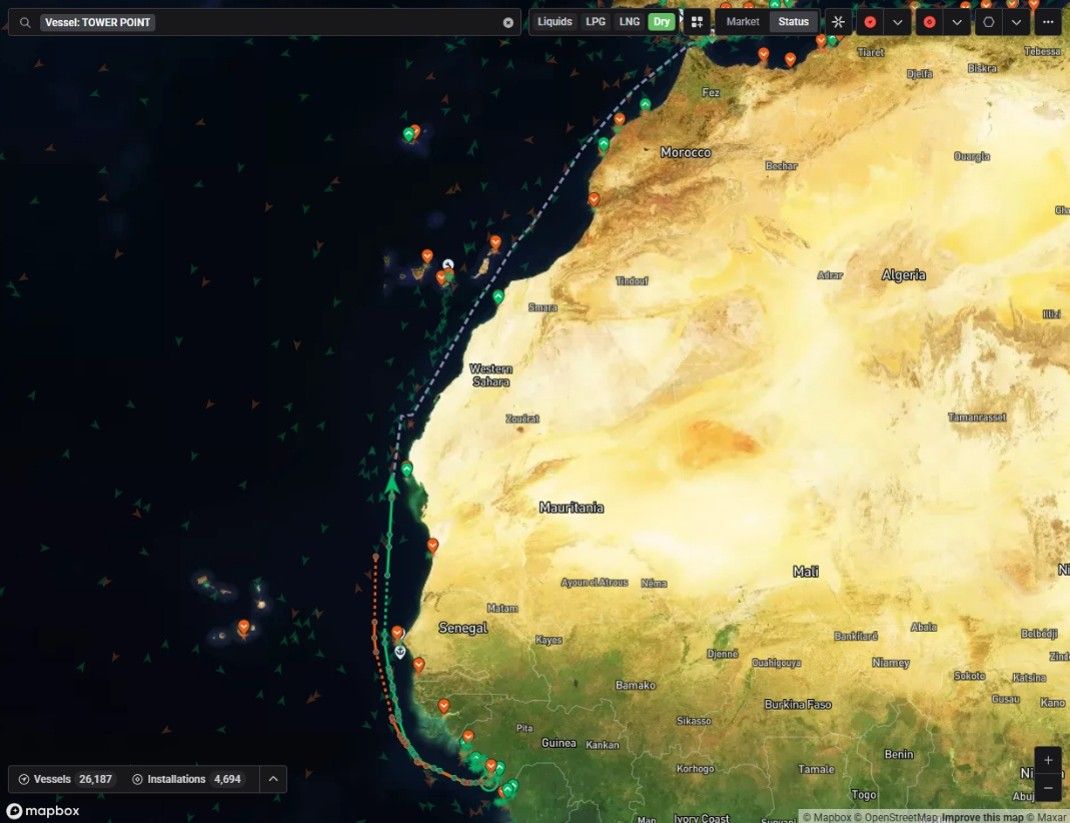
The first Simandou cargo bound for Europe is already at sea. TOWER POINT, an 82,050dwt Kamsarmax, sailed from Morebaya Anchorage on 23 November with 79.1kt of Simandou Fines sold by SimFer. Kpler expects her at Dunkerque on 4 December.
A Capesize follows close behind. TRUE CASPIAN arrived at the anchorage on 24 November and is loading 176kt for Gijón, with arrival expected on 8 December. Market sources point to a third cargo being booked for the region, most likely Fos-sur-Mer, also the location of an ArcelorMittal steelworks.
TOWER POINT heads north with Simandou's first cargo for Europe
Source: Kpler
The two confirmed cargoes are bound to ports that feed ArcelorMittal’s integrated plants. The vessel choice is the tell. Simandou's China trade runs on big ships. VLOCs, Newcastlemaxes and Capesizes carried 98% of November's loadings. A Kamsarmax parcel of under 80kt is the kind of lot a steelmaker buys to test a new ore in its sinter blend.
Liberia's rainy season leaves a hole
ArcelorMittal has its own West African ore. In its third-quarter results on 5 November, the company cut its 2026 Liberia shipment guidance to about 16Mt, from about 18Mt. It blamed poor weather that began late in the second quarter and lasted through Q3. Two million tonnes is not a crisis for a group of ArcelorMittal's size, but it lands on a handful of coastal blast furnaces that lean heavily on Liberian fines .
The group’s Spain and France EAF projects are advancing. Gijón (1.1Mt long products) and the Sestao expansion (1.6Mt) are on track for commissioning in 4Q 2026, with ramp-up through 2027, while the 2Mt flat products EAF at Dunkirk has moved into execution. Together, these projects are expected to add approximately 3.9Mt of EAF capacity by 2029, supporting both decarbonization and long-term value creation. That is where Simandou comes in.
But here is the twist. Liberia is shipping far more than previous years and most of the extra ore is sailing to China.
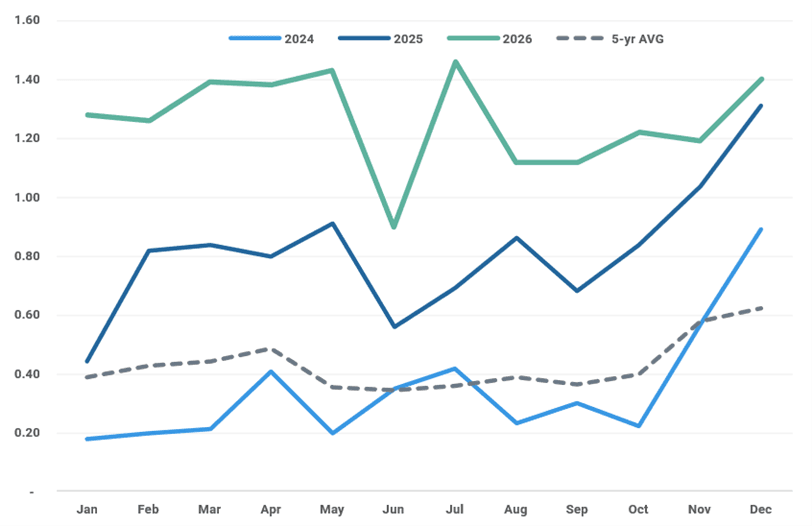
Kpler data shows Liberian iron ore exports reached 11.34Mt in the first three quarters of 2026, up 72% y/y from 6.60Mt. China took 5.41Mt of that, against 0.41Mt a year earlier. ArcelorMittal's European plants felt the squeeze. Shipments to France and Spain, home to Dunkerque, Fos-sur-Mer and Gijón, fell 10.2% y/y to 3.73Mt over the same nine months.
Liberia had shipped 13.64Mt this year, by 25 November. We forecast 15.2Mt for the full year, just short of ArcelorMittal's revised guidance.
Liberia iron ore shipments forecast at 15.2Mt in 2026 (Mt)
Source: Kpler Insight
Eleven days to Dunkerque, six weeks to Qingdao
TOWER POINT should cover Morebaya to Dunkerque in about 10-11 days. Simandou cargoes leaving for China this month show voyages of 43 to 53 days. GENCO TIBERIUS, for one, sailed on 20 November and is due at Qingdao on 2 January. That makes each Europe-bound tonne worth roughly a quarter of the tonne-miles of a China-bound one.
The tonnes Simandou sends to Europe appear to be replacing Liberian tonnes on an equally short West Africa to Europe run. Meanwhile, Liberia's extra ore is making the long haul to China. Shuffle the cards and the tonne-miles look much the same as if Simandou had sailed east itself.
ArcelorMittal could have pulled China-bound Liberian tonnes back to Europe. Instead, Simandou ore is heading to its plants. Whether that reflects grade, contracts or price will decide how far this trade can grow. For now, Simandou remains a China story with a European footnote.
Meanwhile at Morebaya, SimFer's first shuttle clocks on
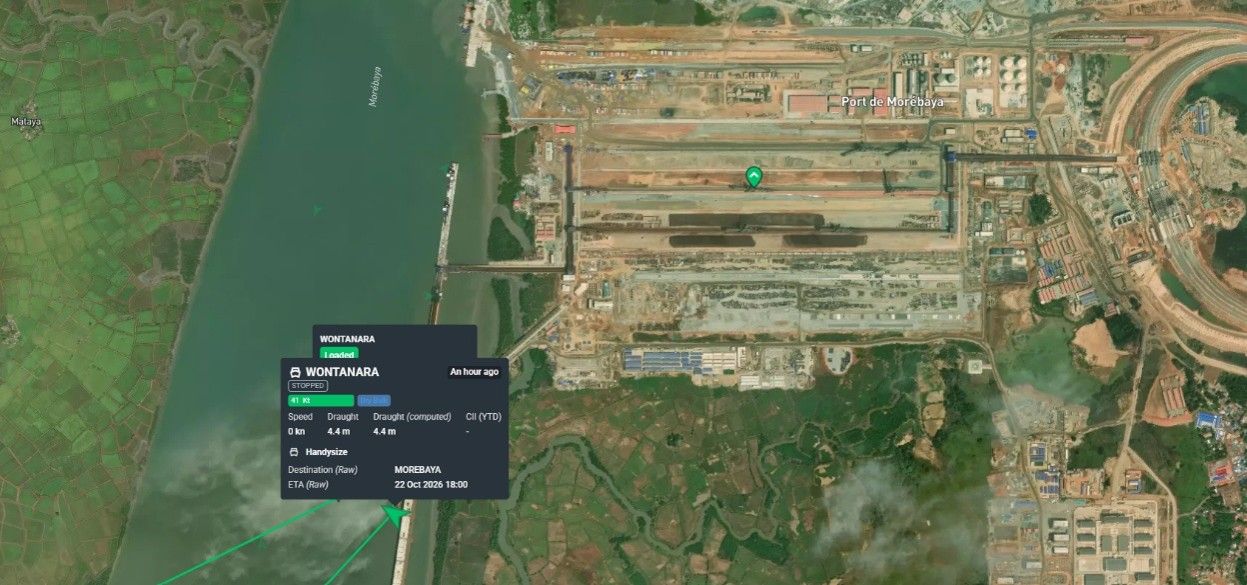
SimFer's logistics chain has a new worker, and it has finally started its shift. WONTANARA is the first of five transhipment shuttle vessels (TSVs) built for SimFer. Kpler AIS shows her at Morebaya port from at least 10 October. She made one trial run out to sea and back on 21 and 22 October, then sat at her berth for 33 days.
TSV WONTANARA at Morebaya on 22 October
Source: Kpler, Mapbox
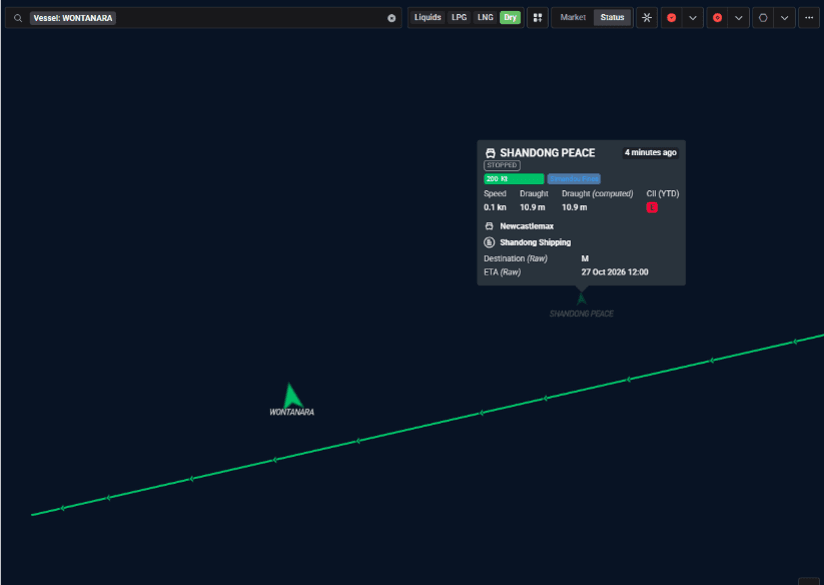
On 24 November she finally sailed for the anchorage. Two days later she was alongside SHANDONG PEACE, and the ore started to move. The 207,995dwt Newcastlemax arrived at the anchorage on 27 October, booked to carry SimFer ore to China. Then she waited for a month. Her reported draught of 10.9m shows she not yet fully laden.
TSV WONTANARA alongside SHANDONG PEACE on 26 November
Source: Kpler, Mapbox
Size is what makes WONTANARA matter. She has a deadweight of 42,366dwt. The WINNING MOREBAYA shuttles serving the WCS side are about 12,600dwt to 12,800dwt, so each WONTANARA trip carries more than three times the deadweight.
Simandou's export ceiling is set at the anchorage as much as at the mine. Every TSV raises it, and four more are due. More shuttles also mean shorter waits, which frees Capesize tonnage that is currently sitting off Morebaya. We forecast 2026 Simandou exports at 31.5Mt.
For 2027, we forecast 72.6Mt in our base case, rising to 77.7Mt in our accelerated scenario. That step-up rests on the four remaining TSVs, plus WCS Phase 2 and SimFer's permanent crushing facilities running at higher rates. Locomotive count on the TransGuinean line and the pace of mine ramp-up remain our leading indicators.
Please see the latest Iron Ore Balances dataset for an Excel file detailing our 18-month ahead forecasts for major iron ore importers and exporters, crude steel production forecasts, quarterly projections for major miners, and iron ore price forecasts.

See why the most successful traders and shipping experts use Kpler

Track Simandou's ramp-up and the iron ore flows reshaping Europe and China