[UPDATE] Middle Eastern supply recovery postponed to early 2027
Despite a brief recovery in Middle East Gulf oil production, supply outages in the region are climbing again as traffic through the Strait of Hormuz has slowed. At the same time, we do not expect Houthi threats to Saudi crude flows via the Bab el-Mandeb strait to trigger further supply shut-ins, as Saudi Arabia would be able to divert volumes via the Suez Canal and the SUMED pipeline.
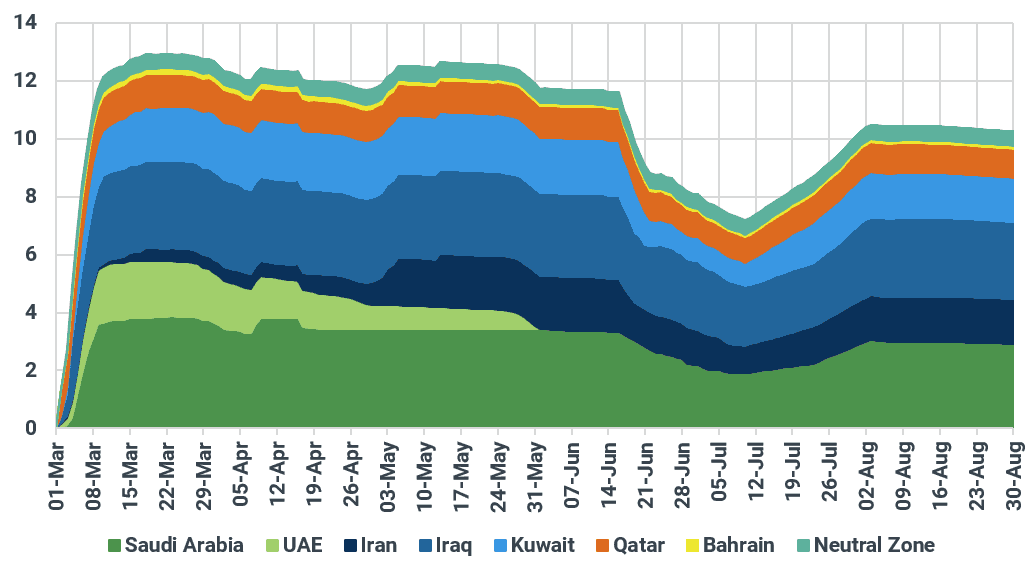
Current production outages in MEG near 9 Mbd
According to our estimates, Middle East oil supply outages peaked at 12 Mbd in the March–May period, when crude transits via the Strait of Hormuz were curbed to just around 2 Mbd. Following the signing of the US–Iran MoU in mid-June, some production returned temporarily, with outages narrowing to below 7.5 Mbd in early July as Saudi Arabia, Iraq, and other countries began bringing supply back online.
Since the re-escalation of tensions, outages have climbed again and now stand above 8.8 Mbd. We expect this to widen further, potentially to 10.5 Mbd in August and 11 Mbd in September.
By country, current outages break down as follows: Iraq (2.2 Mbd), Saudi Arabia (2.3 Mbd), Kuwait (1.4 Mbd), Iran (1.3 Mbd), Qatar (1 Mbd), the Neutral Zone (0.5 Mbd), and Bahrain (0.1 Mbd). The UAE, by contrast, now has zero outages.
Middle East crude supply outages, Mbd
Source: Kpler
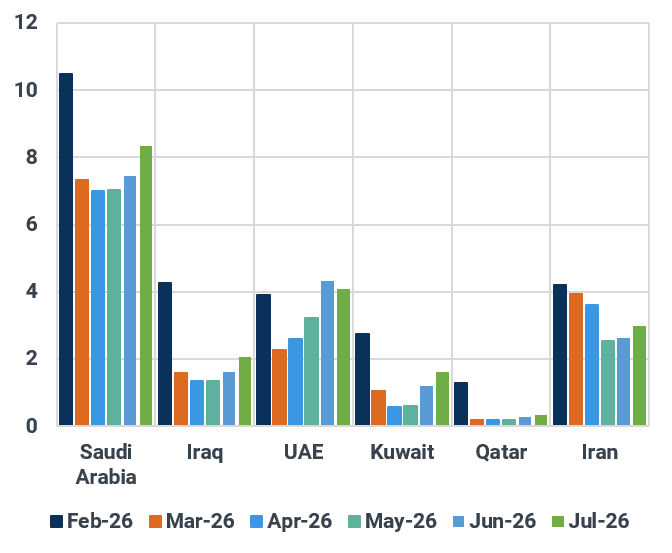
The UAE has been the exception among MEG countries, having already returned to pre-war crude and condensate production levels above 4 Mbd in June. This reflects the UAE's ability to bypass large volumes via the ADCOP pipeline, and more recently via the Strait of Hormuz itself, using STS transfers in the Gulf of Oman. Kpler data shows UAE crude exports trending above 3 Mbd so far in July, in line with year-ago volumes.
Middle East crude/condensate production by country, kbd
Source: Kpler
Delay in MEG supply recovery amid renewed squeeze on SOH transits
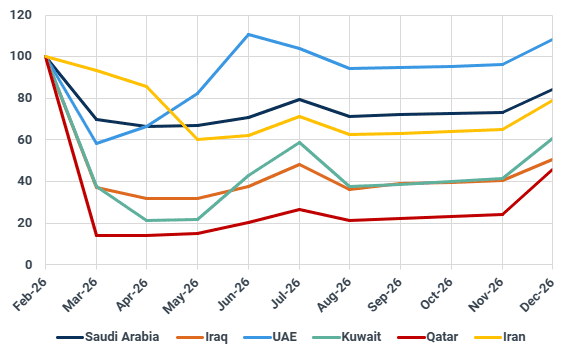
Amid the renewed escalation between the US and Iran and the resulting squeeze on tanker transits through the Strait of Hormuz, we have pushed back our outlook for a Middle East oil production recovery. Our previous outlook—assuming a return to pre-war levels by September 2026—reflected a de-escalation scenario in which the MoU led to a return to stable SOH traffic. Given recent events, however, we have shifted toward a prolonged-conflict scenario, expecting continued military strikes, back-and-forth negotiations, and squeezed SOH flows over the coming months.
As a result, we project most MEG countries to continue producing at subdued levels through late this year. Specifically, after MEG production fell from pre-war volumes of 27 Mbd to a low of 15 Mbd in May, we estimate it recovered to an average of 19.4 Mbd in July. We expect levels to fall back to 16.6 Mbd in August, before a full recovery to 27 Mbd only in early 2027.
Should the geopolitical situation change dramatically—for instance, if a peace deal were signed next week—we would revise these numbers accordingly.
Oil production recovery by country, % (February 2026 = 100%)
Source: Kpler
Red Sea strikes should not lead to massive Saudi supply shut-ins
Amid Houthi attacks on Saudi vessels in the Red Sea, Saudi Arabia has the potential to continue exporting crude at stable volumes from Yanbu while avoiding the Bab el-Mandeb strait. This could be achieved by redirecting Asia-bound exports via the Suez Canal and the SUMED pipeline, allowing roughly 3 Mbd to be diverted.
Since fully laden VLCCs cannot transit the Suez Canal, such a diversion would require offloading half the cargo at Ain Sukhna—from where crude is transported to Sidi Kerir via SUMED—while the remainder is transferred via STS onto a Suezmax vessel to transit the Suez Canal (alternatively, the VLCC could continue half-loaded) and then go via the Cape of Good Hope route to reach Asian destinations). This would double transit time on the Yanbu–South Korea route, from approximately 24 days to 54 days, but would offer a viable temporary workaround to the Red Sea threat.
Market insights you can trust
Kpler delivers unbiased, expert-driven intelligence that helps you stay ahead of supply, demand, and market shifts.
Trade smarter. Request access to Kpler today.

See why the most successful traders and shipping experts use Kpler