
Clean-to-Dirty switching reshapes LR2/Aframax market balance
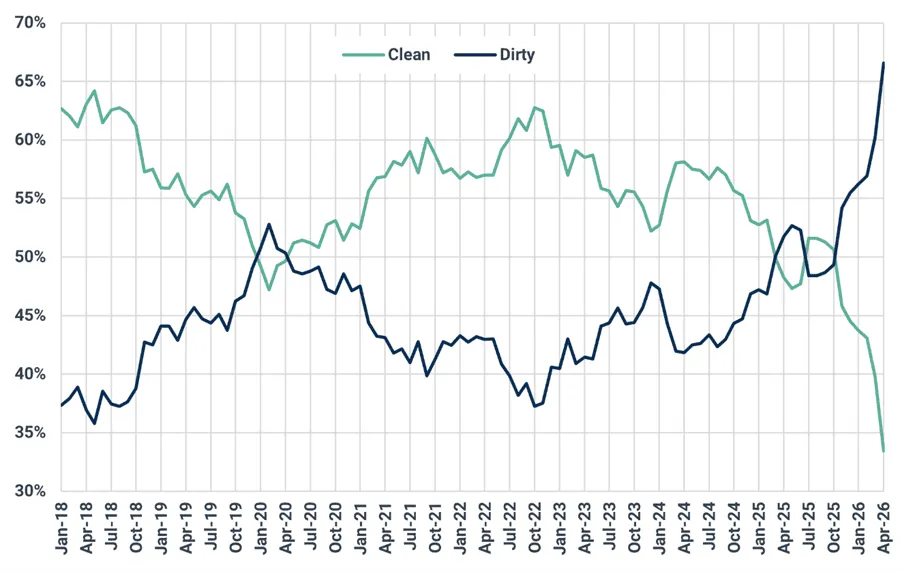
Clean-to-dirty switching has been the defining supply-side adjustment across tanker markets over the past two months, materially reshaping both clean and dirty segment balances. At its peak, more than a quarter of LR2 vessels previously trading clean migrated into dirty service, reducing the clean LR2 pool by 43 vessels, or approximately 20%. This contraction pushed the fleet to below Covid-era levels, providing critical support to clean tanker earnings during a period of disrupted Middle East Gulf flows.
Market & Trading Calls
- Clean-to-dirty switching has removed up to 20% of LR2 clean capacity and materially increased Aframax supply
- The shift accelerated the April correction in dirty tanker rates while tightening clean markets
- Switching is now stabilizing, limiting further supply shocks but capping upside across both segments
The driver of this shift was a pronounced earnings dislocation. Between early March and mid-April, clean LR2 earnings traded at an average discount of $87,000/day to dirty equivalents, creating a strong economic incentive to switch. This dynamic was reinforced by geopolitical disruption in the Strait of Hormuz. Increased demand for West of Suez crude for both short and long haul voyages drove US Gulf Aframax demand higher, lifting rates. On the clean side, the loss of MEG volumes was a major hit to LR2 demand, with the region accounting for 44% of LR2 ton-miles in 2025. As a result, owners rapidly redeployed coated tonnage into crude and fuel oil trades.
Share of LR2/Aframax coated fleet by cargo type
Source: Kpler
The impact on dirty tanker markets was immediate. Aframax markets in the West absorbed a significant influx of supply, with switching contributing to one of the sharpest rate corrections across the complex. US Gulf to Europe Aframax rates fell from $21.15/bbl to below $10/bbl within weeks. While VLCC and Suezmax segments were more influenced by macro demand weakness, switching amplified downward pressure by redistributing available capacity toward shorter-haul trades.
At the same time, the tightening effect on clean markets helped sustain elevated rate levels despite weakening underlying demand. The Med to Japan LR2 rate rose to $15.90/bbl in April, up $4/bbl m/m, highlighting the extent to which supply contraction offset softer trade flows.
The large switch in April is unlikely to continue in May. The dirty market correction eroded the earnings premium that initially drove switching. Looking forward, the switching dynamic is entering a stabilization phase. Clean and dirty earnings are now expected to trade closer to parity, removing the primary economic incentive for further migration. Operational constraints also limit reversals, as switching back to clean service requires time, cost, and sustained earnings premiums. In addition, new deliveries of coated LR2/Aframaxes are likely to be distributed based on current demand. This is already evident with the vessels that have hit the water since January, with less than 50% trading clean. As a result, the current fleet distribution is likely to persist in the near term.
This equilibrium has two key implications. First, additional supply-side shocks from switching are unlikely, reducing volatility across both markets. Second, the absence of further tightening in clean segments removes a key pillar of recent strength, exposing rates to underlying demand weakness. For dirty tankers, the bulk of the supply adjustment has already materialized, suggesting that future rate direction will be increasingly driven by trade flows rather than fleet shifts.
In this context, clean-to-dirty switching should no longer be viewed as an active bullish or bearish catalyst, but rather as a completed rebalancing process. The market has absorbed the shock. From here, fundamentals will dictate direction.

See why the most successful traders and shipping experts use Kpler