Trader Tools

Real-time tools to enable faster, better decisions.

trusted by thousands of organisations worldwide
Trader Tools

Never miss an opportunity

Arbitrage analytics for crude oil
  • Compare delivered crude values by region and freight cost
  • Quantify refining margins and route profitability
  • Spot open arbitrage opportunities quickly
  • Breakdown value drivers like FOB differentials, spreads, and freight
  • Model scenarios with custom market inputs
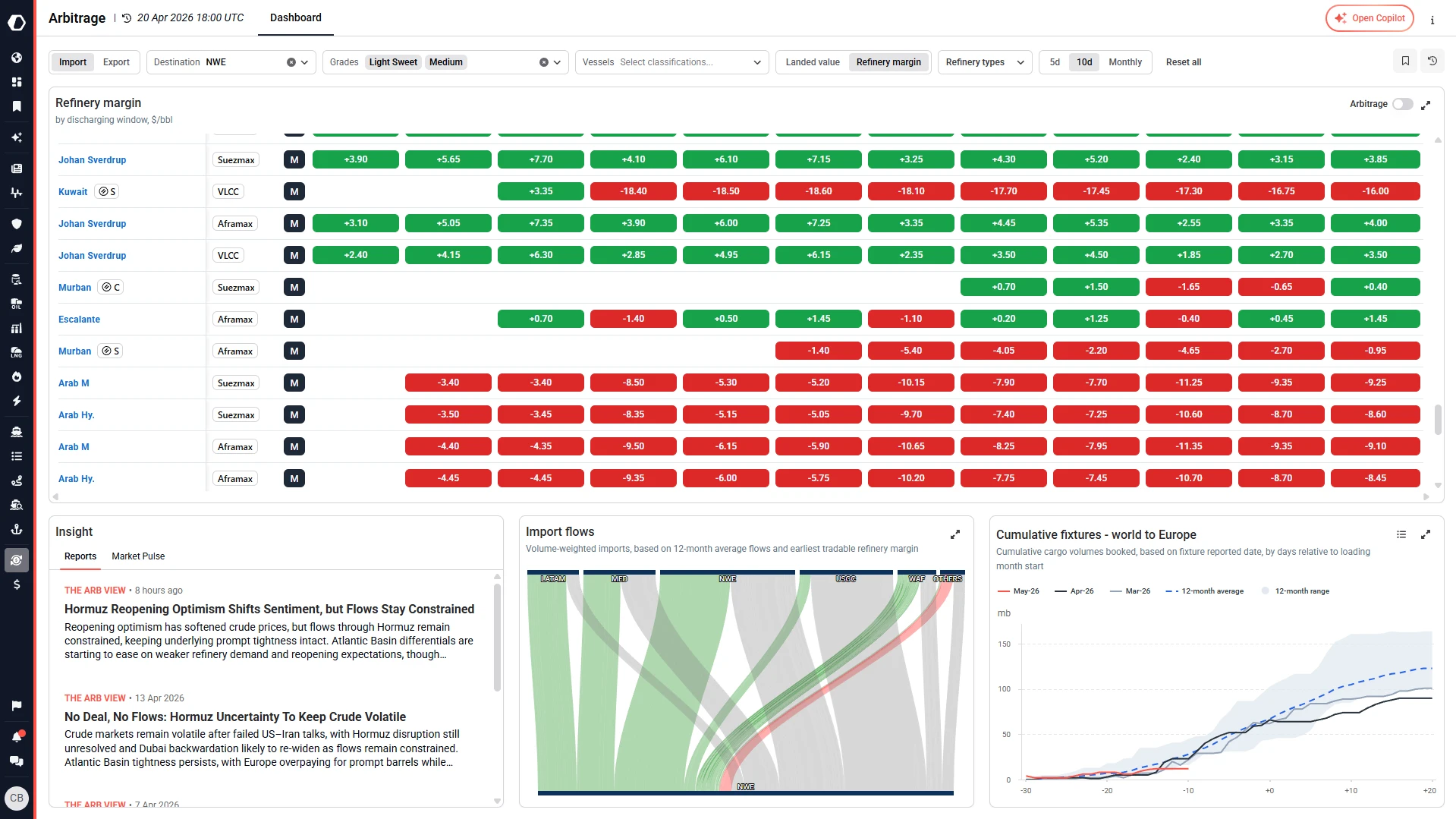
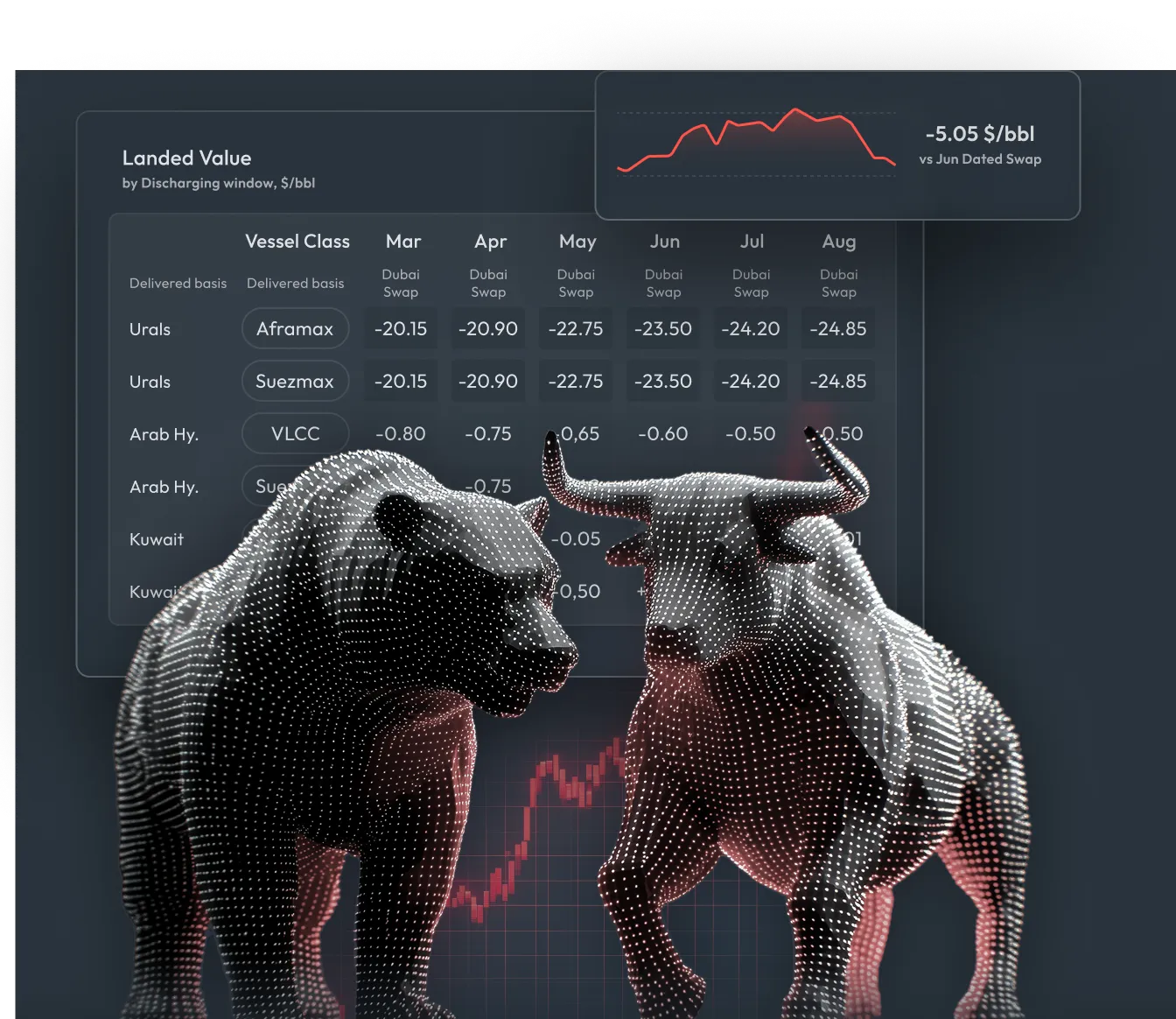
Landed value
  • Pinpoint the most profitable crude routes by comparing delivered values across regions, factoring in freight, quality, and pricing.
  • Split by origin/destination, grades, matrix granularity (5 day, 10 day, or monthly), vessel classifications, refinery type
  • Greyscale cells update every 30 minutes
Refining margins
  • Instantly gauge refinery profitability by tracking crude costs versus refined product values across global markets.
  • The matrix displays refining margins by crude, refinery type, route, vessel type, and voyage time
  • The refining margin view is the profit lens: how much money can a refiner make running this crude?
  • It shows the absolute profit potential of each crude for a refinery type
  • The landed value doesn’t take crude quality into consideration - the refinery margin does
  • This view is useful for ranking crude grades for a refinery
Arb value
  • Spot real-time price gaps between markets to uncover high-value trading and reallocation opportunities.
  • Shows whether an imported crude delivers higher profitability than the local reference grade — the ultimate “is it worth switching?” test
  • Distills complex economics into a simple red/green signal, saving hours of manual diff and margin comparisons
  • Highlights incremental gains or losses versus local supply, so refiners and traders can act quickly on open arbs or avoid loss-making moves
Transparent value breakdown
  • See exactly what drives landed value with a full breakdown of freight, quality, and pricing components.
  • Displays the component and subcomponent values for:
  • FOB diff
  • Time structure
  • Benchmark spread
  • Freight
  • Costs
  • See clearly why a landed value, refining margin, or arbitrage value has changed by interrogating the component values
Scenario builder
  • The Scenario builder is an interactive tool that helps traders, analysts, and risk managers test, compare, and visualise arbitrage opportunities in dynamic market conditions.
  • Custom assumptions: Adjust inputs such as freight rates, duties, and pricing basis to reflect the specific market environment you want to test
  • Scenario modelling: Evaluate how a particular set of conditions impacts arbitrage economics
  • Sensitivity exploration: Quickly see how changing a single assumption (e.g., freight or duty) shifts the outcome of a trade
 Compare grade value across trading regions
  • The comparison feature lets users quickly benchmark arbitrage values or refining margins for a crude grade across multiple regions, helping them see where that crude is most competitively valued.
  • Compare a single crude grade across several destination markets in one view.
  • Compare multiple crudes within a trading region.
  • Instantly spot which regions offer the strongest economics or weakest demand signals.
  • Supports faster, data-driven decisions on pricing, tender strategy, and market allocation.
Flows vs arbitrage time series
  • Correlate trade flows with arbitrage signals to time market entries and validate trading strategies.
  • See economics turn into action. Overlay past flows with arb values to reveal when traders actually moved on an opportunity
  • Gauge momentum in hindsight. Rising flows after open arbs confirm windows that were lifted; flat flows show missed or constrained plays
  • Learn the lag. Measure how long it took flows to respond, sharpening your instincts for timing the next window
Identify systematic flow inflection
  • Access daily systematic CTA flow estimates with explicit trade direction, order size, and positioning updates
  • Anticipate when systematic flows are likely to enter the market
  • Time entries and exits with clearer visibility into flow-driven market pressure
Track systematic financial positioning and consensus
  • View daily systematic CTA positioning across various strategy types
  • Track aggregate financial flow exposure and consensus across assets and factors
  • Align with prevailing systematic positioning — or lean against it — with confidence and transparency.
Detect systematic crowding and liquidity risk
  • Monitor systematic flows across multiple strategy types to identify congestion points before liquidity becomes constrained
  • Track positioning and flow dispersion across the curve, revealing where systematic exposure is concentrated and where risk is building
  • Enhance risk management by contextualising systematic exposure across evolving market regimes
Explore systematic flows across scenarios
  • Quantify how flow magnitude, order size, and execution intensity evolve across scenarios
  • Identify inflection points where financial flows are likely to accelerate or unwind
  • Manage exposure through structural shifts in systematic behaviour
Benchmark and validate systematic CTA flows
  • Track how replicated CTA strategies are performing in real time, linking positioning, execution, and realised market impact
  • Validate flow signals by comparing model outputs to observed performance and historical CTA behaviour
  • Cross-check systematic, discretionary, and commercial participation using disaggregated Commitment of Traders data.
Benchmark-correlated analysis for financial flows accuracy
  • Kpler evaluates the accuracy of its Financial Flows product by correlating derived flow signals against leading CTA benchmarks, providing a quantitative framework to assess how closely modelled financial activity reflects the performance and structure of systematic managed futures strategies.
 Compare grade value across trading regions
  • The comparison feature lets users quickly benchmark arbitrage values or refining margins for a crude grade across multiple regions, helping them see where that crude is most competitively valued.
  • Compare a single crude grade across several destination markets in one view.
  • Compare multiple crudes within a trading region.
  • Instantly spot which regions offer the strongest economics or weakest demand signals.
  • Supports faster, data-driven decisions on pricing, tender strategy, and market allocation.
Flows vs arbitrage time series
  • Correlate trade flows with arbitrage signals to time market entries and validate trading strategies.
  • See economics turn into action. Overlay past flows with arb values to reveal when traders actually moved on an opportunity
  • Gauge momentum in hindsight. Rising flows after open arbs confirm windows that were lifted; flat flows show missed or constrained plays
  • Learn the lag. Measure how long it took flows to respond, sharpening your instincts for timing the next window

“Kpler is one of the few truly objective research outfits. No agenda, just data-driven insights.”
Aldo Spanjer
Commodity Strategist, BNP Paribas
How can I use physical asset data to improve my trading decisions?

Real-time visibility into vessel movements, cargo flows, and inventory levels gives you advance signals on supply and demand shifts before they're reflected in market prices. By tracking actual physical movements—ships, containers, cargoes—rather than relying solely on financial indices, you can identify arbitrage opportunities, spot regional imbalances, and anticipate price movements with greater accuracy. This structured intelligence enables you to enter trades with better timing and conviction based on what's actually happening in the physical world.

What commodities and markets does Kpler cover?

Kpler provides comprehensive coverage across all major trading markets: crude oil, refined products, and NGLs in energy; natural gas and power analytics; agricultural commodities including grains and oilseeds; metals and dry bulk; containers and shipping; and emerging sectors. Each market gets unified, granular coverage across major and minor producing regions, allowing relative-value traders to analyze flows and spot opportunities across commodity complex spreads and inter-commodity relationships.

How current is Kpler's data and how often does it update?

Kpler combines real-time data feeds (AIS vessel tracking, market prices, outages) with proprietary satellite imagery and customs intelligence to deliver decision-grade insights within hours of events occurring. Daily updates ensure you have the most current view of flows, inventories, and market movements, while advanced forecasting provides visibility up to 7 weeks ahead of customs data. This speed advantage is critical for capturing trading windows before they close.

How do I integrate Kpler data into my existing trading systems and workflows?

Kpler offers flexible deployment options to fit your workflow: access data through the Kpler Terminal for direct research and analysis, use APIs to embed insights into proprietary trading systems, or integrate via Snowflake for enterprise-scale analytics. This means you can pull Fundamental Intelligence directly into your risk systems, pricing models, or trade recommendation engines without requiring infrastructure changes. Most trading operations use a combination—terminal for research, APIs for automation, and exports for reporting.

How does Kpler's approach differ from traditional market research and point solutions?

Traditional research is typically backward-looking, published after events have moved markets; Kpler is real-time and forward-looking. Most traders subscribe to fragmented point solutions—one for shipping, another for inventories, another for customs—creating blind spots at the intersections. Kpler provides a unified platform that connects assets, flows, and events across your entire trading scope, reducing blind spots and enabling analysis of cross-commodity relationships that point solutions can't reveal. A single source of truth beats managing ten different vendors.

Other decision tools

We also cover

Chartering
Risk & Compliance
Market Insights
Defense Intelligence
Ship Tracking
Oils & Chemicals
Gas & Power
Containers
Ags, Metals & Dry