
US corn's winter of discontent: exports lag, stocks build
US corn export commitments trail last year's record pace, and ample South American supply leaves little room to catch up. With China absent and USDA's export forecast looking high, Kpler sees 2026/27 ending stocks well above USDA's, a heavy carry-in for the 2027 crop.
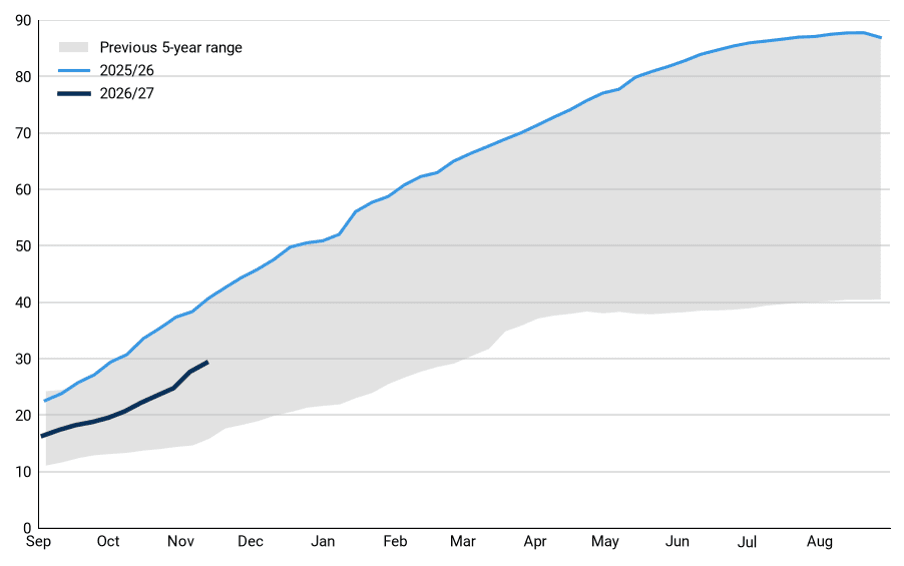
US corn export sales trail last year's record pace
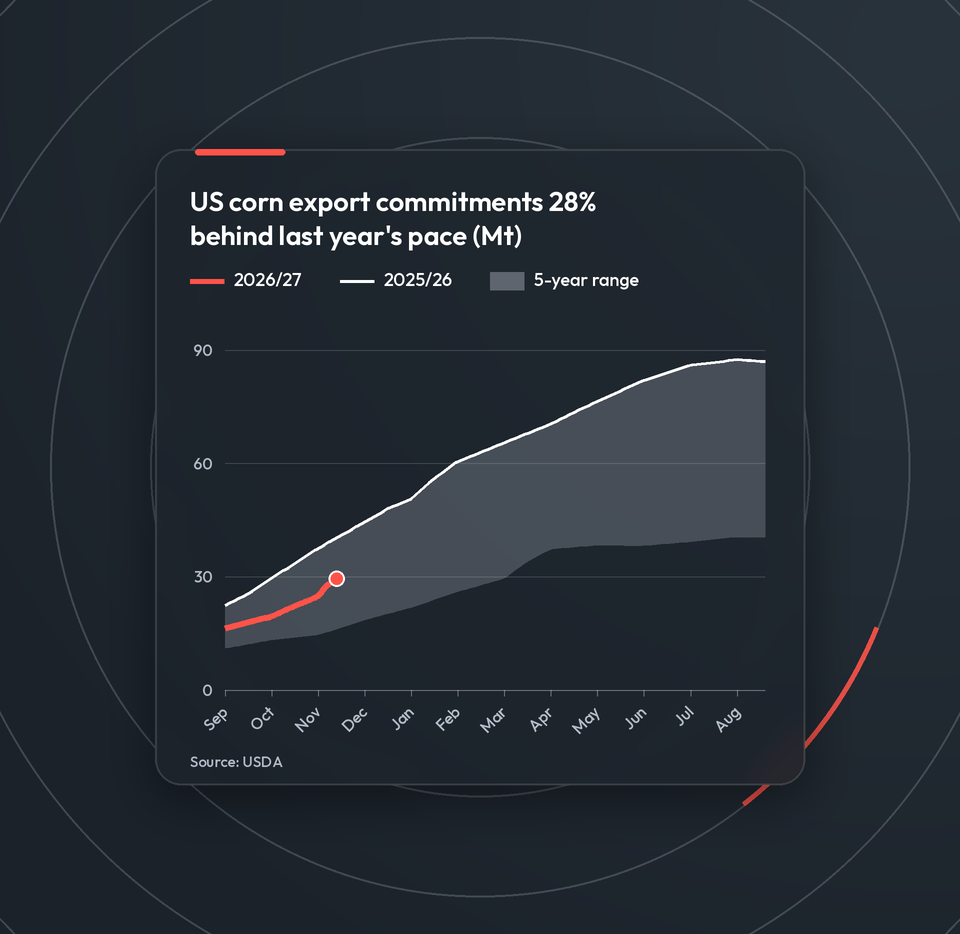
US corn export commitments, shipped plus outstanding sales, sit far below last year's record pace and well behind what USDA's high forecast requires. Kpler seaborne trade show US shipments in the first three weeks of November at about half the level of a year earlier.
US corn export commitments 28% behind last year's pace (Mt)
Source: USDA
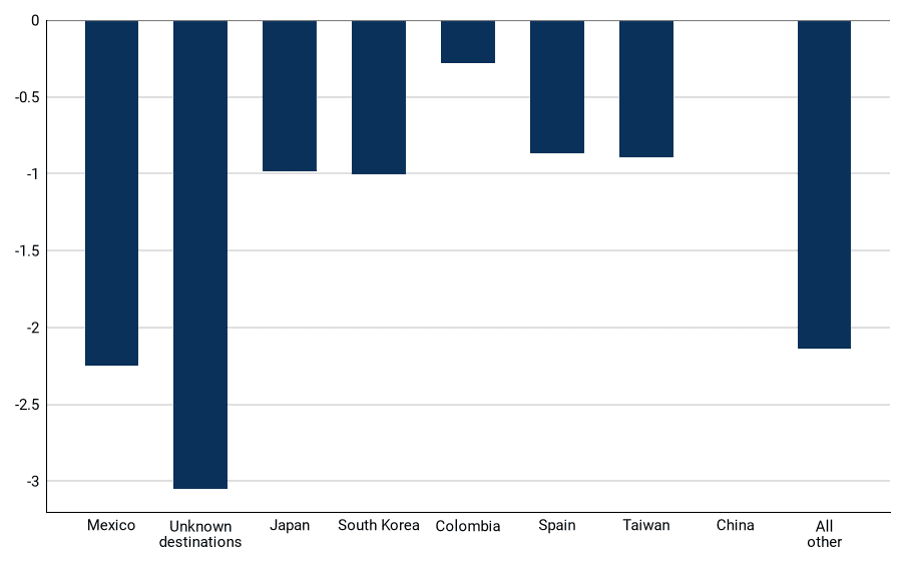
The gap to last year sits mainly in unknown destinations and a few steady buyers. Mexico, South Korea, Japan, and Colombia all trail last year. China remains inactive, with the US not seeing material demand since 2023/24.
Unknown destinations and Mexico lead the shortfall against last year (Mt)
Source: USDA
Sales picked up in the week to 5 Nov 26, the strongest of the season so far, although the following week eased and was below a year earlier. Funds swung from a large net long to a net short since September, and Dec-26 futures fell by about 20%. Even so, at the lowest share of final shipments seen at this point in the last five years, 40%, commitments would imply about 73 Mt (2,870 mbu), below both Kpler's 76.7 Mt (3,019 mbu) and USDA's 83.2 Mt (3,275 mbu).
South American corn supply grows as Argentina and Brazil lift exports
Argentina's 2026/27 corn crop looks favourable. The Buenos Aires Grains Exchange reports planting at 51.5% by 18 Nov 26, ahead of last year and the 10-year average, with early plantings complete and crop conditions normal to good. Argentine seaborne exports in September and October were far above a year earlier, and in the first three weeks of November they were about double. In Brazil, Conab reports soybean planting well advanced and first-crop corn sowing on schedule. Timely planting of the soybean crop reduces the risk of a delayed harvest, which can delay planting of the safrinha corn crop and pose yield concerns.
Brazilian corn is also becoming more available for export. Domestic use for ethanol has risen sharply over the last two years, and ethanol producers bought corn beyond their processing needs and stored the surplus. That, together with soybeans taking priority at port elevators, kept Brazil less competitive in the export market. With those inventories more adequately stocked, more Brazilian corn is going to exports, with shipments in the first three weeks of November about a third above a year earlier and Kpler's 2026/27 exports above 2025/26.
NOAA expects a strong to very strong El Niño through early 2027. It typically brings more rain to Argentina and southern Brazil but dryness to parts of northern and central Brazil. A smaller Brazilian safrinha corn crop would cut export availability from mid-2027 and give US exporters room in the second half of the marketing year, but that depends on moisture in March and April.
Why the January NASS yield report could still shift US corn supply
NASS cut the 2026 US corn yield to 179.6 bu/ac in November from 181.2 in October. The January report sets the final figure and has moved from the November estimate by about 2 bu/ac on average, up and down in equal measure. An average revision changes ending stocks by about 170 mbu (4.3 Mt), roughly 10% of USDA's 2026/27 ending stocks forecast.
2026/27 US corn ending stocks: a heavy carry-in for the 2027 crop
The CBOT new-crop soybean-corn price ratio, Nov-27 soybeans against Dec-27 corn, has risen since September to 2.47 as corn fell faster than soybeans, which favours soybeans at planting. Soybeans also start from tighter stocks than USDA assumes. A smaller 2027 corn crop would not remove the overhang.
On Kpler's numbers, 2026/27 US corn ending stocks reach 50.5 Mt (1,989 mbu), 5.9 Mt (231 mbu) above USDA and just below last season.
Higher global supplies are adding competition for US corn exports, and USDA's export forecast looks high with China absent from the market for large imports. US ending stocks are therefore likely to finish above USDA's estimate and pressure spreads.
US corn export commitments trail last year's record pace, and ample South American supply leaves little room to catch up. With China absent and USDA's export forecast looking high, Kpler sees 2026/27 ending stocks well above USDA's, a heavy carry-in for the 2027 crop.

See why the most successful traders and shipping experts use Kpler
Track US corn exports and South American supply as stocks build