Resumption of Iraqi flows via Strait of Hormuz?
Iraq—having recorded the largest oil supply shut-in volumes during the US–Israel–Iran conflict—may soon see a recovery in both production and exports following an agreement with Iran. For the first time since the conflict began, an Iraqi-laden crude tanker transited the Strait of Hormuz on Sunday. The return of Basrah barrels would provide a welcome source of medium and heavy sour oil for Asian buyers, primarily India, China, South Korea and Southeast Asian countries.
Market & trading calls:
- Rather slow return of Iraqi oil supply over a 3 month period, with crude and condensate production rising from currently 900 kbd to above 4 Mbd in late June/early July.
- Around 17 Mbbls in onshore inventories and over 20 Mbbls of Iraqi crude in floating storage in the Persian Gulf, ready to move through the Strait.
- Bearish impact on oil prices if the return of over 3 Mbd Iraqi crude materialises, with impact first felt for medium and heavy sour differentials.
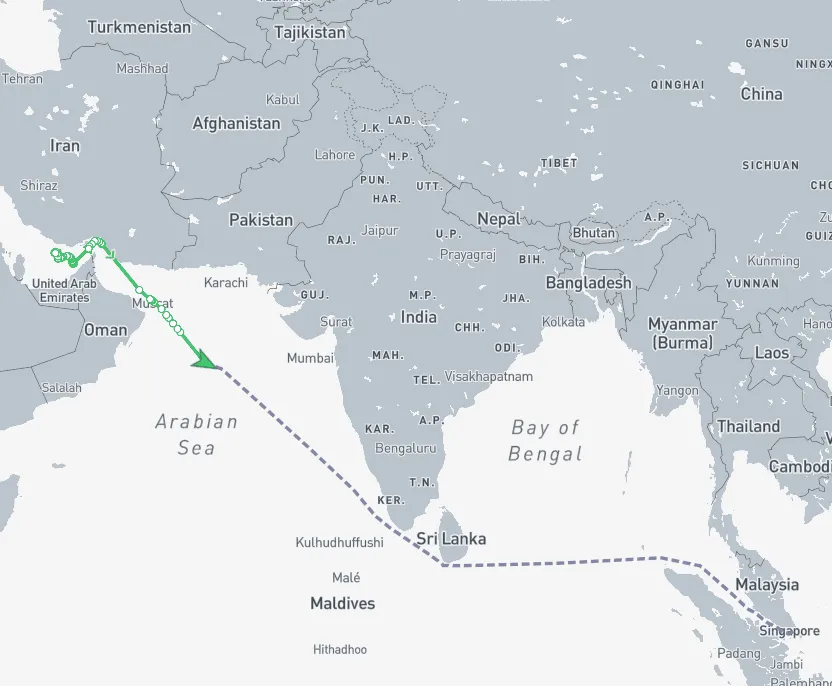
Iraqi and Iranian officials have recently been negotiating terms to allow Iraqi crude to transit the Strait of Hormuz once again. While no formal agreement has been announced, Iran appears to have granted Iraq a de facto exemption for its oil shipments, likely contingent on the payment of a transit fee. Kpler data supports this development: the Iraqi-owned vessel Ocean Thunder, which loaded close to 1 Mbbls of Basrah Heavy on 3 March, remained stranded in the Persian Gulf throughout March before transiting the Strait on 5 April. The cargo is expected to discharge at Malaysia's Pengerang refinery on 18 April, marking the first Iraqi crude shipment since 28 February.
Ocean Thunder, carrying Basrah Heavy to Malaysia
Source: Kpler, mapbox
On Sunday, Iraq’s SOMO requested lifting schedules from buyers, including vessel details and volumes, noting that all loading terminals—Basrah included—were “fully operational.” That said, uncertainty persists. Transit remains tightly controlled, and Iraq lacks firm guarantees of uninterrupted passage. Moreover, as Iraq sells crude on a FOB basis (i.e., responsibility transfers to the buyer once the cargo is loaded), buyer confidence will need to rebuild before volumes recover meaningfully. After several successful voyages, however, purchasing activity is likely to accelerate rapidly.
How quickly can Iraqi crude supply return—and at what volumes?
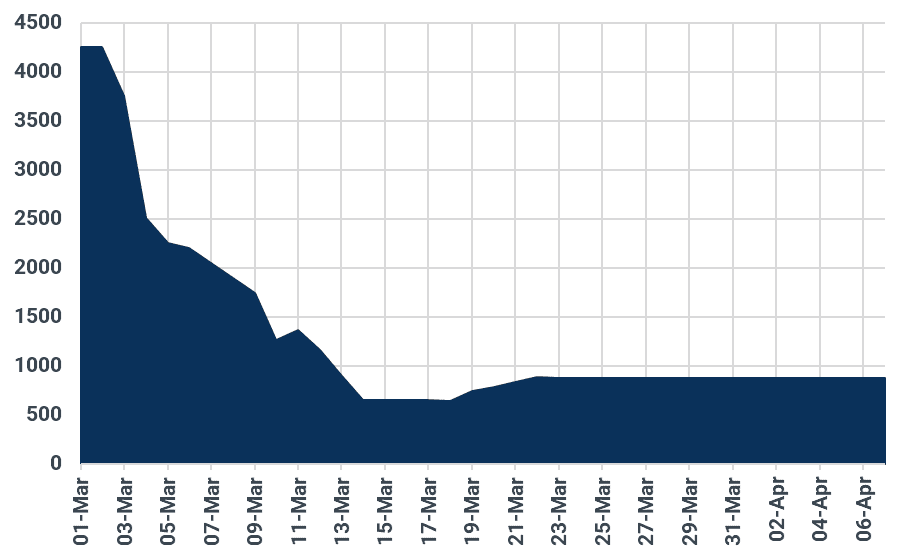
We estimate that Iraq has currently shut in around 3.4 Mbd of crude production (from 4.25 Mbd pre-war of cru/co supply down to 875 kbd now), largely due to export constraints. The country remains heavily reliant on southern Gulf exports, with limited diversion options (some 200 kbd via Kirkuk–Ceyhan pipeline) and constrained storage capacity.
Although drone strikes occurred in early March and again on 4 April—targeting storage facilities west of Basra and the North Rumaila oilfield—no significant damage has been reported. The attacks appear to have hit equipment storage areas rather than critical infrastructure, suggesting minimal repair requirements.
Iraqi crude and condensate supply since war, kbd
Source: Kpler
Overall, production shut-ins are primarily driven by export bottlenecks rather than physical damage. Still, we estimate that a full recovery in Iraqi oil output would take around three months, depending on operational conditions.
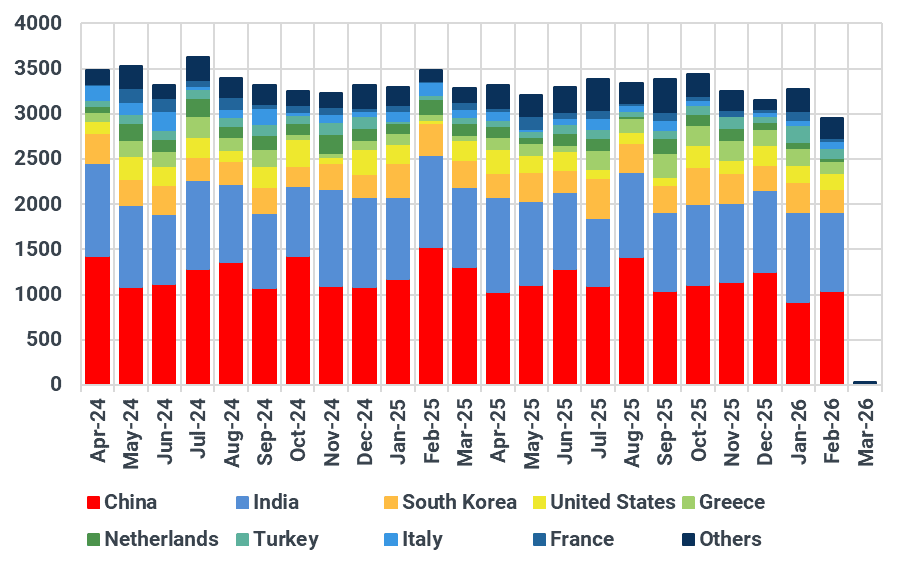
Assuming transit arrangements hold, Iraq would first draw down its oil inventories (onshore storage close to 17 Mbbls) and then ramp up supply. Initial cargoes are expected to come from volumes already afloat. Kpler data indicates that over 20 Mbbls of Basrah crude is currently held in floating storage in the Middle East Gulf, with nearly all of these 15 vessels previously stranded in the Persian Gulf. From there, voyage times are approximately 5 days to India’s Jamnagar and around 19 days to China’s Zhejiang Port. The release of Iraqi crude from onshore and offshore inventories would allow exports to rebound to typical levels above 3 Mbd quite quickly (3 Mbd export pace over 2 weeks until inventories are exhausted).
Moreover, Iraqi crude and condensate production could rise from below 900 kbd currently to around 3 Mbd by late May and exceed 4 Mbd in late June/early July. Key buyers will include India, South Korea, and China, particularly for Basrah Medium and Basrah Heavy grades, with Southeast Asian buyers such as the Philippines and Malaysia following shortly after.
Iraqi crude and condensate exports via SOH, kbd
Source: Kpler
More bilateral agreements to come?
The apparent arrangement between Iraq and Iran may signal Tehran’s intent to demonstrate that direct talks with the regime can yield results and negotiated access to the strait is possible—thereby reinforcing incentives to ensure the safe passage of Iraqi-laden tankers.
We assess that Iran’s broader strategy is to pursue multiple bilateral arrangements with “friendly” countries, granting transit permissions in exchange for security or transit fees. Similar understandings are already believed to be in place with Pakistan and Bangladesh. Eventually the goal would be a toll system for all vessels (around $1-2 million per vessel ie. roughly 1% of cargo value for crude tankers). Such an approach would allow Iran to generate revenue, deepen ties with strategic partners, and gradually reshape regional trade dynamics—increasing long-term pressure on the US.
Market insights you can actually trust
Kpler delivers unbiased, expert-driven intelligence that helps you to track critical crude oil market developments for your own analysis. Our precise forecasting empowers smarter trading and risk management decisions. In times of conflict and geopolitical uncertainty, our real-time data keeps you ahead of supply disruptions and price volatility.
Unbiased. Data-driven. Essential. Request access to Kpler today.

See why the most successful traders and shipping experts use Kpler