The US may not need more strikes on Iran as blockade tightens
Washington’s Iran strategy is increasingly shifting from direct military confrontation toward economic strangulation through maritime containment. While the White House continues to frame the latest delay in strikes as temporary, the repeated pattern of postponements suggests the US currently views the blockade itself as the primary pressure tool.
Key Takeaways
- President Trump again delayed a potential resumption of strikes on Iran on 18 May , reportedly following requests from Qatar, Saudi Arabia, and the UAE. Gulf officials later denied knowledge of any imminent operation, deepening doubts around the credibility of repeated US strike warnings.
- The US blockade strategy appears increasingly effective. Since 13 Apr., no tanker carrying Iranian crude has crossed the blockade line between the Gulf of Oman and the Arabian Sea.
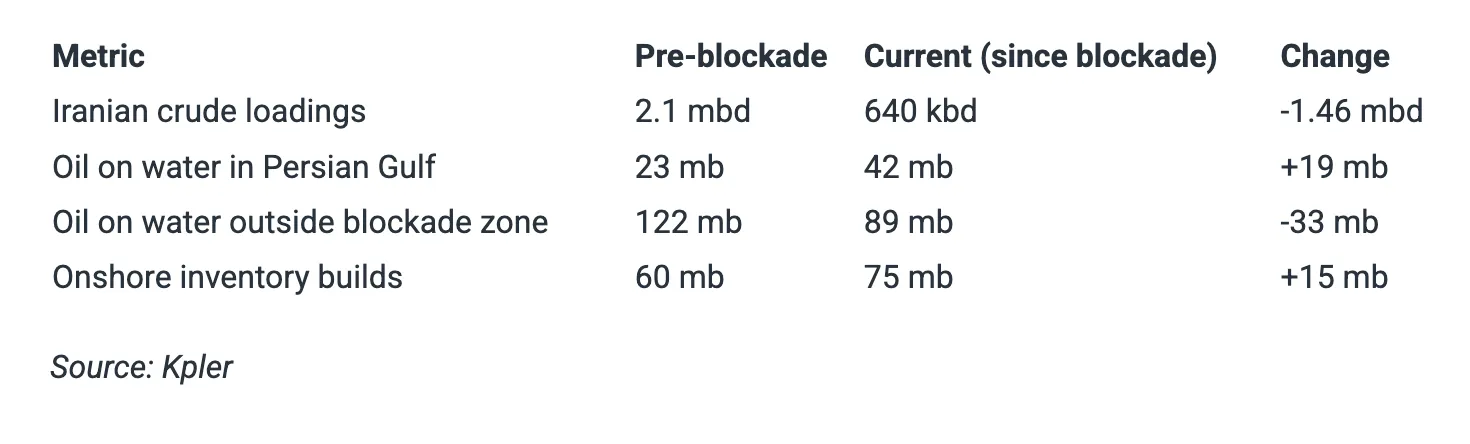
- Iranian crude loadings have collapsed from 2.1 mbd in the two weeks before the blockade to 640 kbd since implementation.
- Iranian crude inventories are rapidly building both offshore and onshore. Oil on water in the Persian Gulf has risen from 23 mb to 42 mb, while onshore inventories have increased by 15 mb, concentrated at Kharg Island and Goreh.
- Barrels available to Chinese buyers are shrinking. Iranian oil on water outside the blockade zone fell from 122 mb to 89 mb over the past month.
- If the blockade remains intact, Iran’s effective oil export revenues could approach zero within 60–70 days.
Since mid-Apr., the conflict has evolved into a low-intensity economic war centered on the Strait of Hormuz. Vessel traffic remains severely constrained. Only three laden crude tankers, one carrying Basrah crude and another carrying Umm Lulu crude, have transited through the strait so far this month. More importantly, no tanker loaded with Iranian crude has crossed the blockade perimeter since 13 Apr.
The operational impact on Iran’s export system is becoming acute. Iranian crude loadings averaged 2.1 mbd in the two weeks before the blockade began but have since fallen to just 640 kbd. Part of the decline may be linked to the oil spill reported near Kharg Island earlier this month. The rapid reactivation of several retired tankers raises broader questions about the condition of Iran’s storage and export infrastructure.
Iran oil loadings by destination, kbd
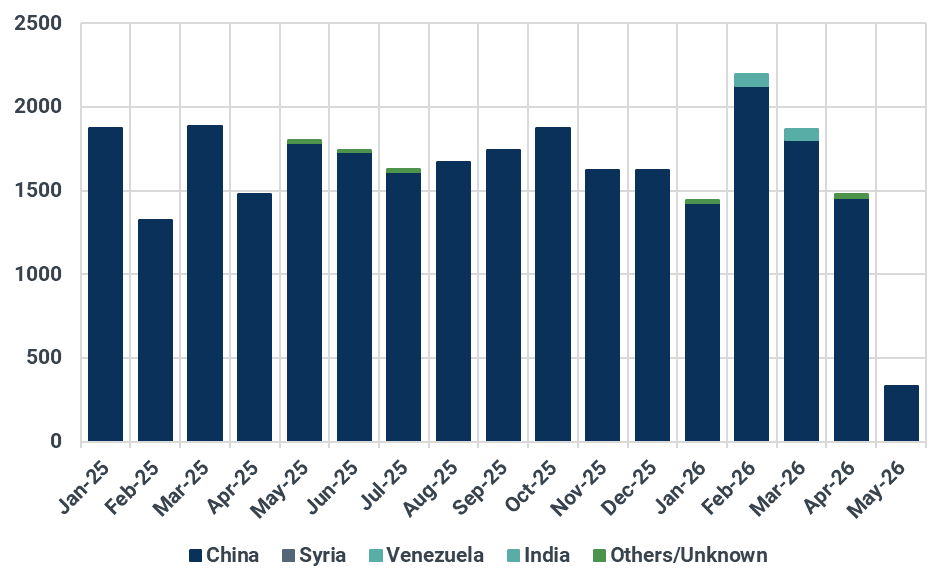
Source: Kpler
Inventories are now accumulating at an accelerating pace. Iranian crude on water inside the Persian Gulf has risen from 23 mb to 42 mb since the blockade started. Onshore inventories have simultaneously increased by roughly 15 mb, with the bulk of the builds concentrated at Kharg Island and Goreh, where key pumping and storage infrastructure is located. Combined inventory growth at those two hubs alone exceeds 12 mb.
Iran onshore oil inventories, mbbls
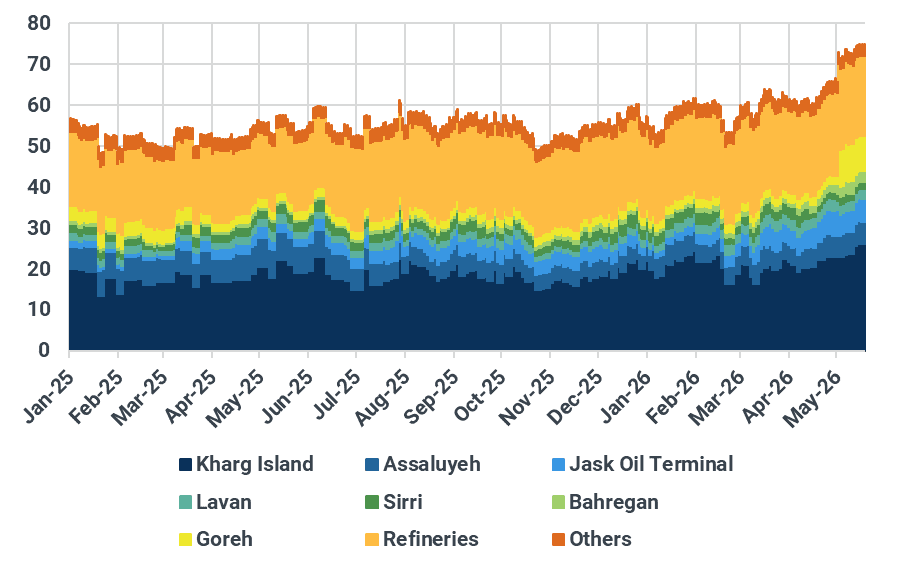
Source: Kpler
On the other hand, Iranian crude stored outside the blockade zone has dropped from 122 mb to 89 mb over the past month. Part of the remaining volume is likely sold already, although payments will only reach Iran after discharge is made. As Chinese teapots favour drawing their own inventories down due to negative refining margins, NIOC may struggle to sell its remaining available barrels. Furthermore, OFAC has recently sanctioned 19 more ships in relation to their trade with Iran, including four VLCCs, making future discharges in China logistically more challenging.
The current trajectory suggests the blockade is becoming materially more damaging than intermittent military strikes would be, with oil revenues likely to collapse to zero in about 60-70 days if the blockade remains in place.
The US may calculate that time is currently on its side. A prolonged blockade allows pressure to build gradually although Washington may eventually combine economic pressure with selective military strikes if negotiations continue to stall.
Ultimately, even this pressure may not be enough to force Iran to surrender. Tehran could just resort to printing money, letting inflation overshoot and the economy sink further. As long as the internet is shut down, domestic uprisings remain unlikely anyway.
Proprietary Data Spotlight
Kpler tracking data shows Iranian crude inventories are now building simultaneously across floating storage and onshore hubs:

See why the most successful traders and shipping experts use Kpler