EXPLAINER: Can Saudi Arabia keep its Red Sea oil exports flowing without Bab el-Mandeb?
Avoiding Bab el-Mandeb would send Saudi oil north instead, through SUMED pipeline, the Suez Canal and a tanker fleet that would all have to scale at once, along with the market rebalancing. The pipeline is the easy part.
Key takeaways
- Saudi Arabia exported about 4.2 mbd of crude from Yanbu in April, its post-war high, plus 0.4–0.5 mbd of Red Sea refined products. Holding that mix exposes roughly 3.4 mbd of Asia-bound crude to the southern chokepoint.
- Test 1, moving the oil north, is credible. Crude can combine Egypt's SUMED pipeline with direct Suez transits; products, which cannot use SUMED, would need about one laden tanker through Suez a day. The mechanism is proven. Running it at full scale is not.
- Test 2, the canal and the fleet, is where it tightens. Suez has handled the total tanker count before, in each direction. The binding constraint is the southbound return of empty replacement tankers: every modeled case exceeds the historical southbound-ballast precedent, which was last set in 2022 and is barely three times today's rate.
- Test 3, the market, is possible but slow and conditional. The 3.4 mbd is a reshuffle, not 3.4 mbd around the Cape: Saudi crude reaching the Mediterranean can push other Atlantic Basin barrels toward Asia. But nothing reshuffles automatically, because long-term Asian contracts, refinery acceptance, freight economics, and vessel repositioning all gate it.
- Recent Russia-to-Saudi fuel-oil tankers are mostly risk-flagged dirty Aframaxes. They count as canal traffic but are not freely reusable replacement capacity. Saudi products could compete with US diesel and gasoil in Europe, but not one-for-one.
The great rebalancing act
Most Saudi crude escapes the Strait of Hormuz through one route: the East–West Pipeline to Yanbu on the Red Sea coast. But cargoes leaving Yanbu for Asia still sail south through Bab el-Mandeb, and Houthi maritime embargo now threatens that leg too.
The theoretical answer is to turn the system around and send the oil north instead. Crude would cross Egypt through the 2.5 mbd SUMED pipeline and the Suez Canal, emerging in the Mediterranean rather than sailing south. This widens the conclusion of earlier Kpler analysis of the Saudi bypass: the risk is not confined to crude, because Saudi Arabia must also preserve an outlet for refined products from Rabigh, Yanbu, Jizan and Jeddah.
Physically, every piece of that system already exists. The hard question is whether they can all run at full scale at once. This note works through it as three tests, each harder than the last: can the crude physically move north; can the canal and the tanker fleet carry it in both directions; and can the oil market absorb the redirected barrels. The pipeline turns out to be the easy part.
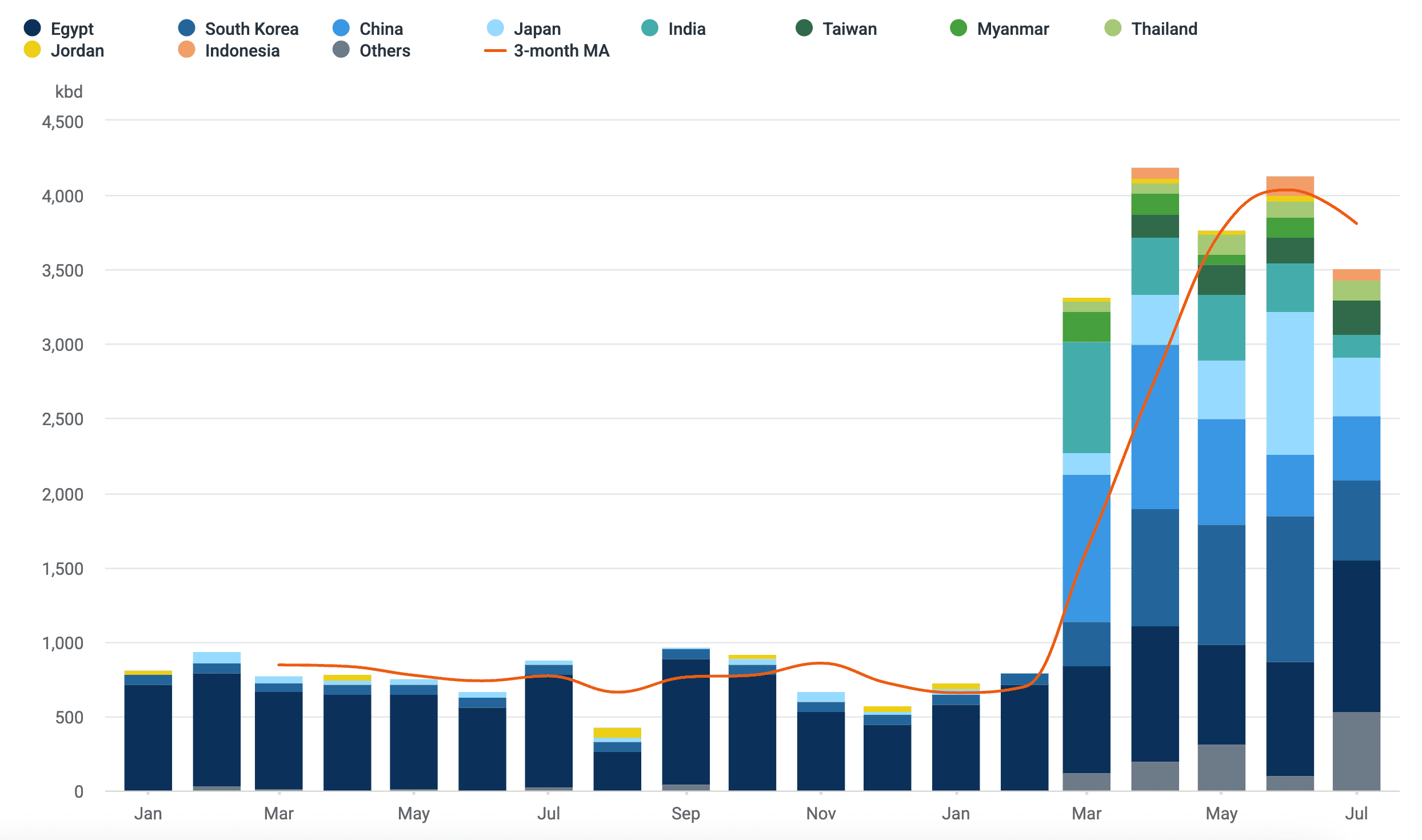
West Coast Saudi Arabia monthly exports (Crude/Co, by destination country)
Source: Kpler
Test 1: Can the oil physically move north?
How much oil is exposed
Saudi Arabia’s Red Sea terminals in Yanbu can sustainably load roughly 4.5–4.7 mbd of crude, including domestic deliveries. True exports reached 4.2 mbd in April, the highest completed month since the war began. In June, total movements hit 4.76 mbd; about 625 kbd stayed inside Saudi Arabia, leaving 4.1 mbd of exports, of which around 3.3 mbd sailed to Asia through Bab el-Mandeb.
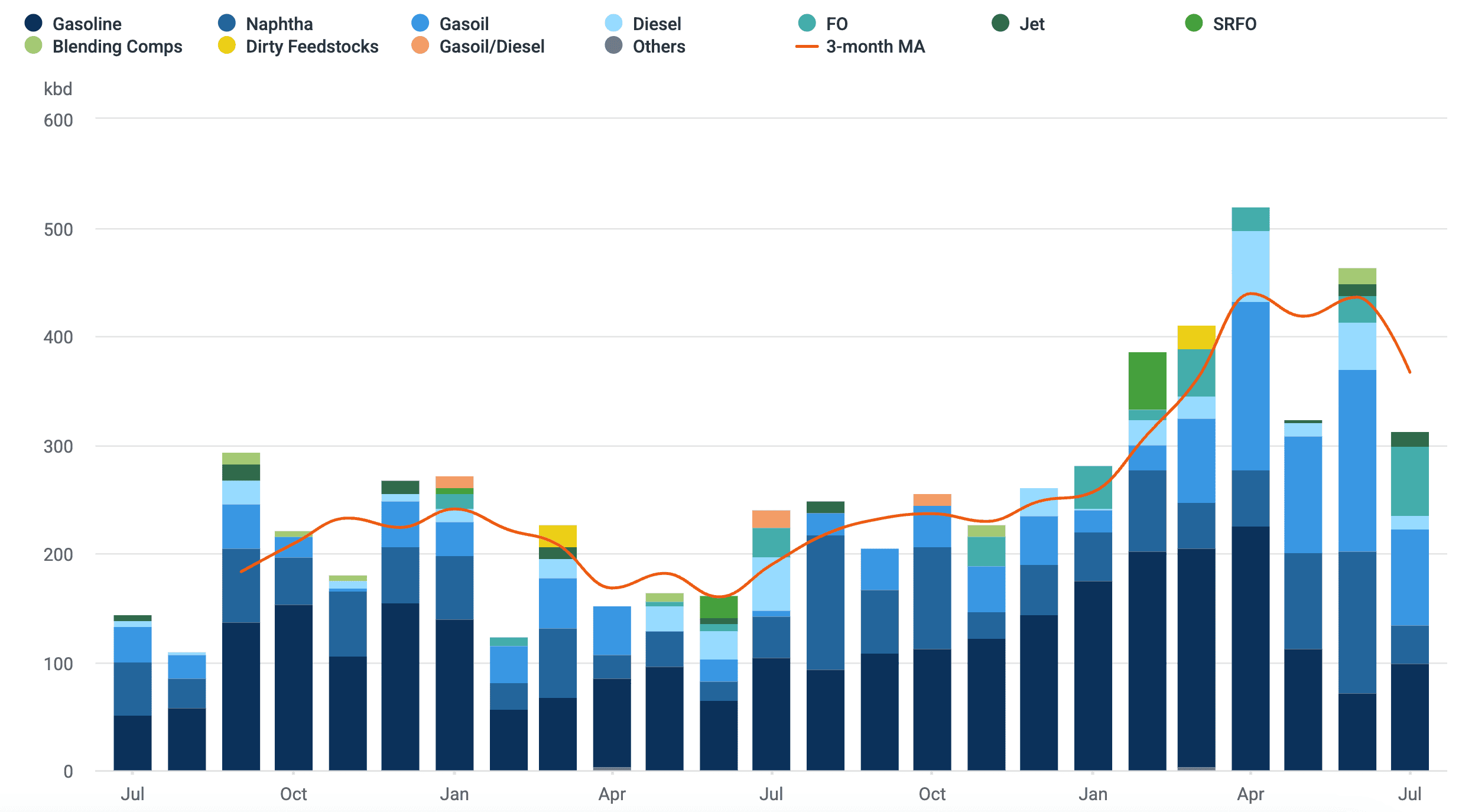
Holding exports at 4.2 mbd with the same destinations exposes about 3.4 mbd of Asian supply to the southern chokepoint. Red Sea refineries add another 0.4–0.5 mbd of products. Kpler data show Saudi products crossing Bab el-Mandeb averaging about 430 kbd in H1 and 464 kbd in June. Together the scenario tests whether Saudi Arabia can preserve roughly 4.6–4.7 mbd of Red Sea crude and product exports.
West Coast Saudi Arabia monthly transits via Bab El Mandeb (refined products, split by product)
Source: Kpler
The crude route: SUMED plus direct Suez
SUMED is Egypt's Red Sea-to-Mediterranean crude corridor, connecting Ain Sukhna to Sidi Kerir through pipelines, storage and offshore terminals. Crude can cross Egypt while the tanker that delivered it stays out of the Suez Canal. That is the "bypass to the bypass": the East–West Pipeline first clears Hormuz by reaching Yanbu, and SUMED plus northbound Suez movements then clear Bab el-Mandeb.
Saudi Arabia would need both SUMED and the Suez canal, because the 2.5 mbd pipeline alone cannot take the whole 4.2 mbd crude exports. The split depends on how much SUMED space Saudi Arabia actually gets. Importantly, the Suez Canal can only transport at most 1 million barrels of oil aboard either a fully loaded Suezmax or a half-laden VLCC.
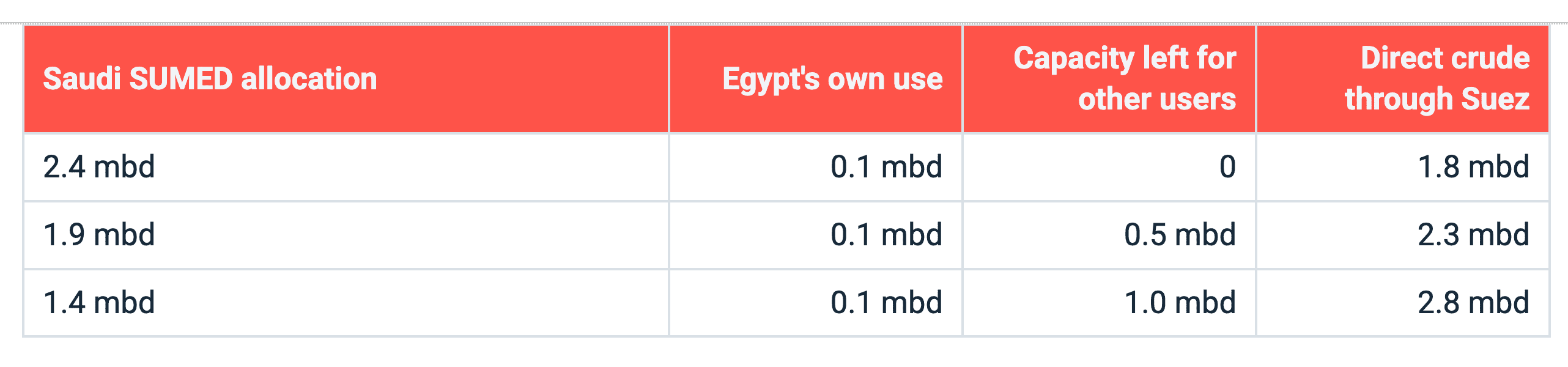
Other countries have a prior claim on part of the SUMED’s 2.5 mbd throughput capacity. Egypt draws its own crude at Ain Sukhna for domestic refining: Kpler shows Egyptian-origin crude arriving in every one of the last 24 completed months, around 90–110 kbd depending on the window. Iraqi and UAE crude also arrives, though those flows depend on the disruption. Basrah and most Gulf-loaded UAE barrels need both Hormuz and Bab el-Mandeb to reach Ain Sukhna, so a wider disruption could thin them out. The table below reserves 0.1 mbd for Egypt's standing draw, then shows the Saudi allocation against whatever Iraq and the UAE retain:
Source: Kpler
These figures are requirements, not assumed capacity limits.
The pipeline leg runs on dedicated VLCC shuttles. A tanker loads about 2 million bbl at Yanbu or Muajjiz, sails north and fully discharges at Ain Sukhna, and a second tanker lifts the crude at Sidi Kerir. Recent port calls show a median 38-hour load, a 44-hour laden voyage and a 42-hour discharge, with under three hours' waiting at Ain Sukhna. At Saudi Arabia's 2.4 mbd exclusive-case share, the fastest observed cycles imply about 10 continuously used VLCCs; a tightly optimized program needs around 12; the median of all observed return cycles implies about 16 before maintenance or reserves.
The mechanism is established, but not at this scale. Saudi arrivals at Ain Sukhna averaged about 770 kbd from March through June and peaked near 1 mbd in April, still under a third of the 2.4 mbd ceiling.
A third option that combines both SUMED and Suez exists but adds no capacity. A full VLCC can half-discharge at Ain Sukhna to pump crude into SUMED, transit Suez partly laden and reload the same volume of crude at Sidi Kerir. Kpler matched 324 such sequences since 2015, but the pattern faded to none in H1 2026 as more West of Suez crude stayed within the region. This lightering-enabled mechanism still uses the same berths, pipeline space and a Suez transit, so the model treats dedicated shuttles as the base case.
The product route: Suez only
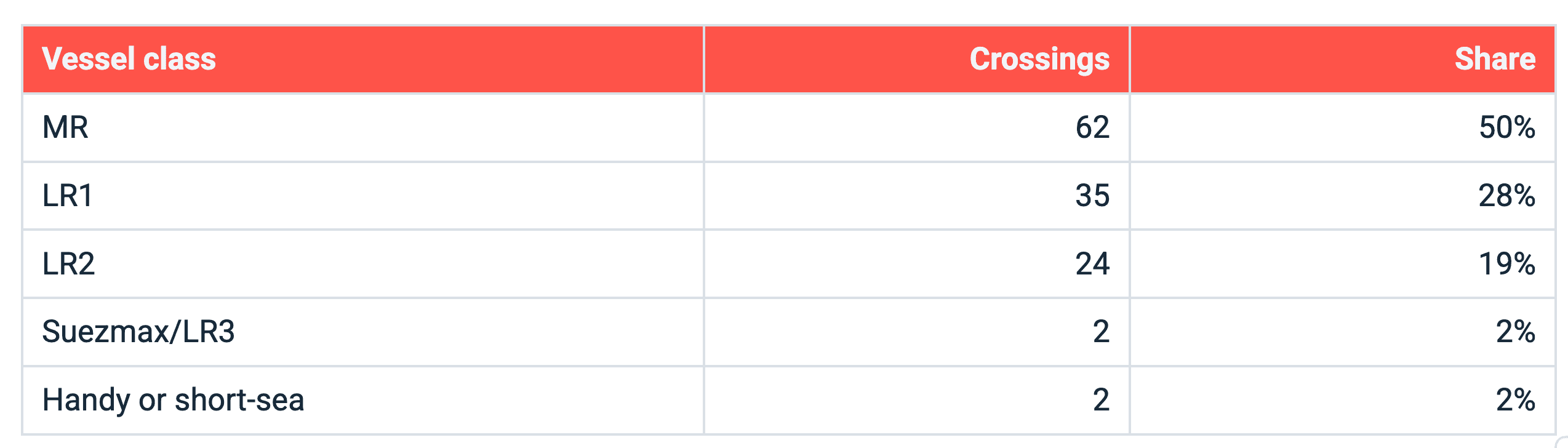
Products cannot use SUMED, because the pipeline is primarily a crude corridor. Preserving Saudi Red Sea refinery exports means sending more product tankers directly north through Suez. Kpler data show 125 Saudi product-tanker crossings at Bab el-Mandeb from March through June in 2026, roughly one tanker a day and 1.2 at April's peak:
Source: Kpler
The median parcel was about 345,000 bbl, so the program uses more hulls than its volume alone suggests.
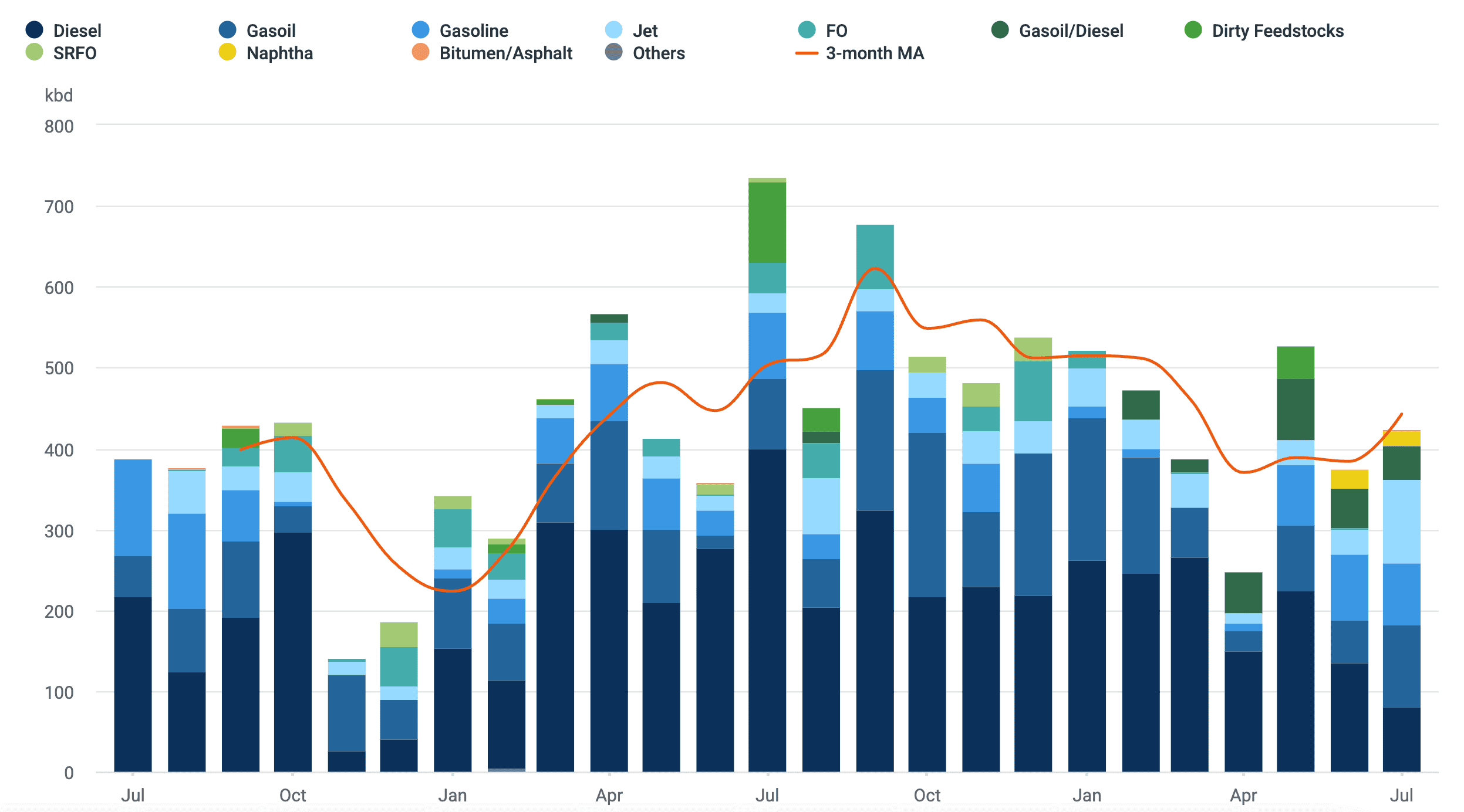
Saudi Arabia already actively uses the Suez Canal to transit refined products, averaging 423 kbd so far this year.
West Coast Saudi Arabia monthly transits via Suez Canal (refined products, split by product)
Source: Kpler
Test 1 Verdict: the physical routing is credible. Both crude and products have a demonstrated northern path. What is unproven is running all of it continuously at full scale.
Test 2: Can Suez and the fleet carry it, both ways?
Every laden tanker sent north has to be matched by tanker capacity sailing back into the Red Sea. The replacement need not be the same ship and need not be empty, but either way it consumes a southbound Suez transit. So the real load on the canal is two-way. Adding the crude Suezmax-equivalents to the product tankers, and counting both directions, the full program is about 5.6–7.9 extra tanker transits a day. The crude count is dependent on SUMED volumes, and refined products add roughly 2.1–2.4.
The aggregate count: room exists
Suez carried 15.4 completed liquid-tanker transits a day in H1 2026. Adding the program lifts the gross total to:

Source: Kpler
On its busiest year following the Russian invasion of Ukraine, Suez averaged 20.8 tanker transits a day in 2023 and sustained 23.7 over its busiest 30-day stretch, 12 April to 11 May 2023. Every case sits inside that peak envelope; the best case runs just above the 2023 annual average once Egypt's draw is netted out. This is a deliberately conservative test, because it adds the whole Saudi program on top of current traffic without subtracting anything that might reroute. Checked separately by direction, all six cases also stay within their own northbound peak (12.6/day) and southbound peak (11.5/day), so the aggregate verdict holds direction by direction.
The large-tanker mix: tighter
Aggregate count is not the whole scheduling problem. VLCCs, Suezmaxes and Aframaxes averaged 9.8 Suez transits a day in H1 2026, against a 13.8/day sustained peak in 2023. The 2.4 mbd Saudi SUMED case lifts that to about 13.7, inside historical precedent but only just. The 1.9 and 1.4 mbd cases reach about 14.7 and 15.7, above the combined peak.
But that 13.8/day combined peak stitches together two directions that peaked three months apart: 7.7/day northbound in June–July 2023, and 7.2/day southbound in April–May 2023. Measured against those separate peaks, the 1.9 mbd Saudi SUMED case actually stays within precedent in each direction on its own (about 7.7 north, 7.0 south); it only "fails" because it assumes both directions peak at once, which has not been observed. The 1.4 mbd case is the genuinely hard one, exceeding precedent in each direction separately. So forcing more crude onto the canal is a real risk, but for the middle case it is a scheduling-simultaneity risk, not an unprecedented rate.
The return loop: the binding constraint
This is where the scenario is tightest, and it is easy to miss in the combined numbers. The northern route cannot run on laden cargoes alone; empty tankers have to flow back into the Red Sea to reload. Today that southbound-into-the-Red-Sea flow is small. Suez carried only about 1.1 ballast tankers a day heading south in H1 2026, against 5.5 heading north. Most ballast traffic is ships leaving the region empty, not entering it.
If every replacement tanker arrives empty, the scenario needs 3.9–5.1 southbound ballast transits a day. The busiest such stretch Kpler has ever recorded is 3.3 a day, set in August–September 2022, before the current disruption. Every case, including the best, exceeds it, by roughly a sixth at the low end and more than half at the high end. The reassuring 8.8/day combined ballast peak is nearly all northbound and says nothing about the direction that matters here.
The escape is that replacements can arrive laden instead of empty, but a laden backhaul still burns a southbound transit and needs a cargo going that way. This is a fleet-positioning and freight problem before it is a hard canal limit, but it is the sharpest constraint in the whole system.
Russia is already using the canal
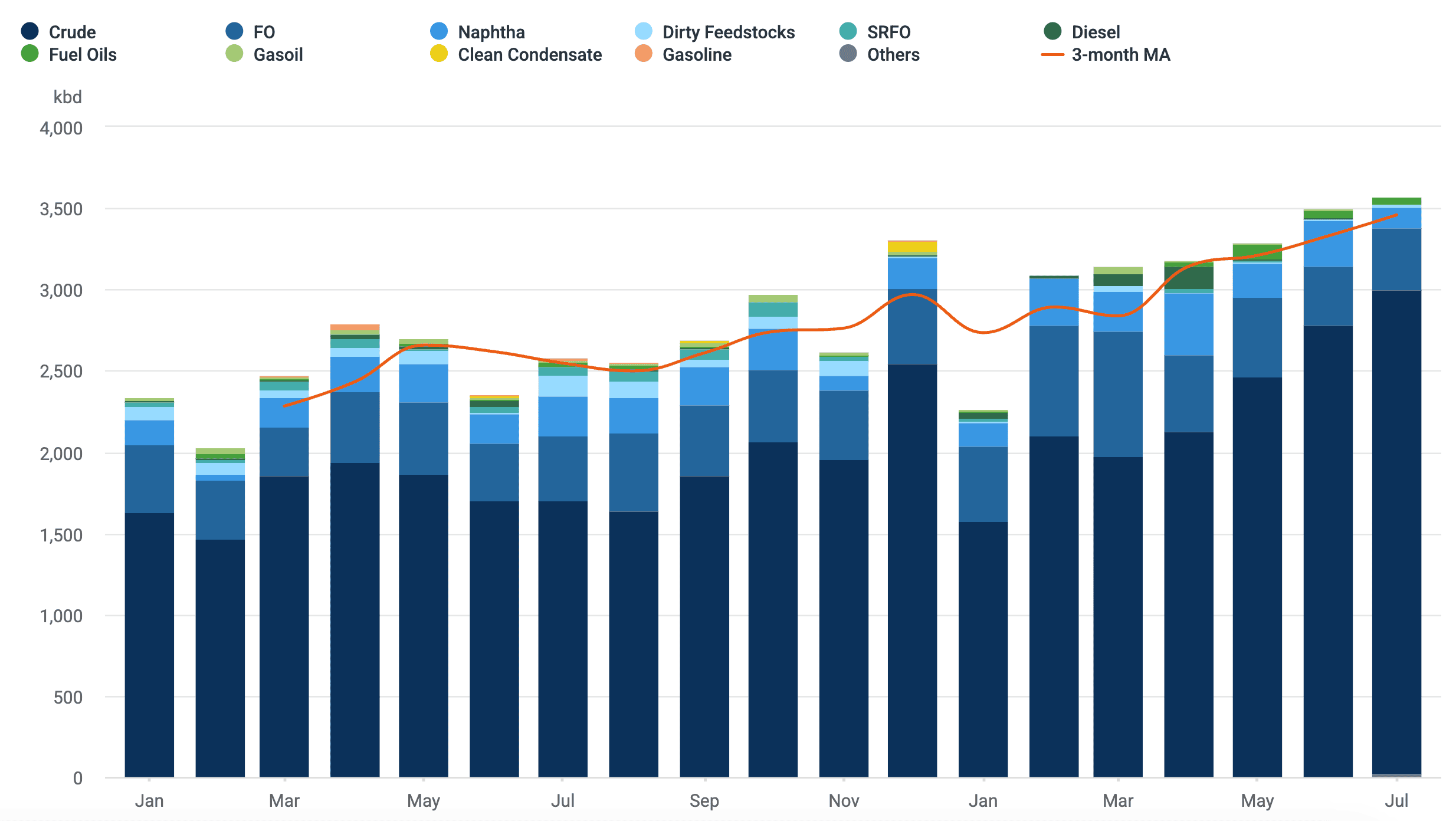
The southbound lane is not empty to begin with. Russia is the other big user, and its ships do not help. Since the EU embargo on seaborne Russian crude and refined products, Russian barrels have redirected from the Baltic and Black Sea toward India and Asia, for which Suez and Bab el-Mandeb are the shortest route. Russian crude and products through Suez averaged about 3.09 mbd in H1 2026 and reached 3.45 mbd in June. Saudi Arabia's program would move north laden while its replacement tankers move south, the same direction as laden Russian cargoes bound for Asia, so the first effect is competition for slots, waiting time and freight, not automatic displacement. That baseline is itself shifting: Russia's full diesel export ban on 8 July and repeated Ukrainian refinery attacks make the H1 Russian product figure a backward-looking reference, not a current run rate.
Could those inbound Russian tankers be the replacement capacity? Not automatically. Kpler identified 87 Russia-to-Saudi product destination movements from 1 January through 27 July, which resulted in 72 physical tanker voyages, 71 of them via Suez. They moved 41 million bbl, 99% fuel oil, on a fleet that is 82% Aframax. These are dirty-service hulls, mostly risk-flagged (59 risk-detected, 13 high-risk, none formally sanctioned). They count in southbound traffic but get zero automatic backhaul credit: reuse would need cleaning, class, compliance and charter terms all to line up. OFAC's maritime advisory flags the same operational and insurance risks around opaque Russian-linked fleets.
Russian Federation monthly transits via Suez Canal (Clean Products, Crude/Co, DPP, by product)
Source: Kpler
Test 2 Verdict: the canal has aggregate room, even by direction. The bind relative to historical precedence is not the pipeline. It is assembling enough southbound replacement capacity, cleanly, in a lane Russia already occupies.
Test 3: Can the oil market absorb the redirected barrels?
Rebalancing the 3.4 mbd crude shortfall does not mean routing that entire volume of Saudi supply around Africa. Rather, it represents the Asia-bound Saudi oil that can no longer pass through Bab el-Mandeb, the bulk of which can be resolved by reallocating buyers and destinations instead of forcing every vessel to take the longer route.
The mechanism has four steps:
- Saudi crude moves north and emerges in the Mediterranean, through SUMED at Sidi Kerir or on a canal-compatible tanker.
- European refiners take some of it instead of their usual Atlantic or Mediterranean supply.
- Those displaced Atlantic barrels sail east to Asia; Iraqi, UAE or Omani crude that would have moved west can also stay East of Suez.
- Only the Saudi volume that cannot be swapped this way takes the full northern route around the Cape of Good Hope.
None of this is automatic. It is a market rebalance that has to clear trade by trade.
How much reshuffles
The central sensitivity replaces the roughly 3.4 mbd shortfall in two steps:

Source: Kpler
The 25% is a sensitivity, not a claim that a quarter of those cargoes are available now. A detailed Kpler route model, which counts a replacement barrel only where route evidence and past Asian trade support it and penalizes quality mismatches, lands close: it redirects about 2.3 mbd and leaves 1.1 mbd for the Cape. Of that 2.3 mbd, 1.3 mbd has exact route and precedent evidence, 0.3 mbd rests on canonical grade or loading-hub mappings, and 0.7 mbd on comparable-basin routes. That distinction matters: allow only exact broad-quality matches and rebalancing falls to 0.6 mbd, pushing the Cape requirement to 2.8 mbd. Two trades have to clear at once: a European refiner accepting the Saudi barrel and an Asian refiner accepting the crude Europe releases.
Why it would not happen fast
Even where the swaps exist on paper, contracts gate them. Much of Aramco's supply moves under long-term Asian contracts. Once monthly nominations are set, cargoes cannot simply be diverted without buyer consent or a force-majeure basis, which Aramco is unlikely to invoke. For FOB sales from Yanbu, Aramco can still meet its obligation by loading the buyer's vessel and leaving the Asian buyer to absorb the longer Cape voyage. So any real swing toward Europe would come mainly from unallocated or newly marketed barrels and, if the disruption holds, would likely show up only from September-loading cargoes onward.
The barrels that do take the long way take it slowly. Yanbu to Chiba, Japan is about 7,650 nm through Bab el-Mandeb, about four weeks port to port. Sent north instead, a Saudi barrel must enter the Mediterranean, pass Gibraltar and round the Cape before turning back toward Asia: about 14,700 nm, roughly double the time at eight weeks once operating time is added. It should be called a Suez-plus-Cape route, not simply a voyage "via Suez."
The detailed central case adds roughly 800 billion ton-miles a year, and redirected Atlantic barrels travel farther too. This reshuffling would not only affect price differentials of oil, but would also materially increase tonnage requirements and freight rates.
Refined products: partial overlap with US supply
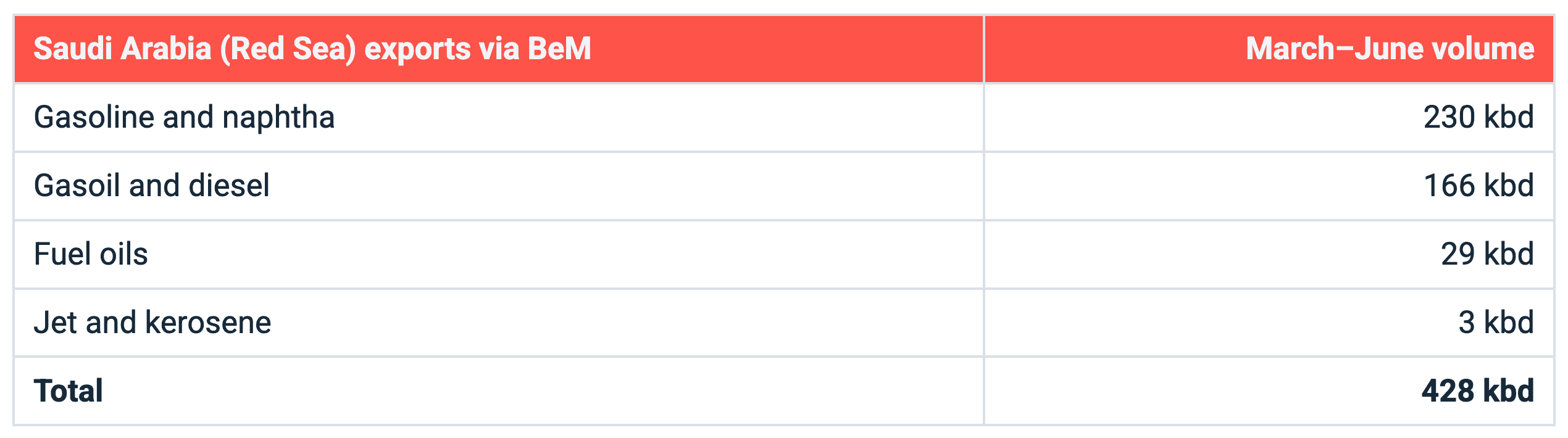
The same reshuffle logic applies to the 0.4–0.5 mbd of products, but only partially. The Saudi Red Sea product stream is mostly gasoline and naphtha, with a smaller diesel and gasoil cut:
Source: Kpler
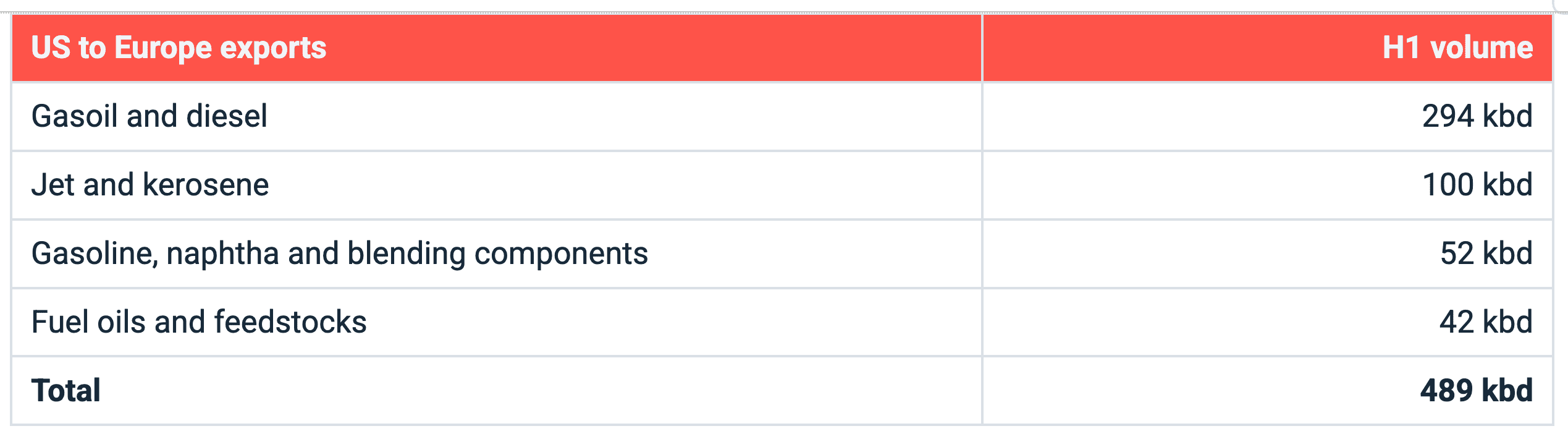
US product exports to Europe and the Mediterranean, by contrast, are diesel-heavy, at about 489 kbd in H1:
Source: Kpler
The clear overlap is the 166 kbd Saudi diesel and gasoil stream against the 294 kbd US pool. The full Saudi program would not displace US products one-for-one, because Saudi gasoline and naphtha (about 230 kbd) dwarf the comparable US supply into Europe and the Mediterranean (about 52 kbd). Some Saudi product could serve Europe directly; the rest needs a wider Atlantic reshuffle while East-of-Suez refiners backfill Asian and East African buyers.
Test 3 Verdict: the market can absorb most of the redirected oil on paper, but contracts, refinery acceptance and freight economics make it slow and partial, not a clean swap.
Who benefits, and who absorbs the cost?
- Saudi Arabia could gain most strategically: a way to hold export volumes and defer production cuts. It pays through extra freight, terminal handling, storage and scheduling. SUMED tariffs, exact Suez tolls, demurrage and war-risk insurance are not modeled here.
- European refiners gain access to more Saudi crude at Sidi Kerir.
- Iraq and the UAE could see shorter voyages to Asia if Saudi Arabia takes more SUMED space and their barrels stay East of Suez, but less European access, and only while Hormuz and Bab el-Mandeb stay usable for them.
- Tanker owners gain from higher demand: VLCC shuttles, Suezmaxes or partly laden VLCCs through the canal, and longer replacement voyages.
- Asian refiners absorb the most adjustment, through replacement grades, revised contracts or longer Saudi voyages. Refineries with limited crude flexibility face the hardest choices.
What should we watch next?
- Northbound Suez tanker counts. The total, large-tanker and product-tanker mix will show whether the alternative route is scaling.
- Southbound ballast movements. A sustained increase would show tanker capacity being repositioned into the Saudi Red Sea system, the constraint that binds first.
- Saudi arrivals at Ain Sukhna. A sustained move above the April high near 1 mbd would be the first evidence of material SUMED scaling.
- Sidi Kerir loadings. Higher Saudi-origin availability would confirm crude completing the pipeline leg.
- Product loadings at Rabigh, Yanbu and Jizan. Lower exports or higher waiting would indicate refinery-evacuation pressure.
- Russian Suez and Cape movements. Waiting, declining southbound Suez transits or more Cape voyages would show whether congestion is changing the route.
- US product destinations. Lower US diesel flows into Europe or changing Atlantic destinations would indicate product displacement.

See why the most successful traders and shipping experts use Kpler