Weak demand, strong runs: US refiners answer the global product call
US transport fuel demand is expected to weaken materially in 2026, declining by around 155 kbd y/y, with gasoline accounting for most of the deterioration. Yet refinery activity remains exceptionally strong, as very strong margins and export demand incentivise refiners to maximise output.
US refiners run hard to meet the global product call
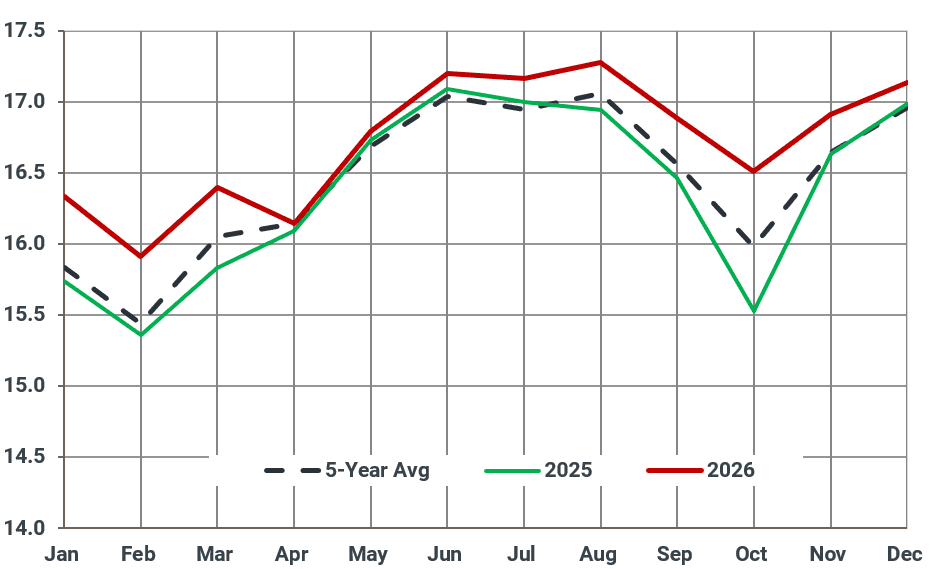
US refinery utilisation has remained above 95% for much of the summer, reaching around 98% in the final week of August, with August 2026 crude runs near 17.3 Mbd. Strong refining margins and export demand continue to incentivise refiners to maximise throughput, as constrained Russian and Middle Eastern product supply increases global reliance on US barrels.
This strength is expected to persist into autumn, with September–November maintenance historically light (IIR). Runs are expected to average around 16.9 Mbd from September–December 2026, around 450 kbd higher y/y and 500–600 kbd above seasonal averages. This should keep US export availability elevated (refer product balance), although sustained high utilisation leaves limited spare capacity and increases exposure to unplanned outages.
US refinery runs (mbd)
Source: Kpler
Domestic transport fuel demand weakens in 2026
US transport fuel demand is expected to weaken materially in 2026, declining by around 155 kbd y/y. While the year started relatively strongly, with demand broadly stable y/y in Q1, the outlook deteriorated sharply from Q2. Transport fuel demand is expected to decline by around 230 kbd y/y in both Q2 and Q3, with weakness persisting into Q4, when consumption is forecast to fall by around 155 kbd y/y.
Gasoline accounts for the bulk of the deterioration, with demand expected to decline by around 125 kbd y/y in 2026. Diesel consumption is also forecast to fall by approximately 35 kbd y/y, driven primarily by declines of around 22 kbd in PADD 3 and 13 kbd in PADD 5, while demand across other the other PADDs is expected to remain broadly stable. In contrast, jet fuel demand remains comparatively resilient, with consumption forecast to increase marginally by around 5 kbd y/y, although this is well below the roughly 30 kbd growth anticipated in our February outlook, before the US-Iran conflict, as elevated fuel costs have since weighed on air travel demand.
US Transport fuel demand growth (y/y, kbd)

Source: Kpler
Gasoline bears the brunt of weaker US transport fuel demand
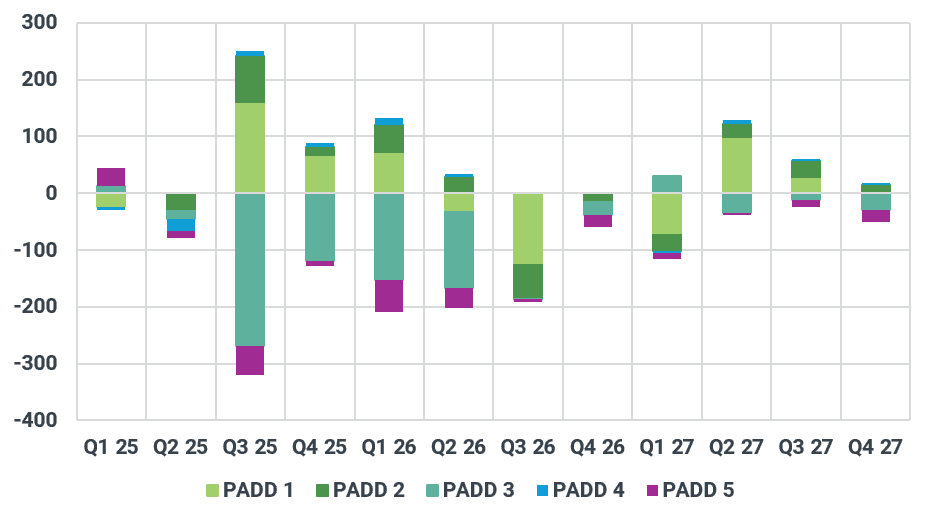
Gasoline has seen the largest deterioration in the US transport fuel demand outlook. At the beginning of the year, we expected gasoline demand to decline by around 35 kbd y/y in 2026. Our latest forecast now points to a much steeper contraction of approximately 125 kbd, with demand falling by around 170 kbd y/y in Q2 and an estimated 190 kbd y/y in Q3.
The weakness is broad-based across most US regions, although the magnitude varies considerably. PADD 3 is expected to record the sharpest decline, with gasoline demand falling by around 80 kbd y/y in 2026, following an already sizeable contraction of approximately 100 kbd in 2025. PADD 5 and PADD 1 follow suit, with demand expected to decline by around 30 kbd and 20 kbd y/y, respectively. PADD 4 is the only one, in which gasoline demand is still expected to grow, albeit modestly, by around 5 kbd y/y.
PADD-wise gasoline demand growth (y/y, kbd)
Source: Kpler
The deterioration from Q2 was driven in large part by elevated gasoline prices. The US-Iran conflict pushed average US gasoline prices more than 28% higher y/y during April-August (EIA), weighing on consumer demand and contributing to the sharp decline in consumption. Indeed, this renewed price pressure is expected to weigh further on gasoline consumption through Q3, with demand forecast to decline by around 190 kbd y/y.
Looking ahead, the gasoline demand outlook remains exposed to further downside. A prolonged period of elevated prices could deepen demand losses through the remainder of the year, particularly if higher fuel costs continue to constrain driving activity and discretionary travel. The divergence, thus, becomes evident: US consumers are pulling back, while refiners continue to run hard to meet the global call for US barrels.

See why the most successful traders and shipping experts use Kpler