FACTBOX: Red Sea crude flows, Bab el-Mandeb, and alternative routes
Rising Red Sea risks are testing Saudi crude exports and the flow of barrels through Bab el-Mandeb, Suez and SUMED.
Analyst note: Key Kpler terminal links for monitoring Red Sea crude flows, Bab el-Mandeb transits and SUMED activity are included at the end of this factbox.
Key Takeaways
- Saudi crude exports through Bab el-Mandeb remain ongoing despite the Houthi embargo and a marked decline in transit volumes.
- Yanbu continues to act as Saudi Arabia’s main export alternative to the Strait of Hormuz, with June exports of 4.14 Mbd and inventories drawing after the 20 July announcement.
- Recent vessel activity and higher Sidi Kerir loadings point to potential increase in use of the wider Suez-SUMED system.
- SUMED offers substantial theoretical flexibility, but operational limits and much longer voyage times mean it cannot fully replace Bab el-Mandeb for Saudi crude moving to Asian buyers.
Why have the Houthis targeted Saudi shipping?
On 20 July, the Houthis declared a maritime embargo against vessels serving Saudi ports. They described it as an "eye for an eye" response to restrictions on Yemen's ports and airports and a recent attack on Sanaa airport. Both claims concern the same strike: the Houthis blamed Saudi Arabia for it, while Yemen's internationally recognised government said its own forces had carried it out.
The grievance dates to Yemen's civil war. The Houthis seized Sanaa in 2014 and advanced against Yemen's internationally recognised government, which requested military support; a Saudi-led coalition intervened in 2015, viewing the Iran-aligned movement as a security threat on its border. Coalition restrictions intended to block weapons also constrained access through Hodeidah and Sanaa airport. A 2022 truce reduced direct fighting but did not resolve the conflict.
The Houthis have repeatedly targeted Saudi oil infrastructure, including the East-West Pipeline and energy facilities in Jizan, Jeddah, and Yanbu. Some Jizan refinery strikes were claimed or intercepted, while confirmed attacks damaged nearby petroleum terminals. The new threat uses service to Saudi ports, not vessel flag, as its test. Its timing gives it leverage: disruption in Hormuz has made Yanbu central to Saudi exports.
Saudi exports continue despite lower transit volumes
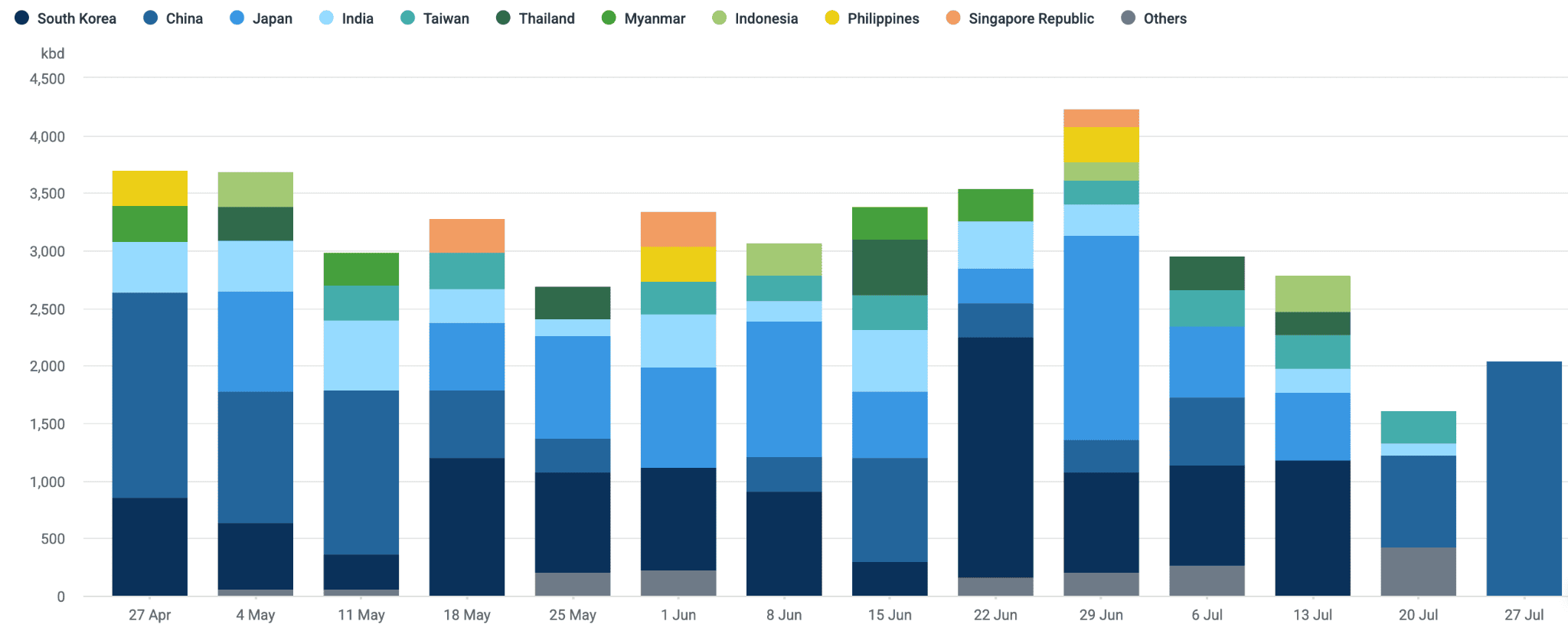
One week since the declaration by Yemen’s Houthis to embargo passage of Bab el- Mandeb (BeM) by Saudi commercial vessels and subsequent attacks, Saudi crude exports through Bab el-Mandeb remain ongoing despite a marked decline in transit volumes.
West Coast Saudi Arabia weekly crude oil transits via Bab el-Mandeb, split by Destination country
Source: Kpler
Since the onset of the Mideast Gulf crisis and de facto closure of the Strait of Hormuz, Saudi Arabia has diverted its crude oil loadings from its Eastern province installations to the Red Sea facing the West coast installations at Yanbu. Yanbu's crude export throughput reached 4.18 Mbd in April, followed by 3.77 Mbd in May, and 4.14 Mbd in June. Compared to the pre-war 2025 baseline average of 0.75 Mbd, this sustained outflow demonstrates Saudi Arabia's operational capacity to bypass 64% of its traditional Mideast Gulf output level. Specifically, the 2025 loading average out of Ras Tanura was 5.4 Mbd; by re-routing an additional 3.39 Mbd (4.14 Mbd minus 0.75 Mbd) through the Red Sea, the Kingdom effectively shifted the vast majority of its vulnerable Eastern exports.
Yanbu inventories indicate continued operations
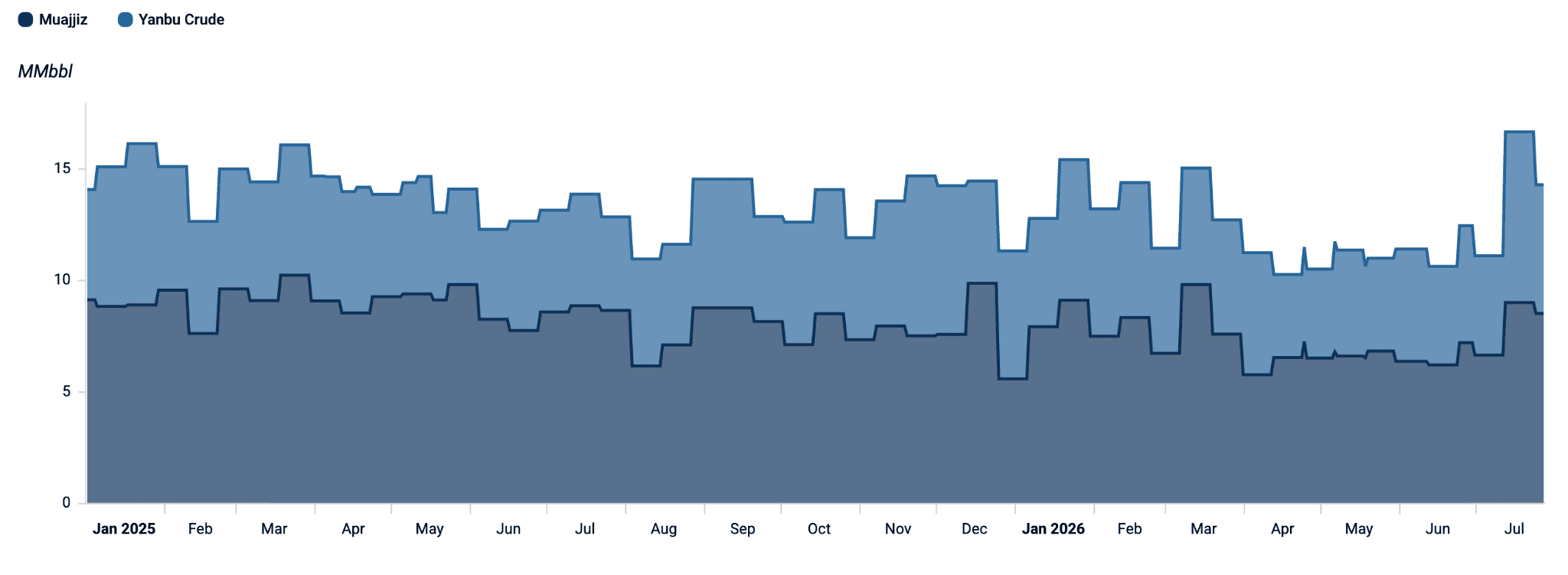
Yanbu Crude Terminal and Muajjiz Terminal are the country’s two western crude oil exporting outlets enabling unprecedented Saudi crude oil export rerouting from the Eastern province. Crude oil tank levels of total 24 Mbbls capacity have been kept low around 12 Mbbls since mid March indicating a fast pace loading operations. Most recently, the inventory level rose to near all time high around 17 Mbbls on 12 July with subsequent drawdown of more than 2 Mbbls by 24 July. It is important to be noted that the build took place prior to the Houthis announcement on 20 July and the subsequent draw confirmed the resumed operations at these terminals.
Yanbu, Muajjiz Terminal crude oil inventory levels
Source: Kpler
SUMED provides an alternative to Bab el-Mandeb
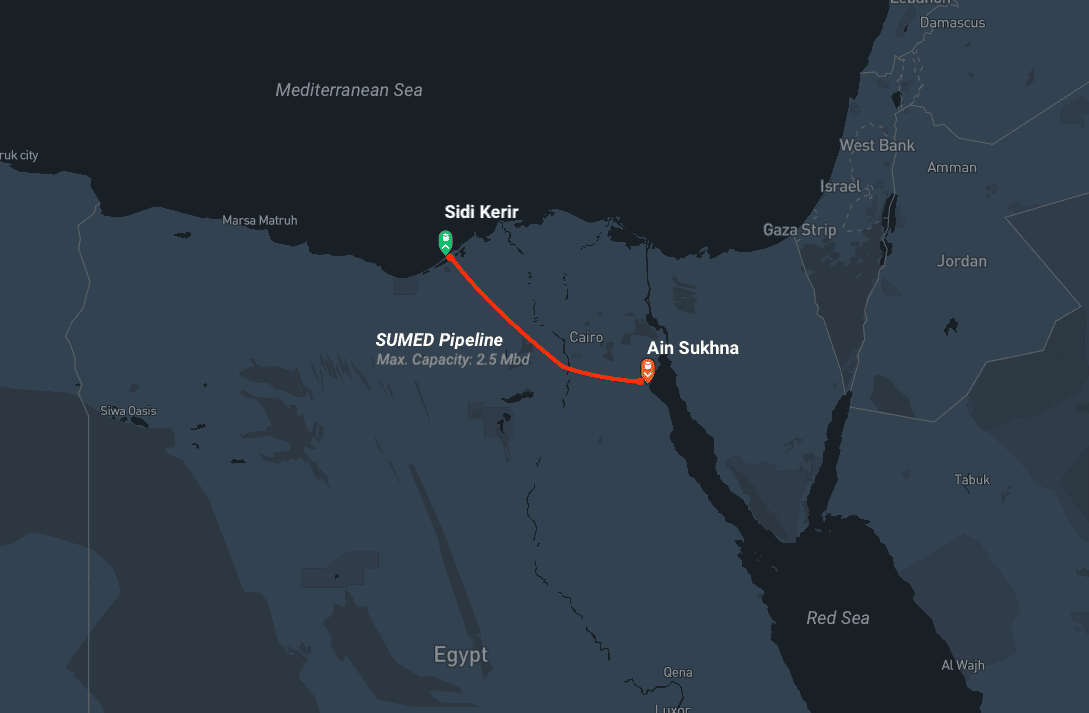
Egypt’s SUMED pipeline originates from Ain Sukhna on the Red Sea, and terminates at Sidi Kerir on the Mediterranean, bypassing the Suez Canal. The 2.5 Mbd pipeline system is designed to move Middle East crude oil to the West of Suez market as the ownership of the pipeline includes key stakeholders from Mideast Gulf oil producers.
Geographical view of SUMED pipeline
Source: Kpler
Due to draught level limitation at the Suez canal, VLCC can only pass the canal with half of its cargo capacity (~1 Mbbl). As a result, a VLCC typically discharges half of its cargo at a Red Sea discharge installation at Ain Sukhna, transits the Suez canal and reloads the cargo transferred by the pipeline from Sidi Kerir on the Mediterranean side.
Since the recent escalation, one vessel has been identified which appears to be carrying out this operation, another vessel has been identified having loaded partially at Yanbu before transiting the Suez, and is now awaiting to load the remaining crude at Sidi Kerir; based on fixture lineups received by Kpler this vessel is ultimately headed to East Asia. More broadly, crude loadings at Sidi Kerir rose by ~250 kbd to 1.3 Mbd last week. Aside from a brief rise to 1.38 Mbd in late March, this was the highest weekly level since loadings reached 2.2 Mbd during the opening week of the US-Iran war.
While most barrels loaded from Sidi Kerir are understood to have moved through SUMED, the terminal has been seen on occasion to receive seaborne crude from other countries, some of which may later have been re-exported or absorbed into Egypt’s domestic system.
SUMED pipeline utilisation status can be estimated from crude oil discharges to Ain Sukhna. In 2025, approximately 850 kbd of oil (including 766 kbd of crude) was discharged at Ain Sukhna, implying that over 1.5 Mbd of crude utilized the broader system to cross from East to West of Suez. Given the pipeline’s 2.5 Mbd operational capacity, an additional ~1.7 Mbd of crude can move between Ain Sukhna and Sidi Kerir. Accounting for VLCC cargo splitting, up to ~3.4 Mbd of Saudi crude could theoretically bypass Bab el-Mandeb on paper.
Inventory levels at Ain Sukhna provide a further indication of how much crude is entering the system and whether barrels are accumulating ahead of onward movement through SUMED. Kpler shows crude inventories at Ain Sukhna were at ~14 Mbbls during the week commencing July 20, equivalent to 69% utilisation.
Ain Sukhna crude oil inventory levels

Source: Kpler
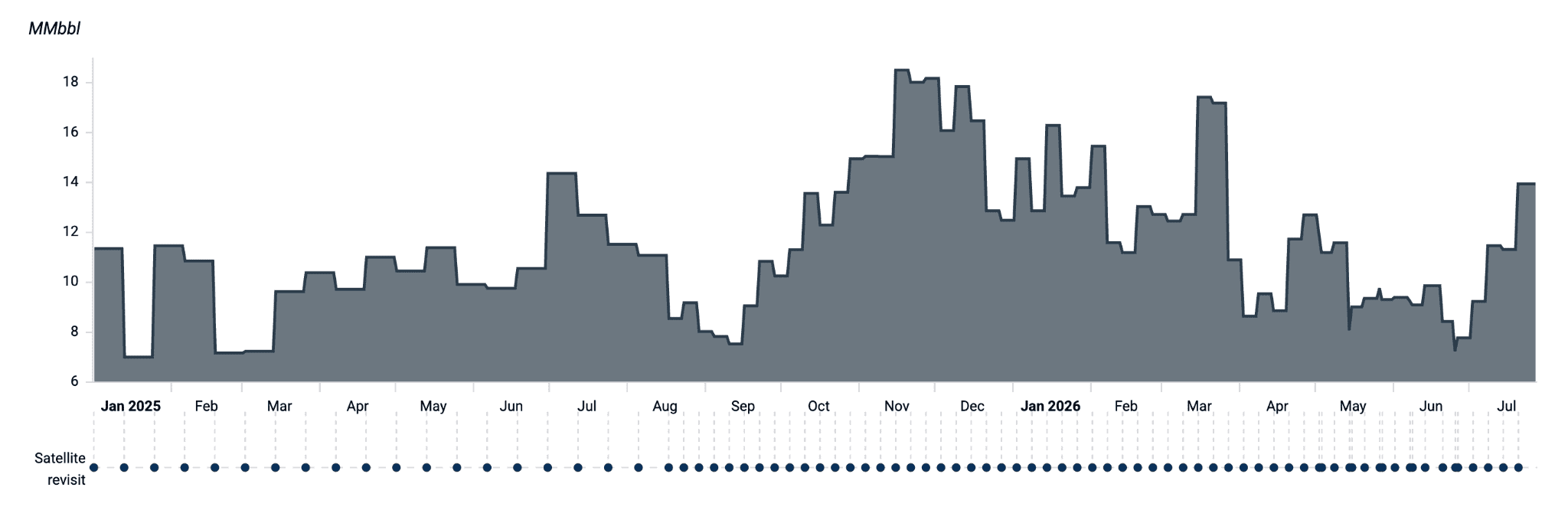
Saudi Aramco, one of the largest beneficiaries of the SUMED pipeline system, possesses crude oil tanks at Sidi Kerir terminal. As a result, crude oil inventory level at the terminal provides a key indicator of how the company responds to a given contingency situation.
Sidi Kerir Terminal crude oil inventory levels
Source: Kpler
Practical constraints limit the alternative route
However, practical execution faces massive bottlenecks. The SUMED pipeline has never been tested at maximum capacity, with its historical throughput peaking at 1.77 Mbd in 2016. The main reason was that the East of Suez crude demand in the West of Suez market has slowed down as the West of Suez has become self-sufficient with supplies from Europe and the Americas. Furthermore, routing Western coast Saudi exports to primary markets in Asia via the Suez Canal roughly doubles total voyage time. This extended transit renders trade economics unviable, making Asian deliveries logistically inefficient and threatening a sharp physical supply contraction for East of Suez refiners.
Yanbu to East Asia by route

To view the voyage route and duration of a BeM bypass route from the West Coast Saudi Arabia to Asia in the Kpler Voyage Calculator, Suez Canal, Gibraltar light. and the Cape of Good Hope route needs to be added to Via boxes.
Key Links to Kpler Terminal:
To monitor the situation at the strategic choking point in a granular and effective manner, Kpler terminal provides different cargo movement views.
Saudi Arabia’s Crude/Co oil exports from the Red Sea coast:
- This view shows all the crude loaded on to vessels from Saudi Arabia’s west coast terminals on the Red Sea (Yanbu North Terminal, and Yanbu South/ Muajjiz Terminal) and are headed to non-domestic markets, this therefore would include volumes which have exited via the BeM or Suez Canal, remain in the Red Sea, and those which have headed to Ain Sukhna to be pumped via the SUMED pipeline.
Saudi Red Sea Crude/Co loadings including domestic flows:
- Saudi’s Red Sea terminals support both non-domestic and domestic demand. This view includes all cargoes which have loaded from Saudi’s Red Sea terminals, including those seaborne volumes headed to Saudi’s west coast domestic refinery (Jizan) and power production installations (Rabigh, Shaoiba, Shuqaiq).
For the northbound Crude/Co BeM transits:
- The figure essentially indicates Mideast gulf crude oil moving to the West of Suez. This view shows crude volumes from the East of Suez markets, excluding the Red Sea, on the date which they physically transited the BeM. This view will not include volumes loaded from Yanbu (Saudi Arabia), Ain Sukhna (Egypt), or Bashair (Sudan/South Sudan), which sit inside the Red Sea. The figure is critical to estimate a spare capacity of Suez canal in conjunction with the SUMED pipeline crude transportation system to the Mediterranean.
For southbound Crude/Co BeM transits:
- This view shows crude volumes from the West of Suez markets (predominantly Russia, the Med and occasionally the US) on the date which they transited the BeM. This view also includes the Red Sea, and therefore will include volumes from Yanbu (Saudi Arabia), Ain Sukhna (Egypt), and Bashair (Sudan/South Sudan).
Ain Sukhna (SUMED origin port) Crude/Co Imports
- Egypt’s SUMED pipeline originates from Ain Sukhna on the Red Sea, and terminates at Sidi Kerir on the Mediterranean, bypassing the Suez Canal. Whilst historically most of the crude that utilises the 2.5 Mbd SUMED pipeline is Saudi in origin, barrels from other Middle East producing countries and Egypt’s own Red Sea terminals use this pipeline too. This view shows the crude and its origin that is being imported to Ain Sukhna, to later run through the SUMED.
Note on using the ‘Transit’ view:
For flows involving both the Suez Canal and BeM, you can type both of those transit points as via points. Adding West of Suez as origin would show you southbound flows, while adding East of Suez as origin would show you northbound. However on the Kpler terminal, the transit view (which aggregates volumes based on transit times instead of export times) only works if one waypoint is selected. You can aggregate these volumes based on either Suez or BeM transit times, but that would require using the Excel add-in.

See why the most successful traders and shipping experts use Kpler