
Iran-US deal logic is building, but the political math doesn’t work yet
Diplomacy and desperation are both accelerating at once. The question for markets is whether either side's decision-makers have enough reason to sign one before the other side's leverage erodes further.
Market & trading calls
- Fade the deal-headline spikes. We'd treat every "productive talks" headline as tradeable fades rather than the start of a sustained de-escalation leg, until there's a verified first move (asset release, blockade easing, or actual transits), not just another Qatar-mediated meeting.
- The Shandong/Arab-grade differential is the tell. Expect continued firmness in competing sour grades into Chinese SOEs and independents. A genuine reopening would show up first as a compression in those differentials before it shows up in Brent.
- Saudi-flow offset is the key catalyst. East Gulf rerouting is capping the rally's ceiling for now, but if talks collapse and tensions resume, the market's cushion is thinner than the recent price action suggests.
The economic case for a deal is getting harder to ignore on both sides. In the US, the 10-year yield is sitting above 5.1%, its highest since 2007, with strong PMI data reinforcing a hawkish Fed just as energy-driven inflation bites into consumers. Diesel prices are now acute enough that President Trump personally floated a 90-day export ban this week, only for his own Energy Secretary Chris Wright to publicly call it the wrong tool, since cutting diesel exports forces refiners to cut runs across the barrel, gasoline included. The White House visibly looks out of easy options less than six weeks before voters start paying attention to the midterms.
US ULSD retail price ($/gal)
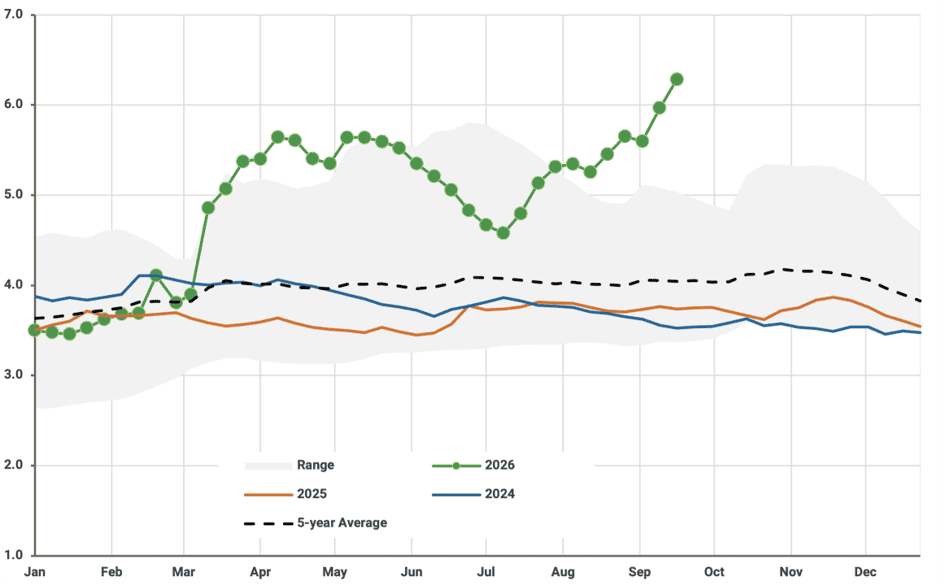
Source: EIA
US refinery runs (mbd)
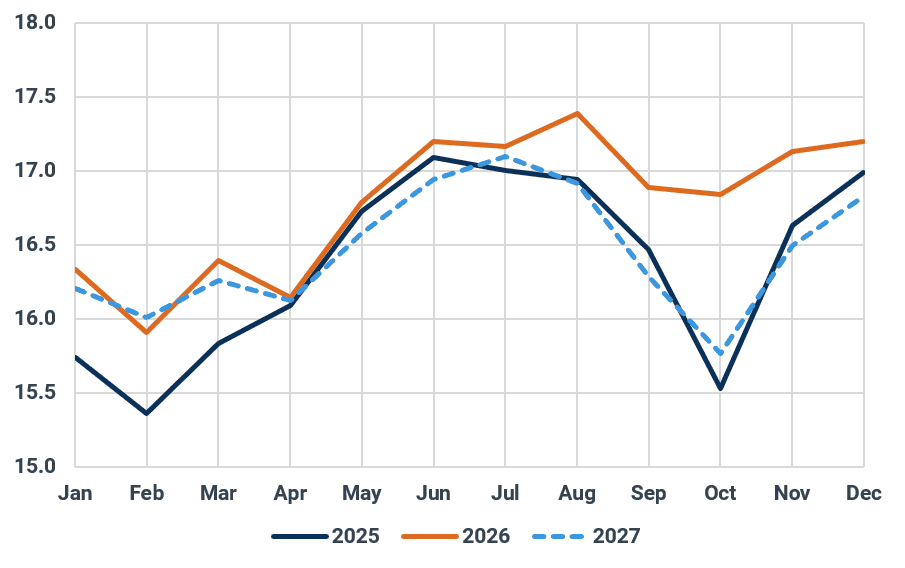
Source: Kpler
Iran's clock is more mechanical. Oil on water outside the blockade zone is down to ~15 mbbls and, at the current drawdown pace, clears by early-to-mid October, meaning Iranian export revenue would drop to zero well before the new year. The Iranian toman has cratered to 230,000 for 1 USD, dropping from 183,000 when the US blockade was reimposed in mid-July. The upcoming financial pressure is likely why Tehran's new offer compresses the June MoU's 60-day runway into seven days.
Iranian oil on water (mbbls)
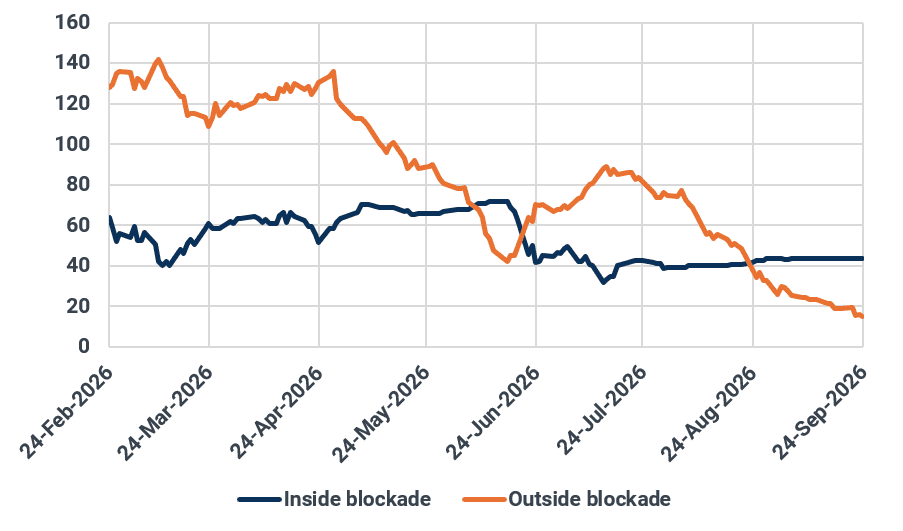
Source: Kpler
Despite that, the barriers to conversion are real. On the US side, there's little upside to a deal for Trump specifically: the midterms look lost regardless, and a negotiated de-escalation now would read as the administration backing off after months of "annihilation" rhetoric, a tacit admission that maximum pressure didn't deliver capitulation. Washington's own framing reinforces this: officials are calling the talks "constructive" while explicitly saying they see no need to rush, because the blockade is working. And it's working better by the week: Saudi Arabia is rerouting crude back to the east coast of the Gulf, denting the chokepoint's leverage for Iran without costing the US anything.
On the Iranian side, FM Araghchi and President Pezeshkian are negotiating from a position with no real cards and no real room: every time they signal flexibility, IRGC-aligned media undercuts them domestically, which is exactly the dynamic that broke the June MoU. A regime that can't credibly commit to what its own negotiators agree to isn't a regime the US has much incentive to rush a deal with.
A deal is directionally logical for both sides' economics, but the actors most exposed to the economic pain (Iranian civilians, US consumers) aren't the ones who control the decision to sign. The ones who do control it (Trump, IRGC) each have reasons to maintain the status quo a little longer while Iranian negotiators need to answer the IRGC leadership. Therefore, we'd treat this negotiation momentum as a real but low-probability near-term catalyst for oil markets. This means we do not expect material sell-offs on futures or in the physical oil market, although higher Saudi flows are pushing the replacement-barrel rally toward its ceiling.
Kpler proprietary data
- Iranian oil on water totals 58.4 mbbls, including 15 mbbls outside the blockade zone
Market insights you can trust
Kpler delivers unbiased, expert-driven intelligence that helps you stay ahead of supply, demand, and market shifts.
Trade smarter. Request access to Kpler today.

See why the most successful traders and shipping experts use Kpler