US crude supply remains resilient despite near-term headwinds
US crude and condensate production rose modestly to 13.79 Mbd in June, as Texas and New Mexico slowdowns and E&P capital discipline were offset by rig efficiency gains and a rebound in Alaskan output, led by ramp-up at the Pikka project and recovery at North Slope fields like Prudhoe Bay.
Market & trading calls:
- June supply slowdown: US national production rose modestly by 37 kbd to 13.79 Mbd in June, though gains were tempered by a 75 kbd drop in Texas (5.73 Mbd) and a 32 kbd decline in New Mexico (2.37 Mbd).
- Capital discipline & local bottlenecks: High oil prices are driving select hedging into 2027, but most E&Ps remain focused on debt reduction and shareholder returns over aggressive drilling, while Permian acreage degradation and wastewater issues constrain Texas output.
- Rig counts & efficiency boosts: Active US oil rigs rose to 447 as of late August (up 30–40 from pre-war levels); despite being below historical peaks, improved rig efficiency, multi-well pads, and extended laterals (2–3 miles) are maximizing recovery per active rig.
- Waha region debottlenecking: Infrastructure relief and takeaway capacity improvements around the Waha hub in West Texas are expected to unlock constrained Permian production and support ongoing field development.
- Regional offsetting & alaskan growth: Rebounding Texas output, sustained New Mexico momentum, and surging Alaskan supply will offset crested US Gulf of Mexico production
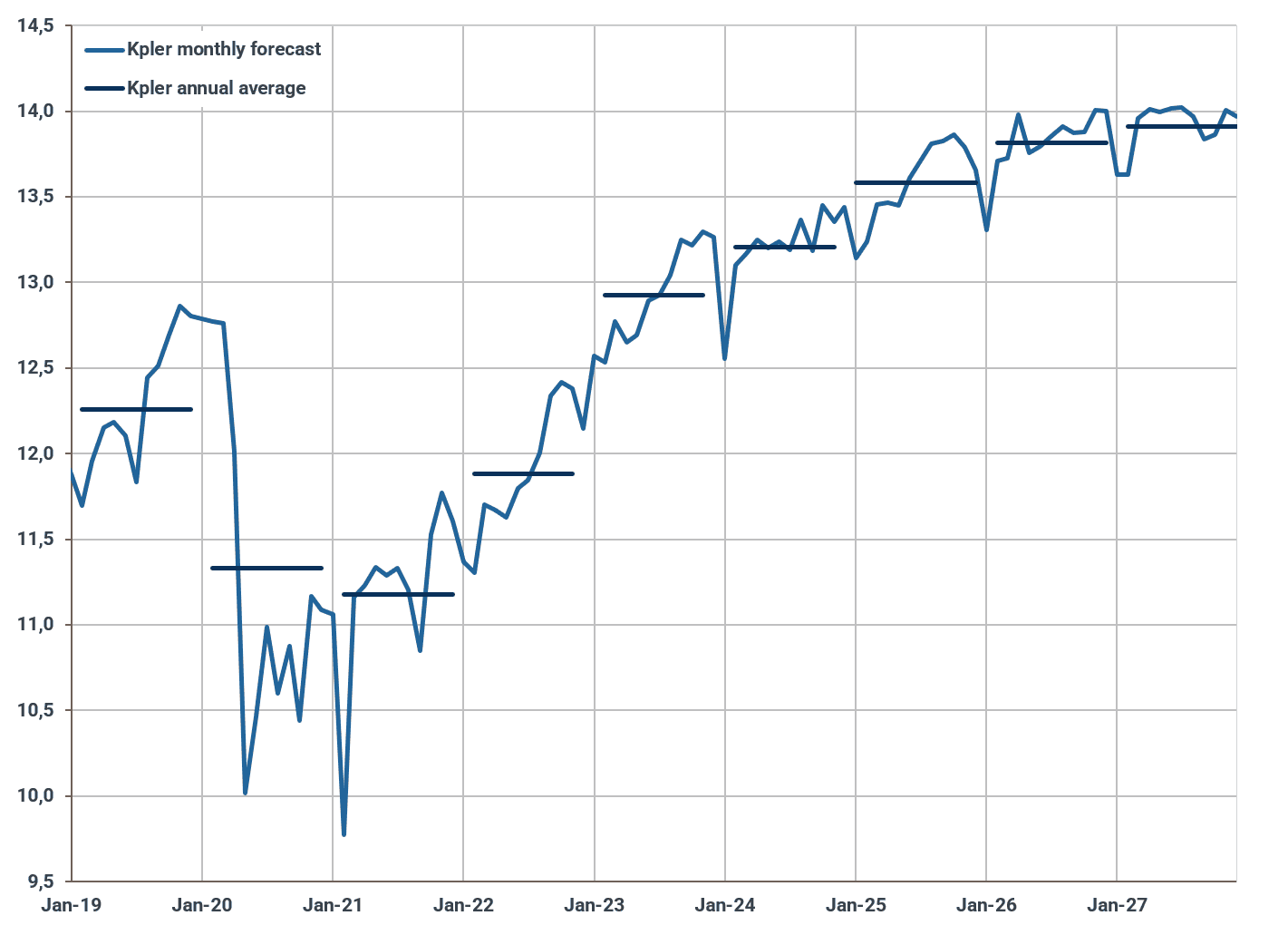
The latest monthly supply data published by the EIA for June suggests that headwinds are beginning to emerge across the US crude and condensate landscape, but the outlook continues to remain promising. While overall national output rose modestly by 37 kbd month-on-month to average 13.79 Mbd—up 136 kbd (1%) year-on-year—growth showed distinct signs of decelerating. This slowdown was particularly visible in Texas, where production dropped 75 kbd from May to 5.73 Mbd, down 28 kbd from June 2025 levels. Even in New Mexico, monthly production eased by 32 kbd to 2.37 Mbd, though it remains up 188 kbd year-on-year.
US crude and condensate supply, Mbd
Source: EIA
While the high-price environment is incentivizing select producers to hedge output into 2027 and expand capital investments, many industry players remain hesitant to aggressively scale up activity. Instead, a large portion of E&P operators continue prioritizing capital discipline—directing excess cash flows toward paying down debt and enhancing shareholder returns via dividends and buybacks rather than expanding drilling programs.
Beyond capital discipline, localized Permian Basin headwinds—specifically acreage degradation and persistent wastewater handling and disposal challenges—have created operational bottlenecks that directly hamper output growth. Nevertheless, recent pipeline additions around the Waha region will help alleviate some constraints over the remainder of the year and further support field activity moving forward.
Notably, the US oil rig count only began trending upward from late May onwards, despite crude prices reaching their highs earlier during the conflict involving Iran. Standing at 447 as of late August—down slightly from early August's high of 455, but up by 30–40 rigs compared to pre-war levels—this rising rig activity will help keep overall domestic crude supply on a gradual upward trajectory.
While active rig counts remain well below historical peaks seen in previous years, modern high-spec rigs have become vastly more efficient, turning out significantly more wells per month than past fleets. These productivity gains—driven by structural advancements such as extended lateral lengths (with 2- to 3-mile horizontal wells becoming standard) and widespread adoption of multi-well pad drilling—allow operators to squeeze far more recovery out of each active rig.
A resumption of growth in Texas, combined with sustained strong expansion out of New Mexico and an upcoming uptick in Alaskan volumes, will help counter soft performance in the US Gulf of Mexico, where production has crested and is expected to decline as field depletion outweighs new project additions.
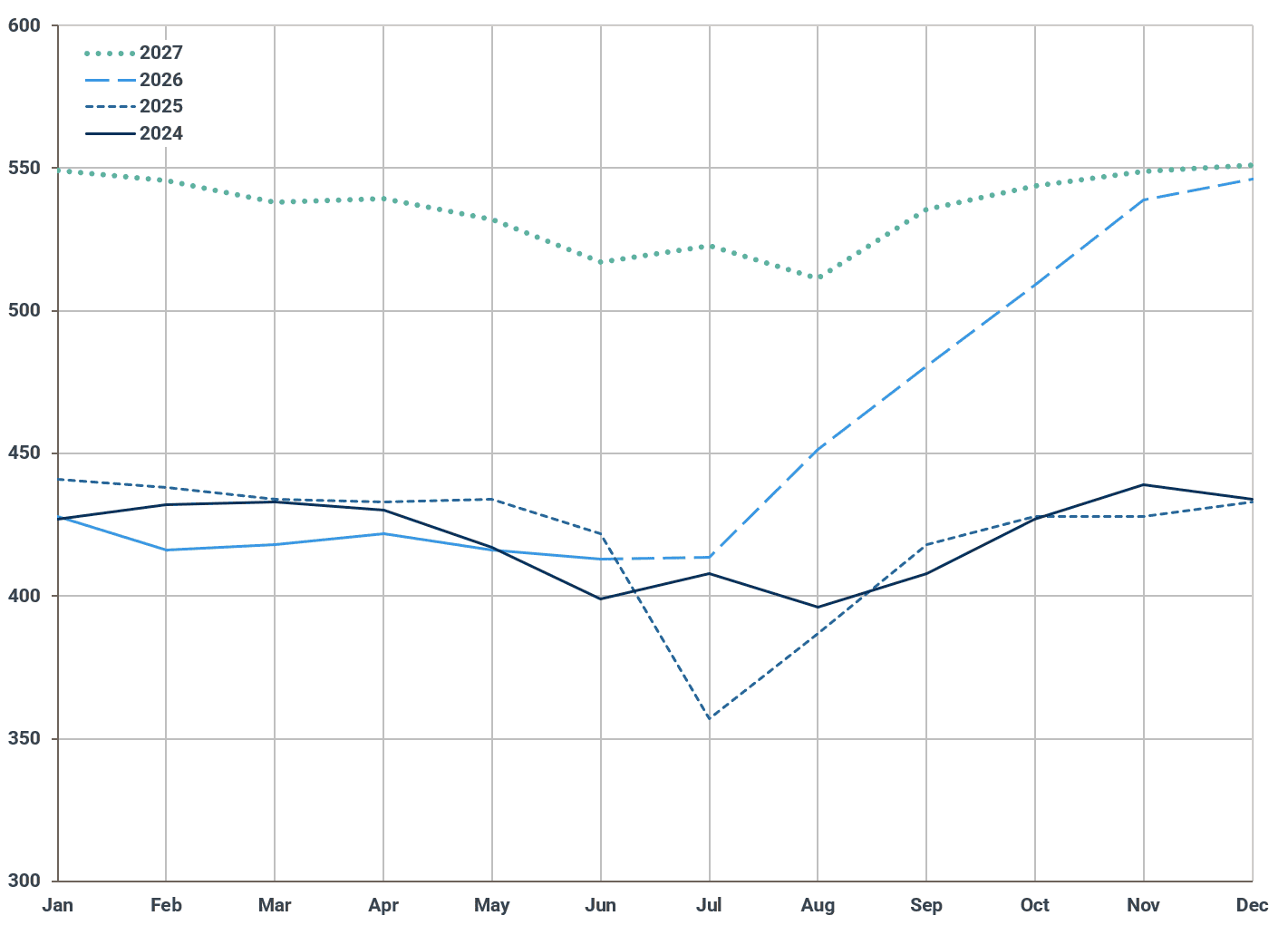
Alaskan crude and condensate supply, kbd
Source: EIA
In Alaska, supply is already seeing a notable boost following the completion of seasonal maintenance and key project ramp-ups. Output from Santos' 80 kbd Pikka project on the North Slope reached 40 kbd—up from 23 kbd earlier in August—supported by the initiation of water injection for reservoir pressure support, with the field targeting peak capacity by the end of the third quarter.
Concurrently, overall Alaska North Slope (ANS) production climbed to 475 kbd in late August—its highest weekly average since December—driven by output recoveries at major fields including Prudhoe Bay, Kuparuk, and Lisburne, which in turn lifted regional inventories at the Port of Valdez by 13.5% to 3.04 million barrels.

See why the most successful traders and shipping experts use Kpler