Refined products demand to fall 2.4 mbd in 2026 before an uneven 2027 recovery
The US-Iran conflict is affecting the refined products through different channels: feedstock shortages are curbing LPG and naphtha consumption, higher pump prices and conservation measures are weakening road-fuel demand, and airspace restrictions are reducing jet demand, and disrupted bunkering activity and gas substitution are weighing on fuel oil. Although demand is expected to rebound by 2.5 mbd in 2027 as supplies normalise and prices ease, structural shifts across transport, petrochemicals and power generation will prevent a return to the pre-conflict demand mix.
Under our updated base case, the reopening of the Strait of Hormuz is no longer contingent on a comprehensive political agreement. Instead, we expect tanker traffic to normalise gradually through operational adaptations, leaving transits increasingly active but volatile through 2027.
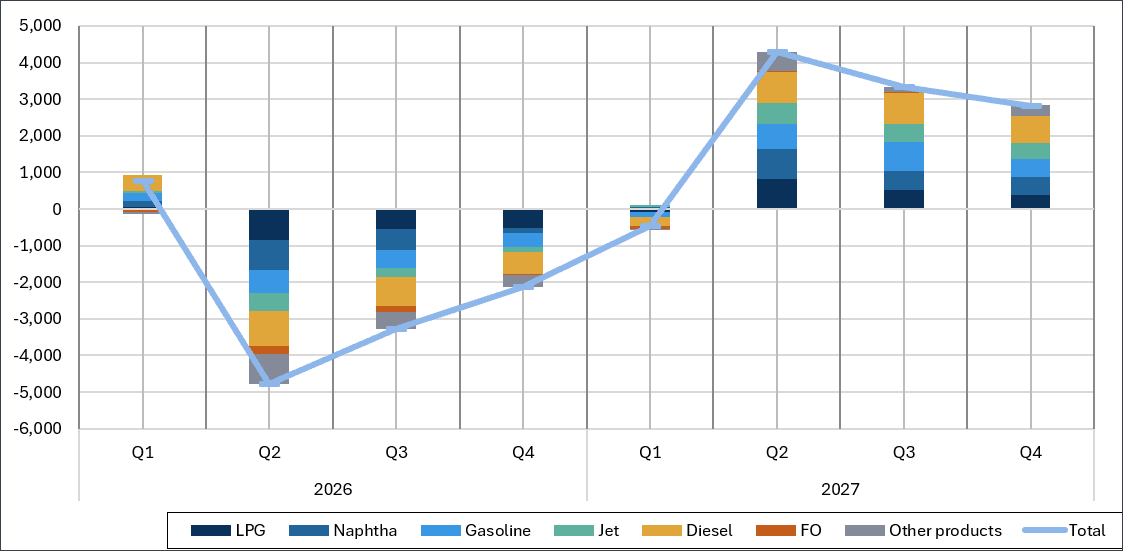
Against this backdrop, total liquids demand is forecast to decline by 2.5 mbd in 2026, while refined-products demand falls by 2.4 mbd, with the decline concentrated in Q2 and Q3, when supply disruptions, elevated fuel prices and restrictions on regional shipping and aviation have their greatest impact. Gasoil and diesel account for the largest product-level loss, followed by LPG, naphtha, gasoline, jet and kerosene, and fuel oil.
The transmission of the shock differs by product. LPG and naphtha consumption has been constrained primarily by reduced feedstock availability and lower petrochemical operating rates. Gasoline and diesel demand has been affected more by higher retail prices and, in some markets, government-led conservation measures. Jet fuel has faced a separate operational shock from airspace closures, disruption to aviation hubs and the prolonged withdrawal of foreign carriers from Middle Eastern routes. Fuel oil has been affected by the displacement of bunkering activity away from key Gulf hubs and the continued substitution of gas for oil in power generation.
Refined demand growth (y/y, kbd)
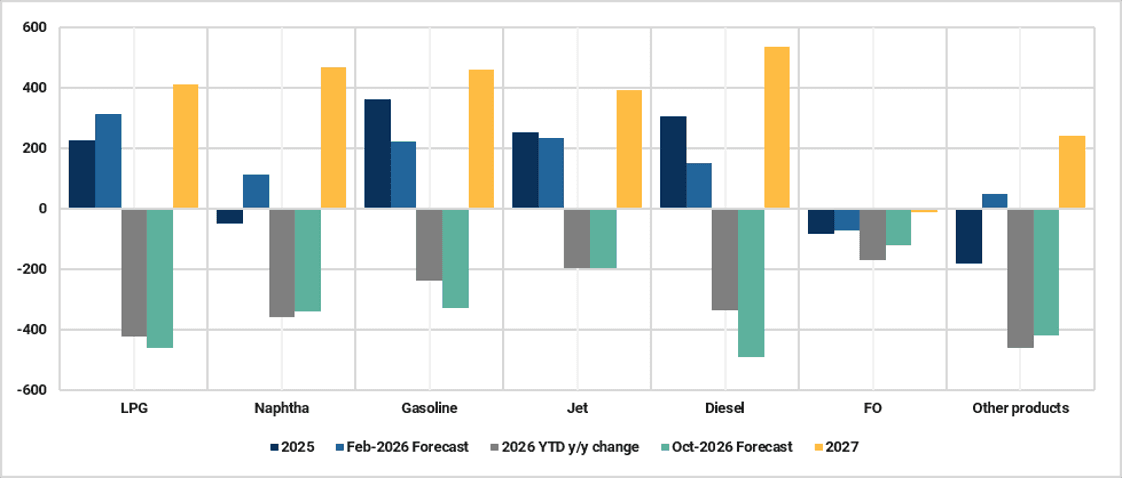
Note: 2026 YTD = Jan to Jul 26
Source: Kpler
Refined-products demand is forecast to rebound by around 2.5 mbd in 2027 as trade flows normalise, feedstock availability improves, fuel prices ease and air travel recovers. However, the rebound will not simply reverse the changes seen in 2026. Some losses are cyclical and should unwind as the immediate disruption fades, particularly those linked to constrained petrochemical operations, displaced bunkering and reduced air travel. Others reflect structural shifts, including EV adoption, the growing use of LNG and electric trucks, fuel substitution in Indian households, petrochemical capacity rationalisation in OECD Asia, and the displacement of fuel oil by gas in power generation.
Refined products demand outlook
LPG: China and India bear the largest supply-driven losses
Global LPG demand is expected to decline by 460 kbd in 2026, with Asia accounting for 370 kbd of the contraction. China and India account for most of the regional decline, with demand expected to fall by 230 kbd and 100 kbd, respectively.
China’s decline is concentrated in the petrochemical sector. Around half of the country’s seaborne LPG imports are exposed to trade flows through the Strait of Hormuz, leaving PDH particularly vulnerable to reduced Middle Eastern supply. As feedstock availability tightened and margins deteriorated, Chinese PDH operating rates fell below 50% in late April (as per SCI, RIM), their lowest level in five years. Operating rates began recovering from May and had returned to around 70% by August as more feedstocks became available and plants gradually resumed operations.
Gross PDH margins per ton of propylene ($/t)
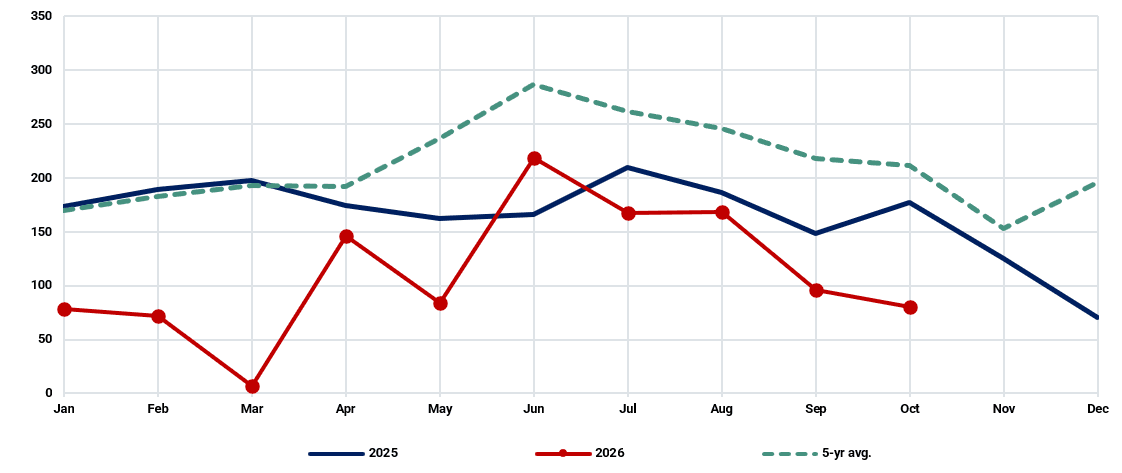
Source: Kpler calculations using Argus Media prices
By 2027, much of China’s demand loss should begin to unwind. Chinese LPG demand is forecast to increase by 170 kbd y/y, recovering most of the volume lost during the disruption and bringing consumption closer to its underlying growth trajectory. Around 2.7 Mtpa of additional PDH capacity is scheduled to come online from the second quarter of 2027 onward, assuming projects remain on schedule. This should support further feedstock demand.
India’s LPG demand is expected to decline by ~100 kbd in 2026. Before the disruption, the country sourced more than 90% of its LPG imports from the Middle East, leaving it particularly exposed to reduced flows through the Strait of Hormuz. The supply shock directly affected end-use consumption as the government introduced measures including the rationing of LPG deliveries. Demand is expected to recover from its Q2 and Q3 lows during Q4 2026, supported by the festival season and higher imports, but the recovery is expected to remain incomplete.
India LPG imports by origin (kbd)
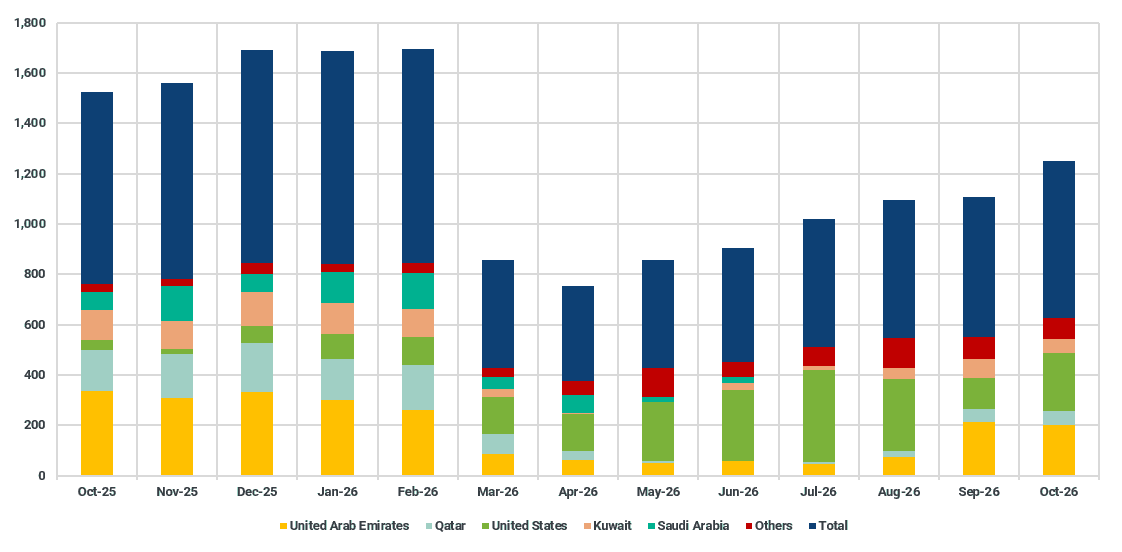
Source: Kpler
Indian LPG demand is forecast to increase by only ~60 kbd in 2027, recovering slightly more than half of the 2026 decline. Part of the remaining loss is likely to be structural as the government promotes PNG connections, particularly among urban households connected to city gas distribution networks.
Globally, LPG demand is expected to increase by 420 kbd in 2027. Asia accounts for ~250 kbd of the growth, while the Middle East, Africa and Europe are each expected to add around 40 kbd. European growth is primarily linked to the start-up of new PDH capacity, while African demand should recover as product availability improves and prices normalise.
LPG y/y demand growth by region (kbd)
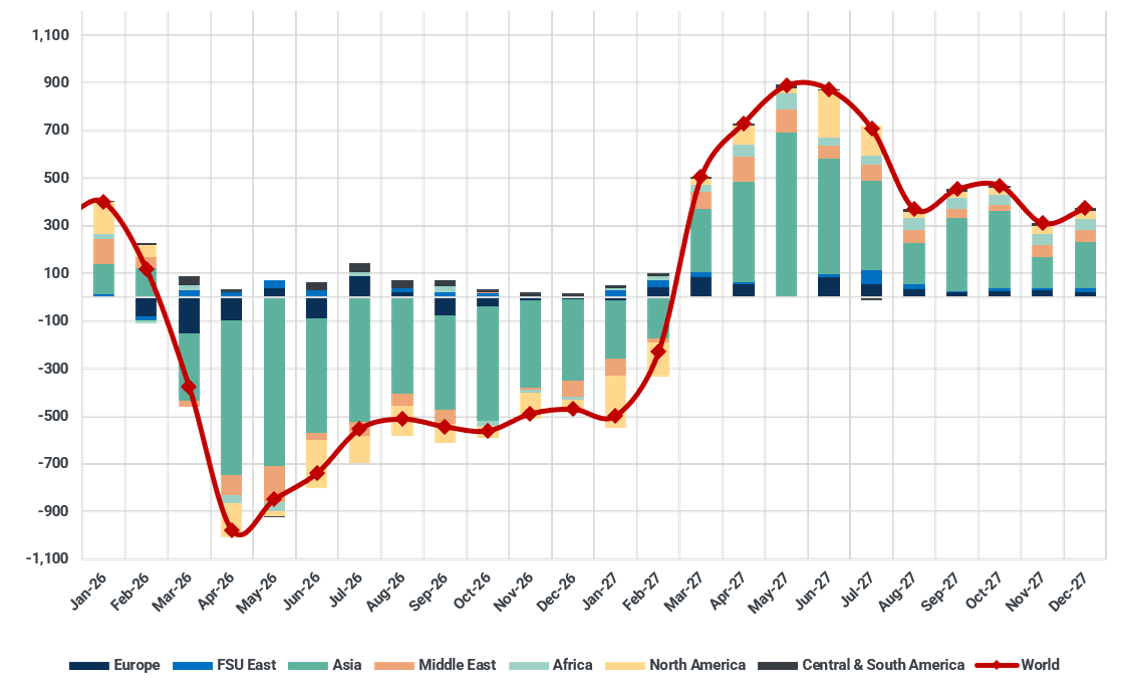
Source: Kpler
Naphtha: Asian petrochemical demand absorbs the largest direct supply shock
Global naphtha demand is projected to decline by 350 kbd in 2026, with Asia accounting for ~340 kbd of the contraction. Reduced feedstock availability has forced steam crackers and other petrochemical plants to lower operating rates, delaying the recovery in regional petrochemical activity.
Asian seaborne naphtha imports fell by 840 kbd y/y between March and September, to approximately 1.7 mbd. The Middle East accounted for most of the reduction, with imports from the region falling by 900 kbd over the same period. Imports from suppliers outside the Middle East increased by only 60 kbd, to 1.03 mbd, replacing only a small proportion of the lost supply.
The resulting feedstock shortage forced petrochemical plants to reduce runs, draw inventories and, in some cases, declare force majeure. The impact peaked in May, when Asian naphtha demand fell by an estimated 830 kbd y/y, with China, South Korea and Japan recording the largest losses.
Northeast Asian gross complex steam cracking margins per ton of ethylene ($/t)
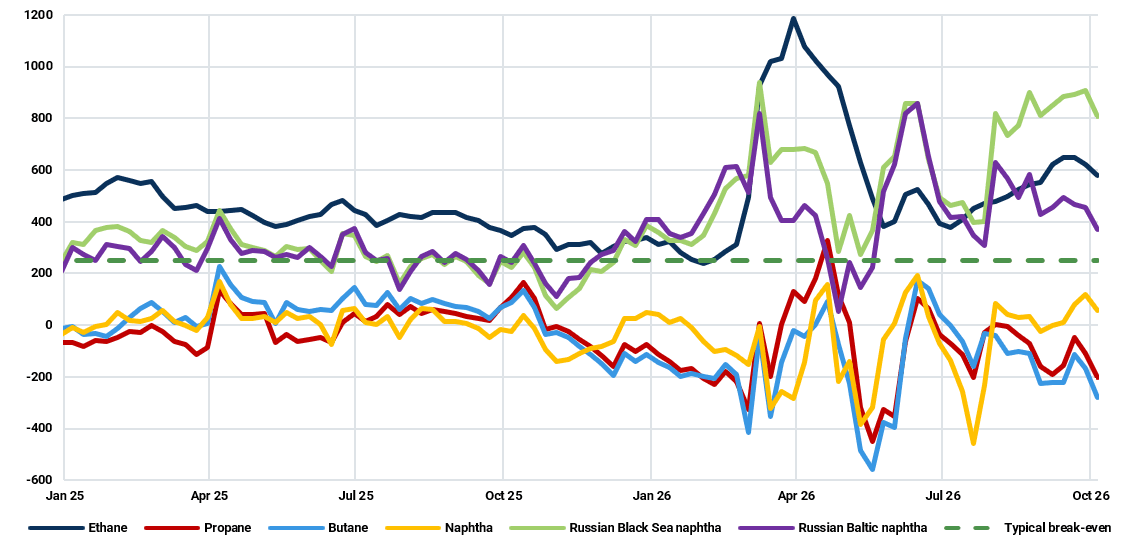
Source: Kpler calculations using Argus Media prices
Asia ethylene output y/y change (%)
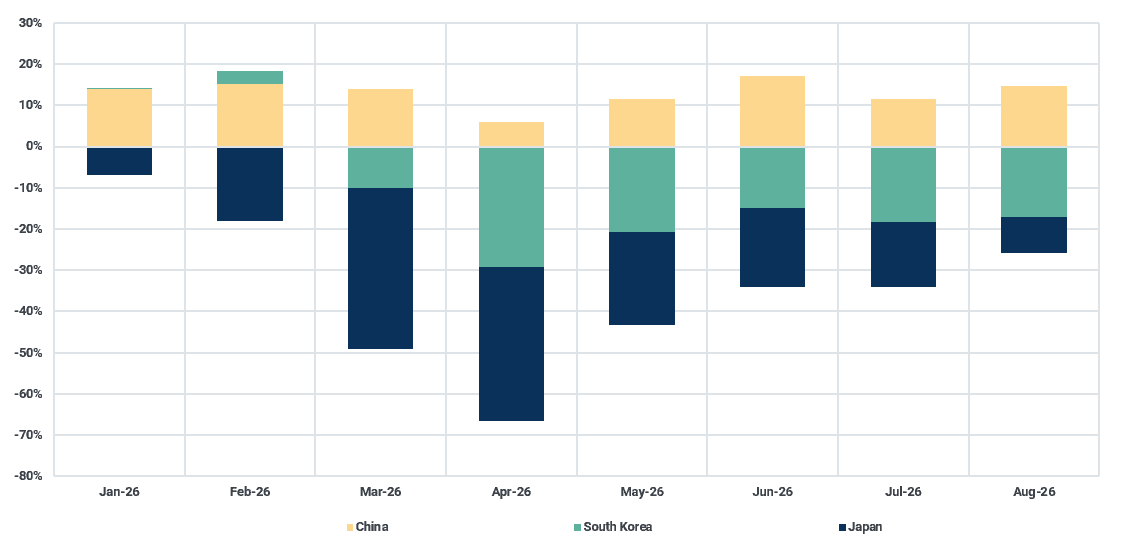
Source: Kpler based on NBS, Kosis and JPCA
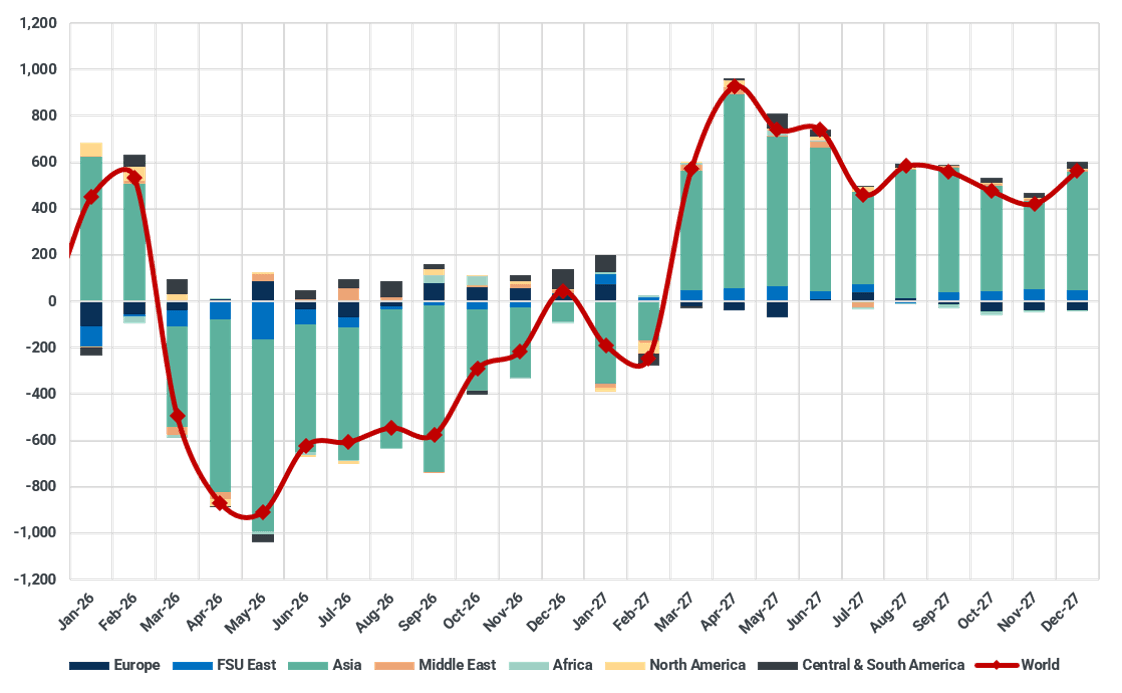
Global naphtha demand is forecast to rebound by 470 kbd in 2027, with Asia again accounting for most of the increase. China is expected to lead the recovery, with demand rising by 230 kbd as feedstock availability improves, cracker utilisation normalises and new petrochemical capacity ramps up.
Close to 6 Mtpa of ethylene capacity is scheduled to start between Q4 26 and Q4 27. Three paraxylene units totalling ~6 Mtpa should provide an additional source of heavy-naphtha demand as they ramp up from late 2026.
However, the recovery will be less complete in OECD Asia. Japanese naphtha demand is expected to increase by 36 kbd in 2027 after falling by 67 kbd in 2026, while South Korean demand is forecast to recover by 50 kbd following a decline of ~115 kbd. This limited recovery reflects growing competition from new Chinese capacity and the rationalisation of less competitive crackers. Sumitomo Chemical and Maruzen Petrochemical plan to close their joint-venture ethylene cracker in Chiba during 2026–27, while Eneos is considering closing one of the two crackers at its Kawasaki refinery.
Naphtha y/y demand growth by region (kbd)
Source: Kpler
Gasoline: retail-price pass-through amplifies demand weakness
Global gasoline demand is forecast to decline by 330 kbd in 2026, a downward revision of 450 kbd from the pre-conflict outlook. Unlike LPG and naphtha, where reduced supply has directly constrained feedstock consumption, gasoline demand has been affected mainly by higher pump prices and government-led conservation measures. Asia and North America account for most of the decline.
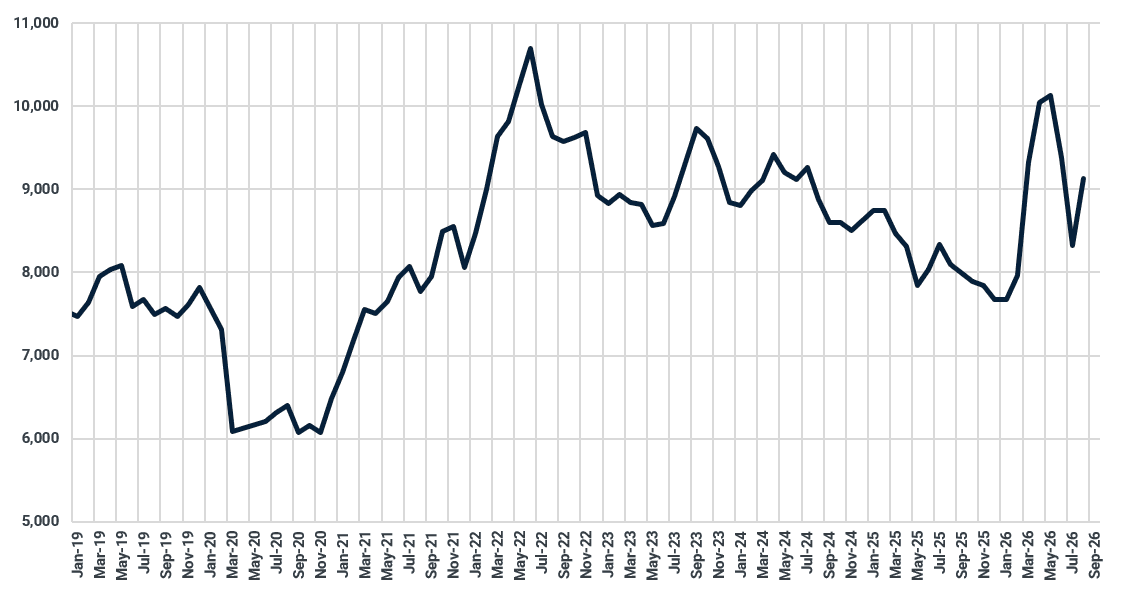
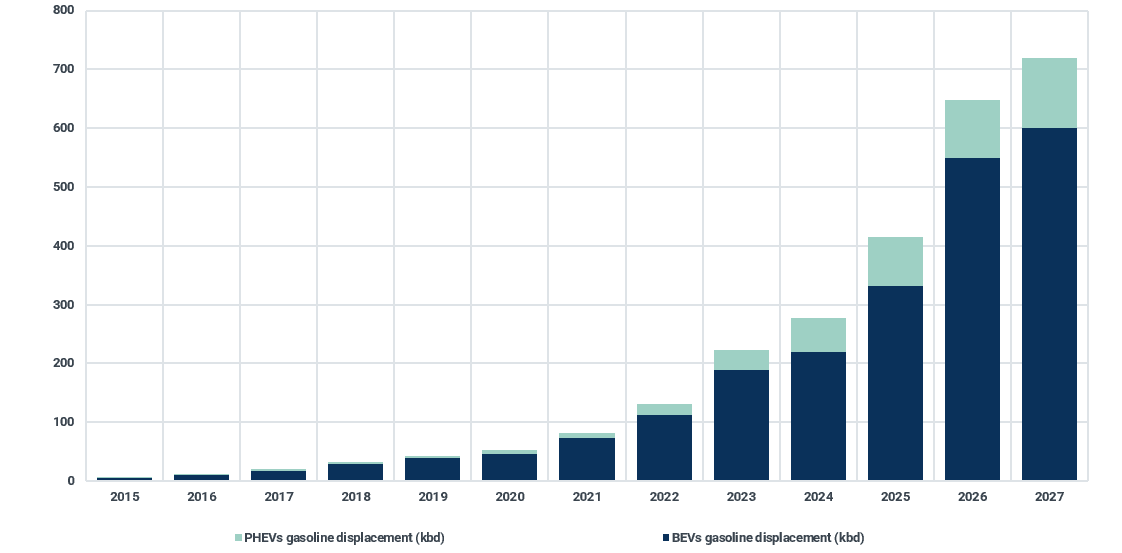
China is expected to record the largest loss, with gasoline demand falling by 260 kbd in 2026. Higher prices have reinforced the shift towards the country’s expanding EV fleet, accelerating an underlying structural decline in gasoline consumption. Demand is forecast to fall by a further 40 kbd in 2027 even as prices normalise, suggesting that little of the 2026 loss will be recovered.
China gasoline prices (renminbi/ton)
Source: EastMoney
Gasoline displacement by passenger electric vehicles in China (kbd)
Source: Kpler
Elsewhere in Asia, demand has also weakened in Australia, Indonesia, the Philippines, Vietnam and Pakistan as higher pump prices and conservation measures weigh on road-fuel consumption.
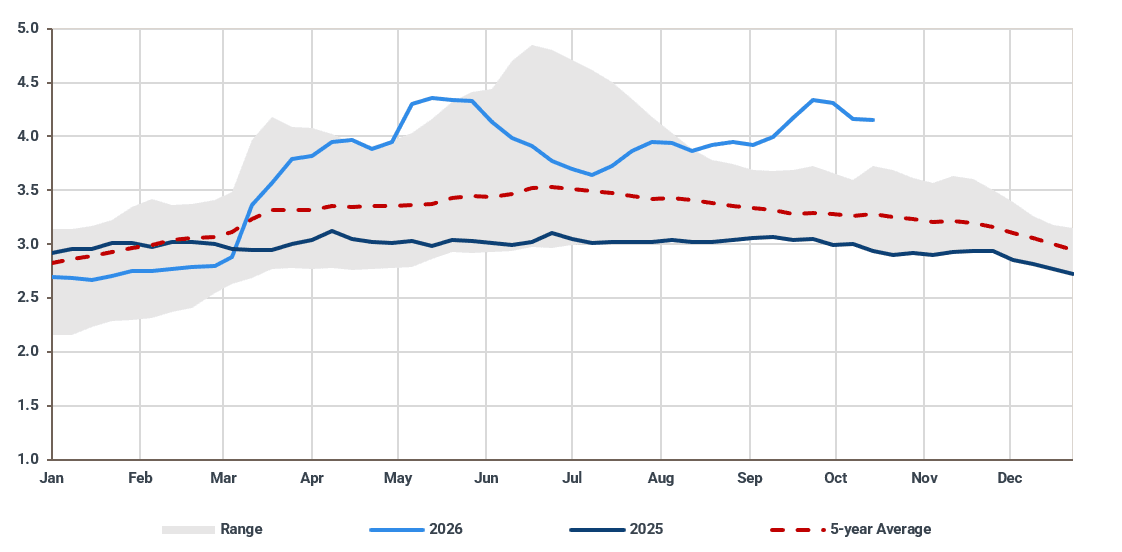
The United States is the second-largest source of weakness, with gasoline demand forecast to decline by 155 kbd in 2026. The contraction is broad-based, although PADD 3 accounts for the largest share, with demand falling by ~ 80 kbd. Higher pump prices have been the main driver of the deterioration since Q2. The US–Iran conflict pushed average US gasoline prices more than 30% higher year on year during March–September.
US weekly gasoline retail price ($/gallon)
Source: EIA
The scale of the demand response has also depended on government pricing policies. Markets where higher international costs have been passed to consumers—including the United States, Europe, China and Australia—have generally recorded greater demand losses than countries where retail prices have been partially controlled.
India is the clearest exception, with gasoline demand expected to increase by 60 kbd in 2026 as incomplete price pass-through shields consumers from much of the international cost shock.
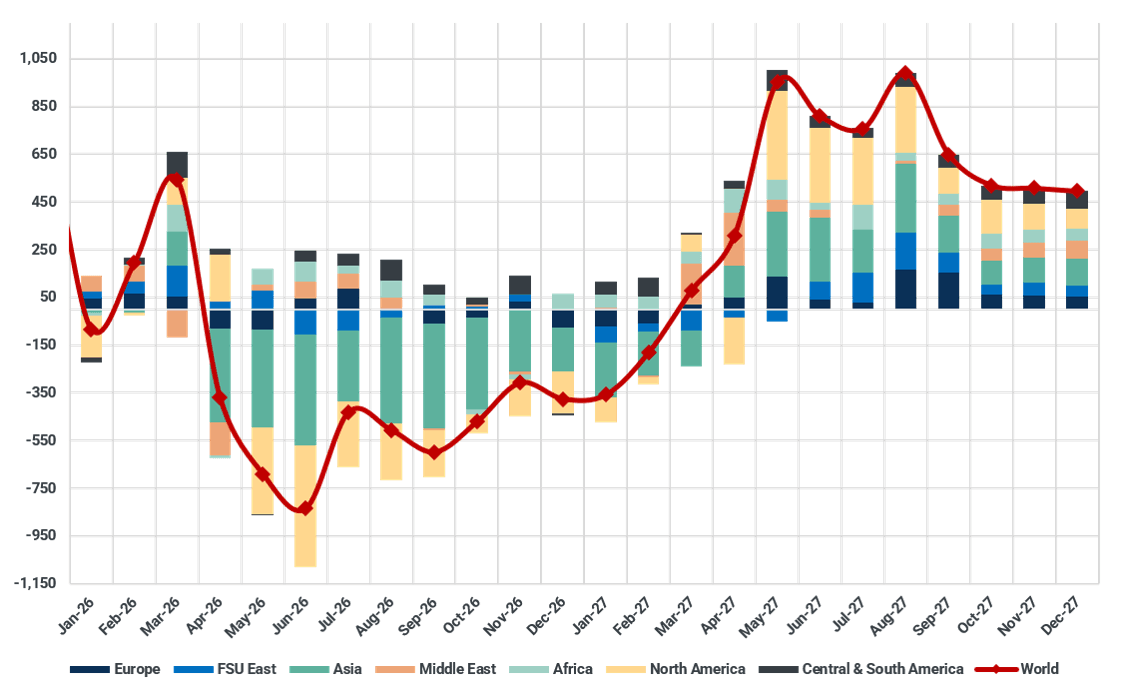
Global gasoline demand is expected to remain weak through Q4 26 and Q1 27 before recovering as supplies normalise and pump prices ease. Demand is forecast to increase by 465 kbd in 2027, supported by easing fuel prices and continued economic growth across most regions. However, the rebound will remain uneven, with structural losses in China continuing even as demand recovers elsewhere.
Gasoline y/y demand growth by region (kbd)
Source: Kpler
Jet-kero: airspace restrictions delay the recovery in Middle Eastern demand
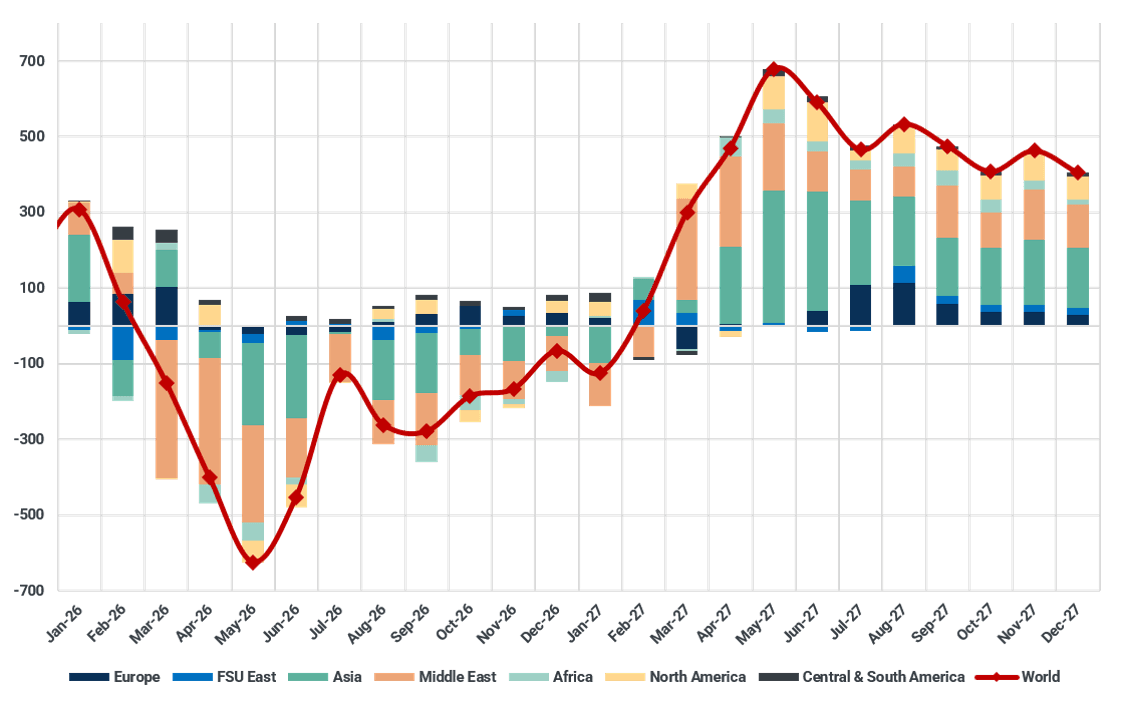
Global jet-kero demand is projected to decline by 200 kbd in 2026. The Middle East accounts for 140 kbd of the reduction as regional airspace closures, disruption to major Gulf aviation hubs and the withdrawal of foreign carriers reduce flight activity. Asia contributes a further decline of 70 kbd, reflecting elevated fuel costs, airline capacity discipline and weaker international and long-haul travel.
These losses are partly offset by comparatively resilient demand in Europe and the United States, where consumption is forecast to increase by 30 kbd and 10 kbd, respectively.
Global jet-kero demand is expected to rebound by 400 kbd in 2027, led by Asia and the Middle East as fuel costs ease and flight activity recovers. However, the pace of the rebound will depend on the reopening of regional airspace, the normalisation of airfares and an improvement in consumer confidence as inflationary pressures ease.
Jet fuel/kerosene y/y demand growth by region (kbd)
Source: Kpler
Gasoil/diesel: Europe and China lead the largest product-level decline
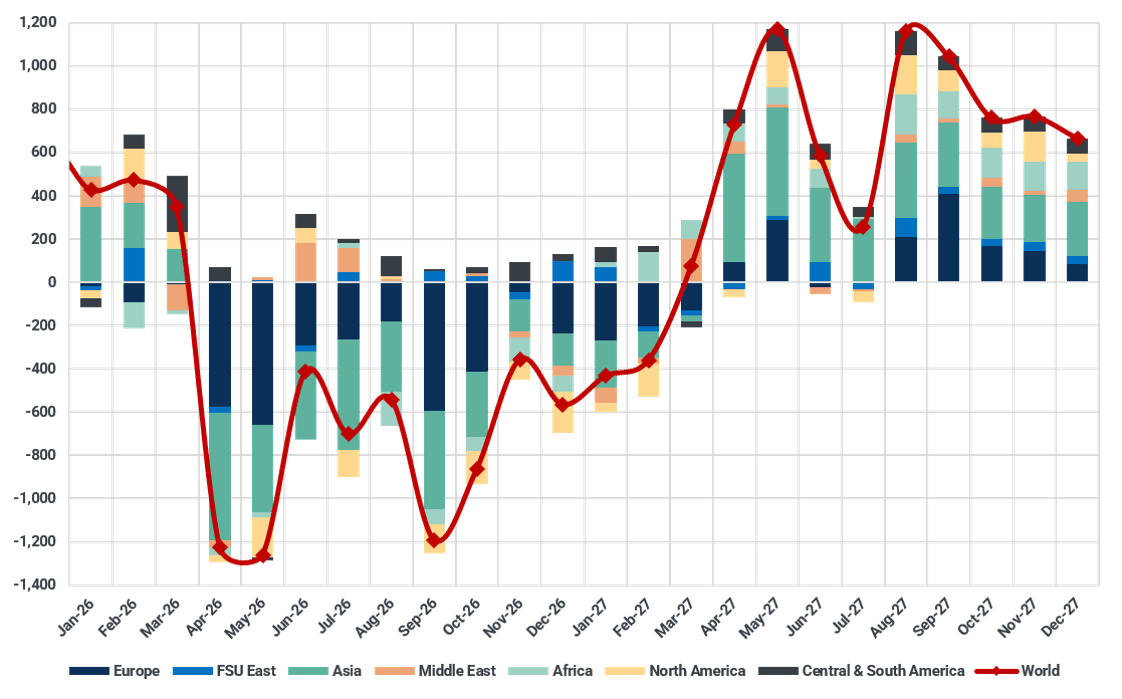
Global gasoil/diesel demand is forecast to decline by 500 kbd in 2026, making it the hardest-hit refined product. The contraction is concentrated in the Q2 and Q3, when demand is expected to fall by 970 kbd and 810 kbd y/y, respectively.
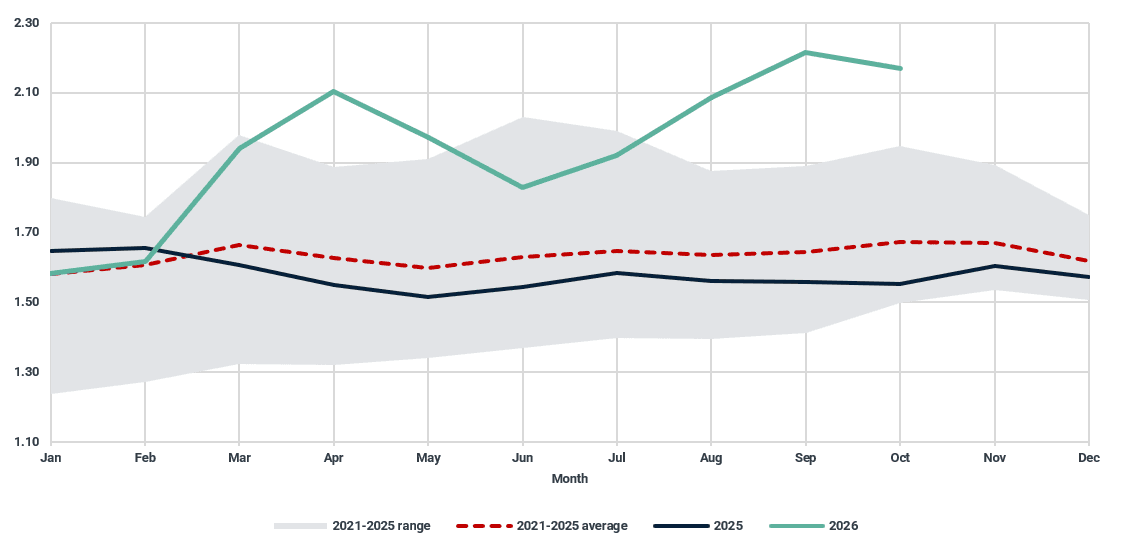
Europe leads the decline, with demand forecast to fall by 280 kbd in 2026. The US–Iran conflict pushed average diesel prices across the EU and UK 35% higher year on year during March to September, weighing on gasoil/diesel consumption.
Euro area diesel monthly average retail price incl. tax (EUR/liter)
Source: European Commission
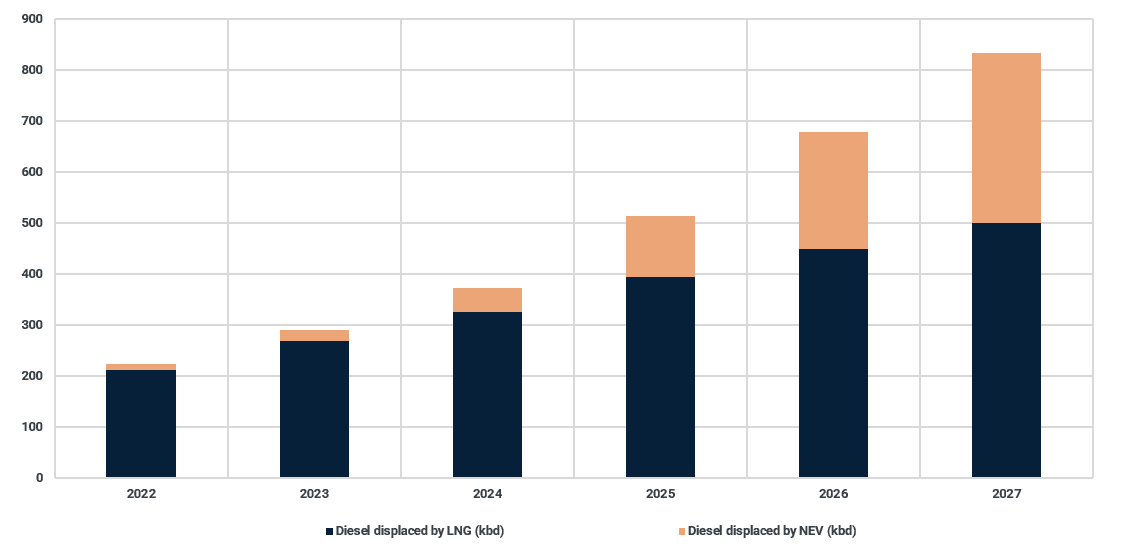
Asia accounts for a further decline of 220 kbd, led by a 200 kbd contraction in China as the growing use of LNG and electric trucks continues to reduce the diesel intensity of road freight. Chinese demand is expected to recover by only 60 kbd in 2027, recouping less than one-third of its 2026 loss and indicating that much of the decline is structural rather than deferred consumption.
China diesel demand displacement by LNG and NEV trucks (kbd)
Source: Kpler
India remains a major exception, with diesel demand forecast to increase by ~ 90 kbd in 2026. Growth is supported by economic activity, weaker monsoon conditions and incomplete retail price pass-through, which has shielded consumers from much of the increase in international fuel costs.
Global diesel demand is expected to rebound by 540 kbd in 2027, led by Asia and Africa as economic activity strengthens, product availability improves and fuel prices ease. However, the recovery will remain uneven. Developing economies with limited alternatives to diesel should record the strongest growth, while structural substitution constrains China’s rebound. In Europe, demand is forecast to recover by only 70 kbd following the 280 kbd decline in 2026, as higher fuel prices amid the conflict have amplified an already-established structural decline in diesel consumption.
Gasoil/diesel y/y demand growth by region (kbd)
Source: Kpler
Fuel oil: demand remains in structural decline
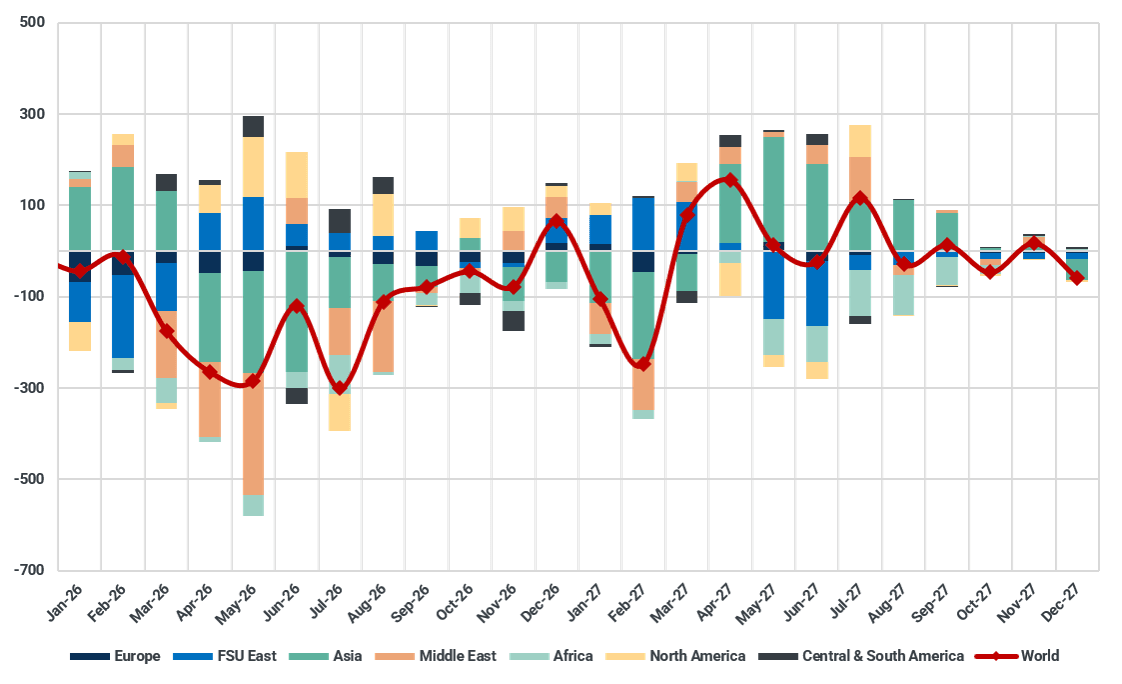
Global fuel oil demand is forecast to decline by 120 kbd in 2026, led by the Middle East. In the Middle East, the contraction is concentrated in Q2 and Q3, when demand is expected to fall by 120 kbd and 90 kbd y/y, respectively. The decline largely reflects the conflict-driven displacement of bunkering activity away from key hubs in the UAE, Oman and the wider Gulf. Unlike the losses in power generation, much of this bunker-related weakness is conflict driven and is expected to reverse from Q4 26 as regional shipping activity normalises.
African fuel oil demand is expected to decline by 30 kbd in 2026, with most of the loss concentrated in Egypt. The decline reflects a shift away from fuel oil in power generation towards natural gas, supported by higher LNG imports. Egypt’s net fuel oil imports averaged 37 kbd between January and September 2026, down from 123 kbd over the same period in 2025, while net LNG imports increased by 84% y/y. Unlike the disruption to Middle Eastern bunkering, Egypt’s decline is expected to be structural. Fuel oil demand is forecast to fall by a further 40 kbd in 2027 as additional power-generation demand shifts from fuel oil to gas.
Globally, fuel oil demand is forecast to decline by a further 10 kbd in 2027. Asian demand is expected to increase by around 40 kbd, while bunker consumption in the UAE should recover as shipping activity returns. However, these gains will be offset by continued losses in Africa and lower power-sector consumption in Saudi and Kuwait as greater gas availability displaces fuel oil.
Fuel oil is therefore expected to be the only refined product to remain in global decline in 2027. A recovery in bunker demand will provide some support, but it will not fully offset the structural reduction in fuel oil use for power generation.
Fuel oil y/y demand growth by region (kbd)
Source: Kpler
The 2027 rebound will be broad, but structural losses remain
Refined products demand is forecast to increase by around 2.5 mbd in 2027 after declining by approximately 2.4 mbd in 2026. The rebound therefore more than offsets the previous year’s contraction in aggregate, but the recovery will not occur evenly across products or regions.
The most direct supply-driven losses should unwind as trade flows and operating conditions normalise. Chinese LPG and naphtha demand should recover as feedstock availability improves and new petrochemical capacity ramps up, while jet consumption should rebound as airspace reopens and foreign airline capacity returns.
However, several markets will remain materially below their 2025 trajectories. China’s transition towards EVs will continue to weigh on gasoline demand, while LNG and electric trucks limit the recovery in diesel. Europe is expected to regain only a small proportion of its diesel loss, reflecting a longer-term structural decline in consumption. Indian LPG demand will remain constrained by the expansion of piped natural gas, while cracker closures and capacity rationalisation prevent a full naphtha recovery in Japan and South Korea.
Fuel oil is the main exception to the broader product-level rebound. Recovering bunker activity in the UAE and parts of Asia will provide some support, but this will be outweighed by continued structural losses in power generation as greater gas availability displaces fuel oil in Egypt, Saudi Arabia and Kuwait. Global fuel oil demand is consequently expected to decline again in 2027.
The main uncertainty remains the pace of normalisation through the Strait of Hormuz. A faster recovery in tanker movements would improve feedstock availability, reduce product prices and accelerate the rebound in consumption. A slower recovery—or renewed disruption to shipping and regional airspace—would prolong the losses into 2027.
Refined products y/y demand growth by product (kbd)
Source: Kpler
Market Insights you can trust
Kpler delivers unbiased, expert-driven intelligence that helps you stay ahead of supply, demand, and market shifts.
Trade smarter. Request access to Kpler today.

See why the most successful traders and shipping experts use Kpler