Saudi export rerouting amid Gulf of Oman STS bottlenecks amplify VLCC intensity of MEG flows
Saudi Arabia’s export rerouting is pushing Gulf of Oman (GoO) ship-to-ship (STS) transfers toward capacity limits. To maintain flows, operations must pivot to longer-distance hubs like West Coast India or Malaysia. These extended round trips severely degrade vessel productivity, requiring 36-40 VLCCs under our base case and driving total fleet demand up disproportionately relative to actual export volume growth.
Key Takeaways:
- Gulf of Oman ship-to-ship (GoO StS) activity has surged to record levels, straining regional auxiliary services as crude transfers dominate MEG export rerouting efforts.
- Capacity constraints may force operations to West Coast India or Malaysia, with the former currently bound by weather restrictions.
- Longer voyages to alternative lightering locations significantly extend round-trip times, requiring up to 58 VLCCs (Malaysia case) compared to 25 in the case of Gulf.
- Our base case sees 3 Mbd of Saudi crude will ultimately demand between 36 and 40 additional VLCCs underscoring that further expansion in MEG trades comes with a sharp increase in fleet exposure to regional risks.
The redirection of Saudi Arabia’s crude exports towards the Eastern ports and the Strait of Hormuz (SoH) appears to be less a question of available tonnage than of logistics. The shift has coincided with a sharp increase in Gulf of Oman (GoO) shuttle trades out of the Gulf Straits, which is increasingly placing pressure on STS auxiliary services at regional ports.
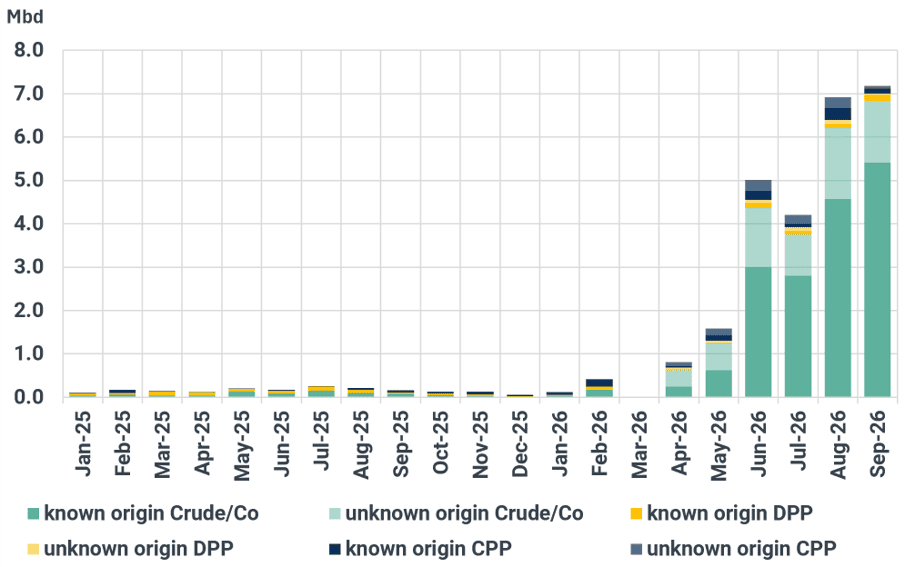
Kpler data show that liquids STS activity in the GoO has risen from just 0.16 Mbd in 2025 to an average of 3.7 Mbd since the US-Iran war, with September 26 to date currently tracking at a record 7.2 Mbd. Crude/Co barrels have accounted for an increasing share of this activity, averaging 90%, or 6.9 Mbd in August. It is important to note that this figure may differ from the volumes of crude actually transiting the Strait, as some barrels can undergo multiple STS transfers within the GoO.
Gulf of Oman (GoO) STS volumes by Product Group
Source: Kpler
Gulf of Oman STS capacity is becoming the constraint
GoO STS capacity is reported to be approaching its practical limits, with shore-side support at Fujairah and Sohar reported operating at or close to maximum capacity. If this is the case, further MEG export growth could increasingly be pushed towards alternative STS locations. However, the longer shuttle distances and additional handling requirements would reduce vessel productivity, meaning that incremental barrels could require disproportionately more VLCC tonnage.
West Coast India offers the nearest release valve
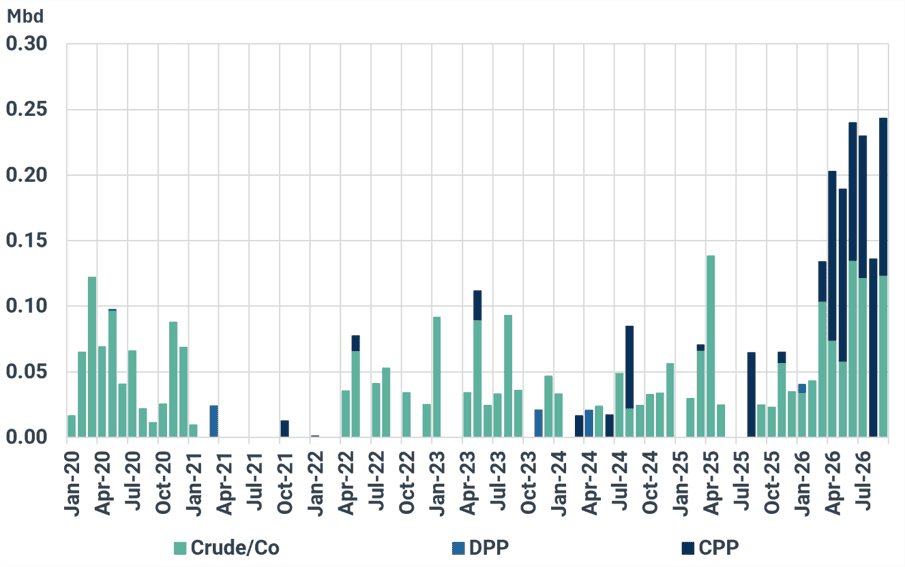
If regional exporters are increasingly forced to move surplus volumes further afield, with West Coast India (WCI), particularly Kutch and Mumbai lighterings, emerge as the nearest alternative. Repeating the same analysis for WCI lightering activity shows a notable increase in regional STS operations. The key distinction from the GoO is that the additional barrels in WCI are predominantly Clean Products. At the same time, a deeper dive in the data reveals that most of the crude volumes remain associated with supplies to regional refiners, rather than the area functioning as a redistribution point. While a further increase in regional crude STS activity cannot be ruled out, a more likely development would be for GoO CPP STS operations to pivot towards WCI lightering, thereby freeing capacity in the GoO to accommodate additional crude barrels.
Any material increase in this activity is more likely to emerge following the conclusion of weather-related disruptions associated with the monsoon season, potentially from September onwards.
West Coast India (WCI) STS volumes by Product Group
Source: Kpler
Malaysia adds capacity but a cost to utilisation
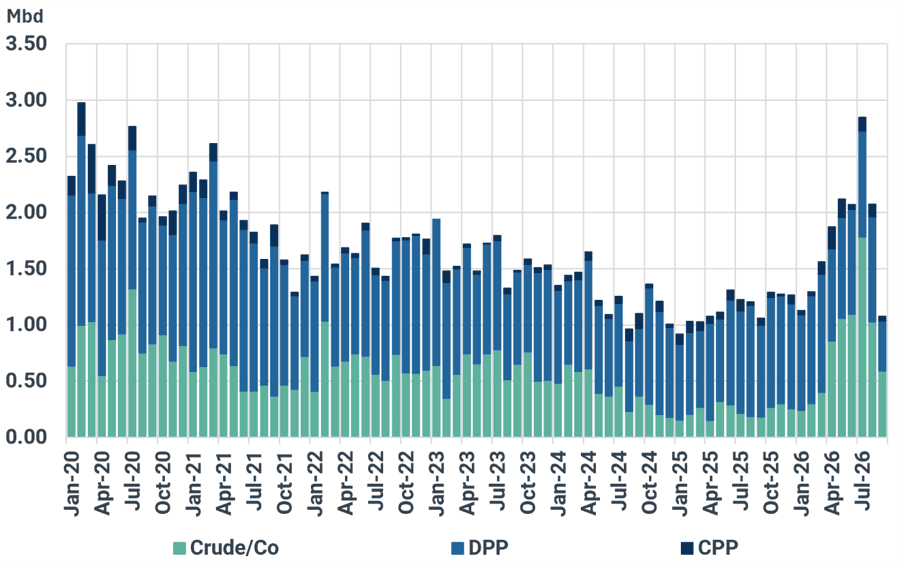
A further alternative, albeit one that involves significantly longer STS legs, is offshore lightering in Southeast Asia, particularly around Malaysia, including the Pelepas and Linggi lighterings. The region has extensive experience handling larger dirty assets and, as with the other locations discussed above, has seen a notable increase in STS activity since the beginning of the conflict. In this case, however, the increase has been particularly visible in crude STS operations, which reached a record 1.7 Mbd in July. A closer look sees Sinokor-linked vessels, the frontrunner in shuttle trades, increasingly operative in the region, though some of the volumes transferred originate outside the MEG.
Offshore Malaysia STS volumes by Product Group
Source: Kpler
Longer shuttle trades multiply VLCC requirements
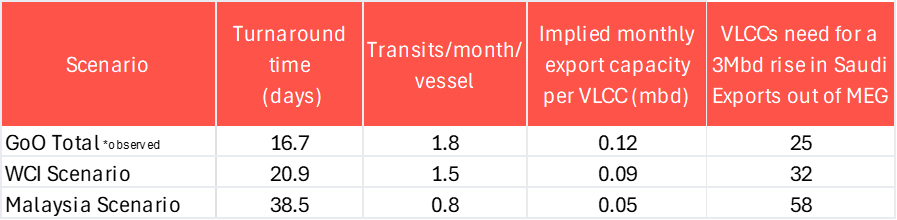
The longer distances involved in these alternative lightering locations have important implications for the shipping transport capacity that can be added through each vessel entering the shuttle trades. As STS operations move further away from the GoO, the monthly transport capacity provided by each vessel declines as round-trip voyage times increase. Kpler data indicate that shifting STS operations from the GoO to WCI adds more than four days to the round voyage, increasing it from an observed 17 days to 21 days. Offshore Malaysia, the round trip more than doubles to 38.5 days. Consequently, the monthly export capacity generated by each additional vessel falls from approximately 0.12 mbd in the GoO to 0.09 mbd for WCI and just 0.05 mbd for Malaysian lightering.
VLCCs required under each STS scenario
Source: Kpler
This difference becomes particularly significant when considering the prospect for a 3+ Mbd redirection of Saudi barrels from Yanbu towards the East (assuming temporary fixes allow for some utilization of the East-West pipeline). Under a GoO shuttle scenario, approximately 25 VLCCs would need to be added in the MEG shuttle trades each month. The requirement rises to around 32 VLCCs if the additional barrels are handled through WCI, while as many as 58 VLCCs would be required if offshore Malaysia were used as the lightering location. The further the STS operation is moved from the GoO, therefore, the greater the fleet requirement and the less efficient the additional shipping capacity becomes. For context, the current size of the VLCC shuttle fleet is estimated at around 54 vessels.
Direct voyages provide another route but still absorb tonnage
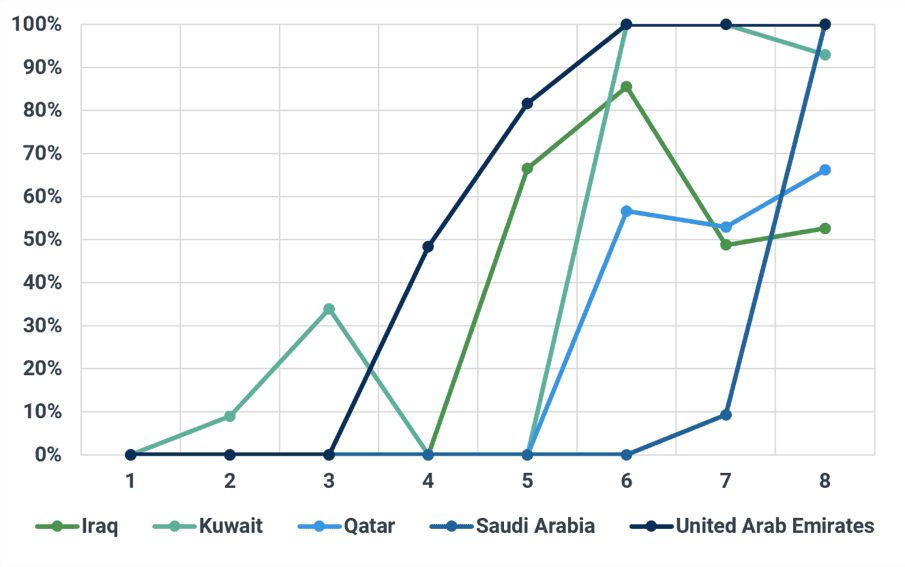
In practice, the adjustment is unlikely to rely solely on an expansion of shuttle trades, as we may also see a greater proportion of Saudi and/or other regional barrels moving on direct voyages from the country, a trend that is already evident among other key regional producers, most notably Iraq and Kuwait. This would once again increase the number of vessels with exposure in MEG trades.
Share of MEG Crude/Co exports STSd in GoO (completed voyages)
Source: Kpler
The bottom line
Further scaling up MEG exports is not a straightforward, binary scenario. Regional exporters have already demonstrated significant operational flexibility in adapting to the constraints associated with moving additional volumes outside the MEG.
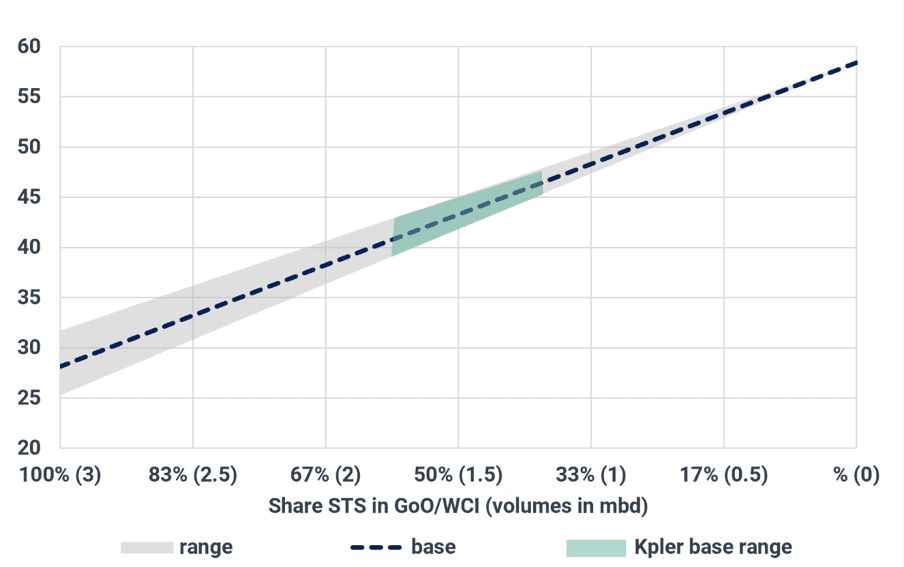
Our base-case vessel demand assumption is based on 0.5 mbd of additional Saudi barrels being accommodated within the GoO through operational efficiencies. This number represents the average of volumes StSd multiple times in the region since June. A further 0.5 mbd of capacity could be unlocked by prioritising crude transits in the GoO at the expense of products, with an increasing share of the latter moving towards the WCI.
Beyond this 1 mbd threshold, which also broadly corresponds to the 60 million barrels reportedly offered by Saudi Arabia on an STS basis to Asian refiners for September-October and may represent a factual ceiling, the additional tonnage requirement will depend on the extent to which STS operations can be scaled up in WCI once weather conditions permit. We assume a further 0.5 mbd of crude can be handled in the WCI, on top of the 0.5 mbd of displaced product STS volumes. This brings the total incremental volume across the GoO and WCI to 1.5 mbd, with the remainder either handled in Malaysia or/and through direct voyages. This ultimately leads to the VLCC demand range shown below. At 36-40 vessels, the resulting requirement represents a significant increase in the fleet exposed to MEG-related risk, providing further context for the sustained freight rally witnessed over recent weeks.
The key takeaway is that shuttle trades in the Gulf of Oman, may be nearing their capacity limits, with further expansion likely to result in declining operational efficiency and a disproportionate increase in tonnage exposure to MEG-related risks.
Vessel demand for a 3 Mbd increase in Saudi barrels basis % STSd in GoO/WCI
Source: Kpler
Market Insights you can trust
Kpler delivers unbiased, expert-driven intelligence that helps you stay ahead of supply, demand, and market shifts.
Trade smarter. Request access to Kpler today.

See why the most successful traders and shipping experts use Kpler
![[UPDATE] Middle Eastern supply recovery postponed to early 2027](https://cdn.prod.website-files.com/65059ad784ac02253c62356c/6a69e80d78fefee5dd2f73d6_pipe_line_conection_in_oil_refinery_2_optimized_350.jpeg)