


Record oil-on-water volumes limit the next leg higher in crude
Brent front-month prices have rallied by around $10/bbl over the past 10 days as renewed military strikes between Iran and the US reignited fears over Persian Gulf supply. Yet, despite flows through the Strait of Hormuz falling sharply, the rally has begun to lose momentum. The reason lies in the physical market: record volumes of crude already on the water are providing refiners with a sizeable inventory cushion, limiting the urgency to chase replacement barrels.
Market & Trading Calls
- Neutral to slightly bullish Brent front month: Geopolitical risk should continue to support outright prices, but record oil-on-water inventories are likely to limit further upside unless Gulf export disruptions deepen.
- Bearish Murban-Dubai spreads as reduced availability of Middle Eastern medium sour crude should continue to support Dubai relative to Murban while Fujairah exports remain elevated.
- Bullish medium sour crude differentials as refiners will increasingly compete for replacement barrels, supporting medium sour grades across East and West of Suez.
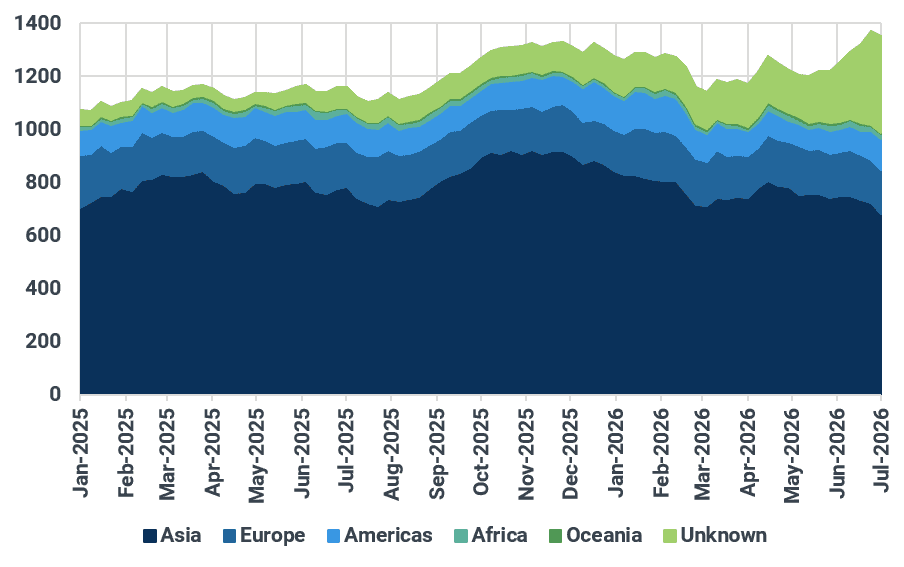
Oil volumes shipped out of the Persian Gulf exporters jumped to 12.5 mbd in late June and early July, nearly 80% of pre-war levels (including piped volumes to Yanbu and Fujairah). Combined with still-elevated exports west of Suez, which came down by 2.7 mbd in July m/m mtd but still remain ~1 mbd above pre-war levels, this has pushed global oil-on-water inventories to a record 1.35 bn bbls, even higher than previous highs of 1.33 bn bbls in late 2025. Roughly half of these barrels are already identified as heading to Asia, while a further 27% remain destination unknown. Given the high proportion of Russian and Iranian oil within that group, we estimate that Asia will ultimately absorb closer to 70% of the total.
Oil on water by destination continent, mbbls
Source: Kpler
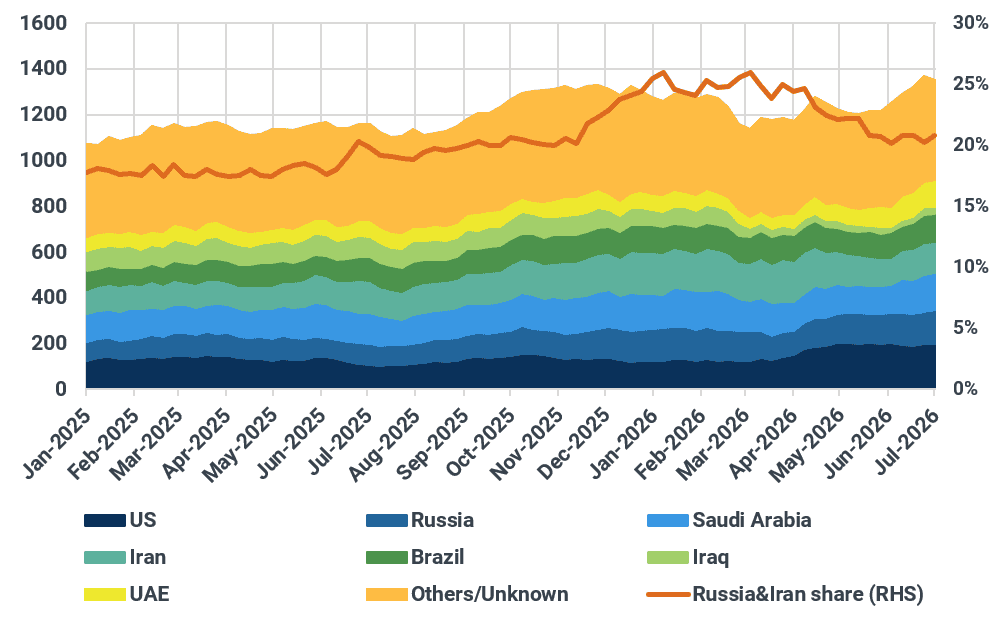
Iranian oil makes up for 10% of total volumes currently on water, or 137 mbbls, with all the volumes bound for China. This is slightly less than Russian crude, which makes up 11% of the total, leaving 146 mbbls on the water, mainly bound for India and China. Continuous Ukrainian drone attacks on Russian downstream infrastructure will allow further direct Russian oil toward export markets. Russia’s seaborne oil exports reached a new record of 4.37 mbd in June and midstream infrastructure allows for another ~300-400 kbd in increment. On the other hand, volumes of US crude now make up close to 200 mbbls, 15% of the total. This is up by nearly 50 mbbls compared to previous records of global oil on water seen in November last year.
Oil on water by origin country (mbbls, LHS) and combined share of Russia and Iran (%, RHS)
Source: Kpler
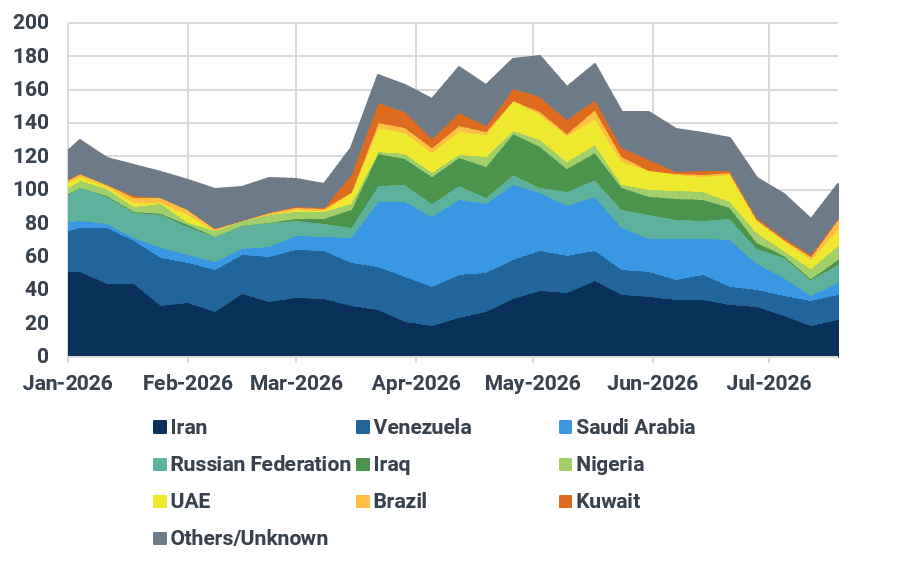
Floating storage has declined, indicating that most of these barrels have already found buyers. However, around 21 mb of unsanctioned Middle Eastern crude has remained idle in Asia for more than a week, suggesting refiners still have immediate access to prompt supply. That availability should continue to temper the need to aggressively bid nearby Middle Eastern grades, even as regional benchmarks strengthen. The Dubai M1-M3 spread returned into backwardation around $1.30/bbl (Argus Media) while Murban’s premium to Dubai swaps vanished as Gulf exports took a hit, supporting Dubai.
Oil in floating storage by origin, mbbls
Source: Kpler
Record oil-on-water inventories are buying the market time rather than eliminating supply risk. Gulf exports have fallen to 4.5 mbd over the past 10 days, including around 1.7 mbd from Iran following the reimposition of the US blockade on 14 July. If these lower export rates persist, the current inventory cushion will gradually erode, forcing refiners to compete more aggressively for replacement barrels. At that point, medium sour crude differentials and Dubai time spreads should strengthen further. Until then, elevated seaborne inventories are likely to limit additional upside in outright crude prices despite ongoing geopolitical tensions.
Kpler proprietary data
- Crude and condensate on water volumes currently around 1.35 bn bbls, a record high
- Russian seaborne oil exports hit an all-time high of 4.37 mbd in June
- Gulf exports have fallen to 4.5 mbd over the past 10 days, half the average seen earlier in July
- West of Suez oil exports down 2.7 mbd m/m, but still up ~1 mbd vs pre-war levels
Market insights you can trust
Kpler delivers unbiased, expert-driven intelligence that helps you stay ahead of supply, demand, and market shifts.
Trade smarter. Request access to Kpler today.

See why the most successful traders and shipping experts use Kpler

![[UPDATE] Middle Eastern supply recovery postponed to early 2027](https://cdn.prod.website-files.com/65059ad784ac02253c62356c/6a69e80d78fefee5dd2f73d6_pipe_line_conection_in_oil_refinery_2_optimized_350.jpeg)






