Warsh takes a hawkish tone at Jackson Hole
Warsh uses Jackson Hole to reassert the hawkish tone that faded after the July FOMC meeting. Credibility now hinges on the path of rate hikes.
Summary
- Warsh Resets Hawkish: After a somewhat confusing July press conference, Warsh used Jackson Hole to signal clear hawkishness, arguing that the economy remains strong and that inflation, which he cited is broad based across the PCE basket and stuck above target, should be the Fed’s predominant focus over employment.
- Markets Believed Him: The 2y surged to an intraday high of 4.32% while the 10y barely moved, narrowing the 2s-10s spread to 0.37%, the tightest since July 29. The dollar rallied as much as 0.4% before fading.
- Follow Through is Everything: June’s hawkish signaling produced no July action and markets quickly lost faith in the initial inflation-fighting message. Credibility now rests on the rate path. We maintain our one-hike call, with a September or November signal the trigger for further dollar strength, curve narrowing, and fading precious metals momentum.
Market Analysis
Every year in August, the Fed chairman gives a speech at Jackson Hole, Wyoming. The speech has often been used as an opportunity for the chairman to reiterate what he/she deems important to focus on heading into the back half of the year and beyond. This year’s speech, in particular, was widely anticipated as Kevin Warsh, the new Fed chairman, needed an opportunity to reset after a somewhat confusing press conference at the July FOMC meeting. Following Warsh’s speech, it is clear that he wanted to signal hawkishness, albeit we await follow through in the form of rate hikes in the months ahead.
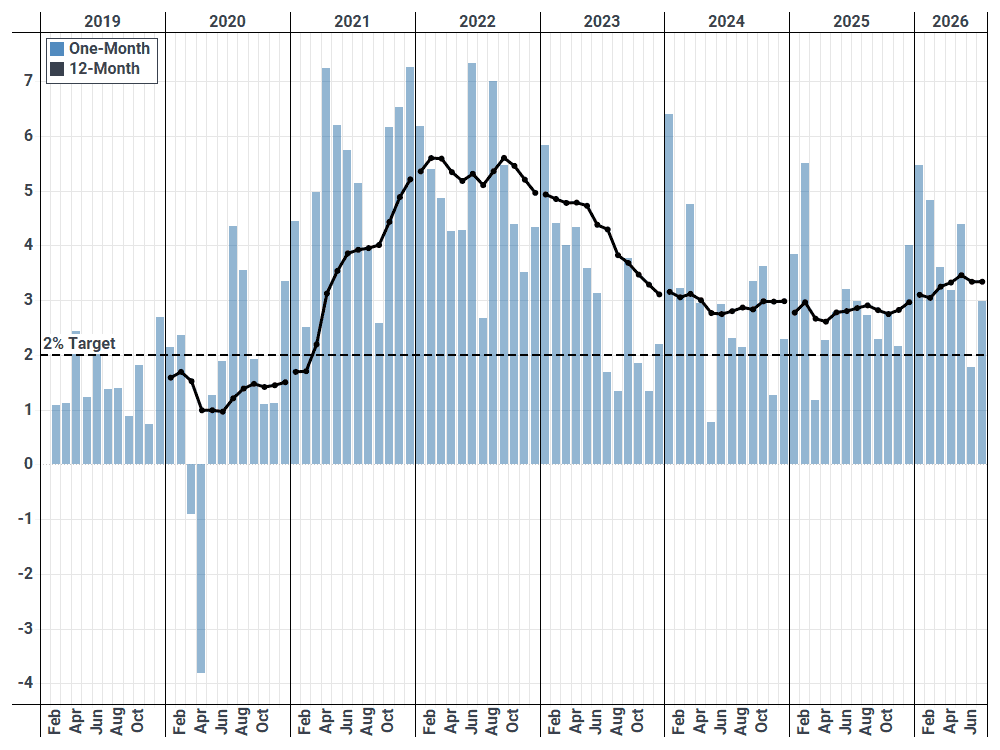
US One- and 12-Month Pace of Core PCE-Based Inflation (%)
Source: BEA
In many ways, Jackson Hole felt like Warsh’s first press conference, held in June of this year, when the chairman struck a clearly hawkish tone. Hawkishness came via two arguments in his speech earlier today. First, he reiterated that the economy continues to look strong citing evidence of healthy S&P 500 earnings growth, alongside an elevated four quarter pace of expansion across AI-related investment, and household consumption. He also pointed to narrow credit spreads, and bank survey data as evidence that broad financial conditions are not overly restrictive. Finally, his view on the labor market was that a somewhat sluggish pace of job growth is evidence of low population growth and low turnover, rather than a sign of weakness, albeit he did point out recent graduate employment as an area of concern.
Second, he made it clear that inflation remains a problem, a message we also highlighted in our note covering PCE-based inflation. He argued that inflation breadth is widely distributed across the PCE basket and inflation, in general, remains stuck above target. He also argued against somewhat disinflationary reads of some of the inflation prints seen over the summer. Ultimately, Warsh argued the predominant focus of the Fed at present should be on prices, rather than employment, both of which are mandates of the central bank.
The market reacted much like it did in June, reflecting a belief that the Fed is hawkish and serious about taking on inflation. The yield curve narrowed considerably. The 2y yield initially surged to an intra-day high 4.32%, marking the largest single day gain since mid-June, albeit the upside move faded a bit after Warsh concluded his comments. The 10y yield barely budged, evidence that the long end of the yield curve is very much reacting to Fed credibility. Predictably, the 2s – 10s spread narrowed considerably, declining to 0.37%, marking the narrowest level since July 29. The dollar also strengthened on the Warsh speech with DXY rallying by as much as 0.4% before fading a bit.
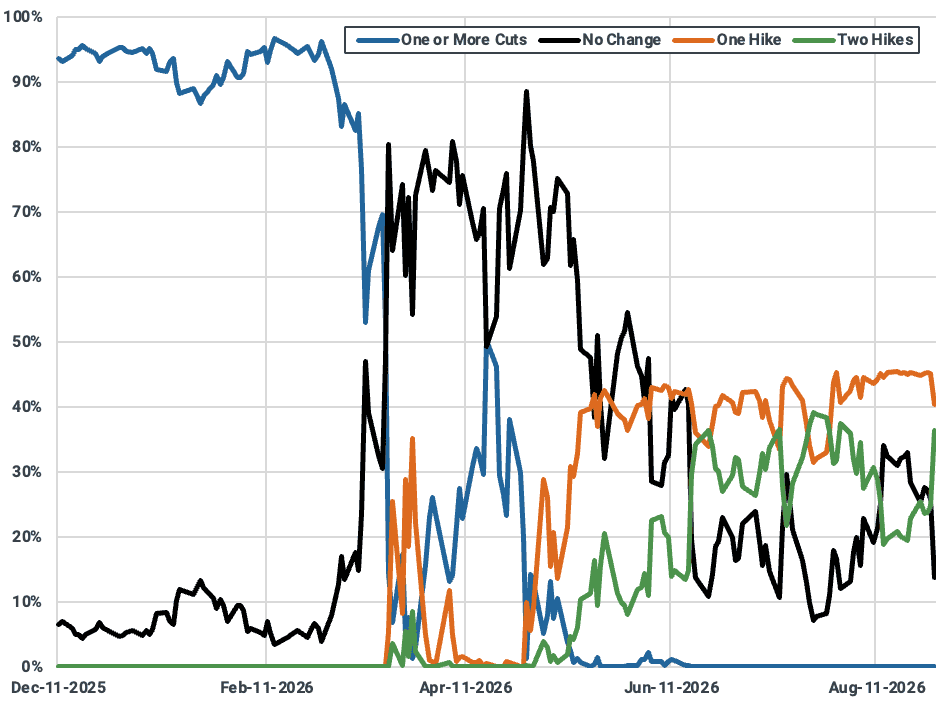
Looking ahead, much depends on follow through. We saw a clear return to a “hawkish” Warsh, but now much will depend on the rate path. If the Fed is serious and clearly signals a rate hike is coming in September or November, we’d expect more dollar strength, a further narrowing in the yield curve, and a loss of bullish momentum across precious metals, including gold and silver. However, we caution that this already happened once over the summer (June), and yet, there was no follow through in July, and things reversed (widening yield curve, higher gold/silver, dollar weakness). We continue to maintain a one-hike outcome for the Fed this year.
Fed Funds Futures Probability by End-2026 (%)
Source: CME

See why the most successful traders and shipping experts use Kpler