Grain imports disrupted across the Middle East Gulf
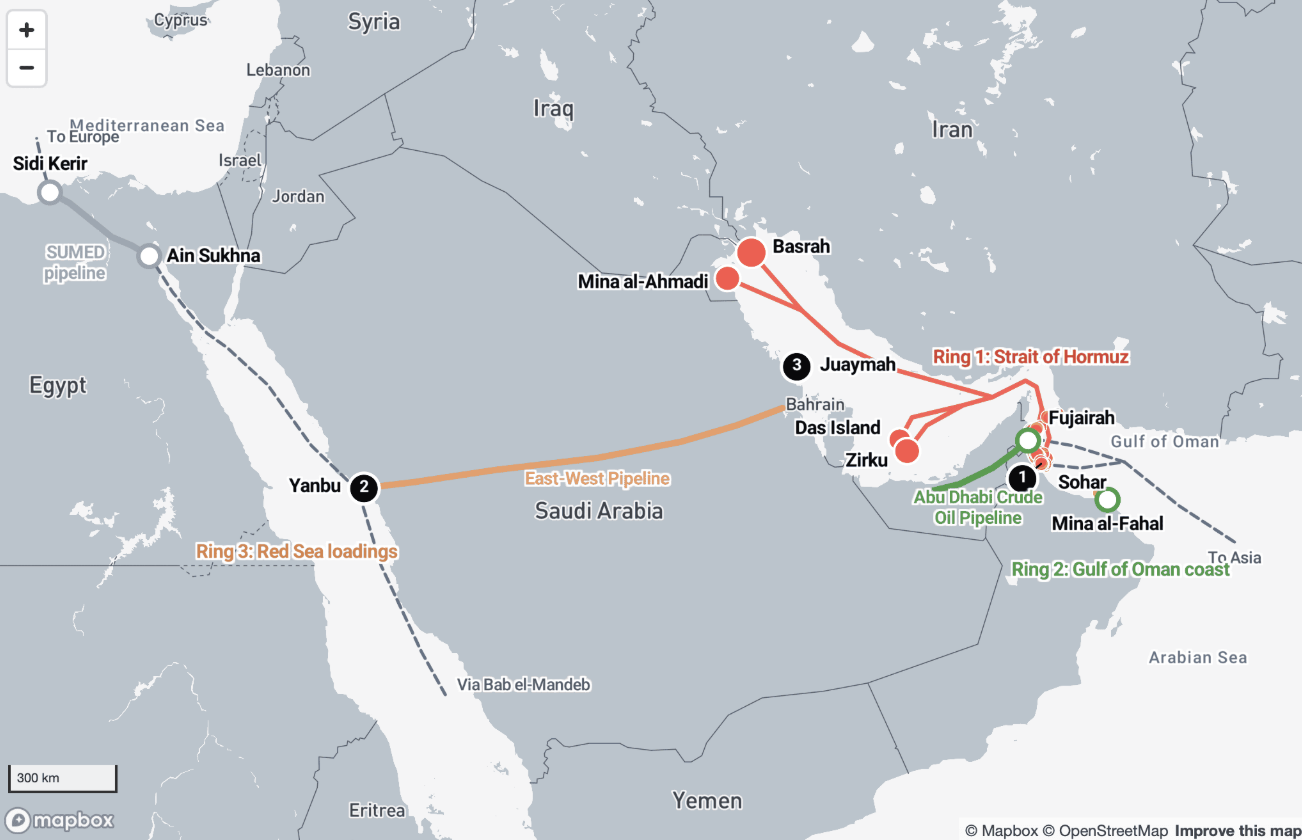
For many Middle East Gulf countries, access via the Strait of Hormuz is key in supporting domestic grain consumption. However, some are more dependent on access than others. For Iran, the loss of access threatens significant food inflation and irreversible supply chain issues. While Saudi Arabia and the UAE have ports outside of the Middle East Gulf which they will become more dependent on.
Iran is not self-sufficient in cereal demand
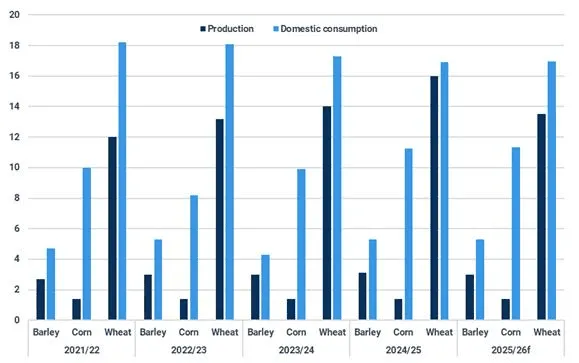
Iran is a significant grain importer as its animal feed demand far outpaces domestic production, with corn accounting for the largest share of grain imports. Though Iran can source grain from Russia via the Caspian Sea, the vast majority of imports are reliant on access via the Strait of Hormuz.
In a month’s time, Iran will begin to harvest its barley and wheat crops, with corn following by July. The country is dependent on imports for about 30% of its wheat consumption. The upcoming harvest and strategic stocks should help cater to food demand. Iran is also able to import Russian wheat through its northern ports in the Caspian Sea, which could prove to be an important lifeline.
The dependence of imports for feed-grains, especially corn, is much higher. Virtually all corn is imported, mainly from Brazil, through the port of Bandar Imam Khomeini (BIK).
Iranian production and consumption of key cereals (Mt)
Source: USDA
Even prior to the escalation of conflict in the Middle East Gulf, Iran had been struggling to finance the purchases of grain deliveries due to sanctions. Outside of BIK, there are over 20 vessels laden with grain waiting to discharge, some for over two months. However, subsequent to the escalation, the port is essentially landlocked. So, while these cargoes may eventually be discharged, further imports will have to wait for the Hormuz blockade to be lifted.
Six vessels carrying grain for Iran are waiting to enter the Gulf in the Arabian Sea and at least three more are underway towards Iran, still in the Atlantic Ocean. Several others are either loading or on their way to load corn and soybean meal from Brazil for Iran.
Feed shortages and food inflation were already an issue in Iran before this conflict. They will get worse. However, the domestic wheat crop will help provide basic food for the next few months.
Saudi Arabia and the UAE can import grain outside of the Middle East Gulf
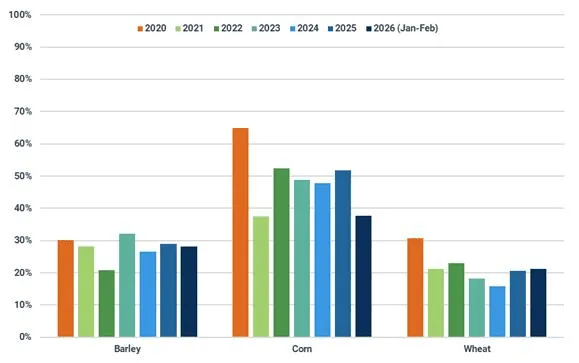
For Saudi Arabia and the United Arab Emirates (UAE), grain imports will also face disruption. Similar to Iran, both countries are unable to domestically produce the volume of grain necessary to satisfy domestic consumption, seeing both destinations highly dependent on imports. However, unlike Iran, both countries have ports where access via the Strait of Hormuz is not required.
For Saudi Arabia, grain can instead be imported at ports along the Red Sea, such as King Abdullah or Jeddah. Though, the loss of imports at ports which require transit via the Strait of Hormuz will add pressure to inland logistics at ports along the west coast. Saudi Arabia is estimated to have enough wheat in reserve to cater for at least six months of consumption. The recent purchase of 794 Kt of wheat at the start of this week, after purchasing 907 Kt in January, illustrates Saudia Arabia’s interest of ensuring national stockpiles do not run low.
Saudi Arabian seaborne imports via the Strait of Hormuz (%)
Source: Kpler
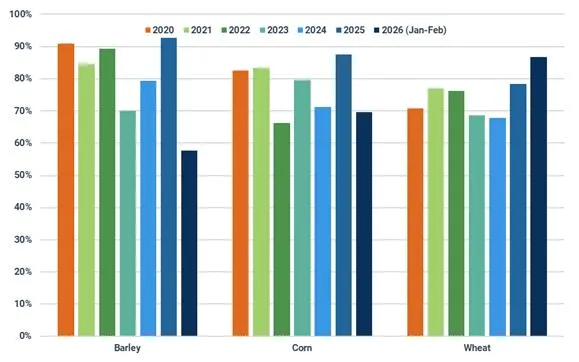
For the UAE, grain can be imported to Fujairah, but it will not be able to make up for the loss of imports at Jebel Ali where transit via the Strait of Hormuz is required. Therefore, the UAE may need to tap into national grain reserves depending on the duration of the conflict. The UAE government has recently stated the country’s strategic reserve of basic goods can last up to four to six months.
UAE seaborne imports via the Strait of Hormuz (%)
Source: Kpler
So, despite the overall loss of import capacity, Saudi Arabia and the UAE are not as shut off from international trade like Iran. The constriction of grain imports will be an unwelcomed challenge, but either country should be able cushion the draw on national stockpiles with careful proactive planning of grain imports. The ample availability of cereal supply across major exporters should also ease supply concerns.
Iran most adversely affected in the region due to Hormuz blockade
Across Iran, Saudi Arabia, and the UAE, there is little seasonality in annual grain imports, with only a modest uptick of Iranian demand in Q4 of the calendar year. Therefore, for at least the next few months, neither country was expecting to see a surge of foreign grain reach their respective domestic market.
Nonetheless, in the coming weeks, Iran’s shortfall of grain will intensify. Options to remedy the situation are few as Iran’s limited financial muscle gives it little opportunity to bolster imports. As the conflict continues, Iran’s livestock population will dwindle, contributing further pressure to food inflation. Moreover, livestock populations can take time to rebuild, so in the event that the supply of animal feed improves, the availability of produce will remain tight.
Iran’s population is double that of Saudi Arabia and UAE combined. Its domestic wheat production will help avoid famine, but if the blockade continues, the lack of grain imports will lead to significant food inflation, change in the food mix, and irreversible supply chain issues.
Market insights you can actually trust
Kpler delivers unbiased, expert-driven intelligence that helps you to track critical grains developments for your own analysis. Our precise forecasting empowers smarter trading and risk management decisions. In times of conflict and geopolitical uncertainty, our real-time data keeps you ahead of supply disruptions and price volatility.
Unbiased. Data-driven. Essential. Request access to Kpler today.

See why the most successful traders and shipping experts use Kpler
Get real-time market intelligence on how the Middle East conflict is reshaping dry bulk trade