A New Deal for the Devil's Excrement
Nearly 50 years after OPEC co-founder Juan Pablo Pérez Alfonzo warned that Venezuela’s oil was the “devil’s excrement,” the country has come full circle, once again turning to foreign investment to unlock its enormous reserves. The new U.S.-Venezuela oil deal raises bigger questions about whether Venezuela can avoid the mistakes of its past—and whether weakening OPEC actually serves U.S. energy and economic interests.
A New Deal for the Devil's Excrement
“Ten years from now, twenty years from now, you will see: oil will bring us ruin. Oil is the devil’s excrement.”
— Juan Pablo Pérez Alfonzo, Venezuela’s first oil minister and co-founder of OPEC, 1976
President Donald Trump has called it “the biggest oil deal in world history.”
Under an agreement announced Friday, Trump says the United States has secured majority control over the development of more than 65 billion barrels of Venezuelan oil reserves, a volume larger than current proved U.S. crude reserves (46 billion barrels). The agreement would pair the U.S. government with private investors to develop 17 Venezuelan oil fields and is intended to attract close to $100 billion of investment into a country that has suffered from years of sanctions, underinvestment and deteriorating infrastructure.
For Venezuela, the announcement represents an extraordinary reversal in the history of its oil industry. More than six decades ago, Venezuela helped create the Organization of the Petroleum Exporting Countries (OPEC) in part to give oil-producing nations greater control over their natural resources and reduce the influence of the international oil companies that dominated the industry. Juan Pablo Pérez Alfonzo, Venezuela’s first oil minister and one of OPEC’s principal architects, helped lead that effort.
Today, Caracas is considering leaving the organization it helped create as U.S. companies seek a larger role in developing its oil. We understand that discussions over a potential withdrawal were initiated primarily by those companies, rather than by the U.S. administration. President Trump has publicly left the decision to Caracas, saying Monday that whether Venezuela leaves OPEC is “up to them.” Earlier this year, he had said it would be better for Venezuela to remain in the group.
Nevertheless, leaving OPEC would represent a major symbolic shift and add to an already visible backlash inside Venezuela, where critics of the new oil deal have portrayed greater U.S. control as a loss of sovereignty and a betrayal of the country’s national patrimony. Rodríguez has pushed back, insisting that Venezuela retains ownership of its resources, while also preferring to remain in OPEC, according to our understanding. Her government must balance those concerns against the need to attract the foreign capital required to rebuild the oil industry.
The full agreement has yet to be made public, leaving questions about ownership, investor protections, revenue distribution and the respective roles of Venezuela, the U.S. government and participating companies. Those questions are particularly important because Venezuela has been here before.
What Protects Investors This Time?
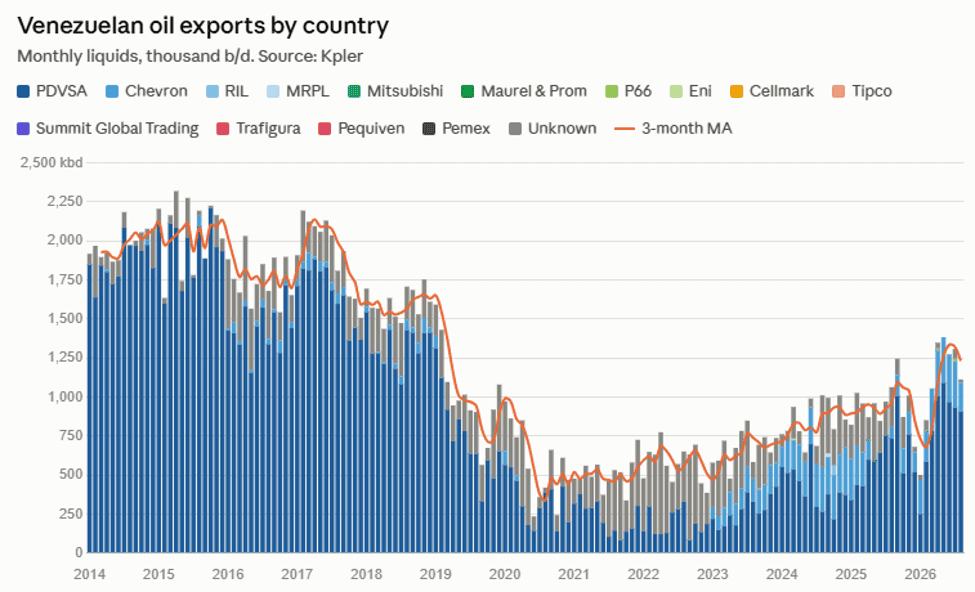
In the 1990s, Venezuela opened its oil sector to international investment, attracting projects that added more than 1 million bpd of production capacity. A decade later, the rules changed.
In 2007, Hugo Chávez required foreign operators in the Orinoco Belt to surrender control and accept PDVSA as majority owner. ExxonMobil and ConocoPhillips refused and saw their interests expropriated, while Chevron, BP, Total and Statoil accepted minority positions and remained.
Nearly two decades later, Venezuela is again asking international companies to commit tens of billions of dollars to many of the same resources. With the proposed agreement reportedly extending 25 years, investors must again make long-term assumptions about contracts, ownership and property rights across multiple Venezuelan and U.S. administrations.
The Devil’s Excrement
Pérez Alfonzo’s warning about the “devil’s excrement” was ultimately about dependence. Venezuela’s reliance on oil left the economy highly exposed when prices and revenues collapsed in the 1980s and 1990s, while debt and fiscal pressures remained. The resulting economic and political dislocation helped create the conditions that brought Hugo Chávez to power in 1998.
The Chávez years deepened that dependence. Soaring oil revenues financed expanding government spending and imports and even allowed the government to reduce some domestic taxes, including cutting VAT from 14% to 9%. The state became increasingly reliant on petroleum revenues, other industries weakened, and investment in the oil sector itself deteriorated.
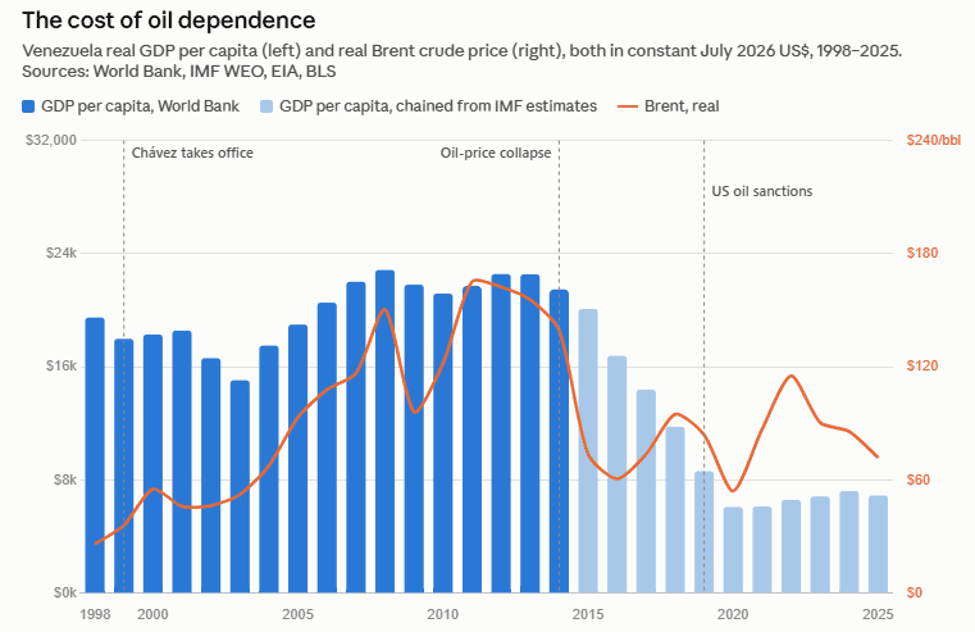
When oil prices collapsed again in 2014, Venezuela was even more vulnerable: revenues plunged while many of the spending obligations accumulated during the boom remained. Production subsequently declined, leaving little else capable of filling the gap.
If $100 billion of new investment arrives and production returns toward 2 million bpd or beyond, Venezuela will once again face the challenge Pérez Alfonzo warned about: how to turn an oil boom into durable economic growth rather than renewed dependence. How the revenues are saved, invested and distributed will be as important as how many additional barrels are produced.
The U.S. Is a Beneficiary of OPEC
Venezuela’s departure from OPEC will do little to increase production in the near term. The country has not faced a binding OPEC quota for almost a decade; its constraints today are investment, infrastructure and operating capacity. Leaving OPEC will not remove any of them.
Nor is a weaker OPEC in Washington’s interest. U.S. energy policy rests on the competing objectives of affordability, reliability and energy security. Lower oil prices help consumers, but sustained prices below the economics of U.S. production eventually reduce drilling and investment, weakening the domestic supply base on which U.S. energy security increasingly depends. The Dallas Fed’s latest Energy Survey found that U.S. producers require a WTI price of about $66 per barrel, on average, to profitably drill a new well. The economic stakes are substantial: a PwC study commissioned by the American Petroleum Institute estimates that the broader U.S. oil and natural gas industry supported 10.6 million jobs in 2023, equal to 4.9% of total U.S. employment, and contributed $2.1 trillion in value added, or 7.4% of U.S. GDP.
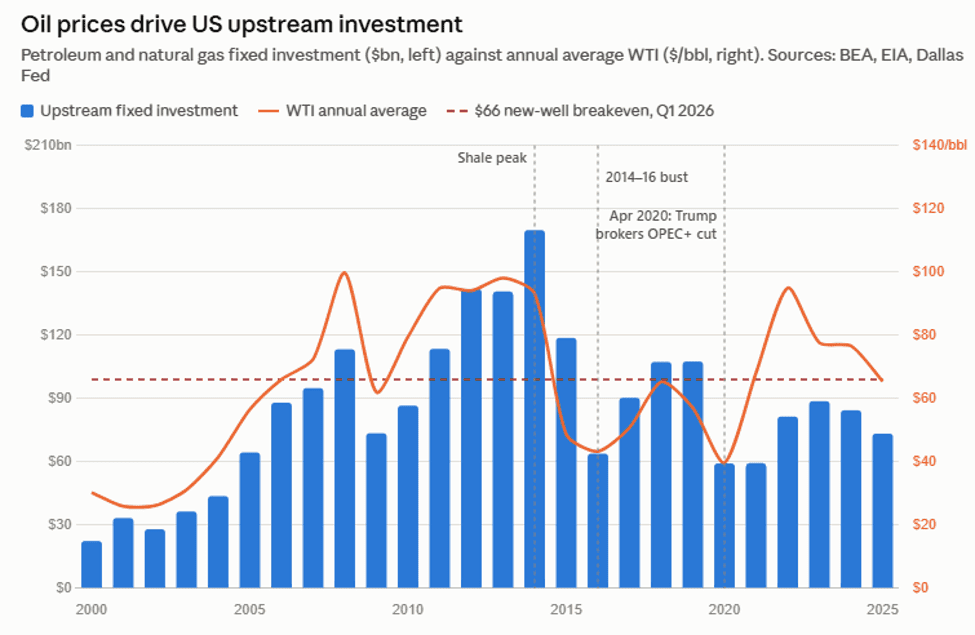
President Trump himself recognized that tradeoff during the 2020 oil-price collapse. As prices plunged and U.S. producers came under severe pressure, he personally pushed Saudi Arabia and Russia to cut production, helping broker the historic OPEC+ agreement that removed nearly 10 million bpd from the market and supported prices.
OPEC therefore serves a U.S. interest that is sometimes overlooked. Its management of supply can help prevent oversupply from pushing prices below levels that sustain domestic investment, while the spare capacity held by its largest producers provides a critical buffer when supply is disrupted elsewhere.
For Washington, the goal is a price that balances affordability with the investment required to maintain reliable domestic supply. A stronger Venezuelan oil industry could add more barrels to the global market, but if they contribute to sustained oversupply, the resulting price pressure will work against U.S. producers.
There are also limits to how Venezuelan barrels can serve U.S. energy-security objectives. Trump has suggested they could help refill the Strategic Petroleum Reserve, but Venezuela’s flagship Merey grade is substantially heavier and higher in sulfur than the SPR’s specifications. Those barrels will ultimately be more valuable to sophisticated Gulf Coast refineries built to process heavy, sour crude.
Beyond OPEC
For Venezuela, leaving OPEC is more politically significant than physically consequential in the near term. The departure would mark a remarkable reorientation toward U.S. capital and markets and cost OPEC a founding member with the world’s largest proved crude reserves.
The harder questions lie beyond OPEC. Venezuela must convince investors that the rules will not change again and ensure that another oil boom does not recreate the dependence of the past. Washington, meanwhile, must balance its desire for more Venezuelan barrels and lower prices against the interests of its own oil industry.
Nearly fifty years after Pérez Alfonzo warned that oil would bring Venezuela ruin, the country is once again placing its enormous petroleum wealth at the center of its economic future.

See why the most successful traders and shipping experts use Kpler