Asian refiners step up arb buying as Mideast shock shows no quick end
While safe navigation through the Strait of Hormuz remains distant, distortions in the Dubai benchmark and limited SPR releases—despite reaching historical highs—are pushing refiners to secure more arbitrage cargoes to bridge the supply gap.
Key takeaways:
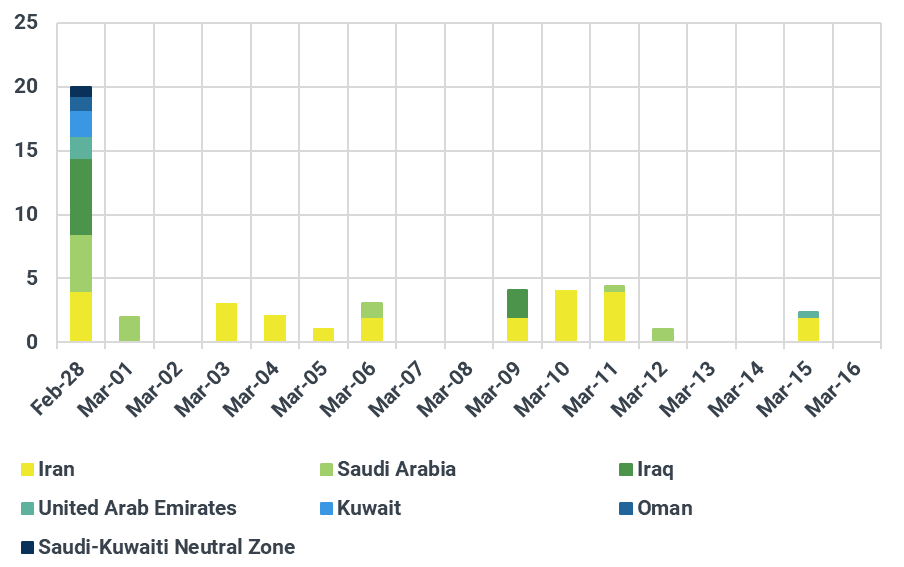
• Non-Iranian crude flows through the Strait of Hormuz remain severely constrained, leaving only about 469 kbd of compliant barrels moving through the strait in so far March.
• Dubai benchmark prices have spiked as deliverable crude into the Platts window shrinks, pushing the M1–M3 spread to an unprecedented $45.5/bbl.
• Asian refiners are stepping up arbitrage purchases as Middle Eastern supply recovery remains uncertain and SPR releases only ease near-term tightness.
• Refinery run cuts in Asia are likely to persist, as arbitrage inflows cannot fully replace lost Middle Eastern crude supply.
As the US–Israel war with Iran enters its third week, only 27.17 mb of crude has been shipped through the Strait of Hormuz so far in March. Of that total, 20.13 mb is Iranian crude—expected to be sold to Chinese teapot refiners—leaving only 7.04 mb of compliant barrels, or about 469 kbd. With no sign of a wind-down in Iranian military strikes and naval escort proposals appearing impractical, non-Iranian oil flows through the Strait are expected to remain sporadic for the foreseeable future.
Even crude shipments from terminals outside the Strait of Hormuz are looking increasingly shaky, with Fujairah—which is capable of exporting at least 1.5 mbd of Murban crude—becoming a frequent target of Iranian strikes and going offline every few days. While shipments from Oman appear largely normal—despite the Mina Al Fahal terminal being briefly shut down as a precaution last week—all cargoes loaded so far this month are bound for China. Market participants told Kpler that China’s state-owned refiners plan to retain all their term cargoes within their own systems, further limiting the availability of Middle Eastern crude in the spot market.
Crude oil tankers transit through the SoH by origin, mb
Source: Kpler
As a result, the volume of crude eligible for delivery into Platts’ Dubai window has effectively fallen to about 2.2 mbd from a typical 3.7 mbd, driving a sharp rise in Dubai benchmark prices. With the recent requirement from ADNOC on Murban liftings, the pool of deliverable crude has shrunk even further. On Friday, the front-month Dubai contract hit $140/bbl, with the M1–M3 spread reaching $45.5/bbl. By comparison, the front-month ICE Brent contract settled at $103/bbl, with the M1–M3 spread at $8.5/bbl.
The surge in Dubai prices has discouraged refiners from seeking physical Middle Eastern cargoes and pushed them to look further afield for supplies. Despite high freight rates, longer voyage times and a steeply backwardated Brent structure, refiners have stepped up procurement of Atlantic Basin and American barrels since last week. This is particularly the case as the market widely expects the supply shock to persist and many refineries to gradually emerge from maintenance ahead of peak summer demand.
A series of deals has highlighted the shift, with Japanese refiners likely buying at least 13 mb of US WTI and Mars for April-loading, potentially the highest monthly level on record. Thailand’s PTT has reportedly bought March-loading North Sea Forties and Angolan crude, while South Korea’s GS Caltex purchased two April-loading cargoes of Kazakh-origin CPC Blend, according to Argus Media. At the same time, Chinese refiners have placed orders for at least 9 mb of April-loading West African crude on top of the term volumes and continue to buy up March- and April-loading Brazilian barrels.
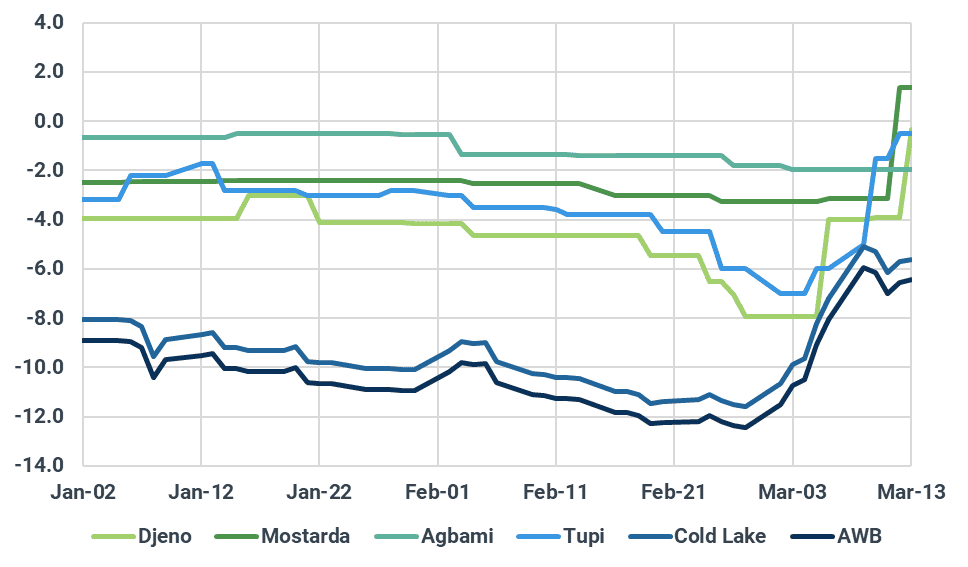
Market participants told Kpler that oil sellers have been reluctant to offer arbitrage cargoes on a delivered basis nowadays due to uncertainties over future freight rates. On an FOB basis, Congolese Djeno is trading at Dated Brent -$0.4/bbl, up from -$8/bbl in early March, while Brazilian Tupi differentials have risen to -$0.5/bbl from -$7/bbl, according to Argus. At the same time, VLCC freight rates for hauling crude from West Africa to China have dropped to $7.4/bbl from as high as $15/bbl in early March.
Selected crude diffs vs Dated Brent/ICE Brent on the FOB basis, $/bbl
Source: Argus Media
At the same time, Asian refiners are still awaiting details of Saudi Aramco’s April allocation plan, which typically comes out around the 10th of each month. Loadings are expected to be restricted to Yanbu and mainly limited to Arab Light, which constrains cargo availability for Asian refiners, especially as European buyers are also expected to receive some volumes.
While SPR releases in Japan, South Korea and potentially more countries in Asia are expected to help refiners overcome the immediate supply shortage—likely for only several weeks from late March into April—this policy band-aid will not be able to address the supply gap over a prolonged period. As such, refiners will likely have to secure more arbitrage barrels than they typically would, buying May- or even June-arrival crude in preparation for an extended period of Middle Eastern supply disruptions.
Given that arbitrage volumes are unlikely to match the normal intake of Middle Eastern crude, and that the high cost of crude cargoes may not be fully passed on to consumers, Asian refiners are therefore likely to see a prolonged reduction in operating rates until a meaningful restoration of Middle Eastern supply.
Market insights you can actually trust
Kpler delivers unbiased, expert-driven intelligence that helps you to track critical crude oil market developments for your own analysis. Our precise forecasting empowers smarter trading and risk management decisions. In times of conflict and geopolitical uncertainty, our real-time data keeps you ahead of supply disruptions and price volatility.
Unbiased. Data-driven. Essential. Request access to Kpler today.

See why the most successful traders and shipping experts use Kpler
.jpg)