

Bab el-Mandeb threat starts reshaping Saudi crude routes
A confirmed attack on two Saudi tankers, apparent turnarounds near the strait and greater interest in Sidi Kerir show Red Sea security risks beginning to affect vessel behavior and export planning.
Confirmed attack raises the risk to Yanbu exports
The Houthi campaign against Saudi-linked shipping moved from threats to a confirmed incident on 22 July. Saudi Arabia’s Transport General Authority said ENCELIA was targeted while sailing in the Red Sea, causing a fire at the bow. All crew members were reported safe and authorities took measures to secure the vessel.
Maritime-security reporting said an unknown projectile struck the tanker’s starboard side approximately 70 nautical miles southwest of Al Shuqaiq. Kpler data shows the Aframax loaded 730,000 barrels of Arab crude at Yanbu on 20 July.
The Houthis also claimed to have targeted the Saudi-flagged VLCC LAYLA using missiles and drones. Damage to LAYLA has not been independently confirmed. The tanker loaded 2 million barrels at Yanbu on 14 July.
The escalation matters because Yanbu has become a more important outlet for Saudi crude while trade through the Strait of Hormuz remains constrained. A sustained threat to Saudi-linked vessels at Bab el-Mandeb would weaken the reliability of that alternative route.
Tankers turn away while others wait outside the strait
Kpler is tracking several tankers that have changed direction or delayed their approach to Bab el-Mandeb. The evidence does not yet support describing every movement as a confirmed diversion, but it shows growing operational caution.
Three vessels have made the clearest moves away from the strait:
- NEW VOYAGE turned north without signaling a replacement destination.
- VL PIONEER moved away from Bab el-Mandeb while signaling that armed guards were aboard. It is scheduled to load at Yanbu on 27 July according to fixture data.
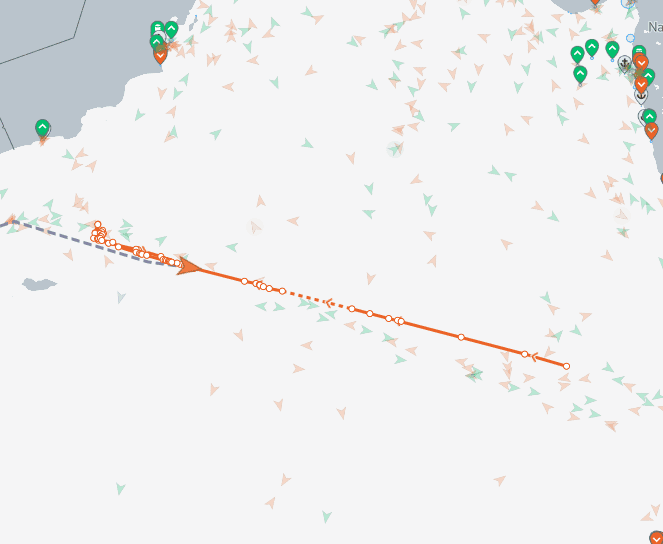
- XIN TONG YANG also turned away without updating its destination. Its scheduled 20 July Yanbu loading date has already passed.
Xin Tong Yang diverting
Three additional tankers remain on the watchlist ahead of scheduled Yanbu loadings:
- NEW CHAMPION has stalled south of Yemen since 21 July ahead of a 25 July fixture.
- NEW PRIME has slowed near the Gulf of Aden ahead of a 27 July fixture.
- RAIN CUBIC has been moored off Oman for approximately one week. Its Yanbu fixture is not until 3 August, making it too early to attribute the delay directly to the Houthi threat.
The next test will be whether these vessels resume their approaches, cancel their fixtures or adopt confirmed alternative routes. Until then, the movements are evidence of caution—not proof that Bab el-Mandeb has become commercially impassable.
SUMED offers an alternative, but the vessel signals differ
Kpler is also seeing greater interest in Egypt’s SUMED system. The route allows crude received at Ain Sukhna on the Red Sea to move by pipeline to Sidi Kerir on the Mediterranean, reducing reliance on a southbound passage through Bab el-Mandeb.
VL BRIGHT and BIDBID are confirmed as routing to Sidi Kerir for SUMED-related operations. AGIOS NIKOLAS, which has been moored near the Azores and is now signaling Gibraltar, remains only a potential Sidi Kerir case.
Other fixtures point to changes in how charterers are evaluating the route:
- DHT STALLION has been chartered by SK Shipping to load at Sidi Kerir in mid-August for discharge in South Korea. A westbound voyage around the Cape would avoid returning through the Red Sea, although its final route still needs confirmation.
- C. GRACE had been scheduled to load at Yanbu for South Korea. It changed its AIS status to “for orders” on 21 July and is now signaling Dos Bocas after exiting the Strait of Malacca, indicating that the earlier Yanbu plan has changed.
These cases do not yet prove a broad diversion to SUMED. They do show that charterers are evaluating Mediterranean loading and discharge options as the southern Red Sea becomes less predictable.
Iraqi crude lifts Ain Sukhna volumes
The physical-flow data provides stronger evidence that SUMED is taking on a larger role. Kpler data indicates that crude receipts at Ain Sukhna averaged approximately 1.6 million bpd month-to-date through 22 July, compared with a normal Saudi-dominated flow of around 800,000 bpd.
Ain Sukhna monthly crude imports
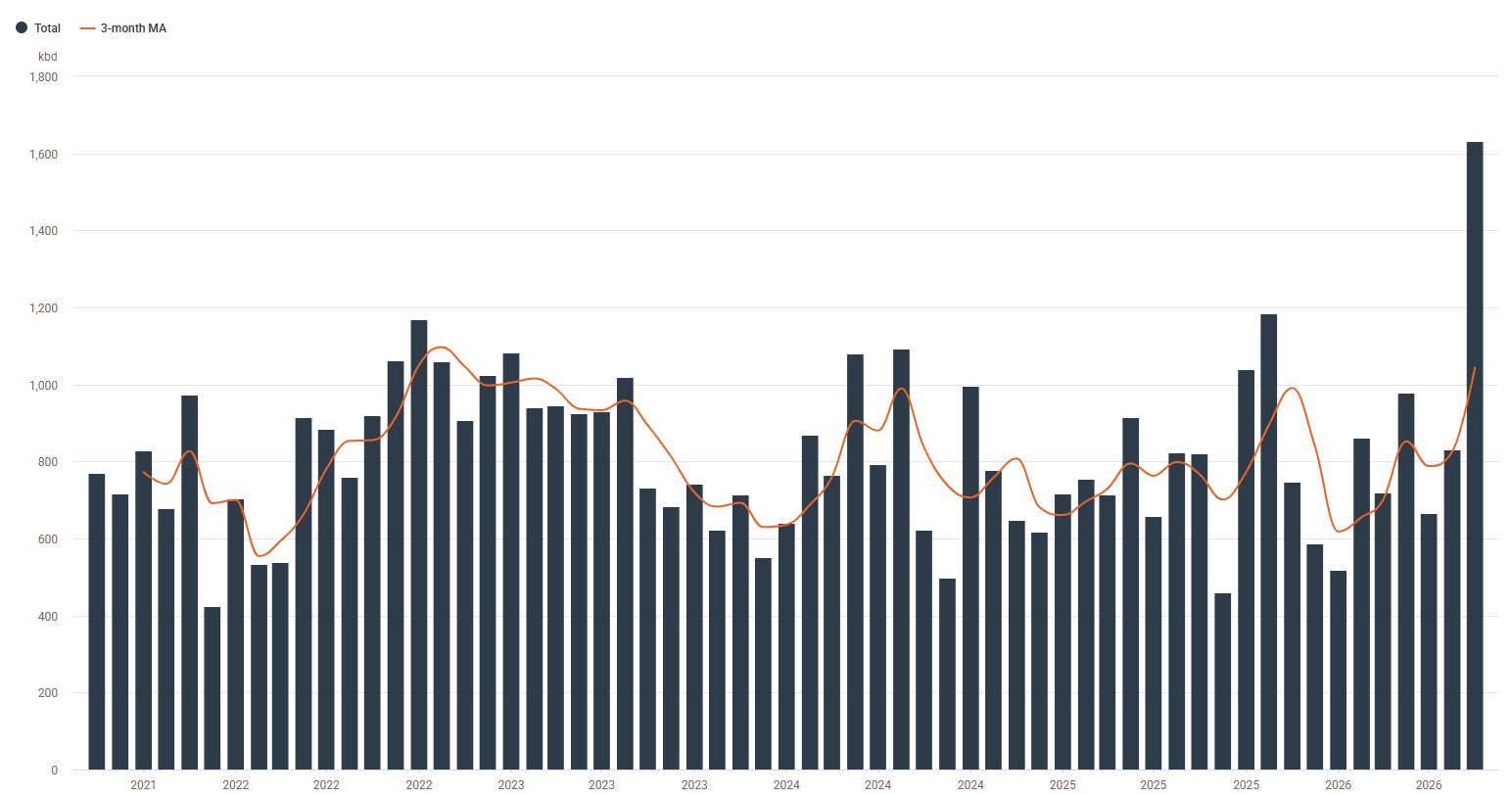
Iraqi crude contributed over 11.3 million barrels during the period, with individual cargoes generally ranging from 1 million to 2 million barrels. That brought Iraqi volumes through Ain Sukhna to a multi-year high, at levels last seen around the 2018 peak.
The increase predates the 22 July tanker attack, so it should not be presented solely as a response to the latest escalation. However, it shows that the infrastructure is already handling more non-Saudi crude as regional shipping routes adjust.
What to watch next
The Houthis claim to have forced approximately 10 commercial vessels to retreat, but that figure has not been independently verified. The more useful indicators will be confirmed route changes, canceled Yanbu fixtures and additional loadings or discharges at Sidi Kerir.
Operation Aspides has advised merchant vessels linked to US, Israeli or Saudi interests to avoid the Red Sea and Gulf of Aden until the threat declines. JMIC and UKMTO have also maintained elevated warnings for the southern Red Sea, Bab el-Mandeb and Gulf of Aden.
Brent settled above $100 per barrel on 23 July as the tanker attacks added another threatened chokepoint to the existing disruption around Hormuz. The key question is now whether the vessel movements near Bab el-Mandeb remain temporary precautions or develop into a sustained shift in Saudi crude routing.

See why the most successful traders and shipping experts use Kpler






