

China’s 15th Five-Year Plan lifts 2027 LNG imports by 0.5 mt, with little impact on Asian prices
China’s 15th Five-Year Plan for oil and gas reinforces domestic supply security while providing modest support to industrial gas demand from 2027. Kpler Insight maintains its domestic gas production outlook at around 270 bcm in 2026, 282 bcm in 2027, and 297 bcm in 2028, as well as its pipeline import outlook of 81.9 bcm in 2026 and 88.5 bcm in 2027. However, stronger policy support for gas use in hard-to-electrify industries adds around 0.7 bcm to our 2027 non-power gas demand forecast, lifting LNG imports by 0.5 mt to 68.5 mt. Our 2026 LNG import forecast remains unchanged at 60.6 mt because industrial coal-to-gas conversions typically require 3–6 months and Kpler expects Asian LNG prices to ease only from April 2027, improving switching economics. The incremental LNG demand remains too small and dispersed to materially alter our 2026–27 Asian LNG spot price outlook.
Market & Trading Calls:
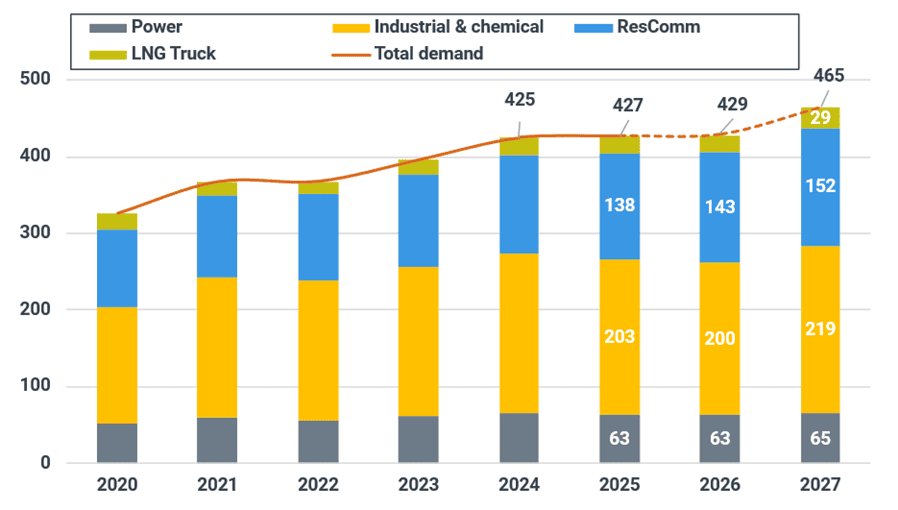
- China LNG demand: Stable in 2026 and slight increase in 2027. Stronger policy support for gas in hard-to-electrify industrial applications adds around 0.7 bcm to 2027 non-power gas demand, lifting our LNG import forecast by 0.5 mt to 68.5 mt. Our 2026 forecast remains unchanged at 60.6 mt.
- Asian LNG spot prices: Stable 2026-2027 outlook. The additional 2027 Chinese LNG requirement is modest and spread across several months, leaving Kpler’s existing Asian LNG spot price forecast broadly unchanged.
- China import infrastructure: Lower near-term utilization. Regasification capacity is expected to reach around 158.5 mtpa in 2026, with another 38.4 mtpa under construction. Capacity remains well ahead of import requirements, with average utilization expected to decrease from 42% in 2025 to around 38% in 2026 and 40% in 2027.
The Oil and Natural Gas Development 15th Five-Year Plan is the sector-specific implementation framework for China’s oil and gas industry through 2030, indicating where Beijing still wants natural gas to grow despite faster electrification and renewable penetration. Released on 17 August, the plan focuses primarily on energy security and system flexibility. By 2030, domestic oil and gas supply is targeted at 440 mt of oil equivalent, long-distance oil and gas pipelines at 220,000 km, LNG receiving capacity at 200 mtpa, natural gas storage capacity above 13% of national consumption, and land pipeline import capacity at 114 bcm/year. On the demand side, the plan explicitly encourages gas use in hard-to-electrify industries, orderly LNG use in heavy trucks and shipping, and locally appropriate peaking gas-fired power.
Compared with the 14th Five-Year Plan, the new plan puts greater emphasis on flexibility and resilience, while several key metrics remain broadly consistent. The 14th Five-Year Plan targeted national gas production above 230 bcm, around 210,000 km of oil and gas pipelines, and 55–60 bcm of storage capacity, equivalent to roughly 13% of gas consumption by 2025. The new plan retains the 13% storage-to-demand ratio, implying continued absolute storage growth alongside consumption, while adding explicit targets for LNG receiving capacity and land pipeline imports. The upstream target is now expressed as combined domestic oil and gas supply rather than a standalone gas production target.
On the demand side, the plan is slightly more constructive for non-power gas use but does not overturn structural pressure from renewables and electrification. Gas-fired power policy remains centered on peaking rather than baseload generation, meaning rising renewable output should continue to cap gas-fired utilization even as capacity expands. For non-power demand, gas is prioritized for users that are difficult to electrify or currently rely on higher-emission fuels, while LNG remains supported in heavy trucks and waterborne transport. However, the separate 40% new-energy heavy-truck target, geothermal substitution in heating, and wider electrification under other recently announced policies continue to limit medium-term upside.
The industrial demand response is also unlikely to be immediate. Switching from coal-fired boilers and kilns to gas-based in industrial plants typically requires around 3–6 months, limiting the potential effect on 2026 consumption. Economics provide a second constraint: Kpler expects Asian LNG prices to ease from April 2027, improving the economics of coal-to-gas switching. We therefore maintain our 2026 LNG import forecast at 60.6 mt, while stronger policy support for hard-to-electrify industrial applications adds around 0.7 bcm of non-power gas demand in 2027.With domestic production and pipeline supply assumptions broadly unchanged, this increases the call on LNG and lifts our 2027 import forecast by 0.5 mt to 68.5 mt.
The plan’s LNG regasification capacity target broadly aligns with Kpler Insight’s existing infrastructure outlook rather than signaling a new import-demand requirement. China is expected to have around 158.5 mtpa of active regasification capacity by 2026, with a further 38.4 mtpa under construction, putting the country broadly on track to reach the 200 mtpa target by 2030. However, LNG demand is expected to grow considerably more slowly than receiving capacity. Kpler Insight estimates average regasification utilization will decline from 42% in 2025 to 38% in 2026, before edging back to 40% in 2027. The widening capacity buffer reinforces our view that infrastructure availability will not constrain Chinese LNG imports in the near term.
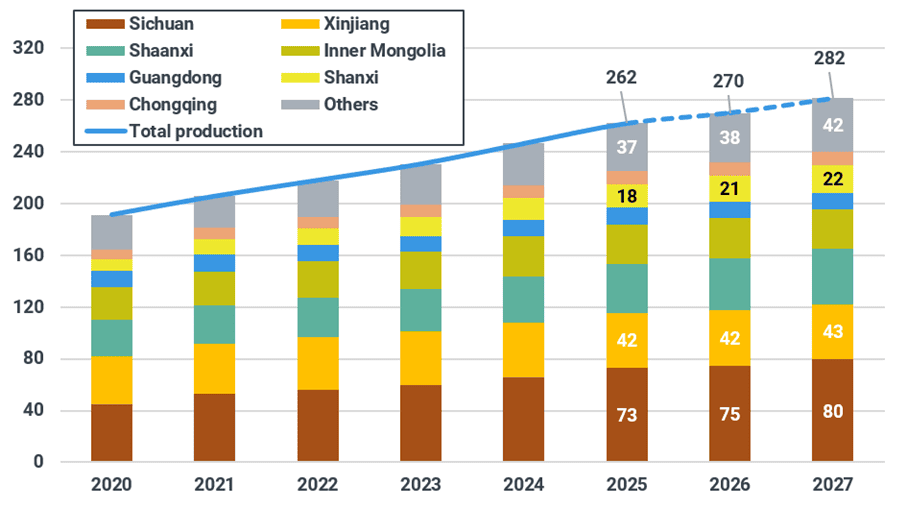
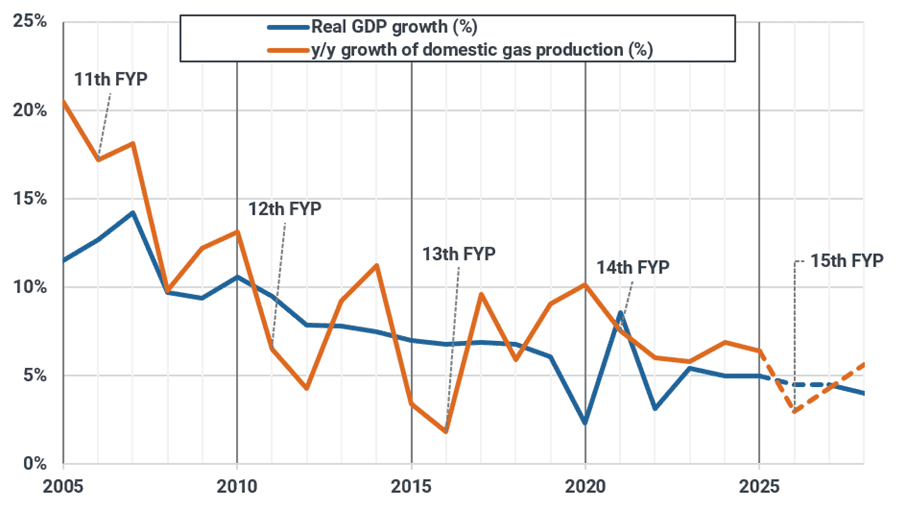
On the supply side, Kpler Insight’s existing domestic gas production outlook remains aligned with the plan’s direction. Policy support continues to focus on deep and ultra-deep conventional gas, shale gas, and deep coalbed methane across major basins including Ordos, Sichuan-Chongqing, Tarim, and Bohai Bay. We maintain our forecast that China’s gas production will rise from 262 bcm in 2025 to around 270 bcm in 2026, up 3.0% y/y, and 282 bcm in 2027, up 4.4%, before accelerating to 297 bcm in 2028, up 5.3%, as upstream projects ramp up.
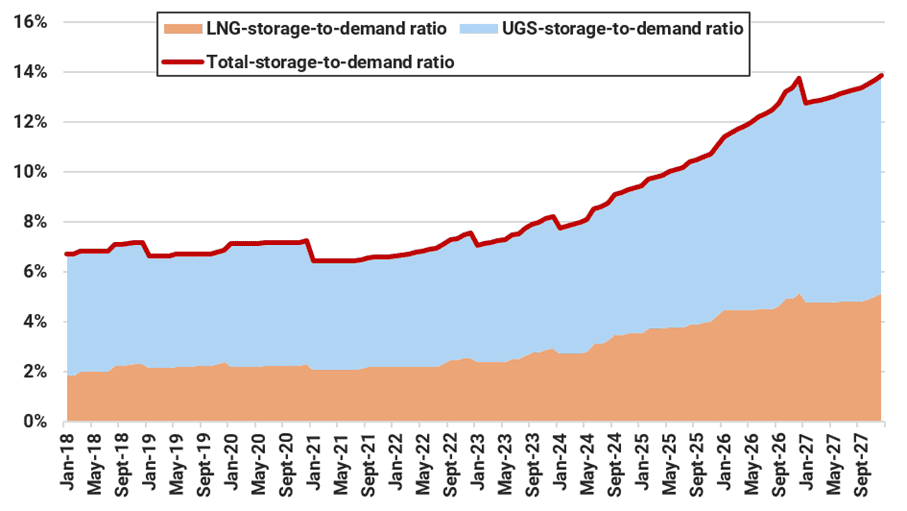
Storage expansion is also consistent with our existing view, but greater capacity improves China’s ability to manage LNG price volatility. The target of more than 13% storage target implies continued expansion rather than a material increase in storage coverage relative to demand. Total capacity almost doubled from ~24 bcm in 2020 to ~47 bcm in 2025, lifting storage from around 7% to 11% of annual consumption. The 2030 target therefore requires capacity additions to keep pace with demand growth. Greater storage should reduce China’s need to enter the spot market aggressively during short-lived demand or price spikes, moderating its contribution to regional price volatility.
By the end of 2025, China has around 105 bcm/year in pipeline import capacity, including 55 bcm/year through the Central Asia A/B/C lines, 12 bcm/year through the Myanmar pipeline and 38 bcm/year through Power of Siberia 1. This leaves only around 9 bcm/year of additional capacity needed to reach the 114 bcm/year target. The expected contribution from Russia’s Far East route should be sufficient to bridge that gap, reinforcing our view that the target does not depend on Power of Siberia 2 or Central Asia Line D.
Import capacity nevertheless remains well above expected actual flows. Kpler Insight maintains its pipeline import outlook at 80.8 bcm in 2025, 81.9 bcm in 2026, and 88.5 bcm in 2027. Average pipeline capacity utilization is expected to remain below full capacity at around 77% in 2025, 78% in 2026, and 76% in 2027. As with LNG receiving terminals, the plan therefore strengthens China’s supply optionality and resilience without implying equivalent growth in physical imports.
Overall, China’s 15th Five-Year Plan is more consequential for gas-system optionality than for incremental LNG demand. Higher regasification, pipeline and storage capacity will expand Beijing’s ability to manage supply disruptions and price volatility, while domestic production remains the core source of incremental supply. Stronger support for industrial coal-to-gas switching adds around 0.7 bcm to our 2027 non-power gas demand forecast, raising LNG imports by 0.5 mt to 68.5 mt, but implementation lags and switching economics leave our 60.6 mt 2026 forecast unchanged. The additional 2027 requirement is too small and dispersed to materially alter Asian LNG pricing. The key implication of the plan is therefore greater Chinese supply flexibility, not a structurally larger call on the global LNG market.
China’s annual gas demand by sector (Bcm)
Source: NDRC, NBS, NEA, CEC, Kpler Insight
China annual domestic gas production by major province (bcm)
Source: NBS, Kpler Insight
China’s domestic gas production y/y growth rate versus GDP growth (%)
Source: NBS, Kpler Insight
Chinese natural gas storage to national demand ratio (%)
Source: Kpler Insight. Note: National demand is annual gas demand.

See why the most successful traders and shipping experts use Kpler






