

Higher and higher: Stronger Asia buying absorbs rising Middle Eastern spot supply
Middle Eastern producers have stepped up tender activity for spot cargoes loading over the next two to three months, pointing to potentially greater spot availability. Despite this, award prices continue to strengthen, suggesting that additional supply is being absorbed by even stronger buying demand.
Key Takeaway:
- Chinese buyers re-emerged as successful bidders in recent Middle Eastern spot tenders, securing several September-November-loading cargoes via STS in the Gulf of Oman.
- Cargoes cleared at around Dubai +$5-8/bbl on an STS Fujairah basis, slightly higher than a week earlier, reflecting elevated Hormuz delivery risk premiums and stronger buying demand.
- Robust product cracks continue to incentivise refiners to sustain high run rates and secure reliable crude feedstock supplies.
- The potential increase in Middle Eastern supply may lag growth in refinery demand, particularly as Chinese buying gradually picks up, keeping sour crude differentials supported.
In its ninth tender round, ADNOC reportedly sold some 16 Mbbls of offshore crude, including Upper Zakum, Das and Umm Lulu, to buyers in China, Japan, India and Malaysia. Clearing prices were heard at around Dubai +$5-8/bbl on an STS Fujairah basis, up from around Dubai +$5-6/bbl in the previous round just a week earlier, and equivalent to roughly Dubai +$12-13/bbl on a delivered basis into Northeast Asia.
Meanwhile, QatarEnergy was heard to have awarded Qatar Land and Qatar Marine cargoes to a Thai refiner at around Dubai +$6/bbl. Iraq's SOMO was also heard to have sold around 10 Mbbls of Basrah Medium and Basrah Heavy for September-October loading to Asian buyers at more than Dubai +$10/bbl on a delivered basis.
The higher clearing prices come even as Middle Eastern producers have issued more tenders over the past two weeks, pointing to potentially greater near-term supply from the region. Saudi Aramco has also joined the wave of spot offerings, reportedly marketing early-September-loading Arab Medium and Arab Heavy cargoes for delivery via STS off Fujairah earlier this week.
The apparent contradiction may reflect a shift in crude procurement and inventory management strategies among Asian refiners, particularly in China, as expectations of prolonged supply tightness encourage more active buying rather than excessive reliance on stock drawdowns, while strong product cracks support higher refinery runs.
PetroChina, Sinochem and a Chinese independent refiner were among the buyers in the latest round of spot tenders, in contrast to just two weeks ago, when Chinese refiners lowballed an ADNOC tender.
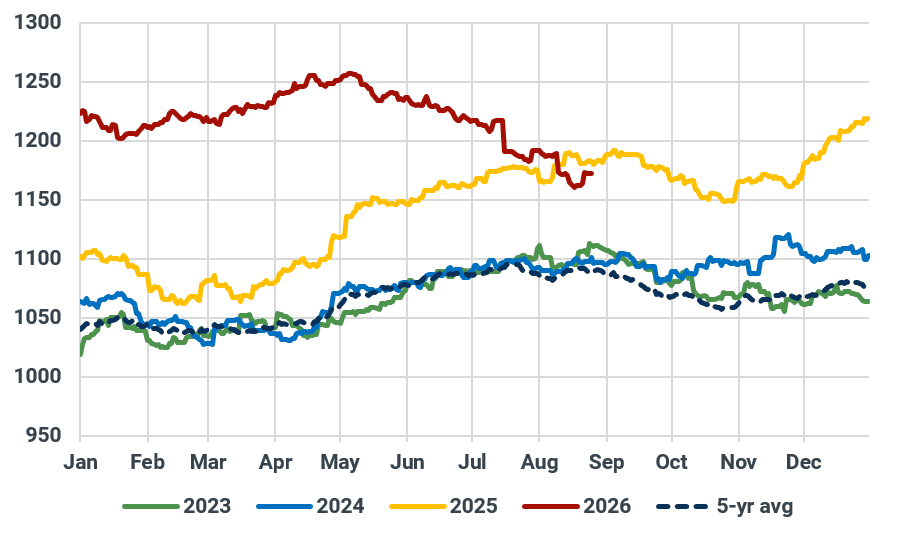
Kpler data show that China's onshore crude inventories have fallen to 1,172 Mbbls, below levels seen during the same period last year. Although the volume still covers around 88 days of refinery demand, based on Kpler's August crude intake estimate of 13.26 Mbd, accelerating stock draws and expectations of higher throughput in the coming months are gradually eroding China's inventory cushion and could increase the weight of energy-security considerations in procurement decisions.
As highlighted in a previous report, limited Iranian crude availability is also creating operational uncertainty for teapots, which have sold sizeable volumes of gasoline and diesel to state-owned refiners, enabling the latter to increase clean product exports and capture strong margins. With state-owned refiners likely to keep product exports elevated in September, reduced availability from teapots would leave them more reliant on their own refining systems, requiring higher run rates and more reliable crude feedstock supplies.
China's onshore crude oil inventory, mb
Source: Kpler
For other Asian refiners, middle distillate cracks holding firmly at around $60/bbl over Dubai swaps provide a strong incentive to maintain high run rates, leaving little appetite to risk production cuts due to unreliable feedstock supplies. Indeed, some refiners appear to have reduced or skipped recent spot purchases, but this likely reflects earlier procurement through term contracts or spot deals for both Middle Eastern and arbitrage cargoes rather than weaker feedstock demand.
Refiners with sufficient inventory buffers may opt to sacrifice prompt delivery in exchange for cheaper barrels, but rapidly shifting Middle Eastern dynamics continue to encourage others to lock in feedstock while supplies remain accessible.
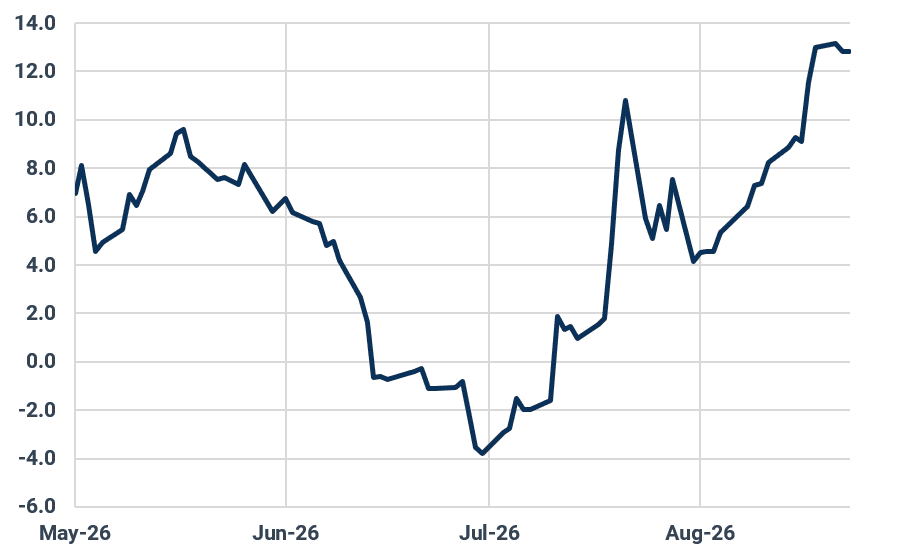
That said, the prompt Dubai structure and Middle Eastern crude differentials are expected to remain supported even as producers offer more cargoes. More active buying may slow the pace of inventory drawdowns across Asia, but robust refinery runs are unlikely to reverse the trend, let alone allow inventories to rebuild.
Dubai M1-M3 spread, $/bbl
Source: Argus Media

See why the most successful traders and shipping experts use Kpler






