Geopolitics keeps freight afloat
Middle East war risk continues to underpin tanker rates despite abundant vessel availability and weaker-than-expected demand. VLCCs remain bullish through Q4, while Suezmaxes benefit from longer-haul Atlantic trades and tightening tonnage. Aframax rates face growing downside into 2027 as traditional crude flows recover. Clean tanker markets remain more fragmented. LR2s retain upside potential as constrained clean tonnage meets recovering Middle East exports, although elevated freight limits arbitrage opportunities. Meanwhile, MR strength is shifting eastward, supported by higher Asian product exports, while returning Saudi and Russian barrels threaten Atlantic demand. Overall, geopolitical disruption continues to outweigh underlying fundamentals, sustaining elevated freight volatility.
Market & Trading Calls
VLCC
- Stay bullish through Q4 as persistent Middle East security risks, constrained GoO STS operations, and reduced fleet efficiency keep freight elevated.
- VLCC demand is forecast to rebound 21% y/y in 2027, although weakening Asian refining margins and a reduction in MEG war risk pose downside risks.
Suezmax
- Small correction expected but rates to remain firm through year-end as VLCC spillover, longer-haul WAF-to-Asia trades, and tightening Atlantic vessel availability support rates.
- Global ton-miles reached a record 240 bn in October, while 2027 demand is revised 0.9% higher m/m.
Aframax
- Expect a near-term rate recovery following an early November slump, although elevated Atlantic vessel availability and weakening European crude demand limit upside into 2027.
- Six-month ton-mile forecasts are revised 3.8% higher, supported by Russian exports, but demand is expected to decline 2% y/y in 2027 as traditional MEG flows recover.
LR2
- Stay cautiously bullish through Q4 as recovering Middle East CPP exports meet constrained clean tonnage availability, supporting further freight spikes.
- LR2 demand is forecast to rebound 34% y/y in 2027, although volumes remain below 2025 levels and elevated freight increasingly undermines long-haul arbitrage economics.
MR
- Favor East of Suez MRs as higher Chinese export quotas and South Korean diesel exports support regional cargo demand, while returning Saudi and Russian barrels pressure Atlantic trades.
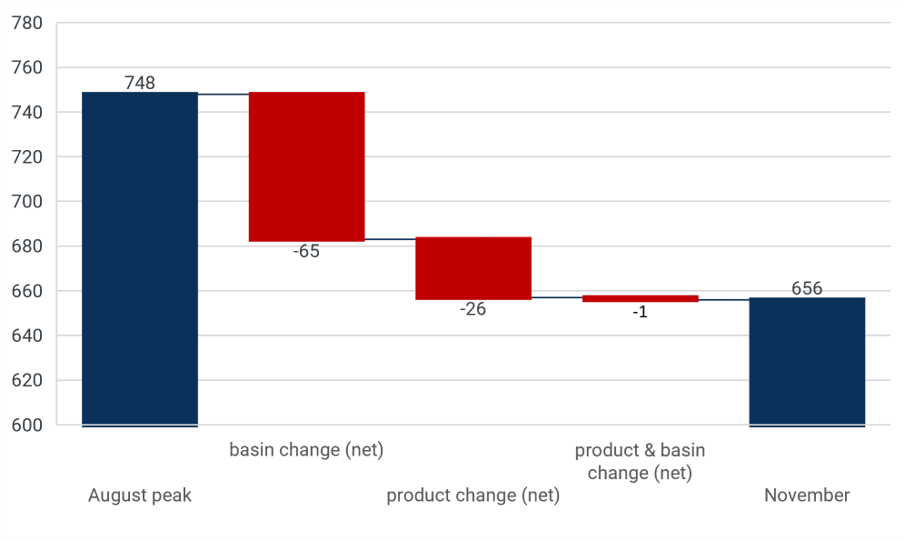
- West of Suez clean MR employment has fallen 12% from August's peak, tightening supply, although 2027 regional demand is expected to decline 7% y/y as average voyage distances shorten.
Forecast Dashboard
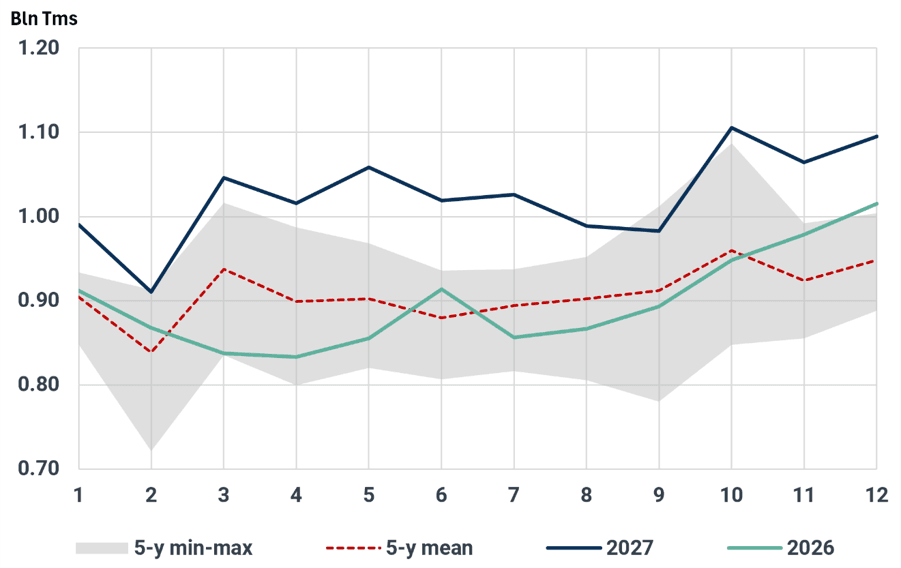
Dirty tanker demand rose in October but underperformed at 948 bn coming in 49.5 bn (5%) below last month’s forecast. The shortfall was concentrated in Middle East loadings and Chinese and Japanese imports amid intensified attacks on Gulf shipping.
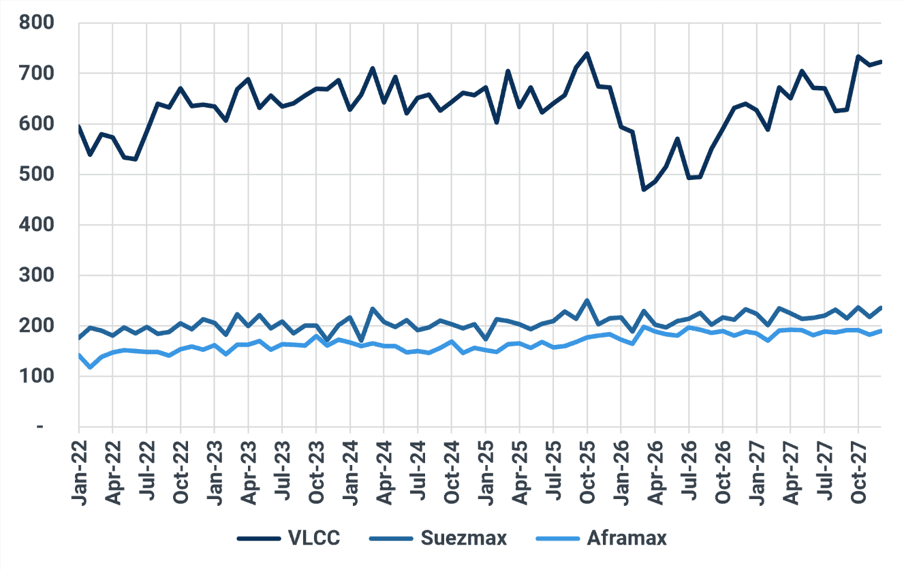
2027 ton-miles are broadly unchanged versus last month (-0.1%), still implying 14% y/y growth, but the profile has shifted. The next six months are revised up 2.6% on postponed US SPR repleased, Iraqi, Russian and Brazilian loadings and Indian, Chinese and South Korean imports, offset by a 112 bn cut to September-December 2027, almost all VLCC. VLCC demand is revised down 0.8% as Chinese imports are cut by 5 bn a month and Saudi West Coast loadings fall, while UAE loadings shift towards Fujairah, outside the Strait, from mid-2027. Suezmax (+0.9%) and Aframax (+2.2%) are revised up on expected higher Russian-origin flows to India as drone attacks resume. VLCC demand rebounds 21% y/y in 2027 while Suezmax demand grows 6% and Aframax eases 2% after a 22% jump in 2026 on US exports.
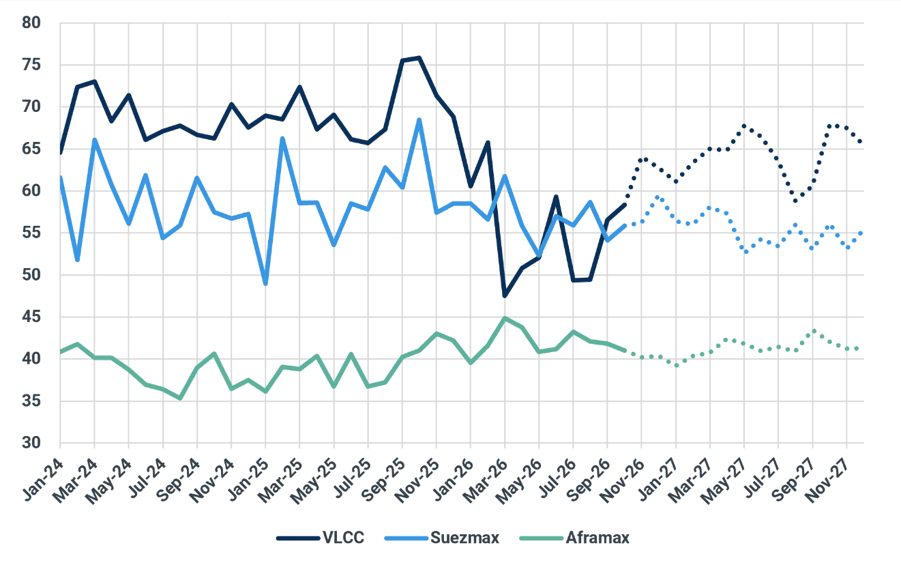
Productivity tempers the recovery, with active fleets 4-7% larger y/y, VLCC productivity recovers 14% in 2027 but remains about 8% below 2025, and Suezmax productivity slips a further 3%.
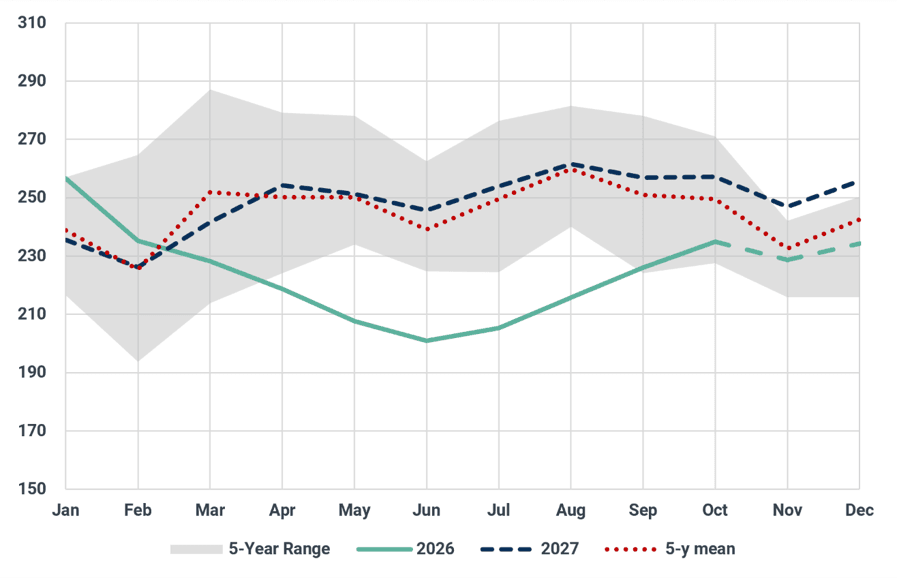
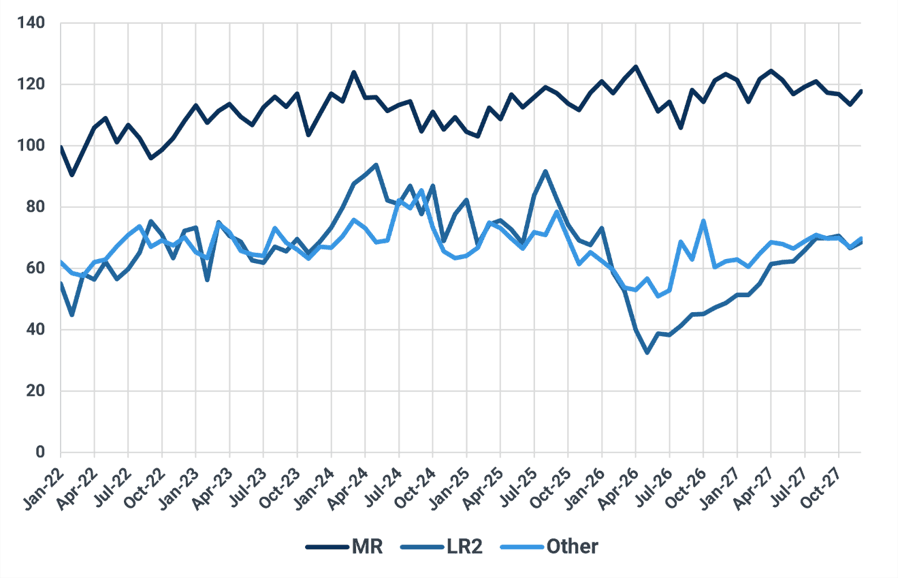
Clean tanker demand underperformed expectations in October, primarily due to stagnating MEG trade flows. While this can largely be attributed to heightened Iranian aggression in the region ahead of the US midterm elections, it also highlights the challenges of a no-deal normalisation scenario, under which regional refinery operations may struggle to ramp up, weighing on ton-mile demand.
2027 clean tanker ton-mile forecasts have been revised down by 7.8% versus last month's publication, although still implying 11% y/y growth in total segment demand. The downward revision is primarily concentrated in the MEG and India, where forecasts have been cut by 12.6% m/m, bringing expected 2027 y/y growth to 45%. Asia Pacific ton-miles have also been revised down by 7% m/m, with growth now assessed at 5% y/y. As discussed below, long-haul exports from the region to the West have proved increasingly circumstantial amid narrowing arbitrage economics.
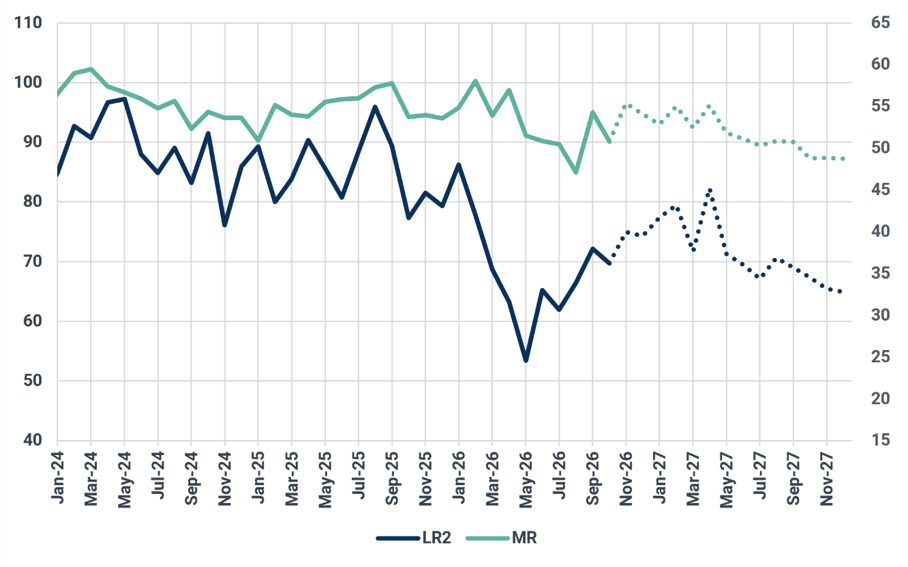
The LR2 segment has borne the brunt of the downward revisions, given its greater exposure to MEG demand, although it is still expected to record a 34% y/y recovery in 2027. Nevertheless, demand is not expected to return to 2025 levels, highlighting the structural downside risks to LR2 demand under a no-deal scenario. Meanwhile, expectations of returning Russian and Red Sea barrels have weighed on WoS demand, as higher volumes are increasingly offset by shorter average hauls, with Russia–Brazil flows emerging as the main exception. Consequently, WoS MR demand is forecast to decline by 7% y/y, offsetting gains in the MEG and Asia Pacific.
These revisions have also tempered expectations for an LR2 productivity spike. With MEG LR demand increasingly constrained by a fleet depleted by dirty trading, some volumes are expected to spill over into the MR segment, although the anticipated scale of this shift has also been revised lower.
Dirty tanker demand outlook (Bn TM)
Source: Kpler
Dirty tanker demand outlook by segment (Bn TM)
Source: Kpler
Dirty tanker productivity (ton-miles / DWT)
Source: Kpler
Clean tanker demand outlook (Bn TM)
Source: Kpler
Clean tanker demand outlook by segment (Bn TM)
Source: Kpler
Clean tanker productivity (ton-miles / DWT)
Source: Kpler
The Big Picture: October
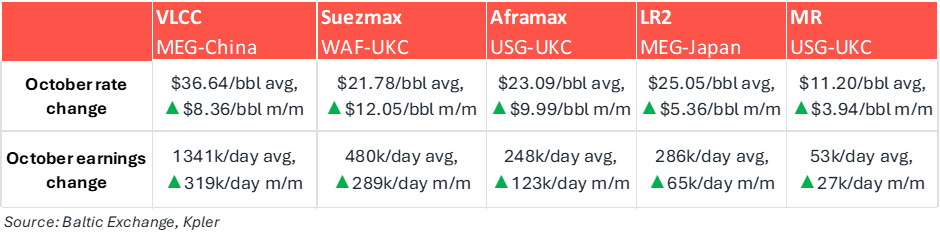
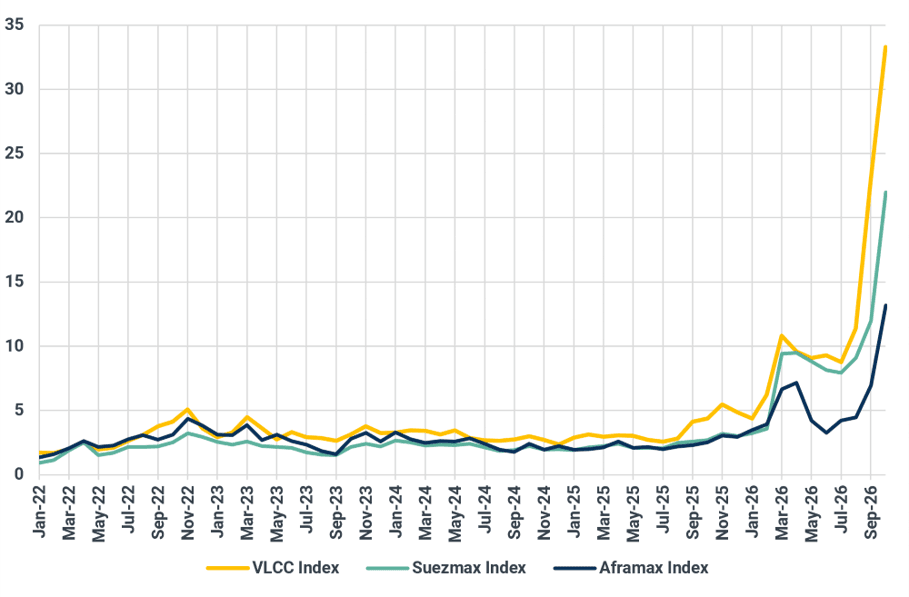
Dirty tanker rates remained elevated in October as Middle East war risk escalated. VLCC rates on MEG–China averaged $36.64/bbl, up $8.36/bbl m/m, despite a record 255 ballasters around the Middle East. Vessel attacks reached 35, the highest monthly total since the conflict began, while constraints on ship-to-ship operations further reduced fleet efficiency.
Elevated VLCC freight accelerated the shift toward smaller vessel classes, particularly on long-haul Atlantic-to-Asia routes. VLCC exports from PADD 3, Latin America, and West Africa to Asia fell from 4.5 Mbd in September to 3.1 Mbd in October as Suezmaxes and Aframaxes gained market share. Suezmaxes captured 80% of West African exports, compared with a historical average of 50%, pushing global ton-miles to a record 240 bn.
Aframax demand also strengthened amid record vessel availability in the West. Record PADD 3 flows of 2.2 Mbd and Canadian exports of 840 kbd lifted global Aframax ton-miles to 228 bn. Meanwhile, renewed Black Sea attacks sustained regional risk premiums, reinforcing a market increasingly driven by geopolitical disruption and changing trade patterns.
The Clean tanker trade growth stalled in October, with loadings averaging 18.5 Mbd across the month versus 18.7 Mbd a month earlier. A closer breakdown shows a distinct shft towards smaller assets, with MR exports surpassing the pre US-Iran conflict threshold of 10 Mbd, while LRs failed to hold September’s gains, settling instead lower by 1 Mbd m/m.
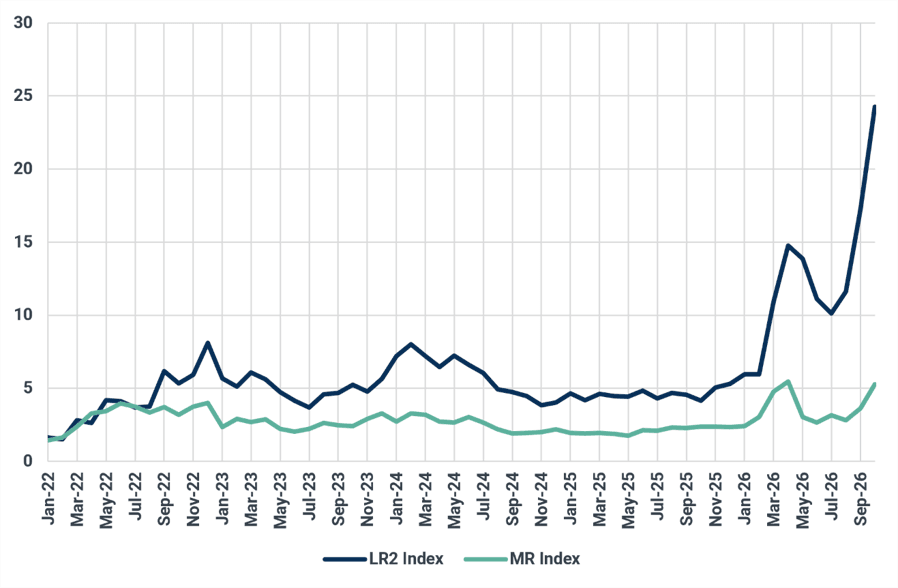
As such, a $7.02/bbl m/m increase in the Kpler LR2 index can be better attributed to residual strength from a fundamentally firm October, coupled with ongoing resilience in the Atlantic dirty market. If the September–October LR2 market has demonstrated anything, it is that in an undersupplied market, a sudden uptick in enquiry can trigger sharp rate spikes, which subsequently erode long-haul arbitrage economics and drive a natural market correction.
In contrast, a $1.64/bbl m/m increase in the Kpler MR index aligns with rectifying fundamentals. In the West, longer cargo lists, driven by the downsizing of MED cargoes and returning Russian volumes, met contracting position lists, as vessels switched to other trades or seeked amployment outside the Atlantic. In the East, improving refinery confidence on regional feedstocks and a narrowing incentive for interbasin flows, saw more barrels return to regional MR trades, offering support to the class.
*Rates and earnings are monthly average based on sheets to be supplied*
Key dirty tanker rates ($/bbl)
Source: Kpler calculations based on Baltic Exchange and McQuilling data
Key clean tanker rates ($/bbl)
Source: Kpler calculations based on Baltic Exchange and McQuilling data
Sector Snapshots
VLCC
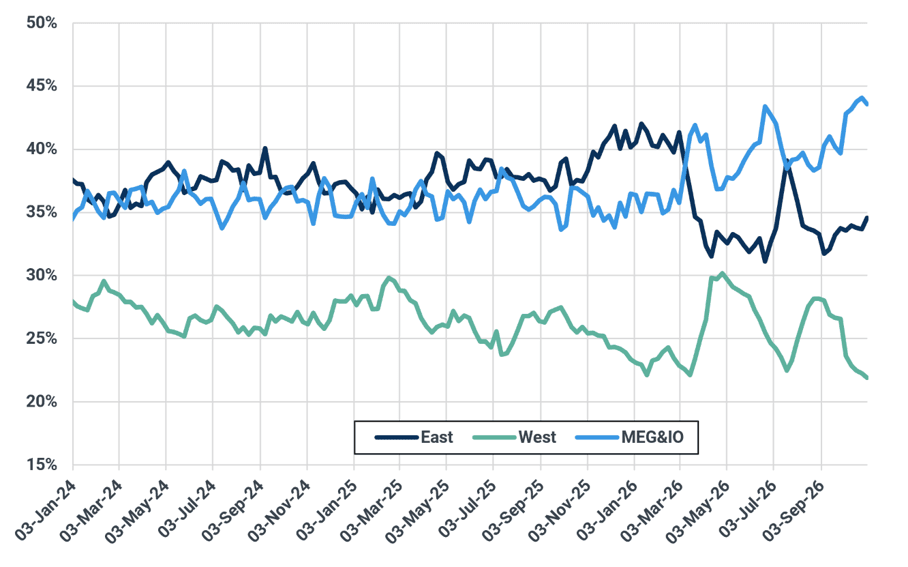
VLCC rates retained September's gains in October. MEG–China averaged $36.64/bbl, up $8.36/bbl m/m, while trading within a $4/bbl range. Rates remain disconnected from underlying vessel availability, with a record 255 ballasters around the Middle East, representing approximately 50% of the global ballast fleet. War risk continues to override fundamentals, with vessel attacks reaching 35 in October, the highest monthly total since the conflict began. Despite the disruption, non-Iranian Middle East crude exports averaged 16.2 Mbd, just 800 kbd below pre-war levels.
VLCC ballast fleet positions
Source: Kpler
More than 95 VLCCs are operating shuttle trades, although many also undertake direct shipments. Constraints on ship-to-ship (STS) operations in the Gulf of Oman have pushed transfers farther offshore, with the first Middle East crude transfers taking place off India's west coast in October. Longer voyages and additional handling continue to erode fleet efficiency.
Atlantic rates were more volatile, peaking at $40/bbl mid-month before falling to $28/bbl and recovering slightly. Record freight costs to Asia squeezed Asian coker margins for Atlantic grades, weakening demand. VLCC crude exports from PADD 3, Latin America, and West Africa to Asia fell from 4.5 Mbd in September to 3.1 Mbd in October. Some cargoes shifted to Suezmaxes and Aframaxes, which became more competitive. However, Middle East strength limited the impact on VLCC rates.
Westbound VLCC ballast movements recovered slightly from September's multi-year low but remain subdued as weak West-to-East arbitrage and stronger Middle East earnings discourage repositioning.
Outlook:
We maintain our view that VLCC rates will remain elevated through Q4, although some easing is likely. Middle East war risk continues to underpin earnings, but deteriorating Asian refining margins will increasingly constrain freight affordability. A sharp correction remains unlikely without a new peace agreement.
Middle East rates should retain their risk premium, forcing Atlantic rates to remain competitive. Returning Yanbu supplies to Europe could redirect Atlantic crude toward Asia, while a 40 Mbbl Strategic Petroleum Reserve release in November–December will increase US Gulf Coast availability. However, the destination of these barrels will depend on arbitrage economics, particularly as elevated freight costs challenge Asian demand.
Suezmax
Suezmax rates extended their September rally into October, supported by elevated VLCC earnings. WAF–UKC averaged $21.78/bbl, up $12.05/bbl m/m. Rates peaked at $25.31/bbl on 5 October before declining to $18.27/bbl by month-end, tracking the Atlantic VLCC correction but remaining well above pre-rally levels.
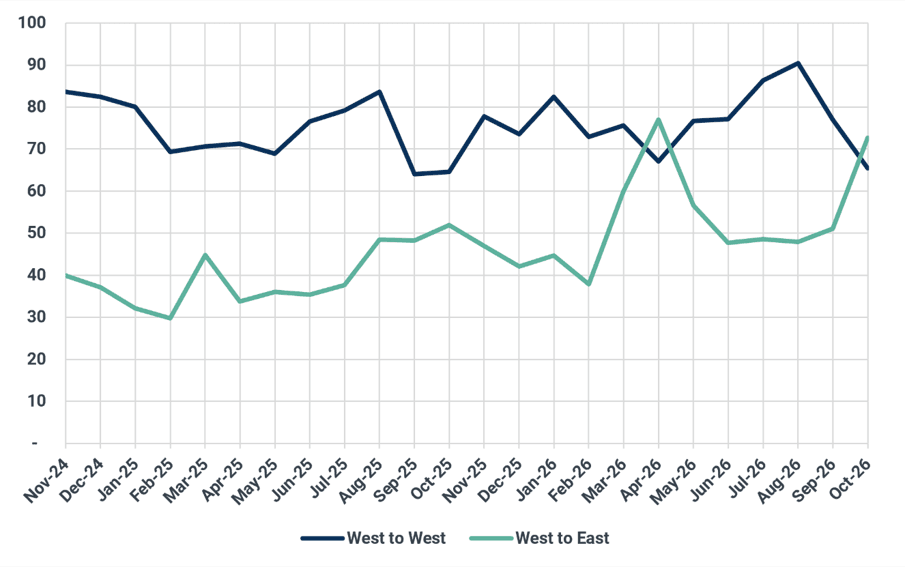
The VLCC spike made Suezmaxes increasingly competitive on traditional VLCC routes to Asia, particularly from West Africa and Latin America. Suezmaxes captured 80% of West African exports in October, compared with a historical average of 50%. West African loadings east of Suez approached a record 1 Mbd, while South American flows reached 3 Mbd. Stronger long-haul demand lifted global Suezmax ton-miles to a record 240 bn.
This growth partly offset weaker short-haul demand within the West of Suez. Regional flows declined as refiners prioritized returning Middle East, North Sea, and Caspian barrels, while increasingly competitive Aframaxes captured additional cargoes.
Outlook:
Suezmax rates dropped sharply in early November but we expect this to be a temporary dip and will remain closely tied to VLCC performance while the larger vessel segment trades at exceptionally elevated levels. We expect the shift toward longer-haul Suezmax employment to persist, supported by an open West-East arbitrage. This will lift ton-mile demand and spread the fleet more widely across regions, adding supply side support.
This redistribution is already tightening Atlantic availability, with Suezmax ballast supply in the West falling to its lowest level since July. Combined with sustained long-haul employment, this should underpin rates through year-end, even if VLCC earnings ease moderately.
Russian crude exports remain another key upside driver. The expected recovery in Russian refinery runs has been delayed following renewed Ukrainian strikes, including the recent attack on the Novokuybyshev refinery. Continued refinery disruptions should sustain higher crude export availability and Suezmax employment. We have therefore revised our Suezmax demand outlook higher for the remainder of the year.
Suezmaxes ton-miles (ex-Russia) (bn)
Source: Kpler
Aframax
Aframax rates followed the broader dirty tanker rally in October. USG–UKC averaged $23.09/bbl, up $9.99/bbl m/m. Rates peaked at $29.35/bbl on 6 October before easing to $20.75/bbl by month-end.
Aframax availability in the West reached a record high as coated vessels continued switching from clean trades. However, stronger cargo demand absorbed the additional supply as Suezmaxes increasingly shifted toward longer-haul voyages.
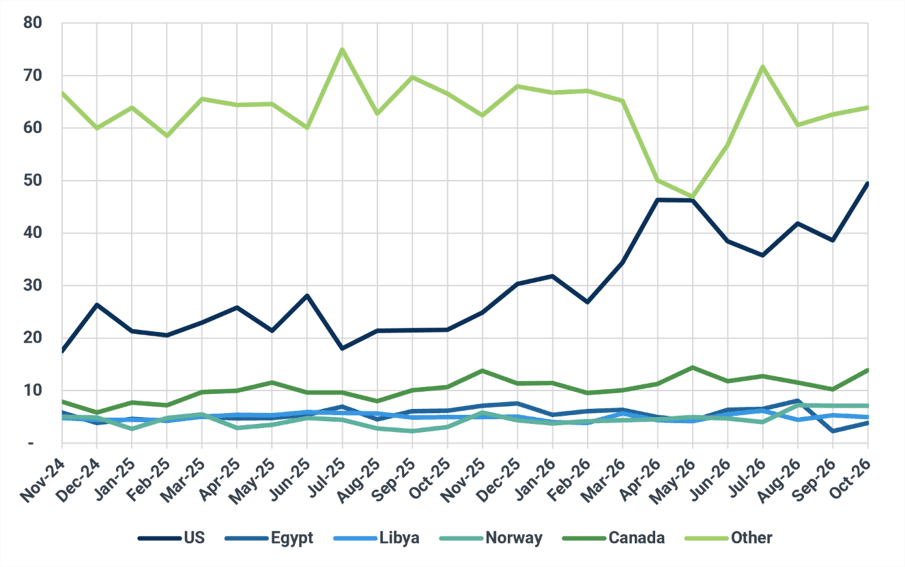
PADD 3 Aframax flows reached a record 2.2 Mbd, while Canadian exports climbed to a record 840 kbd. This pushed global Aframax ton-miles to 228 bn. Cross-Med rates reached a record $11.65/bbl on 22 October before closing at $10.12/bbl. Kirkuk loadings from Ceyhan reached 420 kbd, their highest since 2023, while Libyan and Algerian exports fell 80 kbd to a three-month low of 1.1 Mbd. Black Sea attacks maintained a regional war-risk premium.
Outlook:
Aframax rates will remain heavily influenced by Middle East developments and VLCC earnings. Midsize rates fell in at the start of November, but we expect a recovery in the coming weeks. It is unlilely rates will bounce back to the recod highs reached in early October as Aframaxes face potentially larger downside threat than Suezmaxes. Elevated ballast availability and softening European crude demand heading into 2027 point to a weakening market.
Aframax demand is projected to increase 22% across 2026, driven by stronger West-to-West flows following the loss of Middle East imports. We expect some reversal in 2027, assuming sustained recovery in Strait of Hormuz transits restores traditional crude trade patterns.
However, we have raised our six-month demand forecast by 3.8%, reflecting stronger-than-expected northern Russian loadings amid renewed Ukrainian refinery strikes. This additional export demand should partially offset weakening European consumption.
Returning Yanbu barrels could also redirect European crude sourcing away from transatlantic routes toward shorter Mediterranean voyages, favoring Cross-Med employment, where earnings are almost double those on USG–UKC. This shift should provide regional support even as the broader Aframax market gradually softens.
Aframax ton-miles by orgin country (ex-Russia) (Bn)
Source: Kpler
LR2
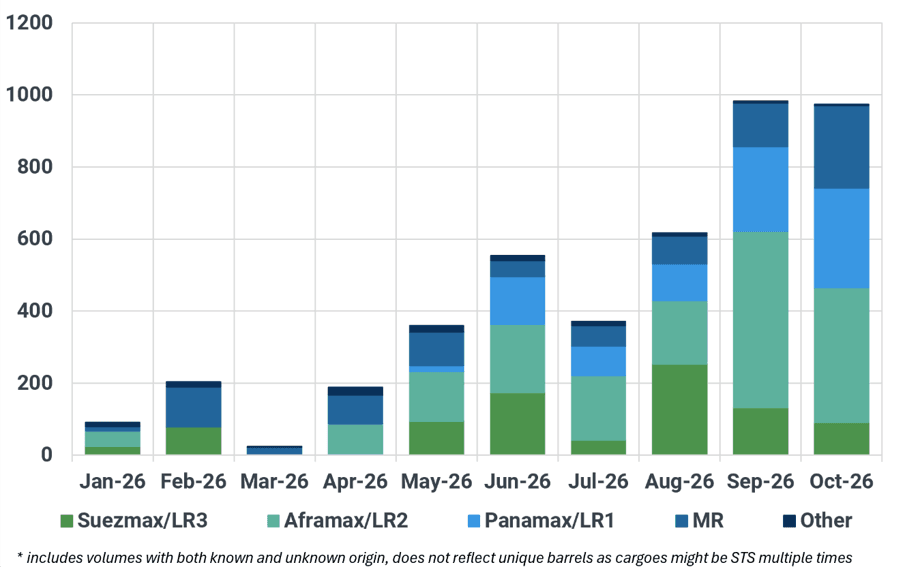
On the clean market, MEG to Japan LR2 rates surged by $5.36/bbl m/m to reach $25.05/bbl. Realised LR2 loadings in the MEG trended flat in October at 370 kbd while CPP STSs in the GoO pivoted to smaller classes, indicating that heightened regional hostilities remained the main driver of price gains, further buoyed by a spike in the dirty Aframax MEG market. The combined clean LR shuttle fleet has failed to follow the growth rates recorded in the case of VLCCs, estimated at around 30 vessels since end-August, while round voyage times have lengthened. Regional refining operations remain exposed to continued aggression, with the Houthis claiming strikes on Saudi Arabia’s Ras Tanura refinery towards the month’s end, adding further uncertainty to regional CPP cargo availability.
Outside the MEG, Med-to-Japan rates gained $7.99 m/m in October to $17.73/bbl. Ex. MEG LR2 loadings failed to repeat September’s high, settling instead at 1.5 Mbd, a 0.5 Mbd decline driven by losses in Eastern Asia and MED. Residual strength from September’s programme, however, saw the utilisation of a shrinking clean LR2 pool rise above 50% of available tonnage in the month’s first half. During October’s second half, prohibitively high LR freight rendered flows from India and East Asia to the West, as well as from the Med to the East, economically unviable. This curtailed interbasin trades, ultimately putting downward pressure on assessments over the same.
Outlook:
Our gradual normalisation scenario assumes MEG CPP flows recover toward crude transit levels, further narrowing the clean-dirty rate spread in the region. Indeed, our Middle East product balances further tighten into Q4 of the year, setting the stage for a spike in LR2 rates and thus earnings, to incentivise a reversal in clean-to-dirty switching.
Absent a sustained rise in MEG loadings, pockets of demand remain circumstantial. While East Asia to Europe jet arb appears to have reopened for LR1s, the Continent has exited its seasonal jet demand peak, capping upside. West-to-East naphtha flows appear more supported, as Eastern Asia naphtha balances tighten into Q4, leaving a window of opportunity for rates before increased procurement from Russia limits support for commercial freight. That being said, several cracker turnarounds in South Korea and Thailand through November and December add a further obstacle. Any isolated spike in ex MEG likely to be short-lived as freight eventually bites into arbitrage incentives and cargoes downsize to MRs.
GoO Clean STS volumes by loading vessel class (kbd)
Source: Kpler
MR
Across October, Atlantic MRs benefited from easing tonnage pressure. Uncompetitive LR2 rates saw some West-to-East flows downsize to MRs, while a record number of WoS MRs have shifted to dirty trades, causing a 12% drop in the basin’s clean MR employment from August’s high.
UKC-to-USAC rates gained $1.43/bbl to $3.92/bbl in October, as supply-side momentum offset the effect of a 150 kbd m/m decline in the region’s MR loadings. Long-haul trades avoided significant declines as weaker demand from a lengthening WAF and to a lesser extend MED market freed up additional barrels for LatAm. CPP loadings from Russia’s Western ports recovered by 100 kbd m/m to 500 kbd, with Russian Baltic rates doubling in the second half of October (Argus), lengthening NWE’s cargo lists. Across the Atlantic, USG-to-UKC MR rates gained $3.94/bbl m/m to $11.20/bbl. The partial return of Saudi barrels to Europe pivoted USG barrels towards LatAm and most notably Brazil, currently tracking a record of 300 kbd across the month.
South Korea to Singapore MR rates rose $1.19/bbl to $5.93/bbl, as firmer South Korean output helped mitigate weaker Chinese loadings, keeping the region’s exports flat m/m at 1.5 Mbd. At 1.4 Mbd, Middle Eastern and Indian exports emerged as the main tailwind for EoS MRs, with India’s MR demand rising to new records in H2 of the year, following the country’s rise as a swing supplier for MEG-dependent import regions.
Outlook:
The role of the USG as a swing supplier for the Atlantic basin is challenged by the return of Red Sea barrels to Europe, as well as increasing Russian supplies to LatAm and MED, lowering the floor for TC14 rates. Both Saudi and Russian refineries, however, remain vulnerable to further attacks, with our revised balances postponing a notable rise in the latter’s exports for early 2027.
The outlook appears more optimistic in the East, where China’s larger-than-expected fourth batch of fuel export quotas could lift November–December exports, as long as domestic stock requirements are fulfilled. The rise in South Korea’s diesel export ceiling from 100% to 110% of year-ago volumes promises to add 200-250 kt per month to the country’s Q4 cargo lists, equal to approximately 5 MR cargoes. Growth in East Asian volumes, however, could be offset by declining Indian exports amid seasonal demand peaks, partly mitigated by replacement South-East Asian flows into long-hauls to the West Indian Ocean.
With the Pacific and Atlantic earnings baskets now in parity, migration economics narrow, though the described shift in the market’s momentum to the East could eventually reopen the spread.
Change in Clean MR employment in the WoS
Source: Kpler

See why the most successful traders and shipping experts use Kpler