Plunging Atlantic rates reprice midsizes into West-East trades
Across crude and clean tanker segments, rates broadly fell this week under pressure from easing geopolitical premiums, narrower transatlantic arbitrage, and softer cargo demand. While VLCC and clean MR benchmarks face ongoing or slight near-term declines, oversold Atlantic Suezmax and Aframax routes show signs of finding a floor and rebounding alongside recovering European intake.
Market & Trading Calls
MEG–China (TD3C): Bearish | Rates dropped to $35.60/bbl on thin Hormuz fixing and de-escalation hopes. Benchmarks should drift lower next week as regional vessel supply expands around the Gulf of Oman.
USG–China (TD22): Bearish | Rates fell to $29.25/bbl amid limited Asian export demand. Despite low regional VLCC supply, rates are expected to soften slightly next week to stay competitive against sliding Suezmaxes.
WAF–UKC (TD20): Bullish | Rates dropped 40% to $11.01/bbl this week as Atlantic arbitrage narrowed. After leveling off, rates are projected to recover next week, supported by improved competitiveness and tighter Western fleet supply.
USG–UKC (TD25): Bullish | Aframax rates plunged to $11.71/bbl on a narrower Brent-WTI spread. Rates should find a floor next week and rebound alongside recovering European intake and firmer larger-tonnage markets.
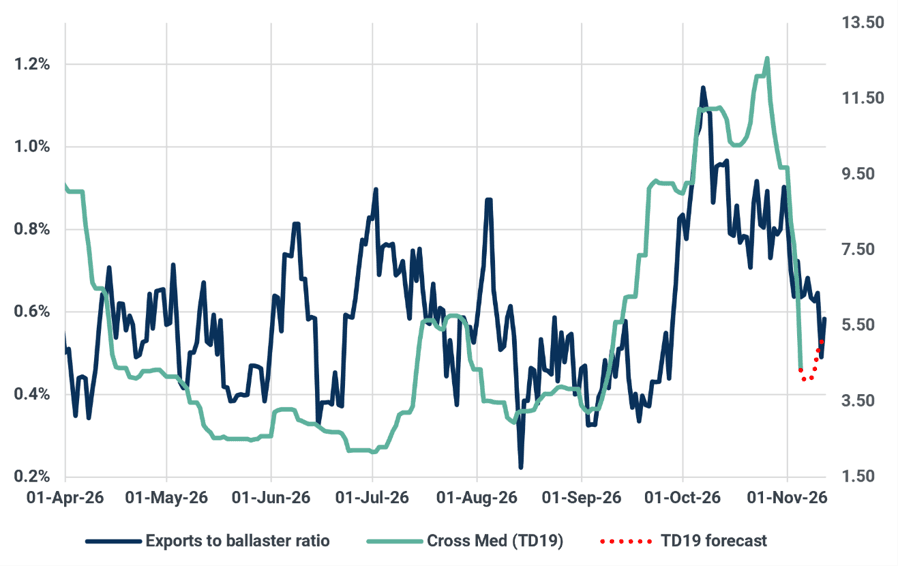
Cross Med (TD19): Bullish | Rates tumbled to $4.32/bbl following broader market contagion. With the correction largely done and cargo flow healthy from Ceyhan and Sidi Kerir, rates are likely to bottom and rise slightly.
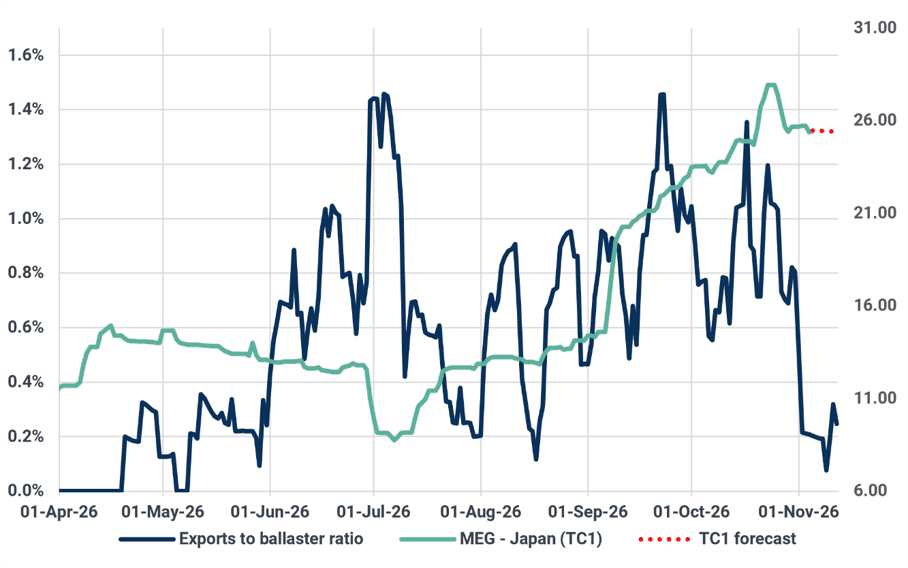
MEG–Japan (TC1): Bearish | Rates held flat at $25.45/bbl amid election pauses and SoH caution. Freight levels are expected to face gentle downward pressure as LR2s adjust to a softening dirty complex.
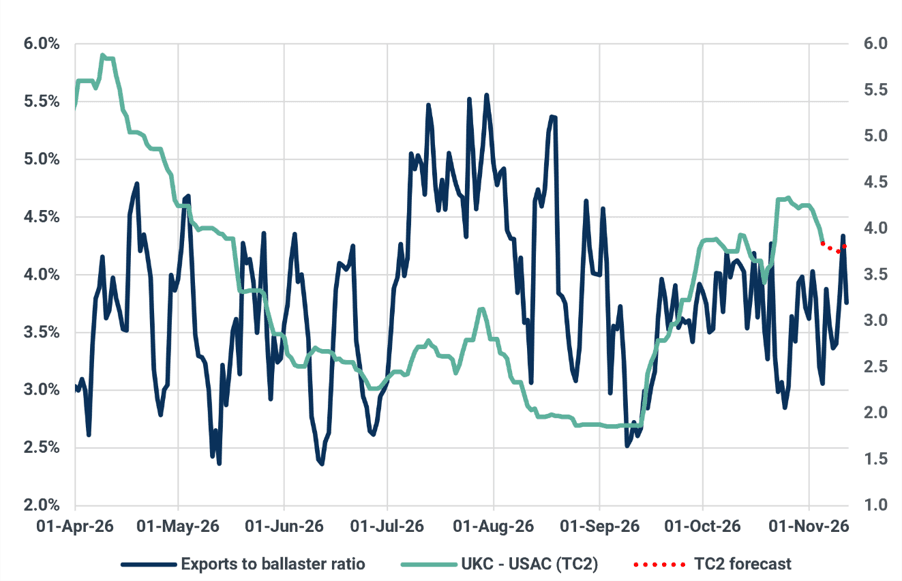
UKC–USAC (TC2): Slightly bearish | Rates dropped to $3.84/bbl on weakening transatlantic gasoline demand and stagnant supply. Rates are forecast to continue declining, though tightening regional tonnage balances should moderate the pace of losses.
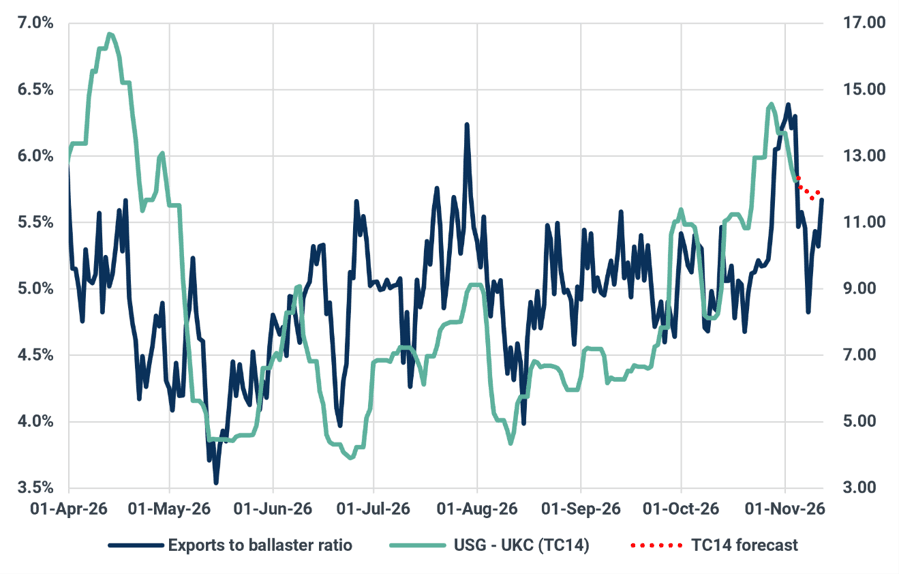
USG–UKC (TC14): Bearish | Rates fell to $12.33/bbl as Atlantic middle distillate pull eased. Downside pressure remains likely next week given current balances, though European refinery outages and fragile Russian runs may begin offering some resistance.
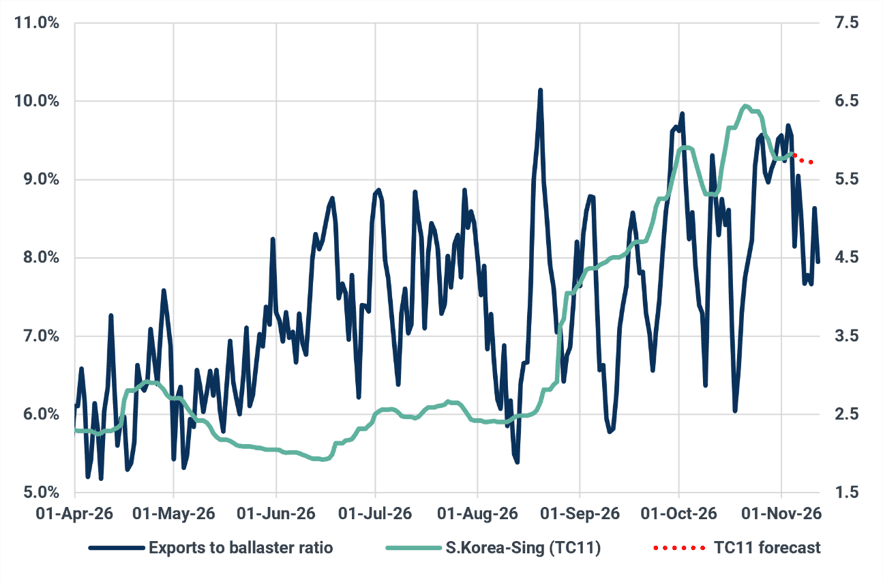
Korea–Singapore (TC11): Bearish | Rates slipped to $5.83/bbl as regional loading activity softened. A counterseasonal lengthening in APAC position lists and loosening tonnage balances point toward lower rates next week.
VLCC
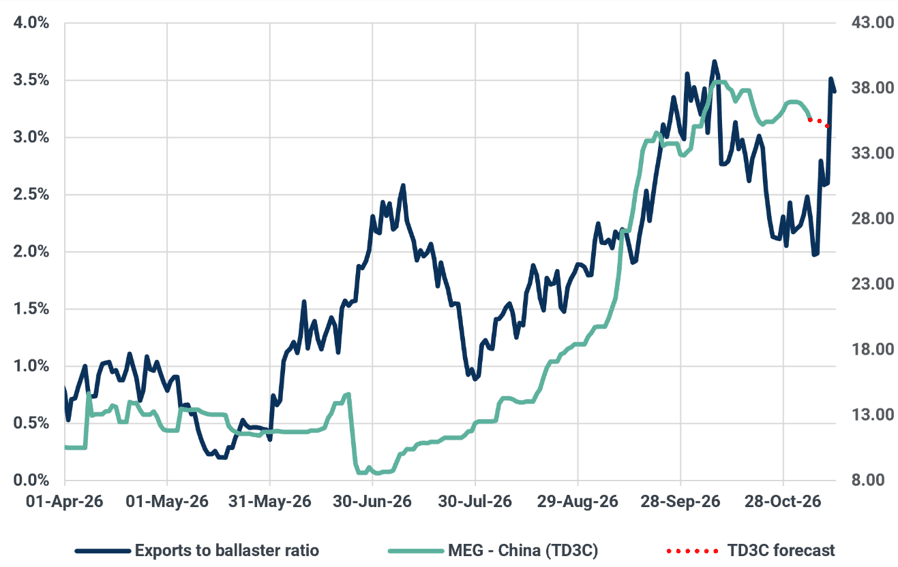
MEG – China (TD3C)
MEG to China VLCC rates fell $1.22/bbl w/w, from $36.82/bbl to $35.60/bbl, after peaking at $36.97/bbl on 30 October. Price discovery remains thin for direct Hormuz loadings are low and privately fixed. Hormuz clearance averaging 11.7 mbd, about 69% of the pre-war level, and tanker crossings near 11 a day versus 50 before the war. Iran reportedly shortened its proposed reopening timeline from seven days to two, conditional on prior US concessions, while the 3 November US strike on Qeshm Island kept owners cautious.
Higher-risk tankers carried 21% of October’s Mideast Gulf crude, concentrating fixing in a narrow pool of willing tonnage. The midterm results revived de-escalation hopes, pushing Brent down 16.6% since 30 October and flipping Dubai prompt spreads into contango. Gulf of Oman to China fell $1.86/bbl to $14.94/bbl, a discount of about $20.7/bbl to the MEG, as ship-to-ship exports and Fujairah and Oman loadings running 27–30% above pre-war levels keep liquidity outside the Strait. MEG benchmarks are likely to drift lower next week as supply in the region increase, particularly around the Gulf of Oman.
VLCC MEG tonnage balance ratio (%) (10MA) vs TD3C ($/bbl)
Source: Baltic Exchange, Kpler
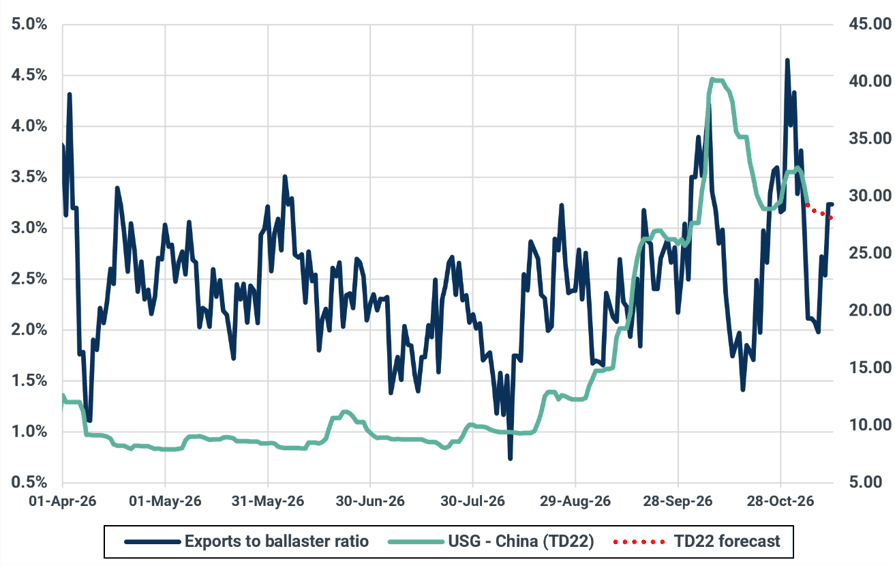
USG – China (TD22)
USG to China VLCC rates fell $1.80/bbl w/w, from $31.05/bbl to $29.25/bbl, retreating from a $32.53/bbl peak on 2 November. October US exports reached 4.2 mbd, up from 3.8 mbd in September. USGC commercial stocks sit at a three-year low and US runs are forecast to rise to 17.3 mbd in November–December, limiting barrels available for Asia. However, 40 mb of postponed SPR volumes may help keep cargoes moving.
A collapse in midsize rates this week has made Suezmaxes more competitive for exports to Asia while non-Iranian Middle Eastern supply averaged 16.5 mbd in October, with Saudi and Iraqi cargoes offered at steep discounts to Chinese refiners. Brazilian and Guyanese medium sweet barrels have struggled to clear as buyers favour Middle Eastern grades. VLCC supply in the West remains low, but rates are likely to soften slightly next week in order to compete with weaker Suezmaxes.
VLCC US Gulf tonnage balance ratio (%) (10MA) vs TD22 ($/bbl)
Source: Baltic Exchange, Kpler
Suezmax
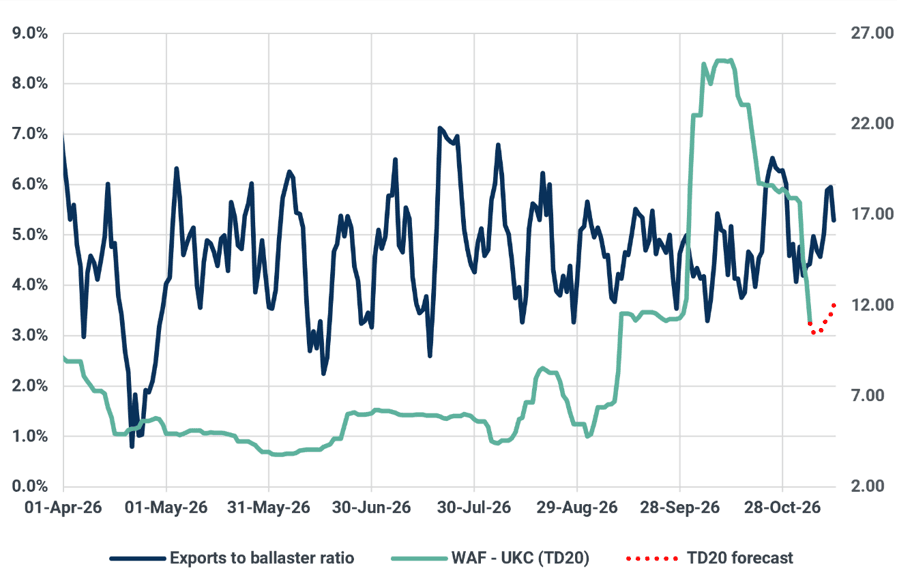
WAF – UKC (TD20)
WAF to UKC Suezmax rates fell $7.27/bbl w/w, from $18.27/bbl to $11.01/bbl, a 40% decline that accelerated into the end of the week.
US crude flows to Europe reached 1.6 mbd in October, up about 200 kbd m/m, helped by a wide Brent–WTI spread, while Guyana sent 64% of its Q3 exports to Europe and Brazilian volumes there doubled. WTI dropped more than $10/bbl over the week to about $90/bbl, narrowing the Brent–WTI spread to roughly $7.50/bbl from $13.50/bbl at end-October and eroding export economics, although this is set to impact Aframaxes more significantly.
Long-haul pull of Atlantic barrels to Asia is fading as Chinese refiners favour cheaper Middle Eastern barrels as spot premiums collapse, and Saudi Arabia’s return to Persian Gulf terminals has restored supply to Asia. However, the slump in rates this week has made Suezmaxes increasingly competitive for these long haul routes compared with VLCCs. The number of Suezmaxes in the East continues to rise, keeping the active fleet in the West under pressure. It will also help re-open short haul demand. We expect rates to level off in the coming days and then rally next week.
Suezmax WAF tonnage balance ratio (%) (10MA) vs TD20 ($/bbl)
Source: Baltic Exchange, Kpler
Aframax
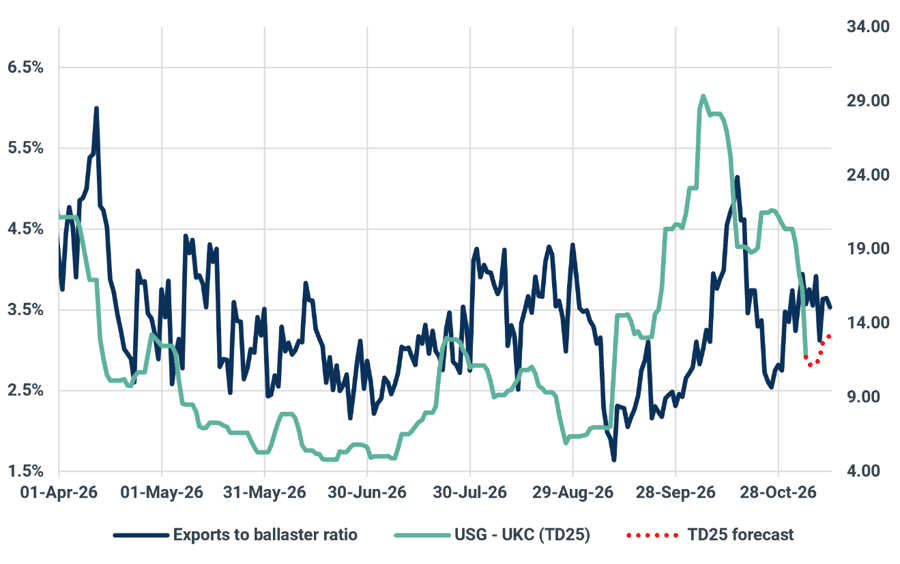
USG – UKC (TD25)
USG to UKC Aframax rates fell $9.05/bbl w/w, from $20.75/bbl to $11.71/bbl, with $4.61/bbl of the decline coming on 5 November alone. The narrower Brent–WTI spread has weakened the transatlantic arbitrage just as WTI loses ground to competing grades. Feedstock flows into the Gulf are also shrinking. US imports of Venezuelan crude fell from 593 kbd in August to 477 kbd in October, and combined imports from Venezuela, Colombia, Ecuador and Mexico dropped to about 980 kbd, trimming Caribbean–USGC Aframax demand. US heavy sour runs are near capacity at 3.8-4.0 mbd, so record Canadian supply keeps WCS discounts near $30/bbl rather than pulling more Latin American barrels. High freight has also blocked re-exports from the USGC. Support should come from Europe, where crude intake is set to recover as turnarounds conclude and US exports to the region are likely to stay elevated into year-end. Rates should find a floor next week and then be lifted by the still firm VLCC market and expected rally in Suezmax rates.
Aframax US Gulf tonnage balance ratio (%) (10MA) vs TD25 ($/bbl)
Source: Baltic Exchange, Kpler
Cross Med (TD19)
Cross-Med Aframax rates fell $5.81/bbl w/w, from $10.12/bbl to $4.32/bbl, with $2.07/bbl lost on 5 November alone as contagion from the Atlantic dirty complex and falling flat prices weighed on sentiment. Regional fundamentals are firmer. Ceyhan crude loadings rose 55% m/m to 463 kbd in October, with Iraqi pipeline throughput up nearly 70%, adding cargoes in the Eastern Med. Sidi Kerir loadings exceeded 2 mbd in recent weeks, as the Houthi risk in the Red Sea has pushed almost all Saudi West Coast exports toward the Suez corridor, keeping Eastern Med activity elevated, though most of that volume moves on larger tonnage. With the sharp correction largely complete and the cargo list supported by Ceyhan and returning refinery demand, rates are likely to bottom out next week before rising slightly.
Aframax Med tonnage balance ratio (%) (10MA) vs TD19 ($/bbl)
Source: Baltic Exchange, Kpler
LR
MEG – Japan (TC1)
MEG to Japan LR2 rates traded largely sideways over the review period, gaining $0.04/bbl w/w to $25.45/bbl. The market has largely come to a standstill in anticipation of the US midterm election result, with the US military warning against unnecessary transits through the SoH and advising vessels to allow for additional transit time ahead of a potential escalation. Indeed, hopes over progress in US-Iran diplomatic talks over the weekend were soon cut short, following a fresh strike on Iran’s Qeshm Island on 3 November. Amidst the above, outbound CPP transits through the SoH have trended lower over the past weeks, with no recorded cargo thus far in early November, though future revisions are likely to see this figure settle higher. The ramp-up of refinery runs in the MEG continues to lag crude production, preventing cargo lists from hitting a tonnage shortfall and postponing any significant volatility in freight levels.
Outside the MEG, MED-to-Japan rates lost an additional $2.62/bbl, settling at $13.0/bbl. East-to-West middle distillate trades are challenged by the end of peak jet demand in Europe, allowing the Continent to focus on short-haul barrels from the USG, Dangote and the wider Middle East. The east-west arbitrage is expected to remain open as LR2 freight adjusts lower on a retreating dirty market.
LR2 MEG tonnage balance ratio (%) (10MA) vs TC1 ($/bbl) .
Source: Baltic Exchange, Kpler
MR
UKC – USAC (TC2)
The momentum in Atlantic MRs came to a halt as we moved into November, starting with the UKC market where benchmark rates to USAC fell by $0.38/bbl w/w to $3.84/bbl. Seasonal pressure is likely to continue creeping in regional assessments as US gasoline import demand wanes off, while NWE supplies stagnate on ongoing maintenance. Indeed, RBOB gains over the review period outperformed those of USG cracks, further narrowing the financial incentive of transatlantic flows. UKC MR loadings averaged 1.3 Mbd in November’s early days versus 1.4 Mbd across October.
At the same time, the supply-side support analysed in our past publications has started to subside. With the Pacific and Atlantic MR earnings baskets now in parity, migration economics narrow. The correction in LR2 rates is likely to see the class reclaim West-to-East trades from MRs, further preventing the latter’s eastbound positioning. Finally, the recent correction in dirty Atlantic midsizes is likely to discourage further MR tonnage from moving into dirty trades. We expect rates to continue declining, although tightening balances suggest the pace of losses will moderate.
MR UKC tonnage balance ratio (%) (10MA) vs TC2 ($/bbl)
Source: Baltic Exchange, Kpler
USG – UKC (TC14)
Broadly in line with their NEW counterparts, USG to UKC MR rates shed $1.95/bbl over the analysis window, following three consecutive sessions of gains, ending the week at $12.33/bbl. November balances suggest easing pull on USG Middle Distillate barrels from both the North-East Atlantic and Brazil, which over October emerged as the main long-haul outlet for PADD 3 volumes.
Yet upside risk persists. Recent attacks on the Yaroslavl and Ryazan refineries challenge further gains to the gasoil export levels recorded from Russia over October, potentially encouraging the pull of USG volumes into the MED. The release of SPR volumes across Europe is contrasted with domestic CDU capacity remaining offline in November, tempering the downward pressure on the Continent’s import demand. As a result, while tonnage balances suggest further downside for rates, resistance should start to build as we move into the month’s second fortnight.
MR US Gulf tonnage balance ratio (%) (10MA) vs TC14 ($/bbl)
Source: Baltic Exchange, Kpler
Korea – Singapore (TC11)
South Korea to Singapore MR rates levelled off over the reporting period, with assessments bottoming out at $5.79/bbl before recovering to $5.83/bbl, still ending the week with a $0.07/bbl loss. Early November has seen Eastern Asia’s MR loadings settle lower at 1.65 Mbd, with losses out of China and Japan, only partly offset by higher South Korean output. Estimates on the Chinese export levels remain highly speculative, with inventory requirements emerging as a running obstacle to longer cargo lists, and the export incentive recently turning negative.
South Korea remains a more trustworthy export outlet, with the export cap increased to 110% of the year-ago level, yet at an estimated approximately 5 MR cargoes per month, support for regional rates appears limited. As noted in our last publication, Indian exports are also trending lower thus far in the month on peaking domestic demand. As a result, APAC position lists have seen a counterseasonal lengthening, resulting in loosening tonnage balances, with rates likely to follow suit.
MR Eastern Asia tonnage balance ratio (%) (10MA) vs TC11 ($/bbl)
Source: Baltic Exchange, Kpler

See why the most successful traders and shipping experts use Kpler