The 1 million TEU question: Do Gulf overland ports have the capacity?
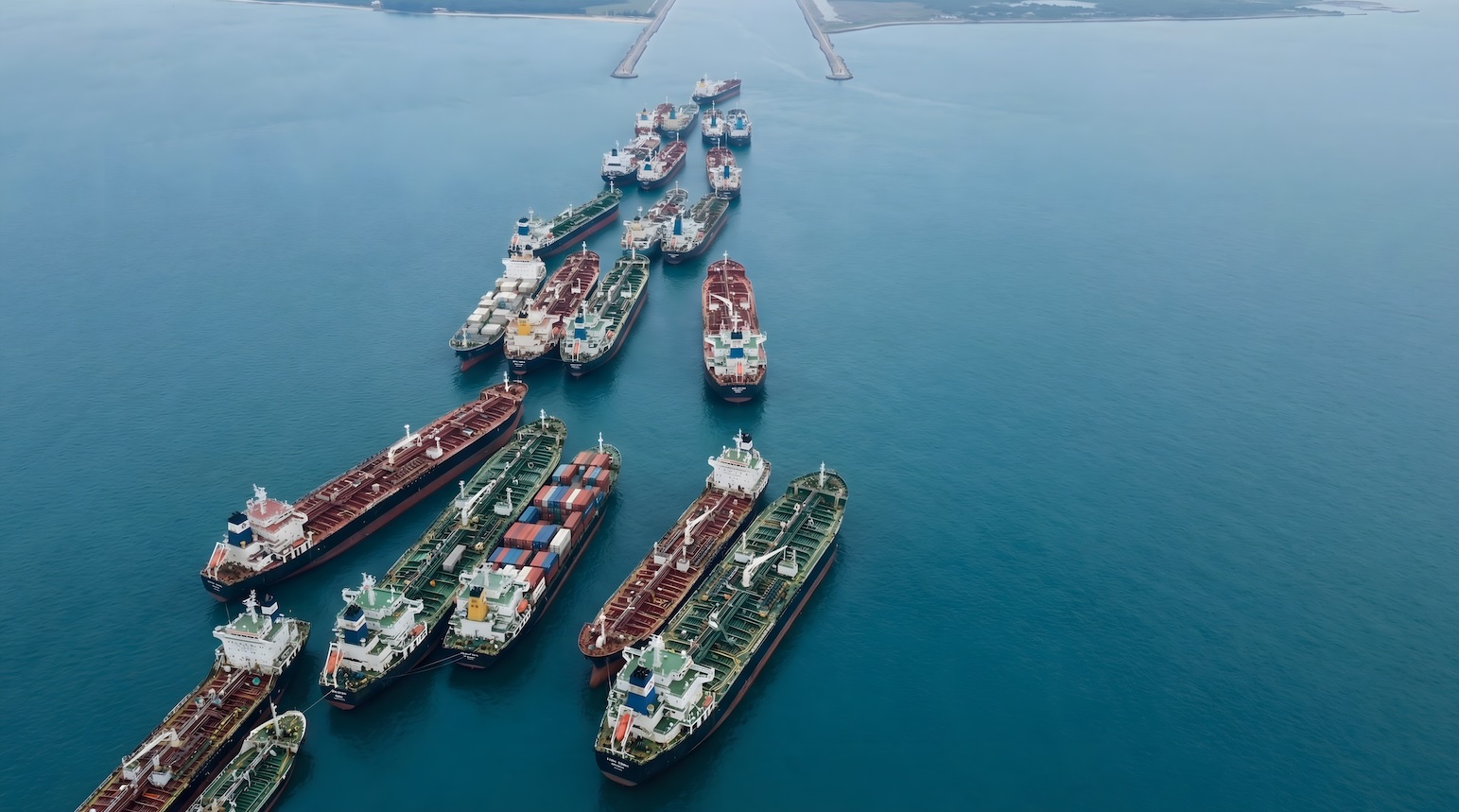
Our analysis of approximately 35,000 vessel calls reveals that alternative ports with overland connections can absorb, at best, 62% of displaced Persian Gulf cargo. At their current average throughput, they cover just 48%. This structural deficit creates an unavoidable supply chain crisis that demands predictive intelligence rather than reactive tracking.
Key takeaways at a glance
- 128 container ships are currently trapped inside the Persian Gulf, representing over 470,000 TEU of capacity
- 1.16 million TEU per week was the pre-crisis average capacity calling Gulf ports, total vessel capacity serves as a proxy for gauging the scale of displaced trade
- 489,000 TEU per week is the combined average throughput of all alternative overland-connected ports
- 38% minimum capacity gap exists even if alternative ports operate at their all-time historical peak
- Single-point-of-failure risks are already materialising, as demonstrated by the 96-hour shutdown at Salalah
Current state of maritime access
The Persian Gulf crisis has forced the global maritime industry into an unprecedented logistical bottleneck. As of late March, direct maritime access remains crippled for the majority of the world's largest shipping lines.
Recent transit attempts
COSCO made a publicised attempt to transit the Strait of Hormuz with two 19,000 TEU container vessels—the CSCL Indian Ocean and CSCL Arctic Ocean. After initially aborting and reversing course back into the Persian Gulf on Friday, MarineTraffic data confirms both vessels successfully completed their transit on Monday, March 30th at around 9 AM UTC.
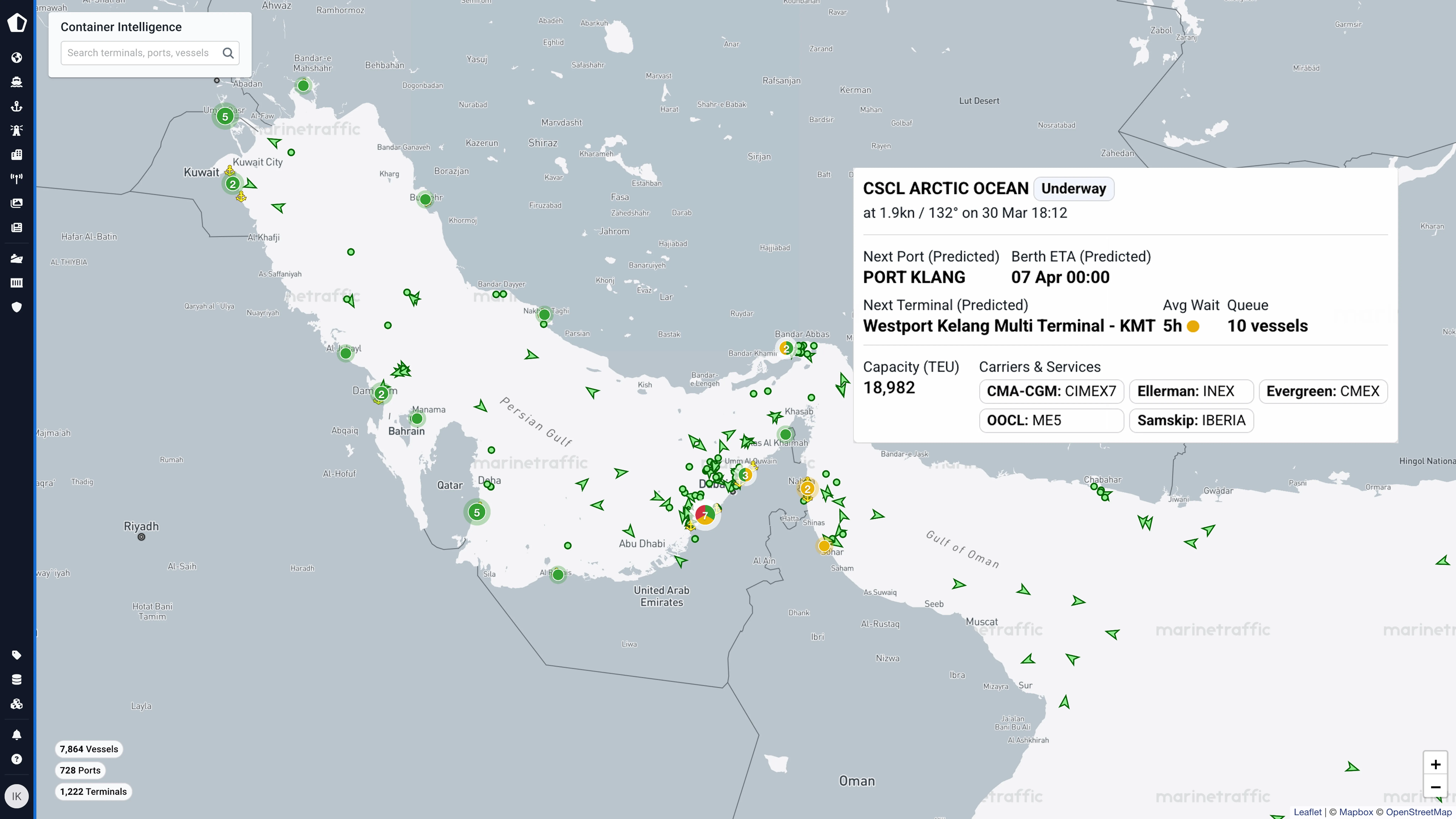
This signals potential diplomatic exemptions or shifting dynamics for specific carriers. However, the only container vessels consistently navigating the Strait are a small number of Iranian-flagged or Iranian-destined ships.
The critical question
With direct maritime access crippled for the world's largest carriers, the supply chain is asking: Can alternative ports with overland routes absorb the displaced cargo?
We analysed the data to answer this objectively.
Assessing alternative ports and overland routes
To bypass the current maritime blockade, carriers are pivoting to ports with theoretical overland trucking and rail connections.
Alternative port network
Capacity comparison – pre-crisis vs. current
The data is unambiguous. Even if these alternative ports operated flawlessly at their maximum historical capacity, they would cover only 62% of the displaced Gulf volume.
Why overland routes cannot close the gap
We observe localised surges at individual ports:
- Khor Fakkan spiked from an 11,000 TEU/week baseline to 78,000 TEU in a single week
- Fujairah is receiving new vessel calls it historically did not handle
However, the broader inland-connected group currently averages 441,000 TEU/week post-crisis—actually below their pre-crisis baseline. These ports simply lack the berth capacity and hinterland logistics to scale to Gulf-hub levels.
Single-point-of-failure risks are materialising
Relying heavily on alternative hubs introduces severe vulnerability. Over the weekend, a drone strike at the Port of Salalah in Oman damaged a ship-to-shore container crane.
APM Terminals responded by pausing operations:
- Initial 48-hour operational halt
- Subsequent 48-hour extension
- Total disruption is at least 96 hours
This incident highlights the profound fragility of current workaround routes. When overflow ports face sudden, prolonged operational halts, the theoretical capacity deficit becomes an immediate supply chain crisis.
Carrier strategies and workarounds
The top five carriers—MSC, Maersk, CMA CGM, COSCO, and Hapag-Lloyd—are deploying highly fragmented strategies based on their unique network strengths and risk tolerances.
Current carrier approaches
Carrier impact analysis: Top 5 operators
Inside Gulf TEU per week for each major operator
.webp)
Challenges inherent in these adjustments
- Alliance shifts and bottlenecks: The Gemini alliance (Hapag-Lloyd and Maersk) relied on Salalah as a cornerstone for their landbridge strategy. The recent 96-hour operational halt severely impedes this workaround, creating instant bottlenecks for diverted cargo.
- Feeder network strain: CMA CGM's feeder solution moves cargo through multiple transshipment points, adding complexity, cost, and transit time.
- Inland capacity constraints: The common denominator across all strategies is that cargo moves off vessels and onto inland road networks, where capacity is already heavily strained.
The need for predictive intelligence in supply chain management
The data is clear: overland infrastructure cannot physically absorb the displaced Gulf cargo. As diverted container ships overwhelm secondary hubs, severe congestion will inevitably cascade through global supply chains.
Why traditional tracking falls short
In this severely constrained environment, relying on aggregated, port-level averages creates a critical strategic blind spot. Traditional milestone tracking tells you where cargo was, not where it will encounter the next bottleneck.
The predictive intelligence advantage
To mitigate these structural deficits and navigate highly fragmented carrier networks, supply chain leaders must pivot from reactive milestone tracking to predictive container intelligence.
By integrating independent, terminal-level data and six-week forward-looking arrival forecasts—capabilities we provide at Kpler—organisations gain the empirical foresight required to:
- Dynamically right-size safety stock before shortages materialise
- Optimise inland transport allocation across strained networks
- Proactively reroute cargo before it hits a bottleneck
- Protect working capital tied up in delayed inventory
The mathematical reality
The physical capacity to seamlessly absorb this displaced volume overland simply does not exist. Consequently, integrating objective, predictive data is the only mathematically sound strategy to protect margins and defend long-term supply chain resilience.
Moving from reactive to predictive
The Persian Gulf logistics crisis exposes a fundamental truth: global supply chains operate on thin margins of redundancy. When primary routes fail, secondary infrastructure cannot scale to compensate.
At Kpler, we help supply chain leaders navigate this reality by providing independent, terminal-level data and predictive arrival forecasts. This empirical foresight transforms reactive firefighting into proactive risk management.
Frequently asked questions
What are the implications of the current crisis for global shipping?
The crisis creates a structural capacity deficit of at least 38%—and likely higher. This means extended transit times, increased freight costs, inventory shortages, and cascading delays across global supply chains. Companies relying on Gulf-origin cargo face immediate operational disruptions.
How can companies prepare for similar disruptions in the future?
Organisations should invest in predictive container intelligence platforms that provide terminal-level visibility and forward-looking arrival forecasts. Building optionality into carrier contracts, diversifying supplier bases, and maintaining dynamic safety stock policies also reduce exposure to single-point-of-failure risks.
Can the alternative port network expand capacity quickly?
No. Port infrastructure—berths, cranes, storage yards, and hinterland connections—requires years of capital investment to expand meaningfully. The current crisis demands immediate solutions; infrastructure expansion cannot address the present deficit.
Which carriers have the most resilient workarounds?
Carriers with diversified feeder networks and multiple landbridge options demonstrate greater resilience. However, all major carriers face constraints when alternative hubs experience disruptions, as the Salalah incident demonstrated.

See why the most successful traders and shipping experts use Kpler
Protect your supply chain resilience