EXPLAINER: Why Kharg Island is the backbone of Iran’s oil economy – and its greatest vulnerability
Donald Trump’s 13 March statement that U.S. forces struck military targets on Kharg Island while sparing oil facilities has thrust the small Gulf outpost at the heart of Iran’s oil economy into the spotlight.
A post by U.S. President Donald Trump on 13 March saying U.S. forces had targeted military installations on Iran’s Kharg Island, while leaving oil infrastructure untouched, has focused global attention on a small coral outcrop that sits at the center of Iran’s oil economy. For oil markets and policymakers, Kharg is the most critical node in Iran’s seaborne crude trade: any sustained disruption there would immediately threaten most of the country’s export capacity and send shockwaves through regional and global supply chains.
Kharg Island remains Iran's most vital—and now most vulnerable—economic asset, situated deep within the Mideast Gulf
Geography that makes Kharg indispensable
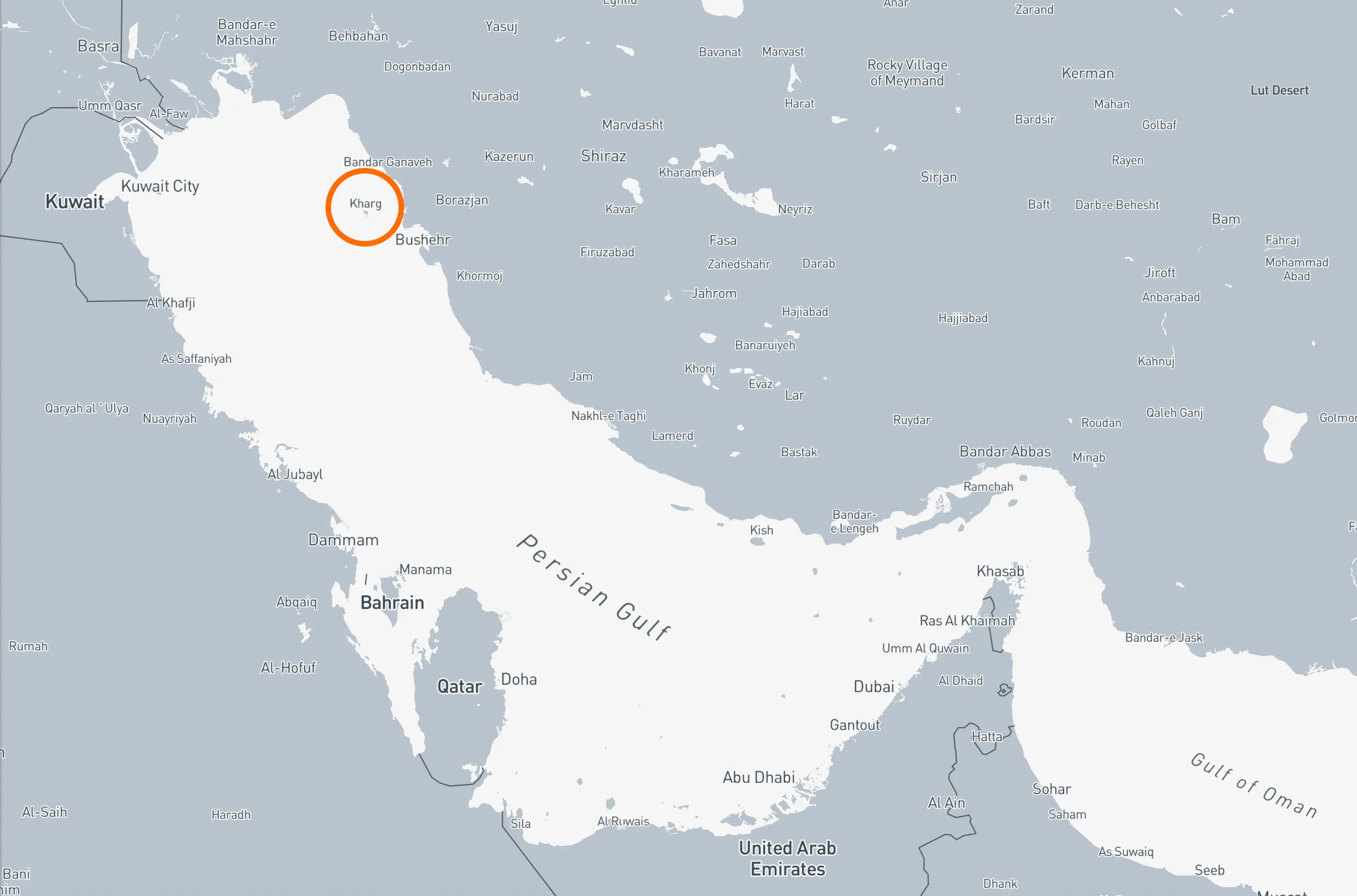
Kharg Island lies in the northern Middle East Gulf, around 25 km off Iran’s coast and more than 480 km northwest of the Strait of Hormuz. Its importance begins with geography. Much of Iran’s coastline is too shallow for the world’s largest tankers, but Kharg is surrounded by naturally deep water, allowing VLCCs (the largest of oil tankers) to berth directly and load cargoes of up to roughly 2 Mbbl.
Iran has spent decades building pipelines from major inland producing areas to the island, turning it into the main collection, storage and loading point for crude before it moves to international buyers.
Kpler data shows the NIOC Kharg Island terminal has total storage capacity of around 31 Mbbl. As of 7 March, inventories stood at nearly 18 Mbbl, or about 58% of capacity, giving Iran operational buffer it can use to smooth exports when production or logistics are disrupted.
Kharg’s deepwater location allows VLCC loading — something much of Iran’s coast cannot do.

Oil exports remain central to Iran’s economy
Kharg’s importance is not only logistical. It is economic. Iran remains structurally reliant on oil exports, which serve as its main source of foreign currency and a core pillar of the state budget. That dependence has persisted despite years of sanctions. Kpler data shows Iran increased its seaborne crude outflows by 9% between 2023 and 2025, reaching a peak of about 1.68 Mbd last year. That means the security of export infrastructure is not a secondary issue for Tehran: it sits close to the center of the country’s fiscal and external-account stability.
This is what makes Kharg so sensitive. Any sustained disruption would not simply delay cargoes. It would threaten the flow of export revenue that underpins Iran’s ability to earn hard currency, fund imports and support state spending.
Iran’s export system runs through Kharg
Kpler data underscores how concentrated Iran’s export system has become around that single island. Over the last 12 months, around 94% of Iran’s crude exports originated from Kharg. Of the country’s roughly 587 Mbbl (1.61 Mbd) of crude exports nationwide, around 553 Mbbl (1.52 Mbd) passed through Kharg alone.
The terminal has remained active despite the recent military escalation. In the first two weeks of March, Kharg handled at least eight crude loadings totaling nearly 14 Mbbl, including cargoes loaded by the Serena and Sinopa on 11 March, just two days before Trump’s post.
The facility’s storage role also matters. Kpler data indicates inventories fell by about 8.03 Mbbl in February, suggesting Tehran has recently used Kharg’s tank farm as a buffer to keep barrels moving even as regional disruption intensified. This is consistent with last month's multi-year high crude loadings observed just before the war, as confirmed by Kpler.
Iran's monthly crude and condensate exports in kbd, by origin installation

China remains the anchor buyer of Iranian crude
The oil leaving Kharg is overwhelmingly tied to China, which remains the primary buyer of Iranian crude and condensate.
China monthly imports of Iranian crude/co in kbd, by destination port

Kpler’s China import data, including Iranian barrels, condensate and EOPL-linked proxy flows, shows Chinese intake has recently ranged between roughly 1.1 Mbd and 1.7 Mbd. Flows were 1.57 Mbd in February and 1.47 Mbd in March, based on the latest Kpler data.
The main receiving points have been Dongjiakou, Qingdao and Lanqiao, underscoring how concentrated Chinese buying is in a handful of coastal refining hubs, primarily destined for independent "teapot" refineries in Shandong Province.
That trade is also visible at sea. Kpler satellite-based tracking shows around 173.6 Mbbl of Iranian crude and condensate currently on the water. Of that total, 60.9 Mbbl is in the Singapore Strait, 32.2 Mbbl in the Yellow Sea, 22.1 Mbbl in the South China Sea, and 31.2 Mbbl remains in the Middle East Gulf, according to Kpler's analysis as of 13 March.
The presence of more than 30 Mbbl still inside the Gulf system highlights how much Iranian oil remains exposed to developments in the region before reaching Asian markets.
Limited alternatives to Kharg
Iran has tried to build alternative export routes, but none comes close to replacing Kharg.
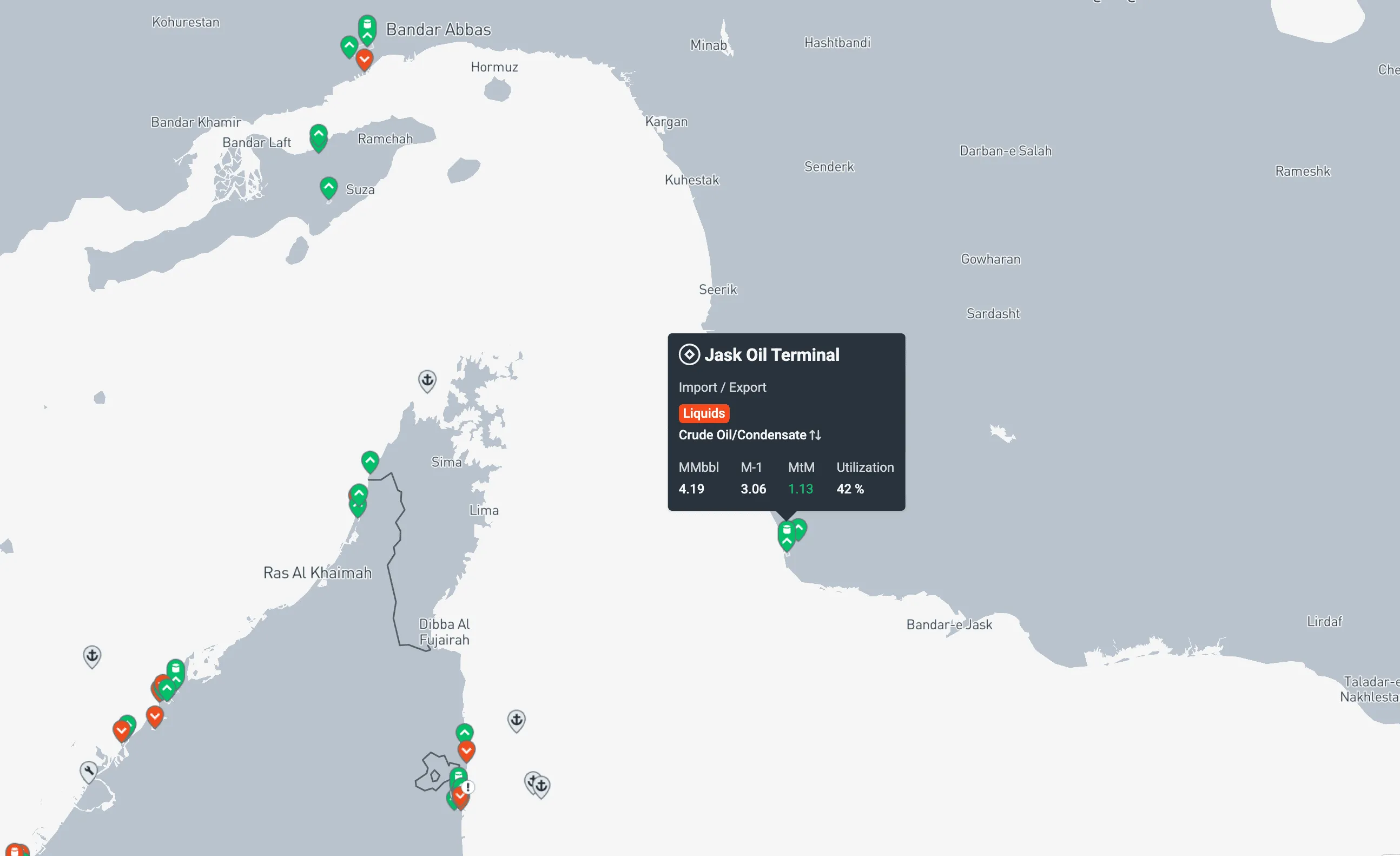
The most important is Jask, located on the Gulf of Oman outside the Strait of Hormuz. Strategically, this terminal offers Iran a way to export crude without relying on the Gulf chokepoint.
Operationally, however, it remains far smaller.
Kpler data shows the tanker Dore loaded 2 Mbbl at Jask on 7 March, the first crude loading there since September 2024. The Goreh-Jask pipeline, which feeds the terminal, was designed for up to 1 Mbd, but its effective capacity is widely estimated at closer to 0.3 Mbd, with historically low utilization. By comparison, Kharg alone has historically exported around 1.5-2.0 Mbd. Other Iranian export points, including Lavan and Sirri, account for only marginal volumes in comparison.
The Jask oil terminal allows Iran to export crude from the Gulf of Oman, bypassing the Mideast Gulf
A strategic vulnerability for Iran’s oil economy
Kharg is both the backbone of Iran’s export system and its clearest single point of failure.
Because the island sits inside the Gulf, any escalation affecting shipping, military activity or insurance costs in those waters can directly disrupt Iran’s main oil artery. If Kharg were seriously damaged or shut for a sustained period, Tehran would not just lose one loading point—it would lose the terminal that handles nearly all of its seaborne crude exports, sharply constraining revenue and its ability to keep supplying China.
Jask offers a strategic backup route, but not at anything close to the scale needed to replace Kharg. That leaves any threat to the island with consequences not only for Iran’s export revenues, but also for Asian supply chains and global oil-market risk.
Market insights you can actually trust
Kpler delivers unbiased, expert-driven intelligence that helps you to track critical crude oil market developments for your own analysis. Our precise forecasting empowers smarter trading and risk management decisions. In times of conflict and geopolitical uncertainty, our real-time data keeps you ahead of supply disruptions and price volatility.
Unbiased. Data-driven. Essential. Request access to Kpler today.

See why the most successful traders and shipping experts use Kpler