

Hydro Outlook - July 2026
Contrasted weather over Europe during the past month impacts the different water basins differently. Alps storages are increasing but remain below the five-year average. The Nordics basin are increasing almost back to the five-year average. Iberia maintains a very high storage capacity. What are the expectations for July 2026?
Executive Summary
Over the last three weeks, the situation has evolved as follow:
- Alps basin: slowly increasing and 6% below the five-year average
- Iberia basin: stable around 30% above the five-year average
- Nordics basin: increasing around 3% below the five-year average
What to watch out for next month ?
- Succession of NAO+ regimes, bringing wet conditions in Norway and in Iberia, dry conditions in the Alps
- Higher than normal temperatures, playing a role in the water management all over Europe
Alps Hydro Storage
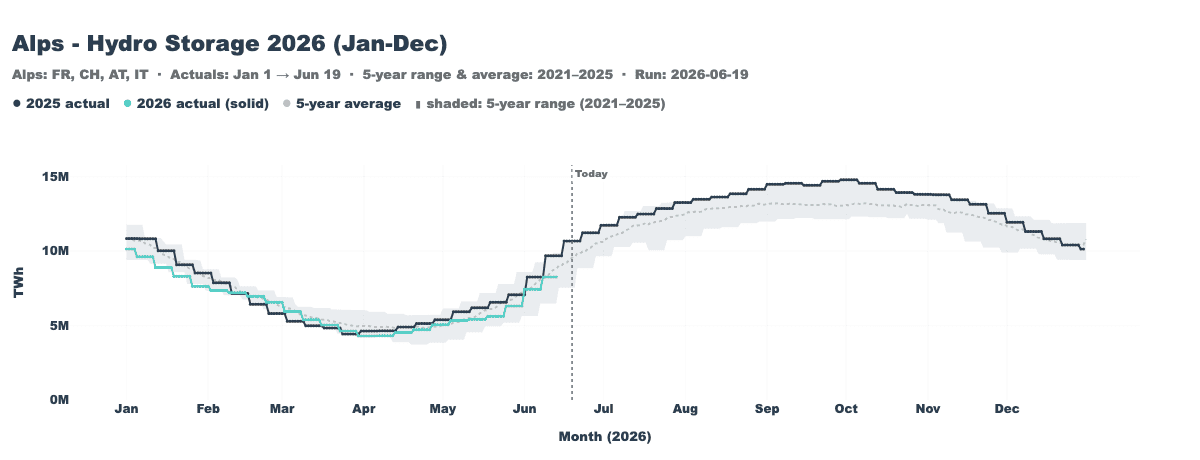
Since the last update, the warm and dry weather of the end of May and the start of June perturbed the refilling of Alpine reservoirs. As of today, Alpine reservoir levels are tracking 14% lower than 2025 year-to-date (YTD), 3% lower than one month ago.
Storage is 6% below the five-year average. The refilling is slow and might stay under the seasonal for the next coming weeks, with the warm and dry weather stagnating over the Alps now and in the coming weeks.
The dry end of May and first half of June penalised the Switzerland storage, now 7% below the five-year average. With the ongoing heatwave and anticyclonic condition, the storage will suffer like last May.
French storage is increasing, with current levels tracking 4% below the five-year average (3% higher than our last outlook). Unfortunately, the stock of snow in the Pyrenees and the Alps decreased drastically during May and as of 1 June are 75 % below the climatology levels (see Meteo France article). The ongoing heatwave and the need for water downstream might not help to replenish storage either. As a consequence, Kpler Insight maintains that the maximum level of storage for the year might be reached sooner than in previous years.
Amid higher temperatures expected to stress water asset management this summer (see our latest temperature outlook), this could fuel tighter conditions in September, potentially impacting the Q3-26 product.
Italy’s snow pack is also continuing its decline, reducing the potential of replenishment in the coming weeks. This raises concerns on the capacity of the country to increase storage during the summer and exposes the Italian mix further to gas pricing. Storage levels are increasing slowly, currently 5% below the five-year average.
Overall, following the past years’ trend and tracking the current remaining snow levels in the French and Switzerland Alps, Kpler Insight believes storage will continue to increase during July 2026 but might reach its maximum earlier than last year during Q3 2026 and stay under the last five-year average.
Iberia Hydro Storage
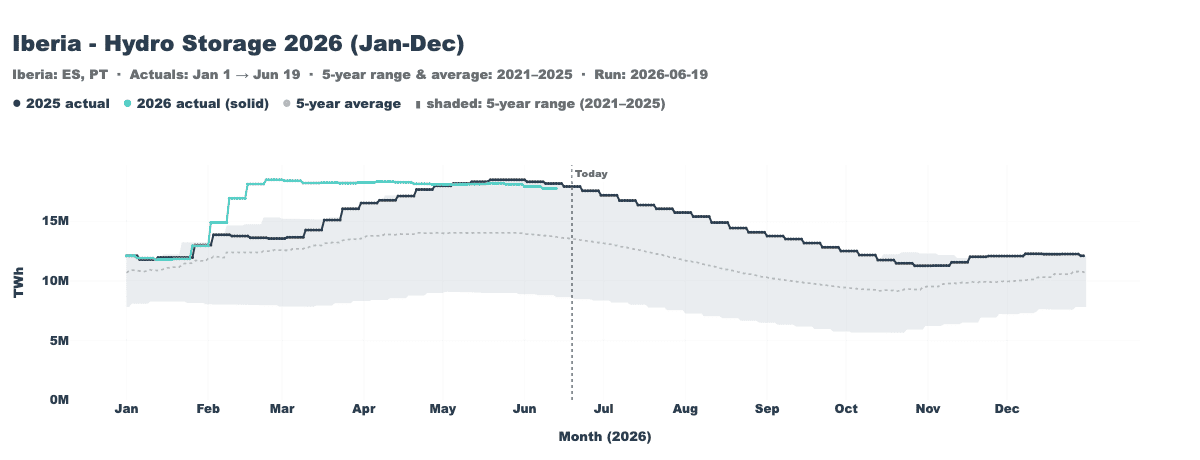
Since our last update in May, the Iberian peninsula maintains a high level of storage. It is very gradually falling and is now 2% below last year’s levels. Still the storage is 30% above the five-year average.
With the ongoing heatwave and wild fire season approaching, we believe Iberian reservoirs will remain high but continue to decrease, following last year’s curve. This should have little effect on the Spanish and Portuguese market.
Nordics Hydro storage
The storage in the Nordics has increased during the past month. It is slowly catching up with the past five-year average and is now 3% below it.
Finnish and Swedish storages have increased in the past month. However, both are 10% below the past five-year average. On one hand, Finnish storage reached its lowest level in the last five years for the period equaling 2025 levels. On the other hand, Swedish storage has increased rapidly since last month but still hasn’t caught up with the past five-year average curve.
In Norway the story is different, the southern part (NO1-NO2-NO5) has recovered and now has levels almost around the five-year average and the northern part maintains stable storage. The succession of NAO+ regime over the month helped replenish the reservoirs.
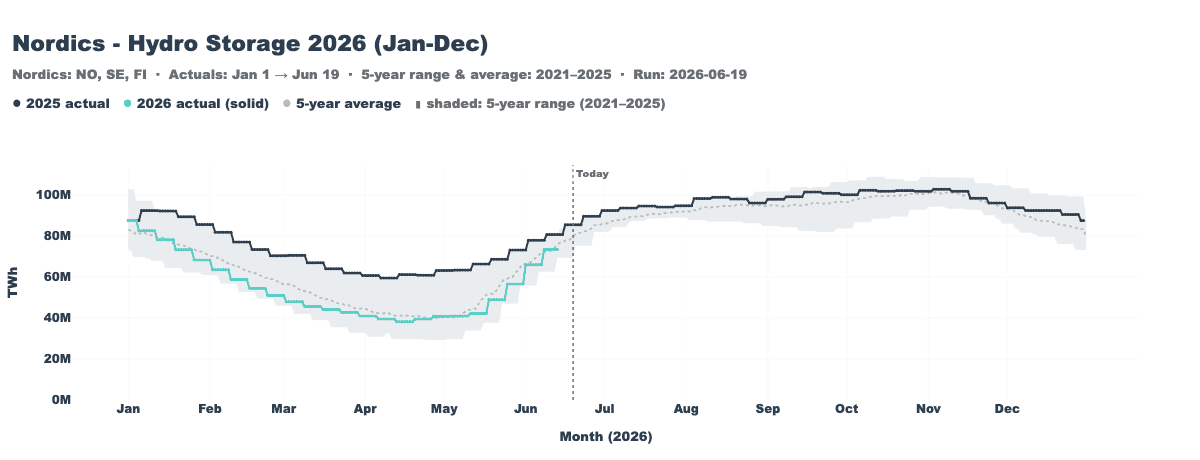
Over the coming weeks, we expect a new succession of NAO+ regimes over Europe. As stated in the knowledge pill in this article, this will benefit the reservoirs and increase the restocking potential in the south Norwegian storages.

See why the most successful traders and shipping experts use Kpler






