Libya plans rehabilitation of 220 kbd Ras Lanuf refinery
In mid-May, Libya’s NOC secured complete ownership of the 220 kbd Ras Lanuf refinery through an agreement with its Emirati partner, bringing an end to a long-running ownership dispute. The move is expected to strengthen Libya’s downstream industry, potentially reducing transport fuel imports from Europe as well as Libyan oil exports to Europe.
Market & Trading calls:
- Stable on Libya crude production for 2026/2027 around 1.35-1.4 Mbd, with potential increases thereafter.
- Conservative outlook on the speed of the Ras Lanuf rehabilitation, which could return over H2 2027.
- Decrease expected for Libyan Amna, Sarir, and Mesla grades to Europe once Ras Lanuf refinery is running at 200 kbd.
2026 has brought several promising developments for Libya's upstream sector. In late January, a major agreement was reached with TotalEnergies and ConocoPhillips to extend the Waha Oil concession through 2050. On 11 February, Libya's NOC announced the results of its first licensing round in 17 years, awarding exploration acreage to five winning companies and consortia, including Repsol-led groups, Hungary’s MOL, the Eni–QatarEnergy consortium, Chevron, and Nigeria’s Aiteo. In April, the NOC also announced three distinct hydrocarbon discoveries made in collaboration with Eni, Repsol, and Sonatrach.
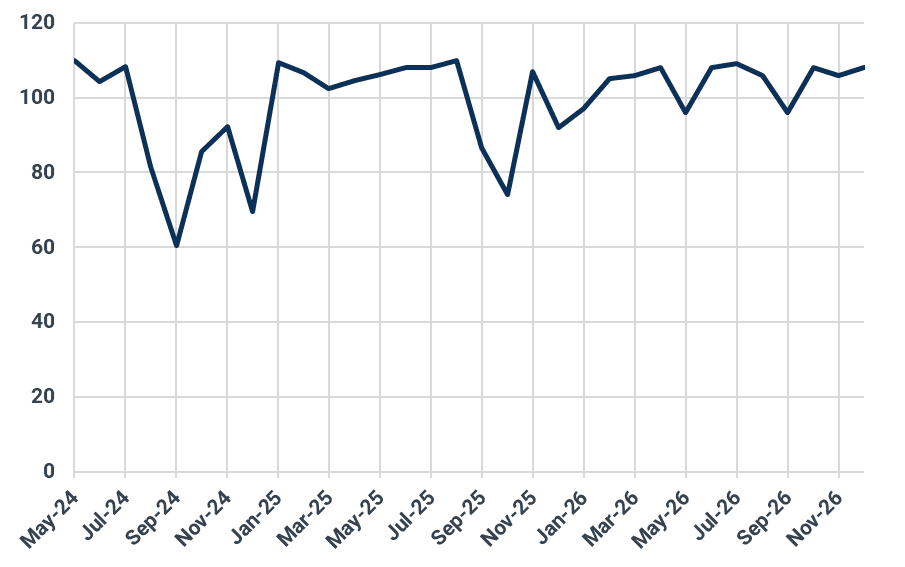
Libya's downstream sector may also soon see an expansion. We estimate that the country's refinery runs currently stand at an estimated 100 kbd, driven primarily by the Zawiya refinery, alongside smaller facilities including the Marsa El Brega (9 kbd), Sarir (10 kbd), and Tobruk (20 kbd) refineries.
Libya refinery runs outlook, kbd
Source: Kpler
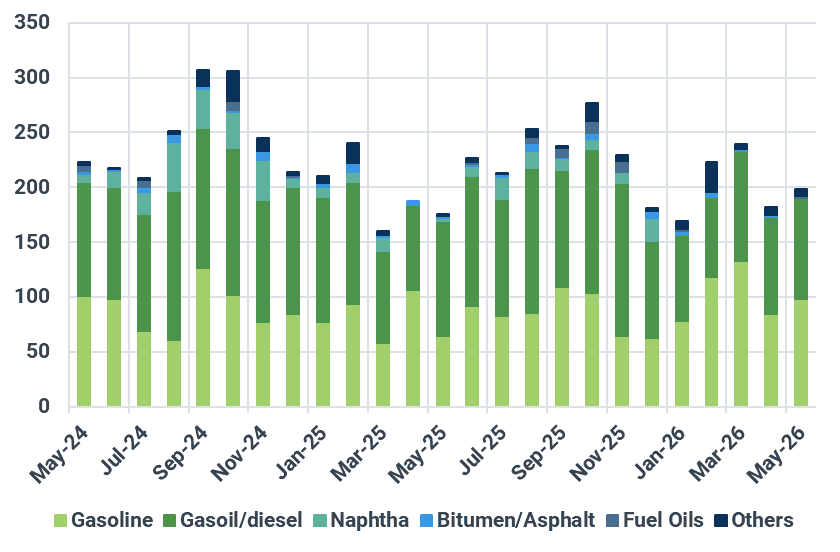
To meet domestic transport fuel demand of up to 250 kbd — comprising gasoline at 90–100 kbd and diesel at 140–150 kbd — Libya relies on importing upwards of 150 kbd of refined products. In recent months, gasoline has been sourced mainly from Italy, the Netherlands, Belgium, and Spain, while diesel imports have come primarily from Italy and Turkey.
Libya refined product imports, kbd
Source: Kpler
This import dependency could diminish significantly if plans to restart the 220 kbd Ras Lanuf refinery come to fruition. This facility has been offline since 2013, but the NOC has indicated that, following some maintenance work, a restart could be achieved within the next 6–12 months. The refinery would run on light sweet domestic crudes, including Amna, Sarir, and Mesla — grades that are currently exported at a combined 270–300 kbd, with Italy and the UK among the principal buyers. Should Ras Lanuf ramp up as planned, it is precisely these buyers that may need to seek alternative supply.

See why the most successful traders and shipping experts use Kpler