Middle East output losses hold firm despite export workarounds
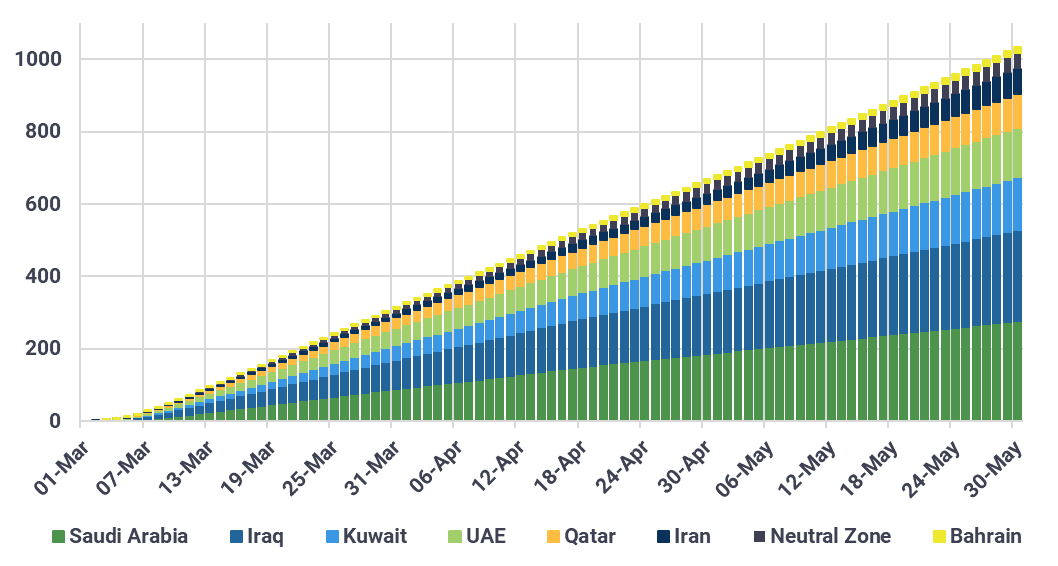
While the back-and-forth over the ceasefire continues and Washington and Tehran remain far apart on key issues needed to end the three-month-old war, at least 12.6 mbd of Middle Eastern crude and condensate production remains shut in, resulting in cumulative production losses of over 1 billion barrels at the time of writing.
With the Strait of Hormuz still firmly under Iranian control, Persian Gulf producers continue to maximise existing infrastructure to bypass the waterway while exploring alternative routes to move crude to market. However, pipeline and terminal constraints appear to have pushed exports from Saudi Arabia's Red Sea hub of Yanbu and the UAE's Fujairah close to their effective limits, with flows reaching 3.8 mbd and 1.7 mbd, respectively, in May.
In the meantime, ADNOC appears to have arranged alternative logistics since mid-April, with barrels marketed either via STS operations off Fujairah and Sohar or through direct deliveries to end buyers. Based on Kpler's tracking, around 860 kbd of crude was loaded from the Gulf of Oman in May, with a portion of these volumes likely linked to Abu Dhabi grades.
That said, while Saudi Arabia and the UAE have managed to export part of their production and benefit from higher oil prices, infrastructure bottlenecks continue to limit their ability to fully restore production, leaving at least 4.5 mbd shut in compared with pre-war levels.
With limited alternative routes for exporting Basrah crude, Iraq has turned to producers in the semi-autonomous Kurdistan region to restart output, in an effort to boost exports through the Kurdistan-Ceyhan pipeline, which have fallen sharply since the outbreak of the war as several oilfields were either shut in or operated at significantly reduced rates. However, renewed military strikes involving Iran and the US may complicate the recovery. Kpler data shows that Iraqi crude loadings from Ceyhan stood at 148 kbd in May, down from 201 kbd in April and well below Baghdad's target of raising pipeline flows to 500 kbd.
Cumulative crude and condensate supply outages by country, Mbbls
Source: Kpler
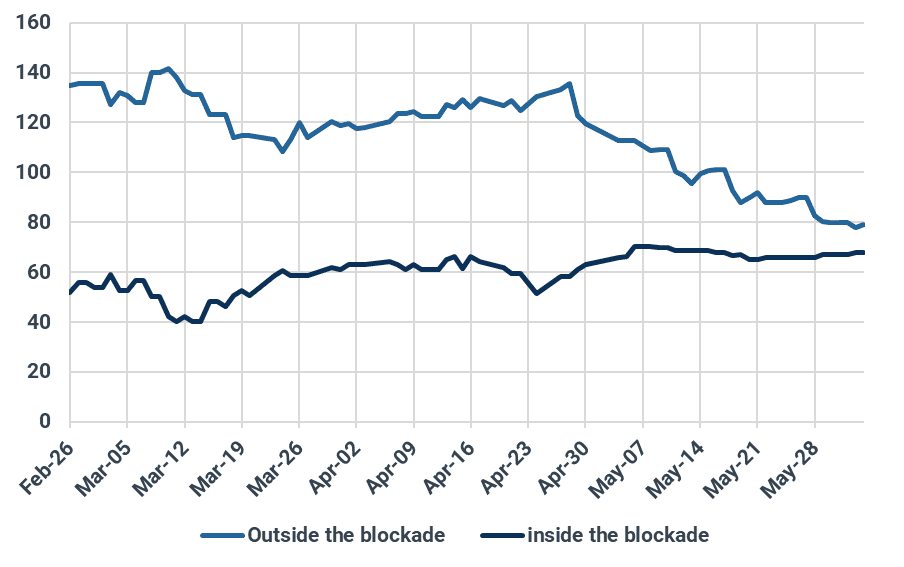
Also struggling to move its production to international markets, Iran is estimated to have reduced crude output by around 1.5 mbd from pre-blockade levels. Despite repeated attempts to move cargoes beyond the Gulf of Oman, Kpler has seen no confirmed successful exits since mid-April.
During this period, Iran appears to have continued loading crude onto vessels for use as floating storage to relieve pressure on onshore inventories, albeit at a much slower pace due to limited tanker availability in the region. Should the US blockade remain in place for longer, Iran may be forced to further reduce crude and condensate production, as storage constraints become increasingly binding, especially if Washington strengthens controls on ballast Iranian tankers entering the blockade zone.
Moving forward, the overall Middle East production outage is likely to remain broadly stable, with potential higher UAE output offsetting further declines in Iran, while uncertainty surrounding the Kurdistan restart limits the upside for Iraqi production.
Iranian crude oil on water by current location, mb
Source: Kpler

See why the most successful traders and shipping experts use Kpler