Nigeria's Dangote success story could be replicated in East Africa
While Dangote’s gasoline and diesel barrels are mainly consumed in Nigeria and WAF countries, more than 50% of jet output is heading to Europe, a share that is likely to increase as summer demand season approaches. In the meantime, plans around building a second Dangote refinery are gaining momentum - this time in Tanzania or Kenya.
Market and Trading calls:
- Further decrease expected in Nigeria’s gasoline imports, as Dangote’s product output crowds out European barrels in Africa.
- Stable on Dangote’s gasoline and jet output, which we estimate at 280-290 kbd of gasoline and 160-170 kbd for jet.
- Future product output from the proposed $17 billion Dangote refinery in East Africa could supply barrels to Uganda, Kenya, Tanzania, Ethiopia, South Sudan, DRC, etc.
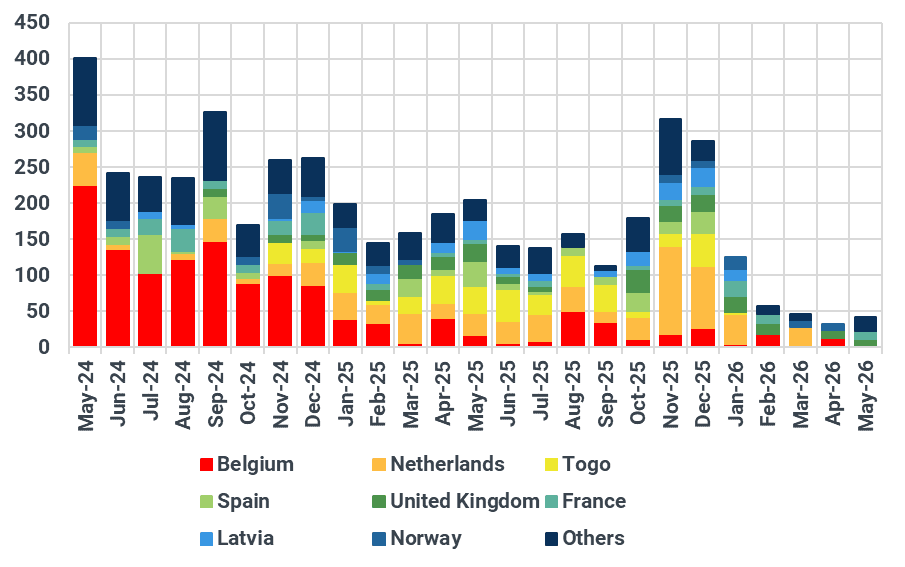
Gasoline imports into Nigeria have fallen to record lows of 30 kbd in April and continue to trend at suppressed levels through the first half of May — a clear reflection of the successful Dangote ramp-up. We estimate refinery runs at Dangote reached a high of around 640 kbd in April, with throughput continuing at effective maximum capacity into May. This ramp-up has been underpinned by the resolution of technical issues at the RFCC and CDU (both units underwent maintenance in January/February), as well as the refinery's role in supplying marginal barrels amid the ongoing Middle East conflict. In particular, Dangote has optimised operations by shifting its hydrocracker toward jet-max mode amid strong middle distillate margins.
Gasoline imports into Nigeria, kbd
Source: Kpler
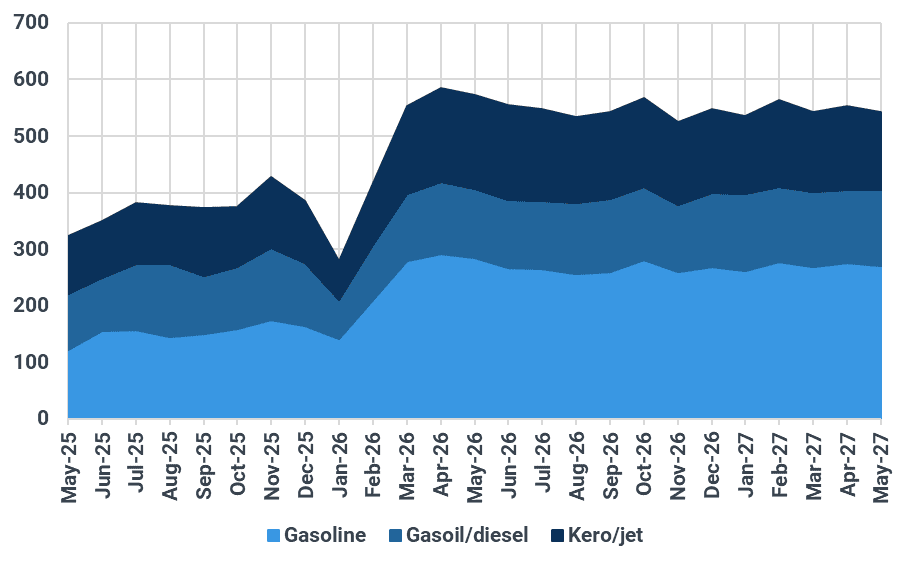
Improved unit reliability and optimisation have also enabled Dangote to operate in maximum jet and maximum gasoline modes. We estimate current output at 280–290 kbd of gasoline, 120–130 kbd of gasoil/diesel, and 160–170 kbd of jet, with these elevated volumes expected to hold steady through the remainder of 2026.
Dangote refinery supply outlook of major refined products, kbd
Source: Kpler
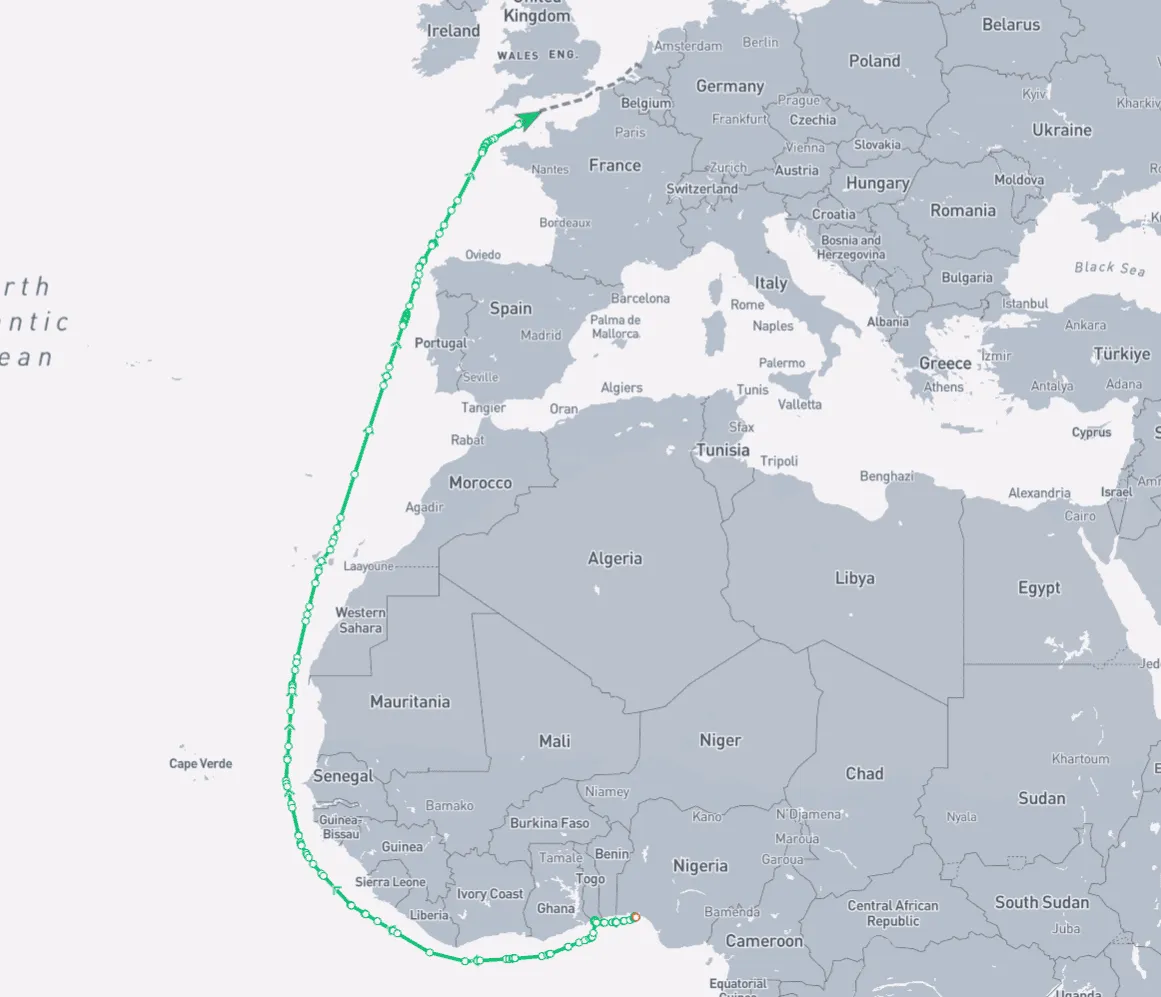
The ramp-up has driven Dangote's refined product exports to surge to 510 kbd in April, with similarly strong levels so far in May, led by gasoline and jet. While gasoline is predominantly consumed domestically — in line with Nigeria's demand of around 330 kbd — April also saw gasoline-laden vessels depart for Ghana, Cameroon, Angola, and Singapore. Gasoil/diesel was likewise directed primarily toward Nigeria and other West African countries, with volumes flowing to Cameroon and Côte d'Ivoire last month. Most notably, jet departures to Europe surged in April, with cargoes heading to Spain, France, Italy, the UK, and Turkey. The first-ever jet cargo from Dangote is expected to arrive in Rotterdam tomorrow, and predictive ship-tracking data points to further departures to the region this month. Looking ahead, we expect jet exports to Europe to increase, as European jet balances tighten significantly between May-August and the ongoing Strait of Hormuz blockade continues to constrain critical middle distillate supplies to the region.
MR tanker Lvm Aaron carrying 350 kb of Jet A-1 from the Dangote refinery to the Netherlands
Source: Kpler, mapbox
Against the backdrop of Dangote's operational success, plans for a new 650 kbd refinery in East Africa are gaining momentum. Kenya, Uganda, and Tanzania are reportedly exploring a joint venture structure to underpin the project, with estimated costs up to $17 billion. The choice of location remains unresolved, with potential sites including Tanga in Tanzania, Mombasa in Kenya, and Lamu, a coastal town in Kenya. Both Tanzania and Kenya offer distinct advantages — Tanzania for its access to Ugandan crude via the EACOP pipeline, and Kenya for the strategic value of the port of Mombasa. Should the project advance successfully, a Dangote-operated refinery in East Africa would meaningfully reduce the region's dependence on transport fuel imports from the Middle East while providing a catalyst for further upstream investment. Notably, future product output could supply transport fuels to Uganda, Kenya, Tanzania, Ethiopia, South Sudan, DRC, and other countries in the region.
Eastern and Southern Africa’s dependence on transport fuel imports from the East has become particularly acute amid the ongoing SOH blockade, with several countries across the region experiencing severe fuel shortages. In Kenya, protests over fuel prices hikes erupted today, including a nationwide public transport strike that stranded commuters. With more than 50% of diesel imports typically sourced from the Middle East Gulf (MEG), diesel flows to Eastern and Southern Africa have fallen sharply from over 400 kbd in February 2026 to around 200 kbd so far in May. Against this backdrop, the strategic importance of the new Dangote refinery has become even more pronounced.

See why the most successful traders and shipping experts use Kpler