
The Houthis' attacks on Saudi Arabia represents more than another escalation. It signals that the geography of the conflict is expanding from the Strait of Hormuz to the Red Sea. As new participants enter the war, governments must consider not only how much additional crude and refined product supply is at risk, but which strategic corridor or country becomes vulnerable next.
For much of the conflict between the United States and Iran, one development stood out. Despite repeated military exchanges between Iran and the US, the disruption of commercial shipping through the Strait of Hormuz, and escalating tensions across the region, the Houthis largely remained on the sidelines. Their restraint preserved one of the Middle East's most important alternative energy corridors and kept the Bab el-Mandeb strait outside the conflict.
This appears to be changing.
Following reported Saudi strikes against Houthi targets, the Houthis launched missiles and drones toward Saudi Arabia, raising the possibility that the Red Sea is becoming the second major maritime front in the war. If the unofficial truce between Saudi Arabia and the Houthis has broken down, the implications extend well beyond Yemen.
The Houthis' re-entry into the conflict raises three increasingly important questions.
The first question is urgent. How much additional crude and refined product supply is now at risk?
The second is strategic. Who joins Iran next?
The third may ultimately prove the most consequential: at what point does protecting national interests become incompatible with remaining outside the conflict?
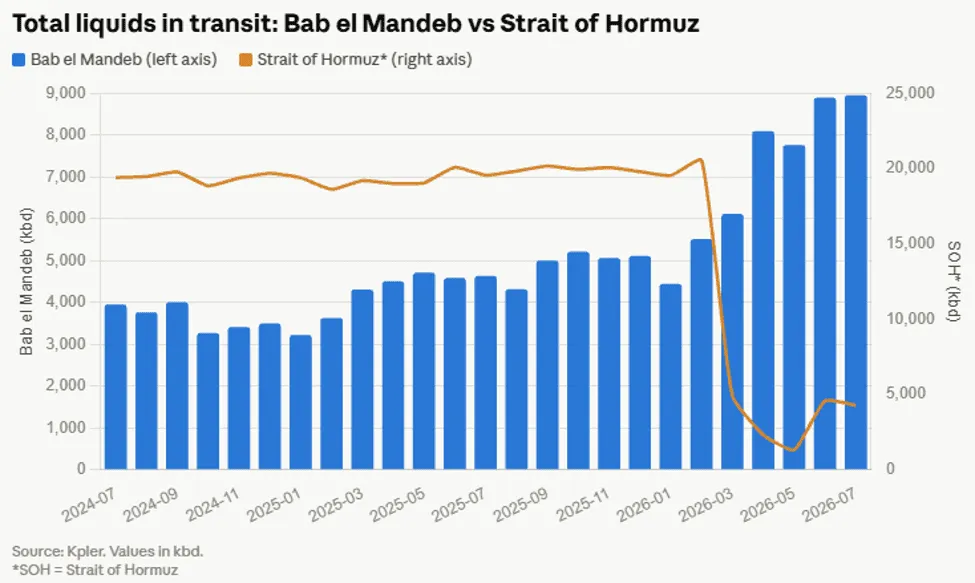
For more than a decade, Saudi Arabia prepared for exactly the scenario unfolding in the Strait of Hormuz.
The East-West Pipeline and expanded export infrastructure at Yanbu were designed to ensure the Kingdom could continue exporting crude even if the Strait became contested. Over time, Yanbu also developed into a major refining and product export hub, transforming the Red Sea from an alternative route into a central pillar of Saudi Arabia's energy security.

The Bab el-Mandeb is one of the world's most important energy corridors, carrying Saudi crude, refined products, and commercial shipping between Europe and Asia. If the Red Sea becomes an active theater of the conflict, governments will no longer be managing a disruption in one chokepoint. They will be managing two.

One of the defining characteristics of this conflict has been its ability to remain geographically contained. Today's Houthi attacks suggest that period of containment may be ending.
Military strategists describe this as horizontal escalation—the gradual expansion of a conflict across new geographies and additional participants. The significance of the Houthis attack is that the geography of the conflict is expanding.
Which raises the next question.
Who joins next?
The immediate possibilities are familiar. Hezbollah. Iranian-backed militias in Iraq and Syria. Which have the potential to bring additional attacks against strategic energy infrastructure and maritime corridors. Wars rarely widen all at once. They expand one participant at a time.
Each new participant has the potential to place another segment of the global energy system at risk. The Strait of Hormuz threatened crude exports. The Houthis now threaten the Bab el-Mandeb, Saudi Arabia's contingency export route, refined product supplies, and one of the world's busiest maritime corridors.
As the conflict widens, the challenge extends beyond Iran's partners. Countries that have sought to remain outside the fighting may increasingly conclude that protecting their own energy infrastructure, shipping lanes, and security interests requires a more active role. Gulf states face that calculation first, but Europe also has a direct stake in maintaining freedom of navigation through the Red Sea.

The geography of escalation may also extend beyond the region itself. Recent reports that Cuba has acquired Iranian-designed Shahed drones have renewed debate in Washington about Iran's ability to extend asymmetric capabilities much closer to the United States. Whether those reports ultimately prove strategically significant remains uncertain. More important is what they represent: policymakers are beginning to ask whether Iran's network of strategic relationships could create pressure points well beyond the traditional boundaries of the Middle East. As we argued in our earlier analysis of Cuba's strategic geography and the Florida Straits, strategic competition increasingly follows the geography of partnerships and critical infrastructure rather than national borders.

History suggests that wars grow increasingly more difficult as they widen. Every new participant creates new military requirements, new political commitments, and additional opportunities for miscalculation.
The Houthis represent more than another participant in this conflict. They may represent the moment the central question shifts from who is fighting the war to which strategic geography becomes vulnerable next.