The jet tightness is not easy to overcome
Jet fuel markets remain structurally tight, with limited ability to increase supply despite strong yield switching incentives and high refinery runs in the Atlantic basin. Constraints stem from low inherent yields, limited yield-switching flexibility, and stringent specifications requiring full-chain traceability, all of which limit the pool of on-spec molecules. As a result, jet balances are set to remain tight as the underlying constraint remains structural; the system can only produce, certify, and deliver incremental barrels at a measured pace.
Jet fuel continues to command outsized attention across global product markets as the Strait of Hormuz (SoH) disruption cuts Europe’s access to its primary supply region (ME), with cracks remaining firm as supply from other sources persistently disappoints despite Atlantic Basin refiners running at near-maximum utilisation and actively optimising yields. The tightness is not purely cyclical. It is structurally embedded across the value chain, spanning crude chemistry, refinery configuration, stringent product specifications, and a highly controlled, inflexible logistics system.
At its core, jet fuel is inherently constrained within the crude barrel. The kerosene cut represents a relatively small fraction of total yields, sitting behind gasoline and gasoil across most refinery configurations. Even in complex refineries, where operators actively optimise product slates, gasoil captures the largest share of incremental upgrading due to both configuration bias and market flexibility. Hence, while refiners do respond to stronger jet margins, the ability to shift yields remains structurally capped by crude slate, unit configuration, and, most critically, product specifications.
Specification is the single most binding constraint in the jet market. Unlike gasoline and gasoil, jet operates within a narrow quality envelope, particularly around freeze point, cloud point, aromatics, and thermal stability. This directly limits how much of the kerosene-range and swing cuts (between 150–270°C) can be upgraded into on-spec material. Blending flexibility is minimal, too. Even small deviations or contamination can push volumes off spec, with limited scope for reprocessing or downgrading. As a result, increasing jet output is not simply a matter of redirecting streams but of ensuring that incremental barrels consistently meet all aviation-grade parameters.
Jet Yield (%)
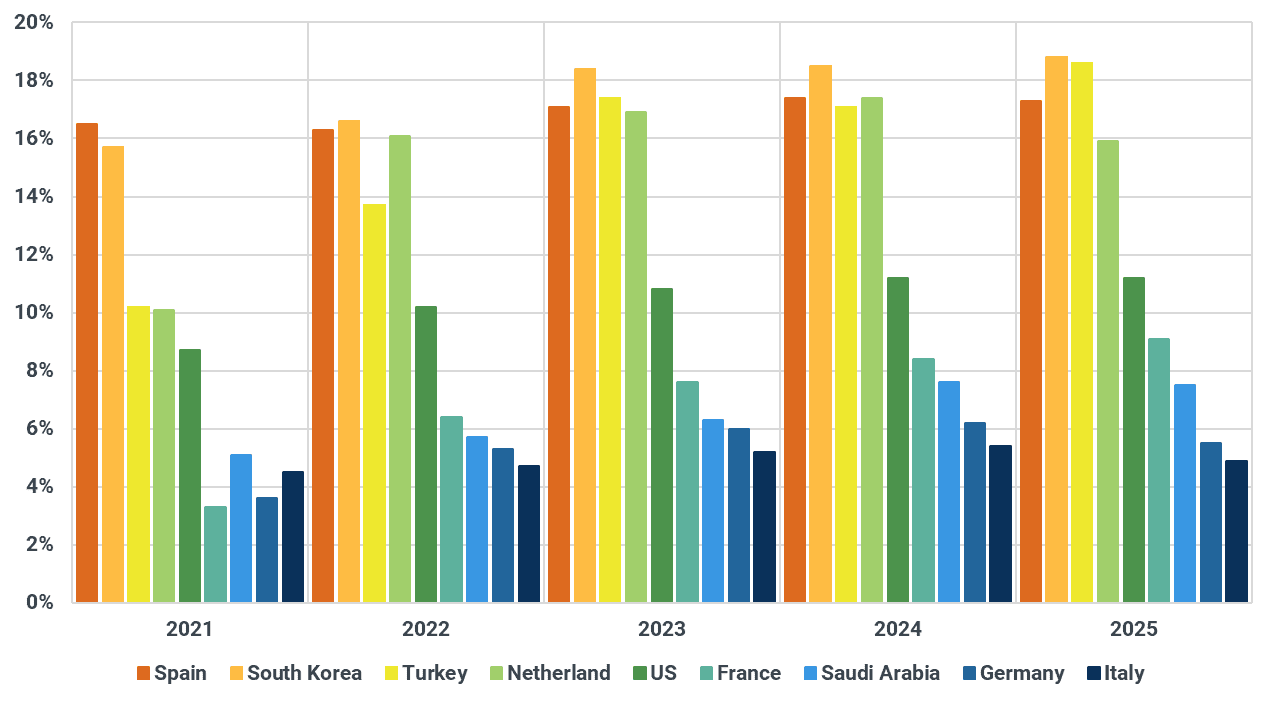
Source: Kpler
Yield shift towards Jet
Yield shift
Simple Refinery 0.2 - 0.4 %
HCK refinery 0.3 – 1.0%
FCC refinery 0.2 - 0.6 %
Complex refinery 1.0 – 2.5%
This constraint becomes more acute when attempting meaningful yield shifts. While refiners can push jet yields typically in the range of 0.3–2.5%, depending on configuration and crude slate, the pool of molecules that can reliably meet jet specifications cannot be expanded proportionately. The challenge is further amplified for military and speciality grades, which impose even tighter requirements.
Overlaying this is the requirement for traceability and reproducibility. Jet must remain within specification from refinery to aircraft, requiring segregated handling, controlled tankage, and strict contamination management. This limits blending flexibility and increases operational risk, as off-spec volumes cannot be easily reabsorbed into the system.
Finally, even as refiners push incremental jet output through higher runs and yield switching, supply does not immediately translate into market relief. With crude availability still constrained, yield optimisation remains the primary lever, with notable shifts already visible across regions. US refiners have increased jet yields by ~1.5% with limited further upside (~0.5%), while new capacity such as Dangote has lifted jet output by yield switching~2-2.5% & incremental crude processing, supporting exports of ~175 kbd in April (+75 kbd m/m). In Europe, the key demand centre, refiners are maximising transfers from gasoil and, to a lesser extent, naphtha, with ~0.7-1.3 % incremental gains expected.
However, these increases remain marginal in absolute terms and require time to accumulate into exportable cargoes, typically over several weeks. This creates a lag between margin signals and seaborne availability, leaving prompt markets tight even as production gradually adjusts.
Fragmented Supply vs Concentrated Demand
Geography further reinforces tightness, with pressure evident across both Europe (via lower imports) and Asia (through run cuts). Europe remains the primary demand centre and is structurally import-dependent, while incremental supply is concentrated in the US, the Middle East, and Asia. Ongoing US/Israel–Iran tensions have added another layer of strain, disrupted flows and increased uncertainty around Middle East exports. In this environment, supply remains constrained from East of Suez to West of Suez: Middle Eastern refiners face export bottlenecks and operational disruptions, while Asian suppliers are limited by crude availability and are increasingly prioritising domestic demand. At the same time, US refiners and Nigeria’s Dangote are already operating at elevated run rates, maximising jet flows. Collectively, this leaves limited headroom for incremental supply, restricting the system’s ability to respond to demand from deficit regions. Still, looking at Europe, considering the lower exports out of the Gulf, limited yield shifting (up to 0.7-1.3%), and the incremental gains from Dangote/US, the physical-net short (net-exports plus domestic balance) is still around 200-250 kbd.
Bottom line is that Jet fuel operates within a structurally low-elasticity system where multiple constraints compound:
- Limited kerosene cut within the crude barrel
- Refinery configurations limit yield shifts
- Narrow and stringent product specifications
- Full-chain traceability and reproducibility requirements
- Constrained tankage and logistics infrastructure
- Geographic dislocation between supply and demand centres
Even in a high-margin environment, the system cannot respond quickly. War-led disruptions have amplified tightness, but the underlying constraint remains structural; the jet is tight because the system can only produce, certify, and deliver incremental barrels at a measured pace.

See why the most successful traders and shipping experts use Kpler