US–Iran 60-day deal will bring temporary relief to Hormuz vessel backlog, while OFAC’s General License X remains conditional
The US–Iran MoU and OFAC General License X mark a real de-escalation signal for shipping, cargo risk and compliance workflows, but not a return to pre-crisis trade. GL X authorizes covered transactions involving Iranian-origin crude oil, petrochemical products and petroleum products through 12:01 am EDT on 21 August 2026, including certain transactions involving blocked vessels where ordinarily incident and necessary to the covered trade. The relief is time-bound, activity-scoped and revocable; it does not delist vessels or counterparties, and it does not resolve broader financial sanctions, tolling risk or later-stage nuclear and UN-related implementation.
Market & trading calls:
- Vessel backlog first, new supply later: Early increases in Hormuz transits and loadings likely reflect delayed vessel activity clearing rather than fresh Iranian supply. Commercial crossings of the estimated 570-vessel backlog are assumed at a safe clearance rate of around 15 vessels per day, with upside possible if transit conditions improve.
- GL X creates a narrow authorization window: Covered Iranian-origin crude, petrochemical and petroleum transactions are authorized through 12:01 am EDT on 21 August 2026, but the license is not a full sanctions lift.
- Compliance relief remains activity-scoped: GL X may cover transactions ordinarily incident and necessary to the authorized oil trade, including certain dealings with blocked vessels, but it does not delist vessels, owners, operators or other counterparties.
- Cargo attribution should improve as the Gulf de-darkens: Lower GNSS interference and AIS spoofing should reduce the undisclosed-destination share, but shadow-fleet behavior will not disappear immediately.
- Post-60-day tolling is the next risk point: Any Iranian fee or safe-passage mechanism could introduce a sanctioned counterparty and keep legal, insurance and banking risk above pre-crisis levels.
A temporary de-risking signal, not full normalization of flows
The announced US–Iran Memorandum of Understanding (MoU) has now been implemented through OFAC’s General License X as of 21 June, which authorizes certain transactions ordinarily incident and necessary to the production, sale, delivery or offloading of Iranian-origin crude oil, petrochemical products and petroleum products through 12:01 am EDT on 21 August 2026.
The authorization also covers certain payments and vessel-related services, including insurance, where they are tied to the covered activity. Broader termination of UN-related, IAEA-related and unilateral US measures remains subject to a later phase. Markets have already reacted: crude prices have fallen to a three-month low on expectations that Iranian supply and Strait of Hormuz traffic could begin to normalize.
The MoU is therefore best read as a de-escalation signal for shipping and cargo risk rather than a return to normal Iran trade. Initial upticks in Strait of Hormuz transits were observed from 18 to 21 June, with 108 total crossings recorded over the period. This marks a clear increase from the previous single-digit daily crossing averages, but it should be interpreted primarily as delayed vessel activity beginning to clear rather than immediate new supply.
Iran has continued to move roughly 1.6–1.7 mbd of seaborne crude throughout the sanctions period before the US blockade in April, overwhelmingly crude rather than condensate or clean products. GL X does not create this trade from zero. Instead, it moves covered flows into a temporary authorized window and re-illuminates activity that never fully stopped. The immediate impact is therefore on cargo-risk treatment and voyage confidence, not necessarily on underlying production or export capacity.
Iranian seaborne crude exports by destination disclosure (kbd)
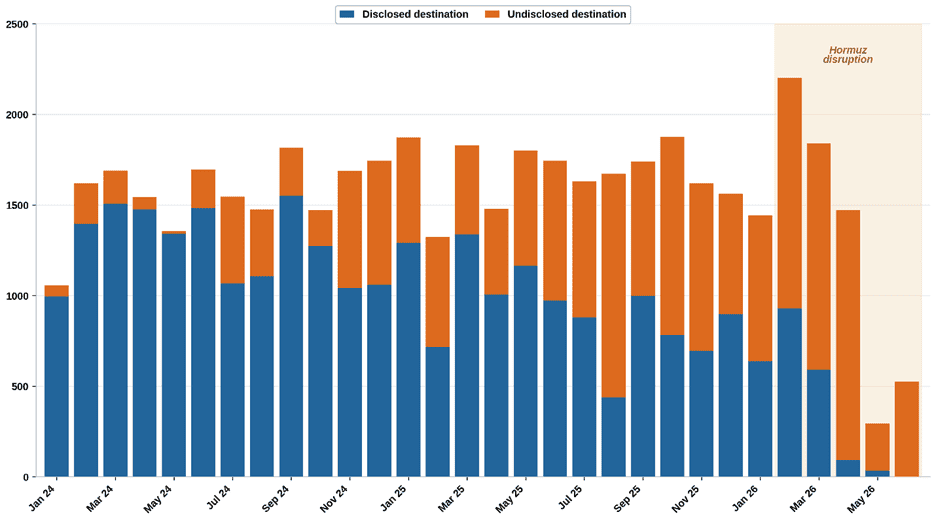
Source: Kpler. Monthly seaborne crude/condensate exports by destination; intra-Iran floating storage excluded. Recent months reflect the Strait of Hormuz disruption and are subject to retroactive revision.
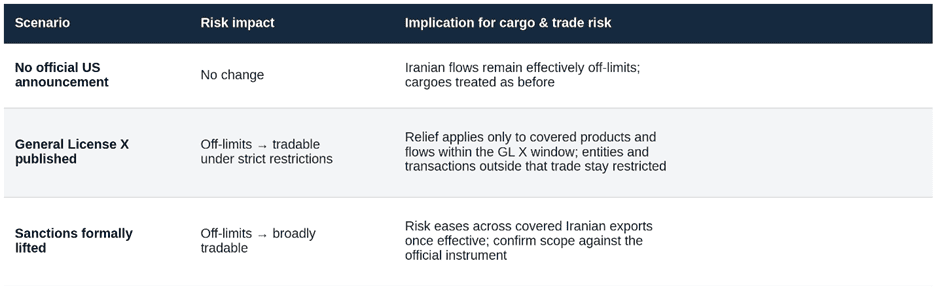
From here, two scenarios dominate the compliance outlook. The base case, now confirmed, is GL X, a temporary authorization that eases Kpler Risk & Compliance’s Iran-related trade-risk rating from effectively off-limits to tradable under strict, time-bound restrictions. Any extension would require further official action and would depend on progress in the negotiations. The second, less likely scenario is a full lifting of sanctions, which would move trade risk materially lower across Iranian exports, but only as a later-stage outcome contingent on the nuclear negotiation, an implementation mechanism and UN Security Council endorsement.
Kpler Risk & Compliance’s base case highlights that GL X is revocable, so if the agreement lapses or is contested, covered cargo can revert immediately to effectively off-limits. Any easing must stay conditional and explicitly time-bound.
The two scenarios at a glance
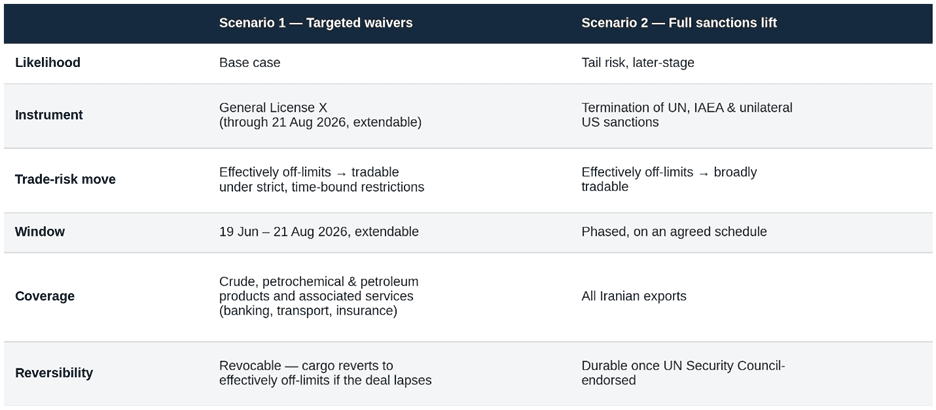
Source: Kpler Risk & Compliance
GL X is not a clean compliance reclassification for the ships carrying the cargo. It authorizes dealings involving blocked vessels only where those dealings are ordinarily incident and necessary to the covered oil, petrochemical or petroleum-products trade. It does not delist those vessels, operators or counterparties. Outside the authorized activity, tankers, operators and trading entities may remain individually sanctioned, including many of the shadow-fleet vessels behind the rising undisclosed-destination share shown above.
Covered cargoes can therefore still carry vessel- and counterparty-level exposure. Screening should remain entity-level even where the product-level treatment has eased. Because GL X is time-bound, residual secondary-sanctions exposure for non-US persons and the risk that later-stage UN-related implementation is delayed, reversed or fails to materialize both keep covered cargoes short of a clean reclassification.
Risk impact by scenario
Source: Kpler & Compliance

See why the most successful traders and shipping experts use Kpler