

When the strait closes: How tanker charterers navigate the Hormuz crisis
Tanker chartering professionals are no strangers to volatility. Rate spikes, laycans slipping, last-minute compliance checks, that is just the backdrop of a normal week. But the crisis that erupted on February 28, 2026 is a different category of disruption altogether. The effective closure of the Strait of Hormuz - one of the world's most critical energy chokepoints - has turned the entire tanker market on its head in a matter of days.
Fixing a VLCC today is not just a freight rate question. It is a real-time intelligence challenge: Where is the tonnage? Who owns it? Can it be insured? What does the voyage actually cost when you reroute 10,000 extra miles around Africa? And critically, is the vessel that just showed up on the list one you actually want to fix?
In an environment where a wrong decision can cost tens of millions of dollars, and the right call made an hour earlier can mean the difference between securing a compliant vessel and watching your cargo stay stranded in the Gulf, the quality of your data and the speed and optimization of your workflow has never mattered more.
The scale of the disruption
The numbers tell the story. Kpler vessel tracking data shows tanker transits through the Strait of Hormuz have collapsed by approximately 92% compared to the week prior to the conflict. As of March 2, 247 vessels of MR size or larger, representing roughly 6% of global tanker DWT capacity, remain stranded in the Middle East Gulf. Expanding to the broader Middle East region lifts the figure to 984 tankers, or approximately 22% of the global fleet.

The closure is not formal, and the real constraint is not insurance. Vessels remain insured as insurers are still quoting, though war risk premiums have surged sharply. What is keeping owners idle is the security threat itself as Iran's Revolutionary Guard has explicitly warned that vessels attempting to transit could be targeted. US proposals on insurance guarantees and naval escorts are unlikely to restore normal volumes in the near term and cheaper cover does not offset the risk of being struck.
What this means for tanker charterers
The VLCC market: record rates, a paralysed tonnage list
VLCC freight futures for the Mideast Gulf to China route more than doubled to $13.8/bbl following the Iran war. In the physical market, a vessel was rumoured on subjects at WS525 for a VLCC MEG-East voyage - equivalent to ~$15/bbl - a level that would lift the delivered price of crude into China to around $100/bbl. For context, the last time rates hit this level was 2020, and many fixtures reported at such heights did not ultimately materialise, but the numbers are a clear guide to the scale of the disruption.
Zooming into the Mideast Gulf, as per March 2nd, 77 VLCCs were trapped, around 8.5% of the total fleet. Of those, 63 are compliant vessels with no affiliation to sanctioned trades, representing 9.2% of the commercial VLCC fleet. The MEG tonnage list has been hollowed out. Previous offers have been cancelled, vessels on subjects have failed as the market attempts to reprice risk in real time, and the physical fixture market has effectively seized up.
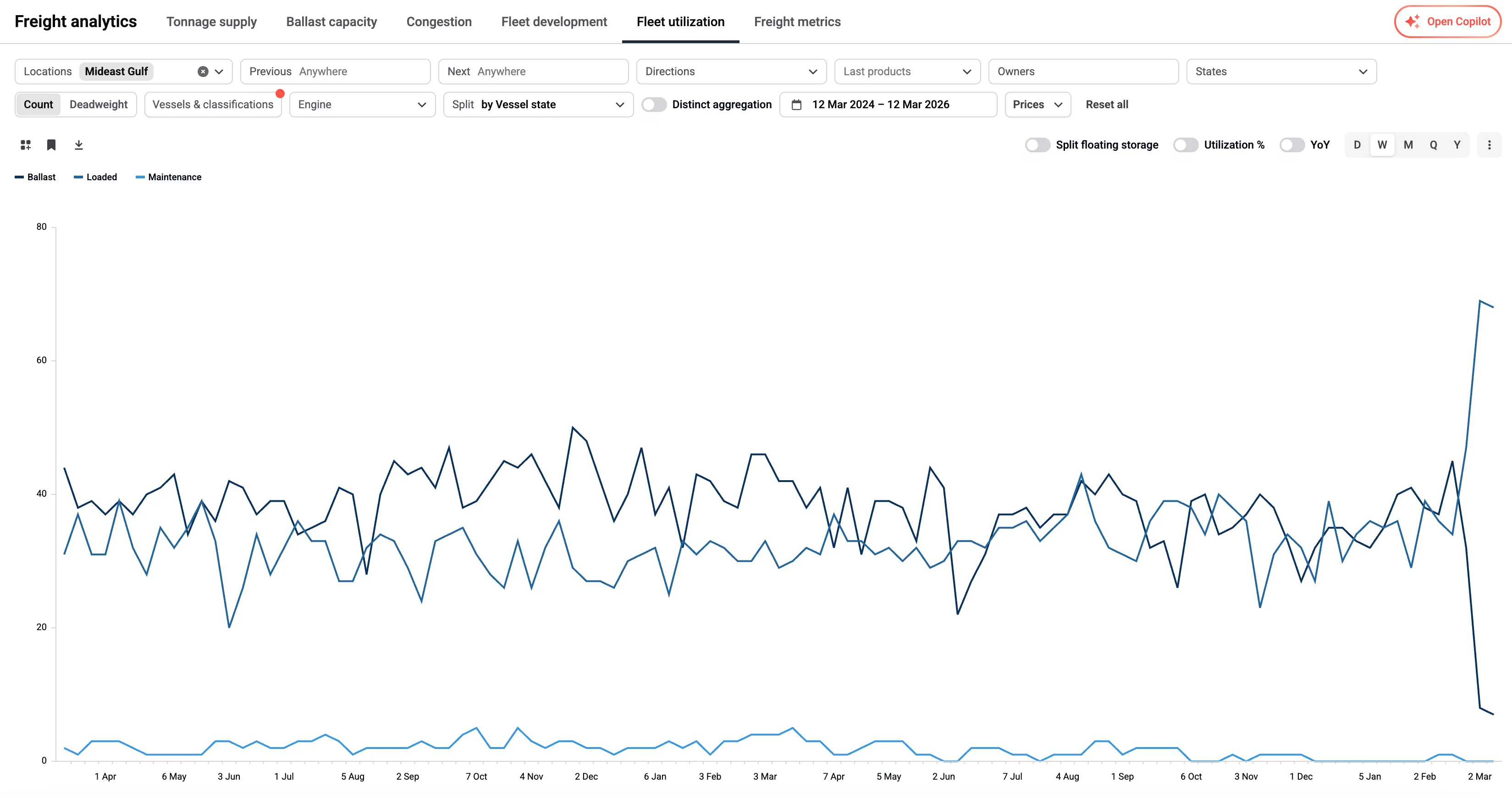
This is precisely where Kpler's Live Tonnage List becomes critical. With real-time vessel positioning powered by Kpler's multi-source AIS, combining terrestrial, satellite, and proprietary signals, chartering teams can instantly filter out stranded Gulf vessels and surface the tonnage that is genuinely open, genuinely accessible, and genuinely compliant. Risk & Compliance intelligence is embedded directly into the tonnage list: ownership structure, sanctioned entity links, AIS dark history, and trade history are surfaced on every vessel before a charterer commits to a fixture.
The spillover: where vessels are repositioning and what that means for freight
The disruption in the Gulf is not just a local shock. It is reshaping tanker supply and trade flows globally, and for charterers who can read those shifts early, it is also creating a window of real commercial opportunity.
Vessels that were ballasting toward Fujairah, the traditional waypoint for MEG liftings, have reversed course. Kpler's Tonnage List and Cargo List, combined with live AIS positioning, can show if shipowners are rapidly repositioning ballasters toward three alternative basins:
- West Africa: Asian buyers seeking replacement barrels are pulling Suezmax and VLCC tonnage toward West African load zones. That should lend near-term support to freight, but if the disruption endures and more vessels continue to shift west, the resulting build in available tonnage over the next 15–20 days could start to weigh on WAF-to-Asia rates.
- The Americas (US Gulf and Latin America):Demand for long-haul Atlantic VLCC lifts to Asia is rising as buyers seek US, Brazilian, and Guyana crude to replace stranded MEG barrels. With the Atlantic basin still short VLCCs after months of owner concentration in the MEG, rates should remain firm initially. But as more ships reposition west, the supply response is likely to catch up, reducing tightness and gradually weighing on rates.
- Asia (Arabian Sea and beyond): Vessels that successfully exited the Gulf ahead of the closure can reposition in the Arabian Sea, waiting for clarity on routing. Kpler data shows an uptick in idle and slow-steaming vessels in this zone as owners hold position rather than commit to a Cape diversion at today's bunker costs.
The real edge in a market like this is not just knowing where tonnage is moving, it is knowing where cargo demand is emerging before it is fully visible in fixture reports. Kpler's Cargo List surfaces new cargo orders as they appear, giving charterers the earliest possible signal of new trade routes developing out of the disruption. Combined with Kpler's trade flows data, which tracks actualised shipments in real time, chartering teams can see where volumes are genuinely starting to move. Charterers who can spot that market changes in either direction, before it is reflected in fixture rates, hold a meaningful negotiating advantage. Kpler's Fixtures List, updated in real time, tracks confirmed deals across all basins and provides the market anchor charterers need to time their approach.
This combination matters most when it comes to vessel positioning. If you can identify early that a basin is about to see a surge in cargo demand - because flows data and new cargo enquiries are pointing there before the wider market has caught on - you can reposition ballasters ahead of the competition. Being among the first to move means fewer vessels competing for more cargoes, which puts freight rates firmly in your favour.
By bringing together cargo intelligence, trade flows, vessel positioning, freight analytics, tonnages list, cargo list and fixtures list fixture data, in a single workflow, Kpler Chartering gives teams the full picture needed to act on these dynamics early, not after the market has already moved.

Rerouting via Cape of Good Hope: a logistical and economic trap
According to Kpler analysts, Cape diversion adds 10–15 days and $1–2 million per voyage in additional costs. But even the Yanbu bypass is compromised: Saudi cargoes via the Red Sea still face the Bab el-Mandeb and Houthi attacks. This could force a full Suez Canal transit followed by a Cape diversion, made structurally problematic by the fact that the Suez Canal can only accommodate a Suezmax, not a VLCC. Every open position that previously anchored on a Gulf laycan must now be repriced entirely.
Kpler's Voyage Calculator rebuilds these economics instantly for any vessel, any route, any speed. Whether you are working from a freight rate to calculate TCE, or from a target TCE to derive cost per ton, the calculator supports both directions, giving chartering teams flexibility to run scenarios the way they actually work. The latest bunker prices are fetched automatically, so every calculation reflects live market costs. ECA exposure and associated emissions costs are calculated together, giving a complete and accurate picture of the true voyage cost. In a market where the optimal routing changes daily and freight is moving $50,000–$100,000 per day, a manual spreadsheet is not a workflow. It is a liability.
The hidden risks: AIS dark activity and the shadow fleet
The Hormuz crisis has introduced compliance and operational risk that goes well beyond freight rate volatility.
Since February 27, Kpler has confirmed more than 10 GNSS interference incidents across the Persian Gulf and Gulf of Oman. Some tankers are still travelling east and west through the Strait, with a number of voyages occurring under AIS blackouts as owners attempt transits without broadcasting position. Standard AIS-based tracking alone produces a distorted or incomplete picture of where vessels actually are, distinguishing genuine signal loss from deliberate evasion requires multi-source satellite intelligence.
On the shadow fleet, Kpler's analysis reveals a critical nuance: a period of front-loaded Iranian exports over the past month has seen the bulk of Iran's shadow fleet already repositioned to East and South-East Asia, where most vessels are now laden. The shadow fleet is not primarily inside the Gulf, it has moved. Any charterer inadvertently fixing one of these vessels faces immediate sanctions exposure, cargo contamination risk, and the very real possibility of the deal collapsing mid-voyage.
Kpler's Risk & Compliance intelligence, embedded across the Tonnage List, Cargo List, and Fixtures List, flags these risks automatically so chartering teams never have to choose between speed and safety.
Conclusion
As Kpler's own tanker freight analysis concludes: "There will be no return to normal vessel movements in and out of the Mideast Gulf until hostilities end or there is a sustained decline in attacks. Even as loads are restricted, rates will increase for the few fixtures that are completed. Meanwhile, the secondary impact of disruption to Middle East flows will increase freight rates across clean and dirty markets outside the region."
The Strait of Hormuz has been a theoretical risk for decades. In the space of a week, it has become the defining operational reality for tanker charterers worldwide. The vessels are stranded. The insurance has been pulled. The rates have broken records. The shadow fleet has repositioned. And two of the world's most critical shipping corridors are simultaneously closed.
The teams that navigate this crisis will be the ones who see it most clearly, where the compliant tonnage actually is, what the market is genuinely fixing at, what the voyage truly costs, and which vessels they can and cannot touch. Kpler's Chartering Suite - with Tonnage Lists, Cargo Lists, Fixture data, embedded Risk & Compliance intelligence, voyage economics, and freight analytics - is built to deliver exactly that clarity, exactly when it matters most.
Want to see how Kpler helps you act faster and smarter in a crisis? Request a live demo and discover the smarter way to charter.

See why the most successful traders and shipping experts use Kpler
Ready to act faster and smarter in a crisis?