

A False Sense of Security: The Limits of the Energy Policy Toolbox
The policies that helped stabilize crude markets are not the same policies that lower gasoline prices. As refining becomes the limiting factor, policymakers face a much narrower—and more difficult—set of options.
A False Sense of Security: The Limits of the Energy Toolbox
US Energy Secretary Chris Wright offered Americans an optimistic assessment of the energy outlook during an appearance on ABC's This Week. Acknowledging that gasoline prices have climbed back toward $4 per gallon following the conflict with Iran and the disruption of the Strait of Hormuz, Wright argued that the administration would do "everything we can" to bring prices lower. He expressed confidence that gasoline prices could begin easing within the next several weeks as oil supplies recover, strategic petroleum reserves continue supplying the market, and military operations restore freedom of navigation through the Strait.
His comments raise a more important question: What can Washington actually do?
The apparent stabilization of crude markets has created a false sense of security. Crude prices have retreated, but largely for reasons outside Washington's control. China's decision to sharply reduce crude imports removed more than five million barrels per day of demand from international markets. Strategic petroleum reserve releases added further supply, while Saudi Arabia and the UAE rerouted a meaningful portion of their crude exports through Yanbu and Fujairah. Together, these developments have prevented a prolonged crude shortage.


None of these developments should be mistaken for a permanent solution. Each of the three pillars supporting today's crude market carries its own risk. China will eventually resume buying, the SPR cannot be drawn indefinitely, and Gulf bypass routes remain exposed to regional conflict.
The apparent resilience of crude markets therefore reflects a series of temporary adjustments rather than a permanent solution.
The policies that stabilized crude markets are not the same policies that lower gasoline prices. The market continues to value gasoline and diesel far more highly than crude oil itself, suggesting that the refined-product shortage remains unresolved.

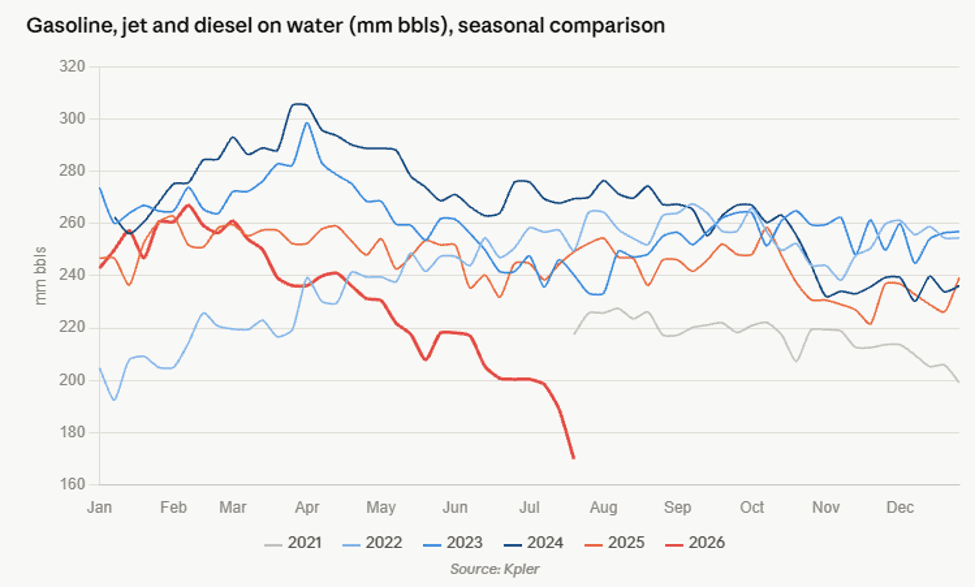
The physical market tells the same story. Refined-product inventories on the water remain well below pre-conflict levels, indicating that replacement barrels have not returned despite the partial recovery in crude exports.
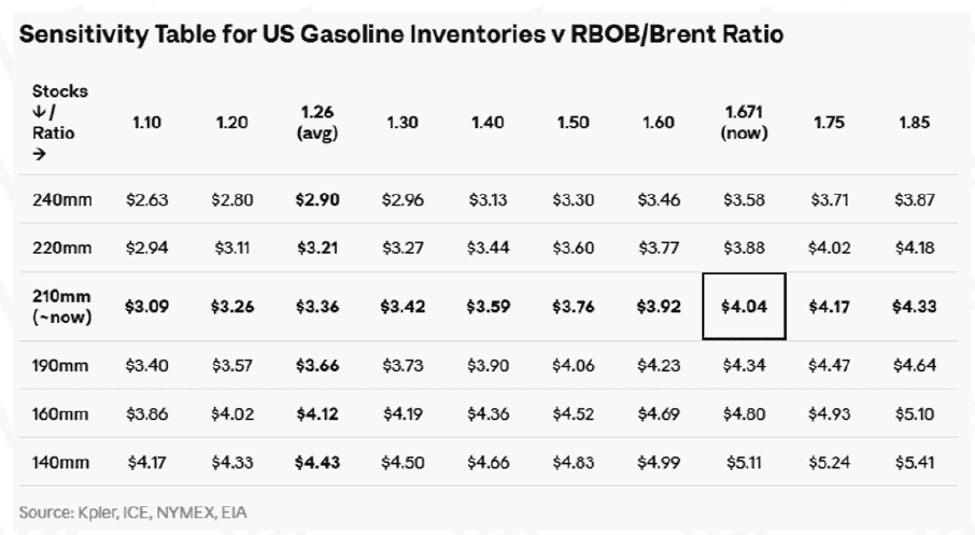
The implication becomes even clearer when current inventories are combined with today's product premium. At roughly 210 million barrels of US gasoline inventories and a RBOB/Brent ratio of 1.67, the market implies a retail gasoline price of approximately $4.00 per gallon. In other words, today's gasoline prices are broadly consistent with current market fundamentals rather than an irrational market reaction. Bringing gasoline prices materially lower therefore requires changing the fundamentals of the refined-product market rather than simply increasing crude supply.
The Tools that Remain
Restoring Global Refining Capacity
Russia: Restoring Russian refining capacity would likely represent the single largest opportunity to increase global gasoline and diesel supply. Repeated Ukrainian attacks have reduced refinery throughput by more than half, but encouraging Ukraine to stop targeting refineries would require sacrificing one of its most effective economic

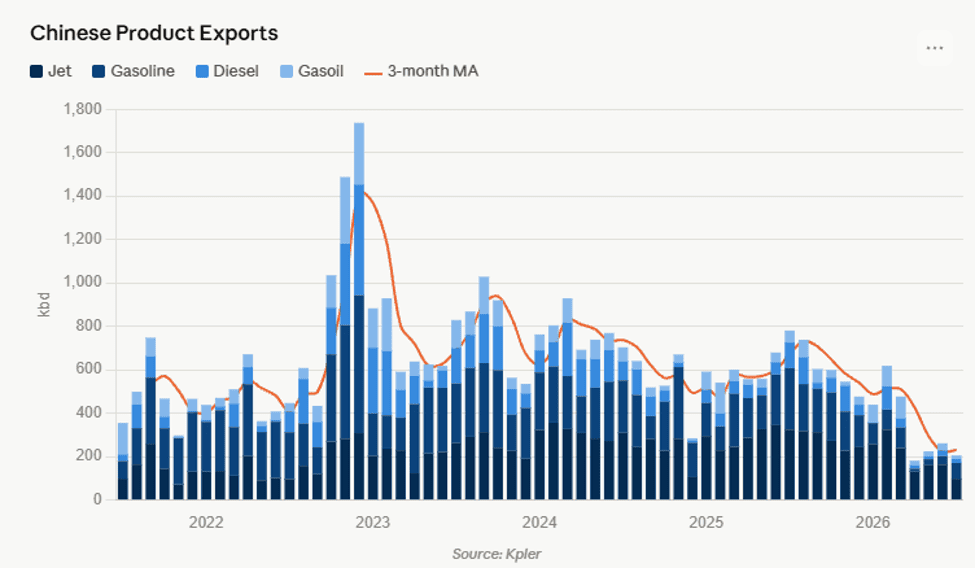
China: Washington could encourage China to increase refinery runs and expand gasoline and diesel exports. The tradeoff is that higher refinery runs would likely require higher Chinese crude imports, tightening the crude market that has helped keep oil prices contained. Even then, China's export policy remains driven by domestic priorities, and any increase in exports would likely only partially offset global product shortages.
Venezuela: Over the longer term, rehabilitating Venezuela's refining system could improve Western Hemisphere product security, though it offers little relief for today's gasoline market.
Export Controls
Restrictions on US gasoline and diesel exports have increasingly entered the policy debate as pump prices approach $4 per gallon. While keeping more fuel in the domestic market could improve regional supply balances, it would not increase global gasoline supply. The risk, however, is that Gulf Coast refineries were built to serve international markets. Artificially depressing domestic product prices while crude prices remain elevated could compress refinery margins, discouraging refinery runs and ultimately reducing gasoline production. Export controls would therefore redistribute existing supply rather than create new supply, while shifting shortages onto US allies.

Restore Commercial Confidence in the Strait of Hormuz
Restoring refined-product exports requires more than reopening the Strait. Shipowners, insurers and traders must also regain confidence that cargoes can move safely and predictably through the region. Military operations can restore access, but they cannot restore commercial confidence. Over the longer term, that may require a more durable governance framework that separates commercial transit from future geopolitical disputes.

Accept Higher Prices
The final option is to allow market forces to restore balance through higher prices. Today's market suggests that adjustment is already underway. Gasoline and diesel continue to trade at historically large premiums to crude oil, encouraging refiners to maximize production while gradually eroding fuel demand.
For policymakers, however, allowing markets to rebalance through higher prices is the least attractive option. Unless additional refining capacity returns to the market, higher prices are likely to reduce demand before they meaningfully increase supply. That adjustment does not necessarily require a recession or government restrictions. It may instead reflect consumers driving less, businesses reducing fuel consumption, or governments adopting greater efficiency and conservation measures. If policymakers cannot materially increase gasoline supply, markets will ultimately restore balance through lower demand.
Conclusion
Secretary Wright is correct that the United States still possesses an energy toolbox. The challenge is that many of the tools that helped stabilize crude markets have little influence over refined products.
Lowering gasoline prices now depends less on crude supply than on restoring refined-product supply—whether through refinery recoveries, increased product exports or renewed commercial confidence in the Strait of Hormuz. Those decisions increasingly lie outside Washington's direct control.
Not all solutions are politically acceptable. Not all politically acceptable solutions are effective. If policymakers cannot materially increase gasoline supply, the market will eventually force gasoline demand destruction enough to restore balance.

See why the most successful traders and shipping experts use Kpler