Cushing inventories to test tank bottoms, curbing record US crude exports
As US crude exports are set to achieve another record this month, and as refinery runs are set to ramp up in the coming weeks, Cushing inventories are going to maintain their downward trajectory as barrels are pulled to the US Gulf Coast. On their current trajectory, inventories should test tank bottoms by end-June.
According to Kpler drone assessments, Cushing stocks fell to 28.7 Mbbls last week, down 4.2 Mbbls over the past month, with a further 0.56 Mbbls decline already visible in the latest midweek assessment as of Wednesday, 6 May. It appears that Cushing inventories are going to have to test operationally low levels, likely in June, as a mechanism to tighten price spreads and ultimately curb record US crude exports.
The current pace of draws reflects a structural pull to the Gulf Coast: US crude exports closed April at a record pace of 5.2 Mbd, supported by competitively priced US crude and a surge in VLCC availability following the closure of the Strait of Hormuz. Forecast loadings indicate May exports should surpass April’s record, but upside should be limited by constraints. WTI Midland’s premium versus Cushing tells us that export demand remains strong, while WTI Houston’s discount to Brent tells us exports should remain robust…for now. The Brent-WTI spread will need to tighten to keep the barrels at home as inventories plummet.
Kpler drone Cushing inventories with projection, Mbbls

Source: Kpler
Operational constraints across Gulf Coast export hubs are now shaping incremental growth. Corpus Christi retains sufficient dock capacity, but pipeline bottlenecks should cap exports near 2.6 Mbd. Houston faces the inverse problem: pipeline availability remains ample, but dock constraints are likely to limit flows near April’s 1.7 Mbd pace.
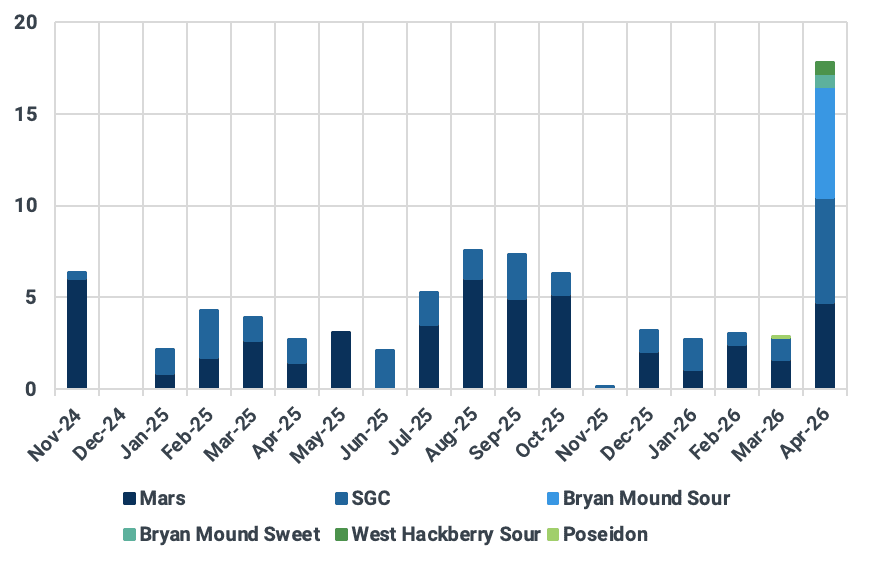
What propelled US crude exports to a record in April was incremental barrels from smaller export hubs. Typically less prolific ports, including LOOP, Beaumont/Port Arthur, and Freeport, contributed an additional 900 kbd of crude exports. Around 590 kbd of that volume consisted of SPR grades and Gulf of Mexico barrels, including Bryan Mound Sour, Bryan Mound Sweet, West Hackberry Sour, Mars, and Southern Green Canyon.
SPR and Gulf of Mexico crude exports, Mbbls
Source: Kpler
SPR dynamics are now influencing Gulf Coast crude quality balances. SPR inventories have declined by 22.3 Mbbls over the last month, with roughly one third, some 7.4 Mbbls, being exported. Historically, more than 90% of US crude exports are light sweet grades, but that share dropped to 86% in April and is likely to decline further in May as SPR barrels move into domestic refinery systems. This substitution effect frees additional medium sour Gulf of Mexico grades for export markets. Gulf of Mexico crudes are more in demand given they are a familiar barrel to foreign refiners, whereas SPR barrels are an unknown quantity. Early May loadings already confirm this trend: LOOP alone has loaded more than 4 Mbbls during the first week of May, nearly matching April’s full-month total. Current forecasts imply LOOP exports could reach 9 Mbbls this month, equivalent to roughly 300 kbd and the highest level in 26 months.
The implication for flat price and spreads is increasingly clear: record exports may be impending for May, but Cushing inventories are on track to test tank bottoms by end-June to compress Brent-WTI spreads enough to slow exports in an effort to stabilize domestic inventories.

See why the most successful traders and shipping experts use Kpler


![[UPDATE] Middle Eastern supply recovery postponed to early 2027](https://cdn.prod.website-files.com/65059ad784ac02253c62356c/6a69e80d78fefee5dd2f73d6_pipe_line_conection_in_oil_refinery_2_optimized_350.jpeg)