How Kpler helps to identify commercial bauxite players
Key takeaways
- Kpler can now trace individual bauxite cargoes back to the specific mining company that loaded them, not just the vessel that carries them.
- The capability works by matching proximity events between tugs and Capesize vessels, then tracing the tug's route back to a terminal tied to a known producer.
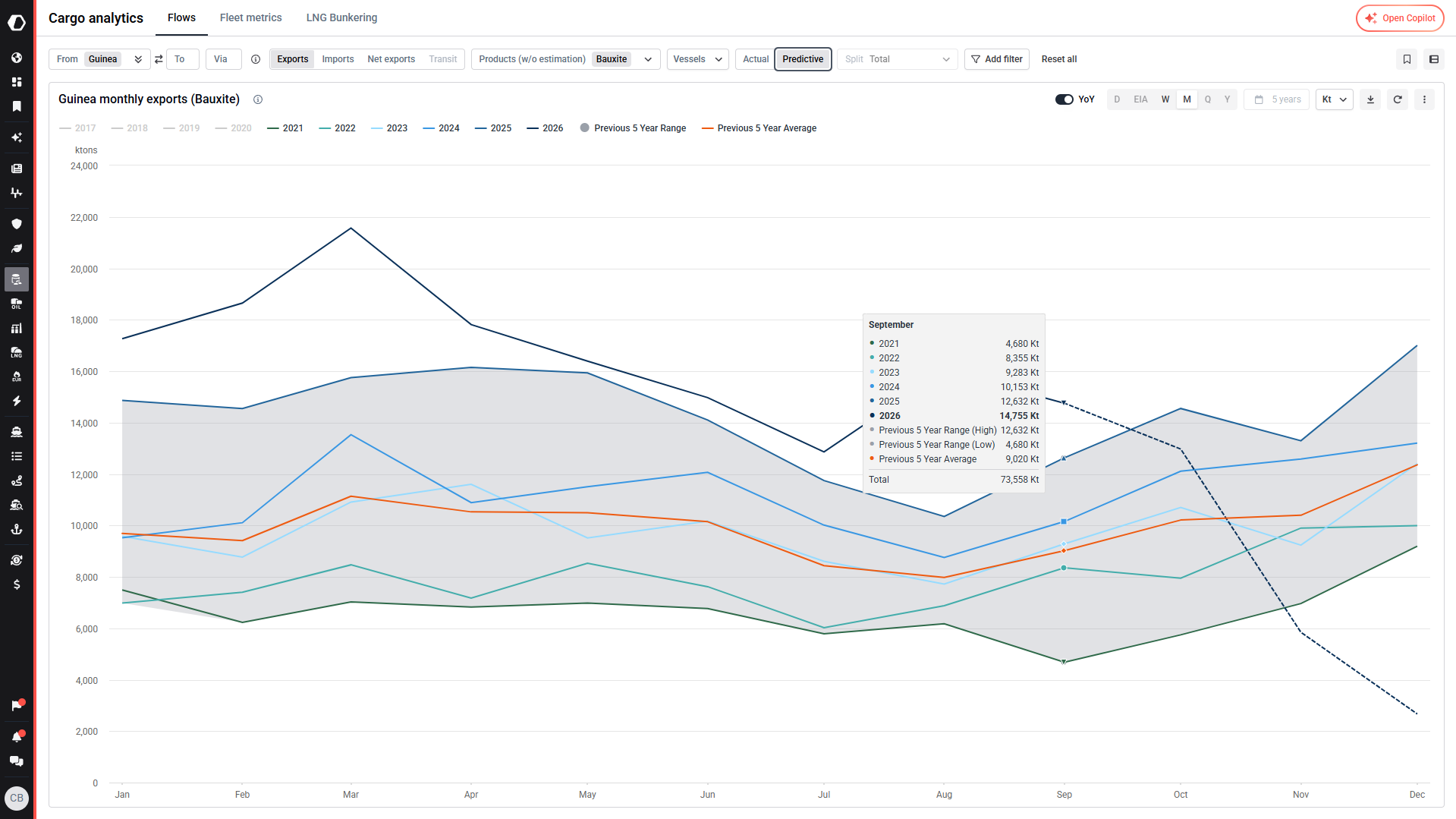
- Guinea, the world's dominant bauxite exporter, has signalled plans for export controls, but Kpler data shows exports running above every year in the last five for most of the period so far.
- Kpler's destination forecast models point to Guinea deliveries outpacing prior years again by the end of September.
- EGA was Guinea's leading bauxite exporter in 2023 but stopped exporting after May 2024 when it failed to build a domestic refinery; Kimba Mining Company took over its concession and began exporting in October 2025.
- With aluminum supply chains already strained by disruption in the Strait of Hormuz, knowing which producers would be hit by any Guinean export controls is critical for pricing and freight markets.
Why the bauxite trade has a data blind spot
As a critical mineral in the aluminum value chain, the trade around bauxite can have large implications for downstream aluminum prices and impact supply chains for aerospace, defense, energy, transportation, construction, and much more. Traders of bauxite and those who need to monitor the overall market are often met with limited visibility and some potentially significant volatility due to the concentrated nature of the supply and how seasonality, weather and outside factors can influence supply & demand. In addition to navigating potential changes to the fundamentals of the market, traders and market professionals are also faced with obscured information about which commercial entities are participating in the buying and selling of bauxite. In fact, it is extremely rare to find a provider with such data. Kpler is able to not only help market professionals navigate the fundamentals of the bauxite market with real-time tracking for cargo and voyages - but with a novel solution built on its proprietary data it can now reveal commercial entities that are involved in the buying and selling of bauxite cargo. Let's take a look at how Kpler is able to reveal this critical data for its customers.
How Kpler links each cargo to its seller
Kpler tracks all commodity vessels globally that carry ocean-bound cargo. This means that Kpler is able to track all Capesize vessels, which are the typical vessel type for this loading, that load bauxite. This is heavily concentrated in Guinea where the majority of bauxite is mined. While other providers are able to capture similar information, they are not going to be able to provide data about which miners are the ones loading any particular cargo. That is because Capesize vessels load the cargo from an anchor point that is closer to the ocean than where the bauxite is mined. When the bauxite is mined and ready for transportation, it is first transported from a more inland location by a much smaller type of vessel, a tug. This is where Kpler's unique capability comes into play.
Kpler generates data both on the global commodity fleet, to provide data about which cargo are loaded onto which vessel, and the volume, product and grade of said cargo. Kpler also generates data about the global maritime fleet across all ship types - albeit without cargo detail for non-commodity vessels. However, through a novel solution that combines the datasets that enable Kpler users to see Capesize vessel cargo and the data that enables Kpler users to see smaller vessel types such as tugs - Kpler’s data team has been able to combine these sources into a unified source of information to identify which miners the individual bauxite cargoes have come from.
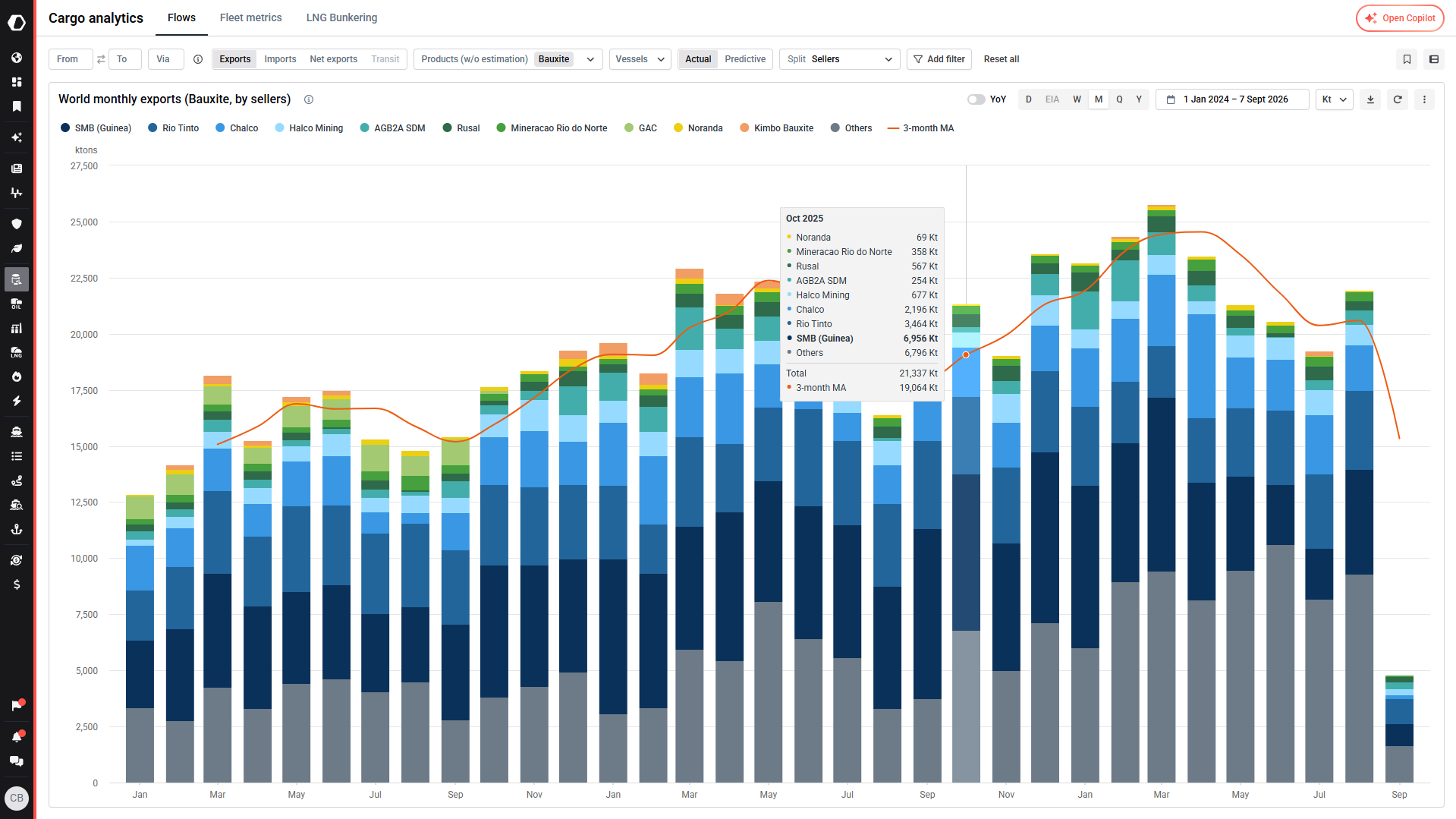
This process begins with the capesize vessels. Kpler is able to identify proximity events between the tugs and the capesize vessels - meaning that Kpler is able to know when one of the tugs has transferred its bauxite cargo onto one of the Capesize vessels that will take those cargo to buyers abroad. By then looking back at the voyage that the tug took , Kpler is able to identify which specific terminal it loaded from. Terrestrial terminals are all tied to specific producers. By connecting the terminal itself to the commercial entity that operates said terminal - Kpler is able to make the connection as to which miner is selling that particular bauxite cargo. As this process is scaled out, Kpler is then able to provide data on which producers are actually tied to which bauxite cargo back to the beginning of 2024, seen below.
What the export data actually shows in Guinea
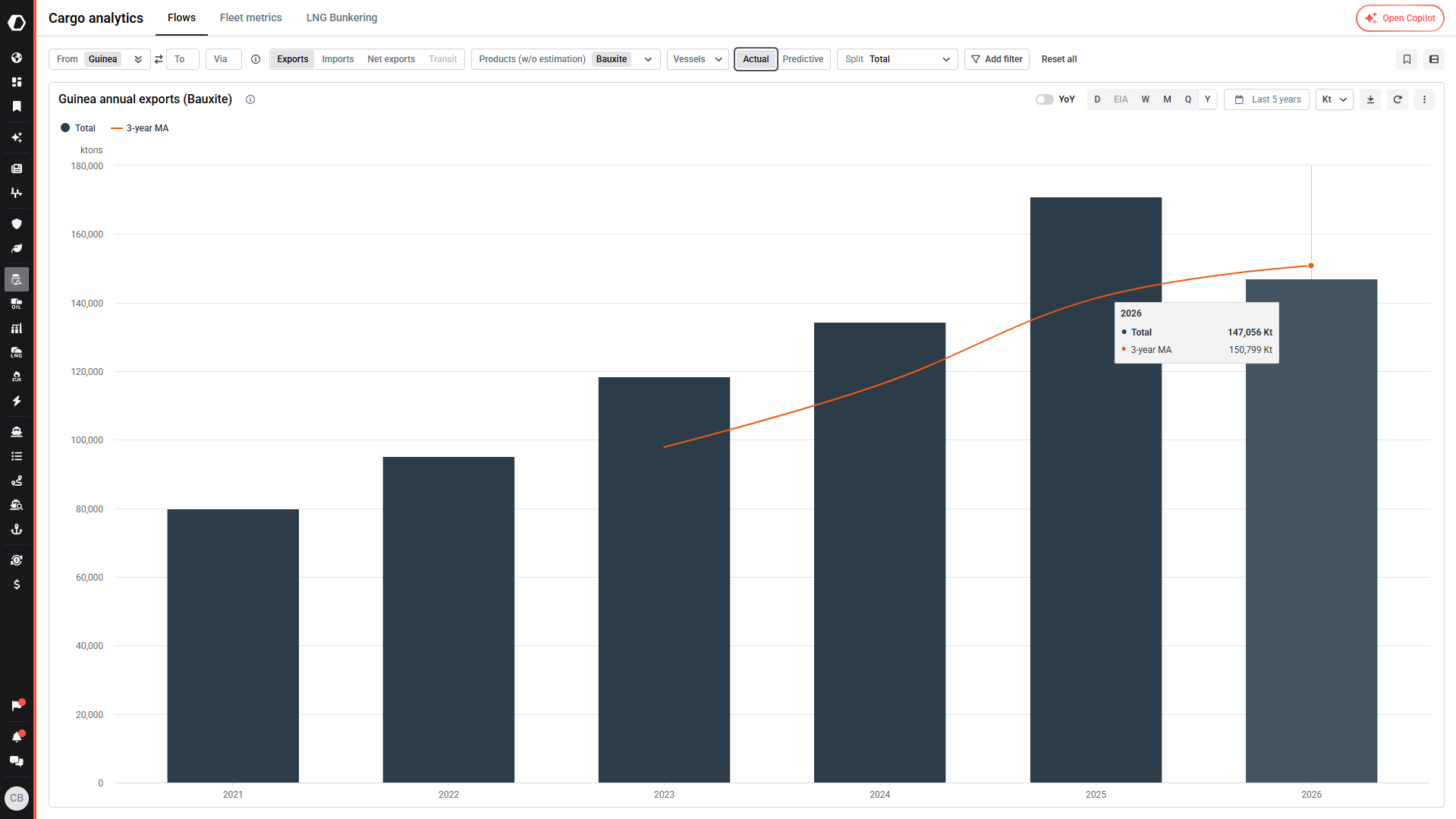
Importantly, Guinea is a massive exporter of bauxite, which has this year planned to introduce export controls over bauxite. Bauxite exports have risen year over year from Guinea as illustrated in this chart below, supporting the aluminum value chain but without any domestic refining capacity itself. The Guinean government has signalled interest in growing its domestic refining and much of the market believes that these export controls will continue to grow over time in order to support this initiative.
However, with Kpler data one can observe that these export controls have not appeared to take place for much of the year. With Kpler's terminal, one can easily create year-on-year views to analyze seasonality of trade flows. Below we can see that the bauxite exports from Guinea have been higher than any year in the last 5 years for most of the year. Kpler also provides predictive destination forecast models for users that show us in the chart below that by the end of September bauxite deliveries will once again outpace the same month from previous years.
However, this does not mean that Guinea will not impart export controls in the near future. When these controls begin to hit, key to understanding the impact on prices, as well as for the capesize freight market, will be knowing the affected mining operations.
A case in point: EGA's exit and Kimba's arrival
We can take a look at a recent example of how Kpler's data can help highlight this key market metric. Kpler is able to provide its users with five years of history to provide robust seasonality analysis. Kpler also provides intuitive chart making and dashboard creation, with the capacity to quickly limit your filters by interacting with the charts themselves. In taking a look at the chart below we can see that the miner EGA was exporting a reasonably significant quantity of bauxite from their Guinean operation in 2023, indeed becoming the leading exporter in many months that year. However, they failed to develop a bauxite refinery in the country - an ask from the Guinean government in order to receive their mining concession. After May 2024, they ceased exports from the country.
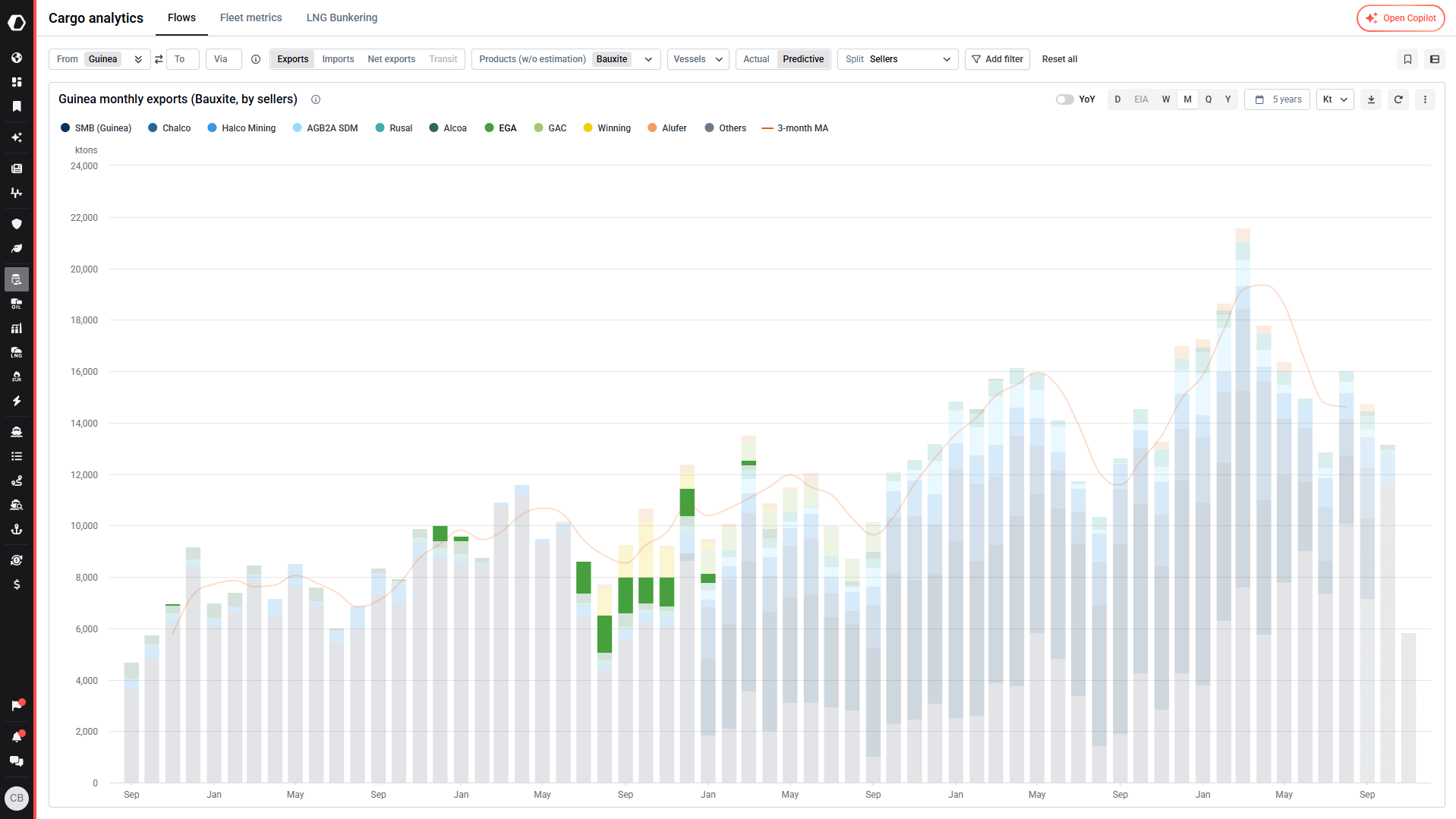
More recently, Kimba Mining Company was awarded the concession that was previously awarded to EGA. Exports from Kimba can be observed with Kpler data beginning in October 2025 and continuing apace through the current month. For those following this market and the operators - real time, accurately sourced data such as what Kpler is able to provide can offer a significant edge to traders and other market professionals.
Why this matters now for aluminum supply chains
Through the methodology described earlier, Kpler is able to differentiate the sellers involved with each and every loading. Given the major disruptions to aluminum supply chains globally - with big impacts to the aluminum supply chain given disruptions in the Strait of Hormuz - gaining information on not only the fundamentals of the bauxite trade but also the commercial players involved is critical for market professionals to navigate these turbulent times. Kpler is the only provider that is able to deliver this level of detail through its data and help deliver transparency to the trade.
If you are interested in learning more about how you can take advantage of what Kpler has to offer, request a demo below to get started.

See why the most successful traders and shipping experts use Kpler
Navigate a shifting bauxite market with accurate data