

Iran faces forced shut-ins as storage ceiling collides with reservoir constraints
Iranian supply is entering a forced adjustment phase, driven by two simultaneous shocks: physical infrastructure disruption and a near-total halt to loadings.
Key takeaways
- Iran faces imminent forced shut-ins, with storage saturation likely within ~20–24 days, triggering rapid production cuts.
- Supply losses will be uneven across blends, likely to affect Iran Light more, and potentially irreversible, as reservoir constraints force selective shut-ins in mature carbonate fields.
- Medium-term recovery is capped by South Pars damage (~100–120 kbd), limiting condensate and associated liquids even if exports resume.
- Operational response will drive structurally higher costs, with rotating shut-ins and complex restarts increasing opex and weakening NIOC’s financial capacity.
Oil production has already declined by ~750 kbd versus pre-war levels due, primarily due to lower domestic demand during the war. However, the more structural constraint comes from Israeli strikes on five South Pars phases, which have reduced condensate output capacity by ~100–120 kbd for at least six months. Given that condensate production is tightly linked to gas processing at South Pars, this loss cannot be rapidly offset and effectively caps Iran’s liquids recovery in the medium term.
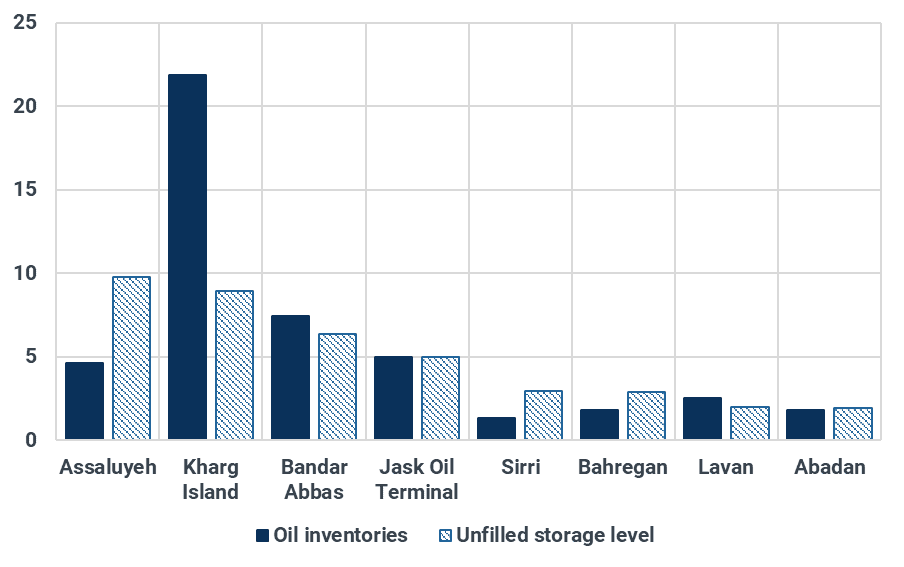
In the near term, the main binding constraint is the US naval blockade. Exports have effectively halted after a few loadings occurred last week. Only a couple of VLCCs are currently stranded in the Persian Gulf, allowing another 4 mbbls to be loaded. Nonetheless, Iran is being pushed into a storage-driven shut-in cycle. Based on displaced exports of ~1.8 mbd and ~39 mbbl of usable onshore storage, capacity could be exhausted within ~20–24 days. This estimate likely overstates usable capacity, as operational tank bottoms and flow constraints reduce effective working volumes. However, our estimate may also underestimate storage capacity at refineries in northern Iran, including the Tehran, Tabriz and Esfahan refineries.
NIOC oil inventories, mbbls
Source: Kpler
While the recent arrival of two VLCCs in the Persian Gulf may provide marginal floating storage (~4 mbbls), this does not materially change the timeline. NIOC is therefore likely to initiate pre-emptive production cuts within days, potentially delaying only to gauge the outcome of near-term negotiations.
Reservoir constraints will dictate the cut profile
Crucially, Iran cannot implement uniform production cuts across its upstream system. The structure of its reservoirs, combined with decades of sanctions-driven underinvestment, forces a highly selective shut-in strategy.
Iran’s production base is dominated by giant, mature carbonate reservoirs, particularly the Asmari and Bangestan formations, where natural decline rates can reach 4–12% annually without pressure support . These reservoirs typically exhibit low primary permeability, with productivity heavily dependent on fracture networks. Once pressure support is disrupted, reservoir performance can deteriorate quickly and, in some cases, irreversibly.
Moreover, Iran relies heavily on gas reinjection to maintain reservoir pressure, around 4.8 bcfd of gas was historically reinjected into oil fields. Any disruption to this system, either from operational constraints or upstream gas issues, directly accelerates decline and reduces ultimate recovery.
As a result, NIOC prioritises three categories of fields:
- Reservoirs shared with neighbouring countries (Azadegan, Yadavaran, Foroozan, Salman), where shutting in risks permanent loss of reserves to neighbouring producers.
- Pressure-sensitive carbonate reservoirs, particularly in the Bangestan group, where flow rates depend on fracture connectivity and pressure maintenance.
- Fields with active gas injection schemes, where interruptions can cause rapid and difficult-to-reverse decline.
This forces cuts into a narrower set of assets, primarily onshore southern fields such as Ahvaz-Asmari, Marun, Gachsaran, and Bibi Hakimeh. These fields, while large, offer relatively greater operational flexibility but are also among the most mature in the system.
Bangestan reservoirs predominantly feed into the heavier export slate, forming the backbone of the Iran Heavy blend (29.5 °API, 1.8% sulphur), while production from the shallower and more productive Asmari formations is largely directed into Iran Light (33 °API, 1.5% sulphur). This geological split is reflected in export composition, with Iran Light typically accounting for ~55% of volumes, Iran Heavy ~40%, and the remaining 5–10% made up of offshore and niche grades such as Soroosh, Sirri, Lavan, and Foroozan. These grades drive distinct refinery demand profiles across Asia.
The implication is that shut-ins will not only reduce volumes but may also damage future productive capacity. Iran’s average recovery rates are already low at ~25%, well below regional peers, reflecting chronic underinvestment and reservoir management challenges. Forced shut-ins risk locking in further losses, although NIOC has strong expertise in managing production flows due to previous rounds of sanctions already curtailing output.
Outlook: fast cuts and high opex, uncertain recovery
The combination of storage exhaustion and reservoir constraints suggests that production cuts will begin imminently and deepen rapidly if the US blockade stays. Today, President Trump announced the blockade will be kept until a deal is signed with Iran, while the Islamic Republic is officially rejecting talks for as long as the blockade will be implemented.
Beyond reservoir constraints, the mechanics of shutting in production will also drive a step-change in operating costs. Historically, NIOC has managed declines and sanctions-related disruptions by rotating shut-ins across wells and fields, rather than fully idling assets, to preserve reservoir integrity and maintain operational flexibility. However, this approach is inherently cost-intensive, requiring continuous well interventions, pressure management, and surface facility adjustments to cycle production on and off. This adds further strain to NIOC’s finances, which are already under pressure as a growing share of oil revenues is diverted toward IRGC-linked channels, reducing funds available for upstream maintenance and recovery.
Restarting shut wells is also technically complex and expensive, particularly in mature carbonate reservoirs, reinforcing the risk that short-term operational decisions translate into structurally higher opex and lower effective capacity over time.
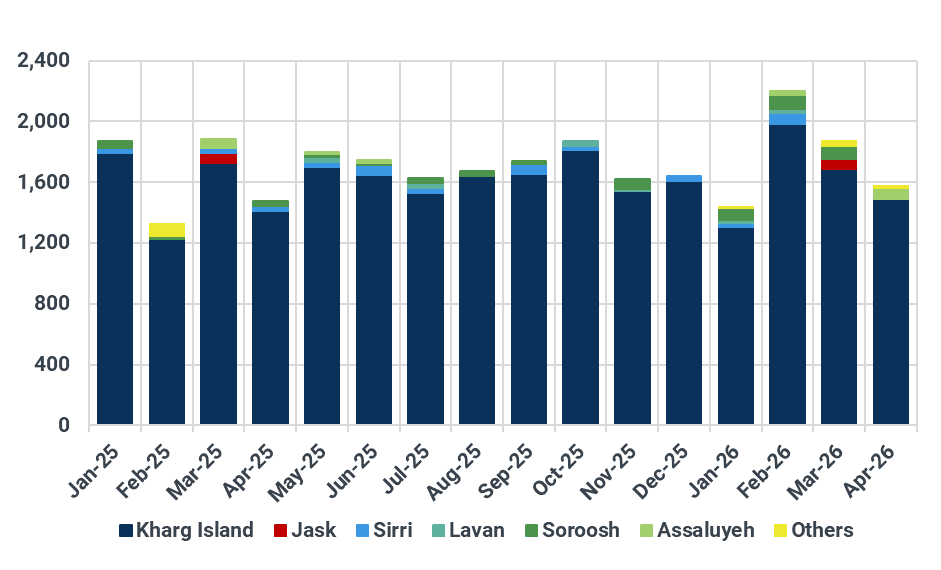
Iran oil exports by port, kbd
Source: Kpler

See why the most successful traders and shipping experts use Kpler