Maritime product update: Vessel Commercial Operator in Container Intelligence
TL;DR: In June 2026, we shipped a targeted but high-impact update to Container Intelligence. Every vessel now shows its commercial operator as the primary carrier, eliminating ambiguity between technical ownership and operational control. This matters most for teams running carrier-level analytics, including waiting time benchmarking, terminal performance, and service intelligence just got sharper.
In one sentence: This update lets you isolate exactly which vessels a specific shipping line operates, not just which vessels are associated with its services.
What Kpler shipped in June
This release addresses a persistent data clarity problem: when filtering by carrier, Container Intelligence previously returned all vessels associated with a service, including alliance partners. That made it hard to draw clean lines between operators.
The fix is structural. The commercial operator is now surfaced as the primary carrier on each vessel, giving analysts a reliable, unambiguous signal for carrier-level work.
Vessel Commercial Operator overview
What it is: The shipping line commercially responsible for operating a vessel is now clearly identified and displayed as the primary carrier in Container Intelligence, distinct from technical ownership or alliance association.
Who it's for: Container analysts, freight market researchers, and terminal teams who need to attribute vessel activity to a specific operator rather than a service or alliance group.
Why it matters: Alliance structures mean a single service can involve vessels from multiple operators. Filtering by carrier used to pull in all of them. Now you can isolate exactly which vessels a specific operator controls, making analyses like waiting time benchmarking and terminal performance by carrier far more reliable.
At a glance:
- Commercial operator highlighted at the top of the carrier list on each vessel profile
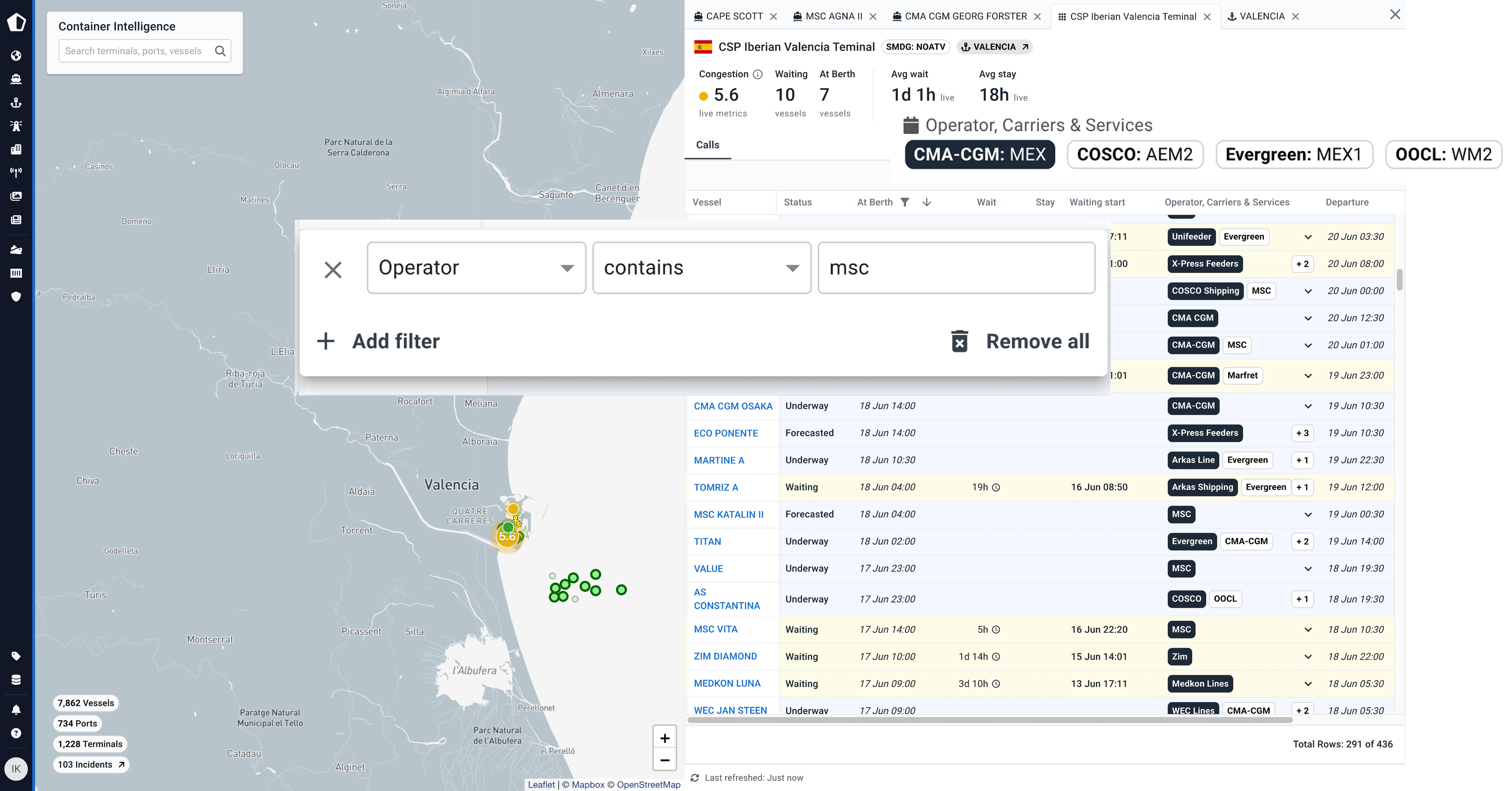
- New "operator" filter in terminal lineups
- Available via the vessel API endpoint — no breaking change, no action required for existing users
- Generally available
- Help Center article
Enhancements & improvements
The commercial operator data is exposed via the existing vessel API endpoint and there are no breaking changes. Existing API integrations continue to work as before, with the new field available to use whenever you're ready.
- Vessel profiles: The commercial operator is now prominently displayed at the top of the carrier list, so the controlling line is the first thing you see rather than being buried among alliance partners.
- Terminal lineups: A new "operator" filter lets you cut lineup data by the carrier actually running each vessel, not just those associated with the service.
What this means for users
Commercial operator visibility strengthens the core analytical loop in Container Intelligence. Vessel data, terminal lineups, and API outputs now share a consistent, unambiguous carrier signal, so whether you're building a dashboard, running a query, or scanning a lineup, you're working from the same ground truth.
For teams tracking carrier performance across ports and trades, this closes a meaningful gap:
- Sharper carrier analytics: Waiting time benchmarking and terminal performance metrics can now be scoped to a single operator, not a service or alliance.
- Less manual filtering: No more cross-referencing alliance membership to figure out who's actually running a vessel.
- Cleaner data confidence: The primary carrier signal is now commercially grounded, not technically ambiguous.
How to use this update
- Find the commercial operator field at the top of any vessel profile's carrier list.
- Use the new "operator" filter in terminal lineups to cut by controlling carrier.
- For API users, the commercial operator is available via the existing vessel endpoint. There are no changes to your integration required.
- Read the Help Centre article for a full walkthrough.
FAQs
What is the difference between "commercial operator" and the carriers listed on a vessel?
A vessel often participates in shared alliance services, meaning multiple carriers are associated with it. The commercial operator is the specific shipping line that controls and deploys the vessel — the one making decisions on its routing and operations. All associated carriers remain visible; the operator is now highlighted as the primary one.
Why does the same vessel appear on multiple carrier pages?
In alliance services, several shipping lines jointly operate a route and each contributes vessels. The Ever Given, for example, operates on a shared service involving Evergreen, COSCO, and others. Each carrier features the vessel on their service page, but Evergreen is the commercial operator.
Does the new Operator filter replace the existing Carrier filter?
No. The existing "Carrier contains" filter returns all vessels associated with a service, including alliance partners. The new Operator filter returns only vessels where the selected line is the primary commercial operator. Both filters remain available.
Is the commercial operator data available in the API?
Yes. The operator field is included in the vessel endpoint as a non-breaking addition. Existing integrations require no changes. See the API documentation for field details.
What is the coverage of commercial operator assignments?
Coverage focuses on mainline container vessels. The dataset is maintained by a dedicated team of industry analysts and is updated on an ongoing basis.

See why the most successful traders and shipping experts use Kpler
Get real-time container visibility, from vessel to terminal