
VLCC rates retreat from record highs amid geopolitical shifts and fundamental pressures
Dirty tanker rates corrected sharply this week on easing geopolitical premiums and lower Saudi loadings. While MEG VLCCs face continued pressure, tight Atlantic tonnage and shifting arbitrage flows should spark near-term rebounds for USG VLCCs, Suezmaxes, and Aframaxes. Conversely, clean tanker markets remain mostly bearish due to softening Western demand, building vessel availability, and spillover weakness from the dirty sector.
Market & trading calls
MEG–China (TD3C): Bearish | VLCC rates shed $6.02/bbl this week, falling below $30/bbl. Further near-term pressure is expected due to lower Saudi loadings and abundant ballasters, though fading geopolitical optimism should help establish a floor.
USG–China (TD22): Bearish | VLCC rates plunged 41% to $17.09/bbl. However, limited regional tonnage, stronger Asian demand for Atlantic crude, and narrowing earnings spreads set the stage for a rebound.
WAF–UKC (TD20): Bullish | Suezmax rates fell $3.14/bbl to $7.86/bbl but found late-week resistance. Limited Atlantic VLCC availability is diverting long-haul volumes to Suezmaxes, helping rates recover some losses next week.
USG–UKC (TD25): Bullish | Aframax rates dropped $3.07/bbl to $8.64/bbl, erasing September gains. Strong USG loadings, competitive WTI pricing, and tighter ballaster lists should stabilize the market and support recovery.
Cross Med (TD19): Bullish | Aframax rates edged down $0.46/bbl to $3.85/bbl. Increased Yanbu and Sumed crude flows to Europe should lead an initial recovery, though opening transatlantic tonnage may cap upside.
MEG–Japan (TC1): Bearish | LR2 rates rose $0.30/bbl to $25.75/bbl. Despite firm selective Asian product cracks, slowing Middle East clean exports and spillover pressure from weakening dirty rates will weigh on earnings.
UKC–USAC (TC2): Bearish | MR rates fell $0.12/bbl to $3.71/bbl. Tighter Western clean supply offers support, but easing transatlantic demand amid rising US product stocks keeps downward pressure on rates.
USG–UKC (TC14): Bearish | MR rates dropped $0.90/bbl to $11.43/bbl. Softening European and Latin American diesel demand, waning advantages over LRs, and rising Gulf ballasters will sustain downward pressure.
Korea–Singapore (TC11): Bearish | MR rates fell $0.36/bbl to $5.47/bbl. Building East of Suez vessel availability, and soft Chinese export incentives will push rates lower.
VLCC
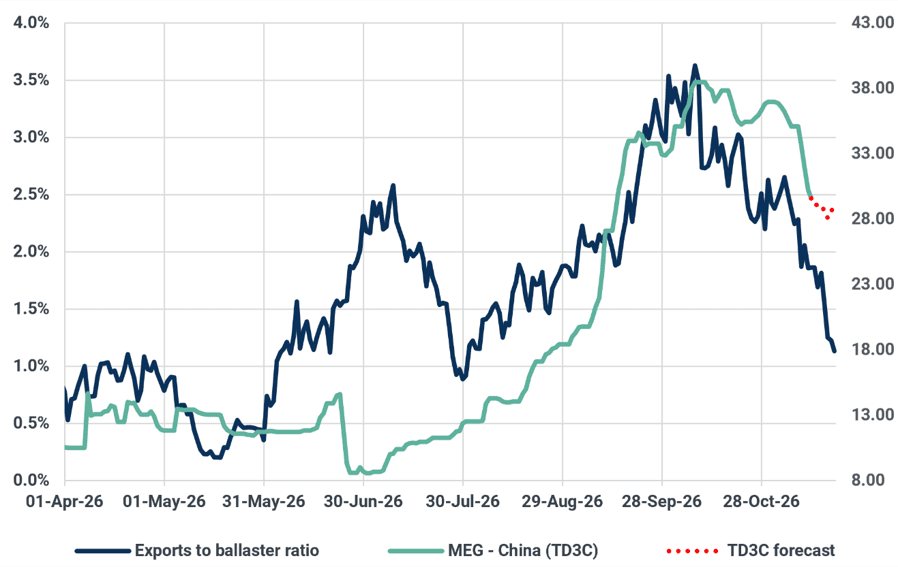
MEG – China (TD3C)
MEG to China VLCC rates shed $6.02/bbl over the reporting week, falling below the $30/bbl mark for the first time since mid-September. We identify three factors behind this contained pullback.
Geopolitical developments have eased regional risk premiums, with Democratic gains in the 3 November US midterms potentially limiting Trump’s ability to escalate the conflict and increasing pressure for diplomacy. Qatari-led negotiations and reports that Tehran has exempted vessels from Iraq, Qatar, China and India from SoH transit restrictions have further boosted optimism. However, this contrasts with the reality on the ground as the President's latest remarks suggest growing confidence in maintaining the current status quo in the SoH, while Iranian aggression against commercial shipping persists, with the IMO reporting at least eight incidents in November.
The subsequent decline in crude prices has also lowered the ceiling on freight rates, although the latter appear to be correcting at a faster pace. TD3c currently accounts for circa 32% of regional fob benchmarks versus 36% in mid-October.
From a fundamentals perspective, MEG VLCC loadings have settled at 7.4 Mbd in the first half of November versus 9.3 Mbd across October, with Saudi Arabia accounting for the bulk of the losses. A sharp increase in Saudi Arabia’s MEG loadings in September following the Houthi attack on the Petroline has been instrumental in the observed freight rally, as it tested the GoO StS capacity, calling for a diversification of MEG trades and leading to a spike in the tonnage operating in the area. A pullback of Saudi volumes has thus eased the above support factors, allowing rates to settle lower.
Outside the MEG, a $5.97/bbl w/w decline in GoO-to-China rates to $7.91/bbl has also been driven by EoS VLCC ballasters reaching a new high, as earnings spreads have discouraged owners from ballasting to the Atlantic.
Rates may come under further pressure next week, although gradually fading geopolitical optimism should help establish a floor over the review period.
VLCC MEG tonnage balance ratio (%) (10MA) vs TD3C ($/bbl)
Source: Baltic Exchange, Kpler
USG – China (TD22)
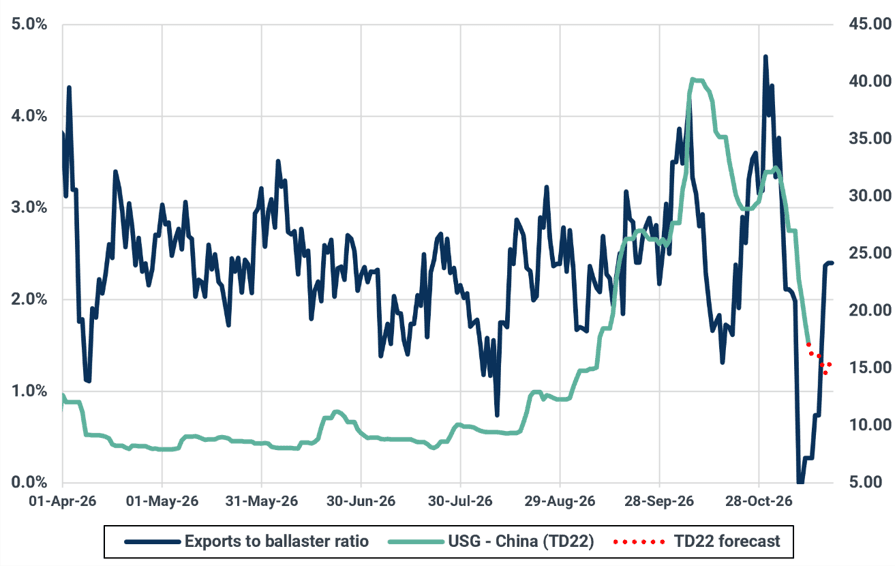
USG-to-China VLCC rates lost 41% of their value over the review period, dropping by $12.17/bbl to $17.09/bbl. A circa $270k/day discount in USG versus GoO earnings over October discouraged owners from positioning in the Atlantic, prompting a sharp rise in regional rates to attract vessels, which subsequently narrowed West-to-East arbitrage incentives. Consequently, USG VLCC loadings have fallen to just 48 kbd so far in November, signalling reduced loading activity. This, coupled with spill-over weakness from the MEG and competition from mid-sizes, has exerted further downward pressure on rates. Tracking the MEG trend, loadings out of Saudi Arabia’s Red Sea ports have also trended lower over November, further muting fixing.
The above sequence of events has started to reverse. Reports indicate that lower freight and crude prices have encouraged increased Chinese purchases of Brazilian crude, while subdued European demand for WTI Midland, amid improved access to ME barrels, could redirect US crude flows towards Asia. Meanwhile, the earnings premium of GoO compared to USG has narrowed to $60k/day. If the financial incentive for West-to-East trades persists, limited VLCC availability could prompt a shift of these trades towards promptly accessible midsizes, eventually forcing a bottom-up rebound in VLCC rates. We expect the recent decline in Atlantic rates to moderate relative to their GoO counterparts, setting the stage for a further narrowing of the earnings spread.
VLCC US Gulf tonnage balance ratio (%) (10MA) vs TD22 ($/bbl)
Source: Baltic Exchange, Kpler
Suezmax
WAF – UKC (TD20)
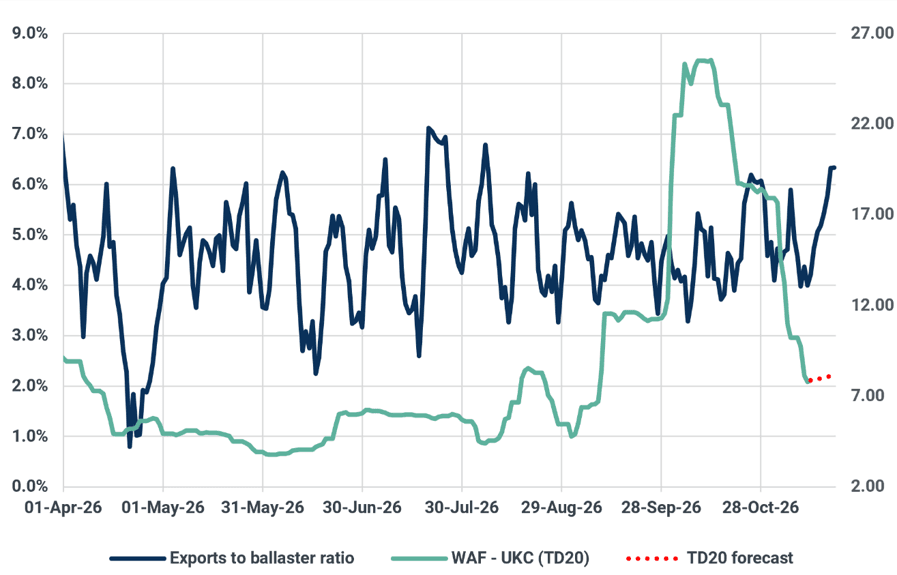
WAF-UKC Suezmax rates declined by a further $3.14/bbl over the analysis period to $7.86/bbl, although some resistance emerged towards the end of the week. West African Suezmax loadings have fallen to approximately 1.9 Mbd in November, down from 2.3 Mbd in October, while the segment’s participation in long-haul trades to Asia remains firm at around 650 kbd. Meanwhile, the conclusion of trilateral peace talks between the US, Russia and Ukraine in Abu Dhabi on 10–11 November failed to deliver a ceasefire breakthrough, although the diplomatic engagement may have contributed to optimism over reduced Black Sea aggression, adding further pressure to Atlantic rates.
Looking ahead, limited VLCC availability in the Atlantic is expected to continue diverting West-to-East volumes towards smaller vessel classes, with Suezmaxes likely to be the first beneficiaries, provided arbitrage economics remain supported. Suezmax employment in the WoS has started tracking the upper end of seasonal norms, following record-high levels across most of the year, although a wave of returning ballasters could moderate the tightening of position lists. Alongside an easing in the pace of the VLCC correction, we expect Suezmax rates to recover some losses over the forecast period.
Suezmax WAF tonnage balance ratio (%) (10MA) vs TD20 ($/bbl)
Source: Baltic Exchange, Kpler
Aframax
USG – UKC (TD25)
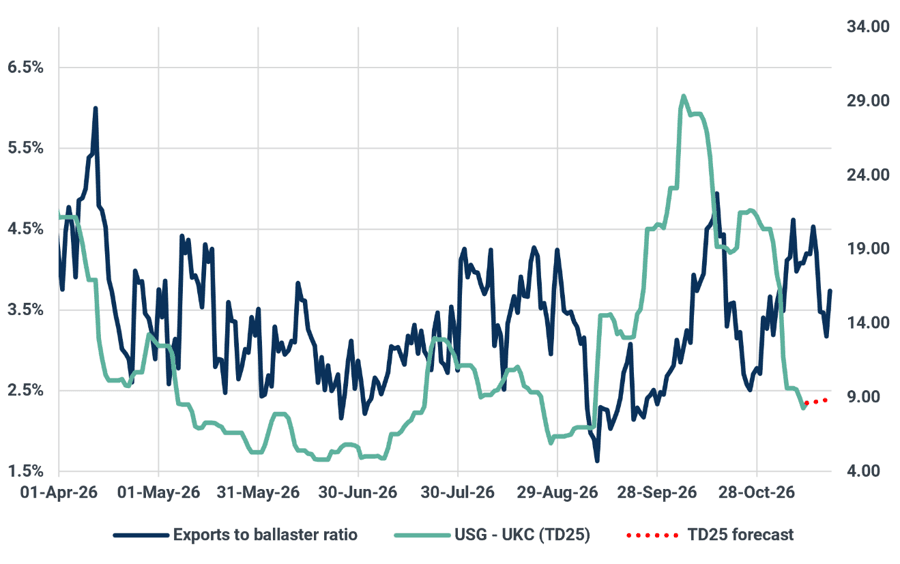
The correction in USG-UKC Aframax rates moderated over the past week, with assessments closing at $8.64/bbl, down $3.07/bbl w/w, effectively erasing all gains made since early September. Much of the recent weakness appears to reflect spill-over pressure from larger vessel classes, as underlying fundamentals remain constructive. Despite an overall decline in USG exports, the complete withdrawal of VLCCs has supported Aframax activity, with loadings increasing to around 2.6 mbd so far in November. Meanwhile, lower freight costs have further improved WTI's competitiveness into Europe. Furthermore, record loadings across October and November have driven a sharp decline in regional ballaster availability, bringing tonnage levels down to seasonal norms. With rates having seemingly exhausted much of their top-down correction, the combination of firm underlying flows, tighter position lists and a slowdown in the VLCC rate correction should support greater stability in the TD25 market over the forecast period.
Aframax US Gulf tonnage balance ratio (%) (10MA) vs TD25 ($/bbl)
Source: Baltic Exchange, Kpler
Cross Med (TD19)
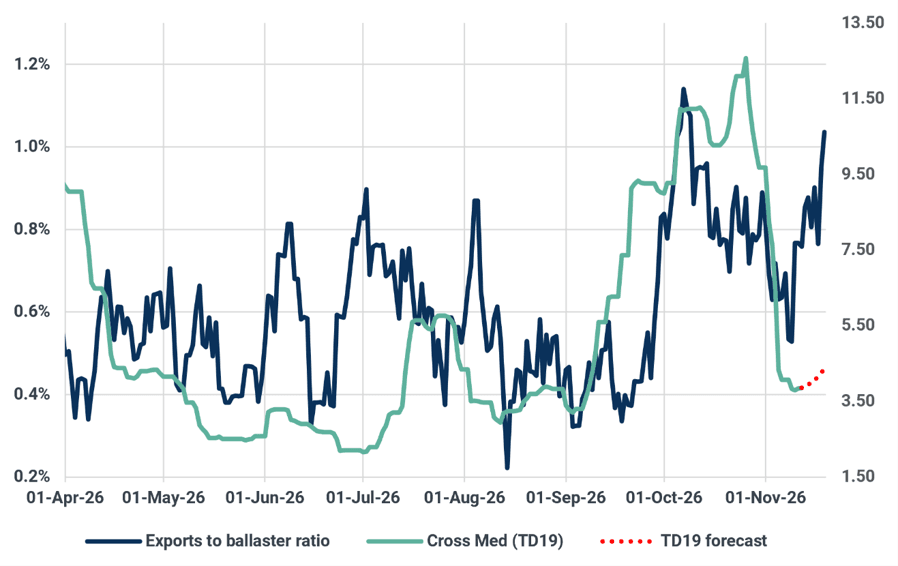
Cross-Med Aframax rates recorded the smallest losses among the reported dirty benchmarks, declining by just $0.46/bbl to $3.85/bbl, once again reverting to pre-September levels. On the demand side, Saudi Aramco has informed several European refiners that it will meet their full crude requirements for next month, potentially extending regional cargo lists. Accordingly, crude flows to Europe via Yanbu and the Sumed pipeline have increased to around 1.3 mbd so far in November, with Aframaxes emerging as the main beneficiaries. However, outside Egypt, Turkish (Kirkuk) and Libyan loadings have both trended lower, providing some fundamental justification for the recent rate correction.
Looking ahead, we expect TD19 to lead the initial rate recovery, although as transatlantic tonnage opens in the region further upside could be capped.
Aframax Med tonnage balance ratio (%) (10MA) vs TD19 ($/bbl)
Source: Baltic Exchange, Kpler
LR
MEG – Japan (TC1)
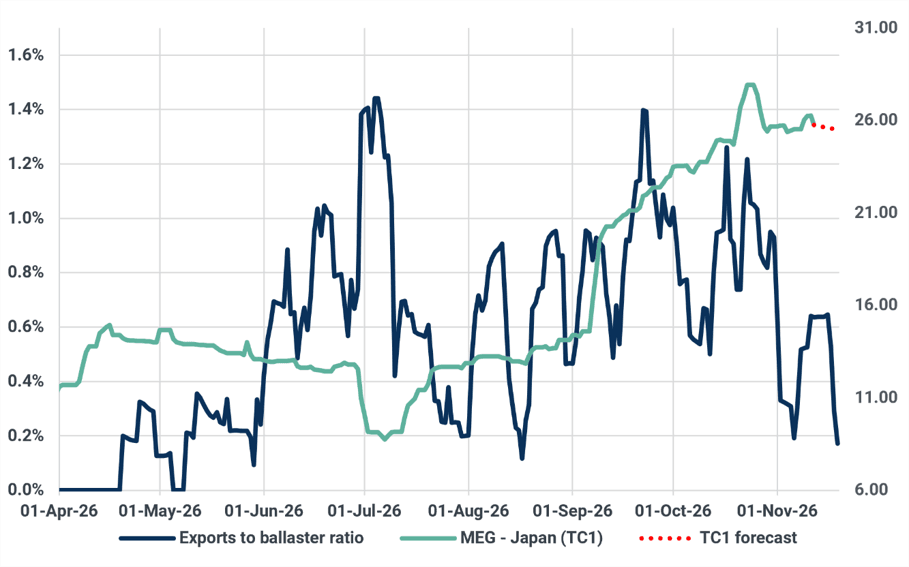
MEG to Japan LR2 rates rose $0.30/bbl w/w to $25.75/bbl, from $25.45/bbl on 5 November. Clean flows from the Middle East have slowed over the last two weeks, dropping from 2.32 Mbd at the end of October. The main decline was from the Mideast Gulf and Gulf of Oman terminals, with an increase in Saudi Red Sea exports offsetting the decline somewhat. While demand has softened, the decline in LR rates appears to also by affected by the decline in dirty rates from the region over the last week.
Outside the Middle East, LR rates from India and the Mediterranean continued lower, faced with greater completion on long haul voyages from MRs where rates remain significantly lower. This has been most notable on West to East trades, denting LR2 demand. Asian pull remains firm in selective products, as the Singapore 95R gasoline crack gained $3.6/bbl w/w and gasoil cracks widened after gasoil fell less than crude. Light-end demand is recovering more slowly. Naphtha stocks sit at five-year seasonal lows, but petrochemical margins, weak outside ethane crackers, will set the pace of any rebound.
The small increase in LR2 freight contrasts with the large declines across the dirty segment this week and has significantly narrowed the spread between LR2s and Aframaxes. We don’t expect widespread dirty to clean switching yet, parimutuel as LR rates in the West are set to fall further.
We expect Middle East rates to trend flat while in the West, competition from MRs will push rates lower.
LR2 MEG tonnage balance ratio (%) (10MA) vs TC1 ($/bbl)
Source: Baltic Exchange, Kpler
MR
UKC – USAC (TC2)
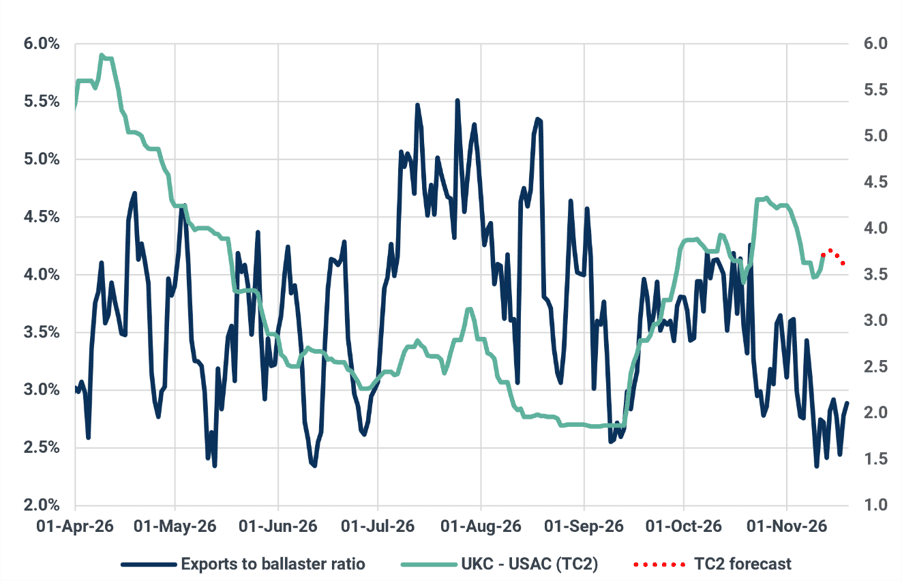
UKC to USAC MR rates fell $0.12/bbl w/w to $3.71/bbl, rising slightly at the end of the week. US pull for transatlantic barrels eased as EIA data showed total product stocks building by 6.7 Mb w/w, the first rise in two months, led by diesel (+4.1 Mb) and gasoline (+1.8 Mb), while refinery utilization rose to 95.2%. The easing in loadings from Northwest Europe is consistent with seasonal norms. Med demand remains an outlier, steadily rising into November, lifted by higher intra-regional demand.
Tonnage supply is the offset to weaker demand. Around 250 MRs, or 12% of the fleet, now trade in the dirty pool and higher Asia-Pacific MR earnings will keep many MRs on West to East voyages from returning to the West after discharging in Asia. Collectively, MR supply in the clean market in the West is lower and set to fall further. However, MR demand on long haul voyages has eased slightly in recent weeks but rates remain competitive with LRs. After rising slightly at the end of the week we expect rates should stabilise next week with the potential to fall again.
MR UKC tonnage balance ratio (%) (10MA) vs TC2 ($/bbl)
Source: Baltic Exchange, Kpler
USG – UKC (TC14)
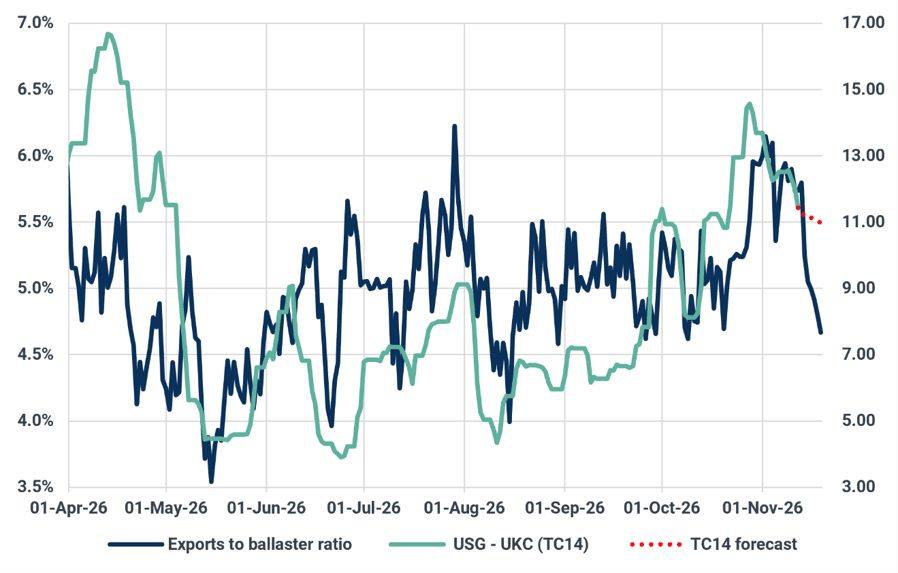
USG to UKC MR rates fell $0.90/bbl w/w to $11.43/bbl. Diesel demand across Europe and Latin America has softened, reducing US Gulf exports which had been trending well above seasonal norms for most of the year.
The MR market in the West has benefitted from high LR rates over the last month, picking up long haul cargoes. But, following the decline across LR markets, the MR advantage will begin to wane. On the supply side, the MR ballast count in the Gulf of Mexico fell in October, helping to push rates higher. It has since increased slightly, which, amid lower demand, will keep the downward pressure on rates over the coming weeks.
MR US Gulf tonnage balance ratio (%) (10MA) vs TC14 ($/bbl)
Source: Baltic Exchange, Kpler
Korea – Singapore (TC11)
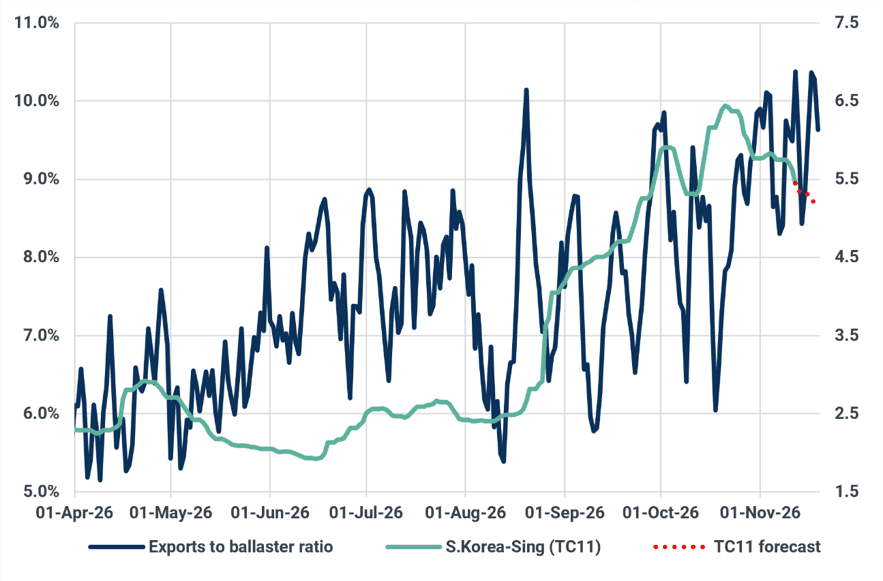
South Korea to Singapore MR rates fell $0.36/bbl w/w to $5.47/bbl, from $5.83/bbl on 5 November, with the daily decline widening to $0.17/bbl on the final session. Asian product signals are mixed.
The Singapore 95R gasoline crack gained $3.6/bbl w/w, but RBOB fell 6.1% in the sell-off, and Middle East refinery runs recovered to 7.7 Mbd in October, adding to regional supply competition as Gulf product exports rebuild. Uncertainty over China's refined product export policy also clouds the outlook for regional runs and trade. Despite higher export quotas, expectations for increases in exports have dimmed, amid weak export incentives and low domestic stocks. Structural demand is weak, with Chinese gasoline and diesel demand expected to keep eroding in 2027 as new energy vehicles reach 70% of new car sales and electric and LNG trucks displace diesel.
On the supply side, uncompetitive LR2s resulted in some downsizing some West-to-East clean cargoes onto MRs, prompting tonnage to reposition east of Suez and add to regional availability. Rates should extend lower next week as vessel availability builds against soft regional demand.
MR Eastern Asia tonnage balance ratio (%) (10MA) vs TC11 ($/bbl)
Source: Baltic Exchange, Kpler

See why the most successful traders and shipping experts use Kpler