Oil tops $100/bbl as prospects for quick Hormuz reopening dim
Oil has gathered all the catalysts it needs for a perfect storm to propel prices to the next level.
Key takeaways:
- Oil prices hit their highest level since June 2022 despite reports that G7 nations may release strategic petroleum reserves to stabilise the market.
- Shipping activity suggests most shipowners remain reluctant to transit the Strait of Hormuz, with only a handful of vessels entering or leaving the Middle East Gulf in recent days.
- Storage pressure continues to build across Gulf producers, raising the likelihood of further output cuts or well shut-ins as tanker availability remains constrained.
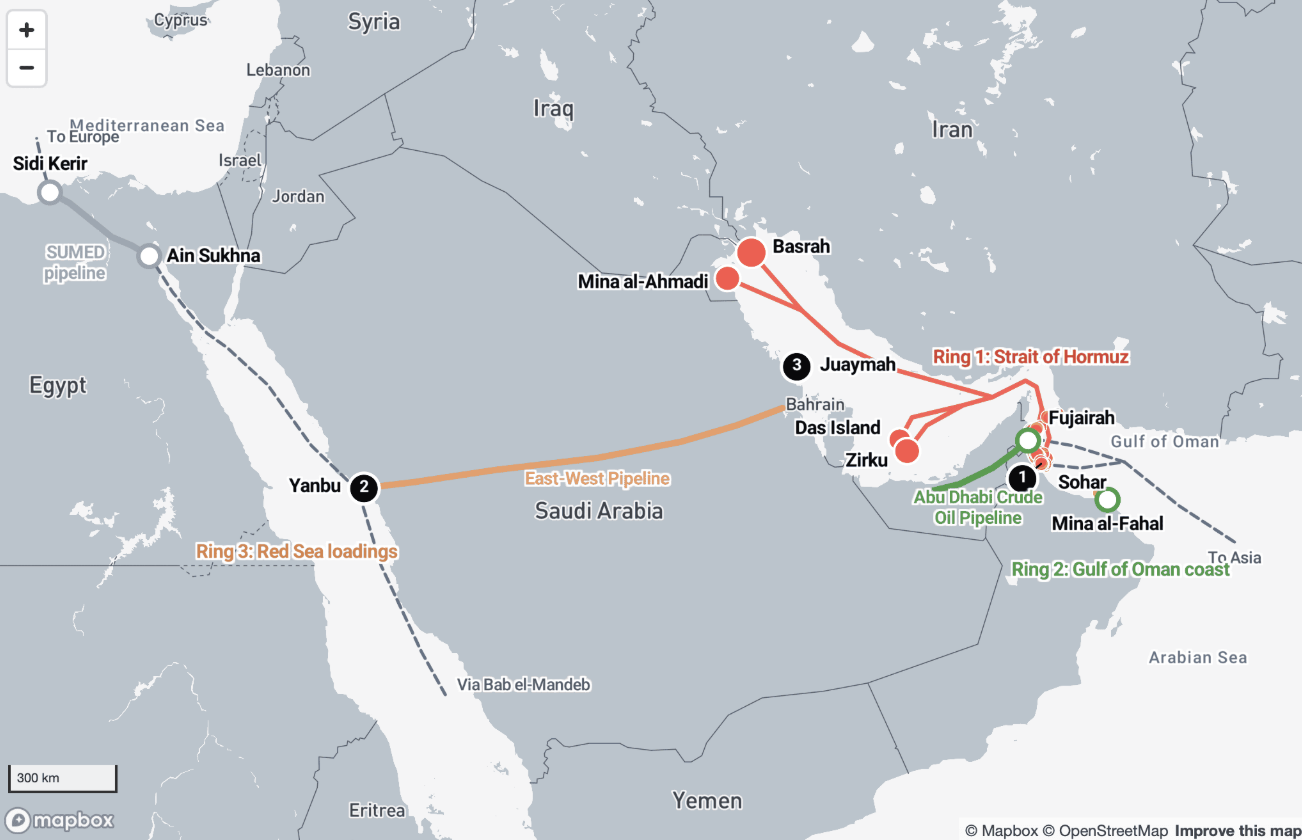
- Alternative export routes are helping but remain insufficient, with record loadings from Fujairah and Yanbu still leaving effective Middle Eastern exports at only about one-third of normal levels.
- Asian refiners are expected to step up purchases of long-haul cargoes from the Atlantic Basin as no quick reopening of Strait of Hormuz traffic appears in sight.
Benchmark crude oil prices opened up more than 20% and held above $105/bbl during Asian trading hours on Monday—a level last seen in the summer of 2022—as fresh signs pointed to widening supply disruptions in the Middle East, with no quick turnaround in sight.
While news reports that G7 nations will discuss a possible joint release of oil reserves coordinated by the IEA later on Monday helped cool oil prices—down as much as $10/bbl before rebounding to around $110/bbl—the move appears insufficient to ease concerns over immediate supply tightness, as the key factor in tempering prices remains the resumption of Middle Eastern oil flows.
Over the weekend, Kuwait’s KPC joined Iraqi and Qatari producers in announcing crude output cuts, becoming the latest Middle Eastern supplier to curb production, although it did not disclose the scale of the reduction. Kpler estimated last Monday that Kuwait’s storage facilities have roughly 12 days of capacity remaining if output continues while no ballast vessels arrive to lift the crude.
Our data shows the last crude tanker to exit the Middle East Gulf with its AIS transponder on was the VLCC New Vision, which transited the Strait of Hormuz on Feb 28 and is now en route to France.
The entry of at least five Dynacom vessels—Athina, Smyrni, Kerala, Pola, and Kavomaleas—into the Middle East Gulf early last week, along with expectations that China-linked vessels might be allowed to pass through the strait, raised hopes in the market for a partial resumption of oil flows, helping keep prices below $100/bbl. However, as traffic through Hormuz has remained clogged for a second week, that optimism is fading.
At least three vessels—Iron Maiden, Ksl Hengyang, Sino Ocean, have left the Middle East Gulf in recent days and listed “China owner and crew” as their AIS destination while passing through the Strait. However, the fact that two of these vessels were in ballast while the third was carrying sulphur, and that the remaining 250+ liquid vessels (MR-sized and above) and 270+ dry bulk vessels stranded in the Middle East Gulf have been slow to follow suit, suggests that the vast majority of shipowners remain unwilling to take the risk—especially those laden with crude now worth more than $200 million.
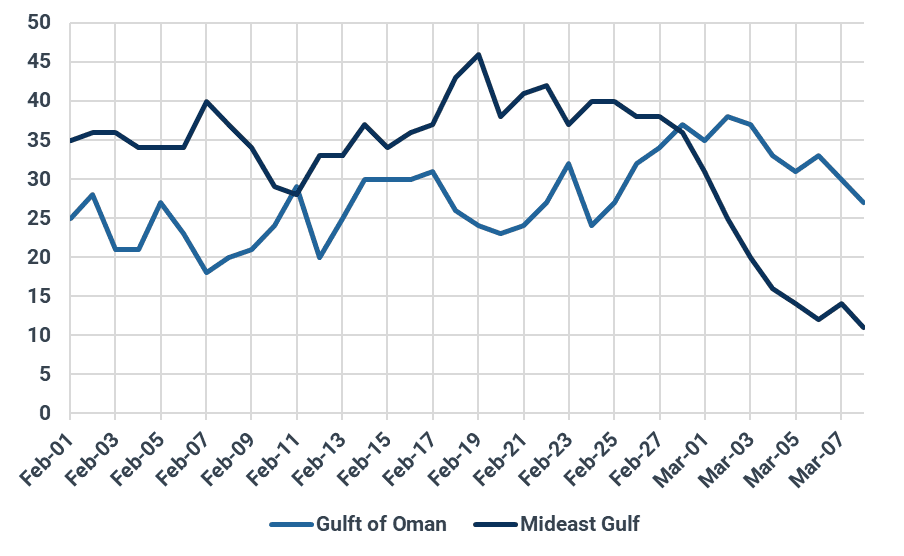
That said, as the number of ballast VLCCs, Suezmaxes and Aframaxes in the Middle East Gulf falls to just 30 in total, equivalent to roughly 38 mb of lifting capacity, oil producers may need to implement further production cuts or even shut in wells to ease storage pressure. Media reports said Iraq cut output from its southern oilfields by 70% to 1.3 mbd on Sunday. Abu Dhabi’s ADNOC also said it is carefully managing offshore production levels to address storage challenges, suggesting that output adjustments are likely if traffic through the Strait remains shut.
Number of VLCC in ballast by current location, count
Source: Kpler
Crude loadings from Fujairah resumed on March 5 after a drone strike forced operations at the terminal to halt for two days. So far, loadings have averaged a record-high pace of 1.43 mbd, still below the pipeline’s theoretical maximum transmission capacity of 1.8 mbd.
Loadings at Saudi Arabia’s Red Sea terminal of Yanbu have also hit a record high of 2.2 mbd so far this month, after Saudi Aramco redirected part of its oil flows to bypass the Strait of Hormuz. At least 11 tankers have been fully fixed to load from Yanbu between now and the end of March, chartered by firms including Aramco, GS Caltex, Unipec, Reliance, BPCL and Petco.
That said, even if Yanbu reaches close to its maximum loading capacity of 4.3 mbd, effective exports from the Middle East would remain only about a third of their previous level. If disruptions to Strait of Hormuz traffic persist for another one to two weeks, global crude benchmarks could climb above $130/bbl despite potential SPR releases.
Even if oil starts to flow through the Strait, it will likely take at least another week or two to reposition tankers to the Middle East Gulf, load crude from storage, and restart oil fields. Therefore, while waiting for the resumption of Middle Eastern exports, refiners are expected to increase procurement of alternative supplies from other regions, pointing to a sharp rise in crude differentials across the Atlantic Basin and the Americas this week.
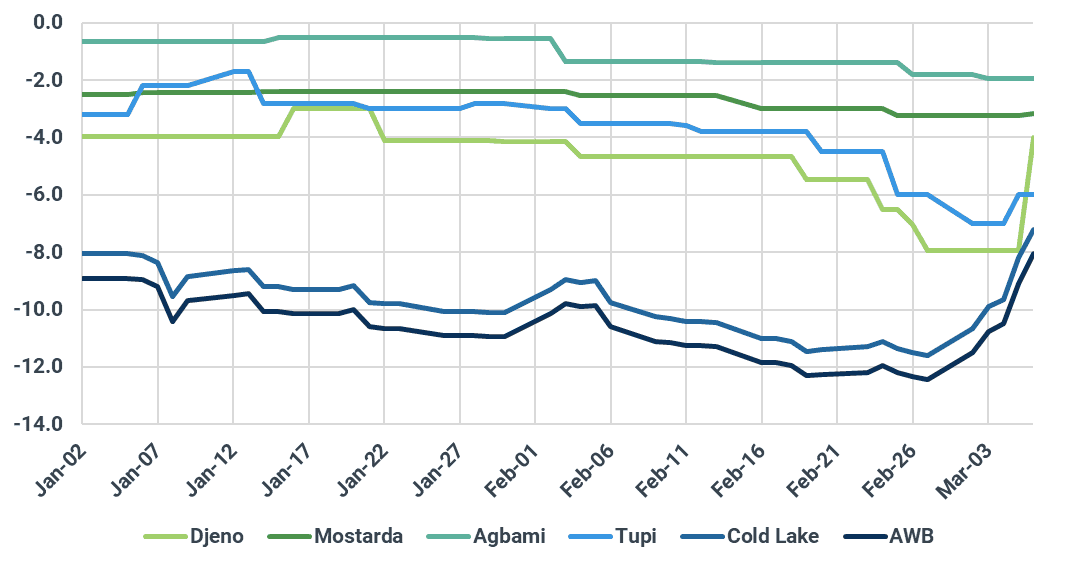
FOB prices for some West African grades—such as Djeno, Mostarda and Agbami—were slow to react following the Middle East crisis, as market participants had hoped for at least a partial resumption of Strait of Hormuz traffic by the end of last week, while high freight rates and a wide Brent-Dubai EFS discouraged Asian refiners from locking in expensive cargoes. However, as prompt cargo availability dries up and a quick resolution in the Middle East appears unlikely, refiners are expected to step up purchases of April-loading barrels to secure supplies.
Selected crude FOB differentials vs. respective benchmarks, $/bbl
Source: Argus Media
Market insights you can trust
Kpler delivers unbiased, expert-driven intelligence that helps you to track critical crude oil market developments for your own analysis. Our precise forecasting empowers smarter trading and risk management decisions. In times of conflict and geopolitical uncertainty, our real-time data keeps you ahead of supply disruptions and price volatility.
Unbiased. Data-driven. Essential. Request access to Kpler today.

See why the most successful traders and shipping experts use Kpler