Chinese economy struggles in April as oil imports precipitously decline
While Chinese goods exports surged in April, domestic household consumption weakened, and industrial production growth decelerated.
Summary
- Reliance on External Demand: Real retail sales fell 1% y/y in April, while industrial production held at +4.1% y/y, firmly keeping a persistent production – consumption gap in place. This dynamic keeps China highly reliant on external demand to absorb excess output. This dependence is unlikely to ease much this year and is a core reason China would prefer to see the Iran conflict end. Higher energy prices imply a weaker global economic environment.
- Narrowing Trade Surplus: Net exports fell to $85bn (-$11bn y/y) in April. However, the move was driven by higher semiconductor volumes and prices for AI infrastructure rather than a reflection of improving household demand. We expect this to persist and limit the pace of net export expansion, though the full-year goods surplus will still finish at a record high $1.2tn, roughly in line with levels from 2025. We also caution reading the compression as a shift towards consumption-led growth.
- Chinese Oil Imports Decline: An elevated dependence on crude imports is another driving factor behind why China would prefer to see an end to the Iran conflict and the Strait reopened. So far through May, Chinese seaborne crude/co imports have fallen 4.7 Mbd against pre-Iran levels. Transportation fuel exports have not recovered into May, currently holding at 126 kbd, down from 625 kbd pre-Iran.
Market Analysis
Last week (May 13), amid the Trump – Xi summit, we argued that China faced a nuanced position regarding the Iran war. On the one hand, China gains from watching US hard and soft power take a hit. Trump faces a bad decision set that involves either escalating or walking away, leaving Iran with control over the Strait of Hormuz. However, given an elevated reliance on external demand and a need for large amounts of imported oil, China would ultimately prefer to see the Iran conflict come to an end.
As the closure of the Strait of Hormuz approaches the three month mark, China’s economy is showing signs of strain. In April, retail sales growth, when adjusted for inflation, declined 1% y/y, falling from an already meagre +1.6% y/y growth rate in Q1. Over the final two months of 2025, similar real consumption declines were also prevalent. Broadly speaking, the Chinese consumer has struggled since the middle of last year, when consumption growth topped out at +5.5% y/y, nearly overtaking the pace of industrial production growth, a rare development. For now, the government has not shown much willingness to step up fiscal support beyond incremental measures that largely just pull forward demand.
Chinese Industrial Production and Real Retail Sales Growth (%, Y/Y Terms)
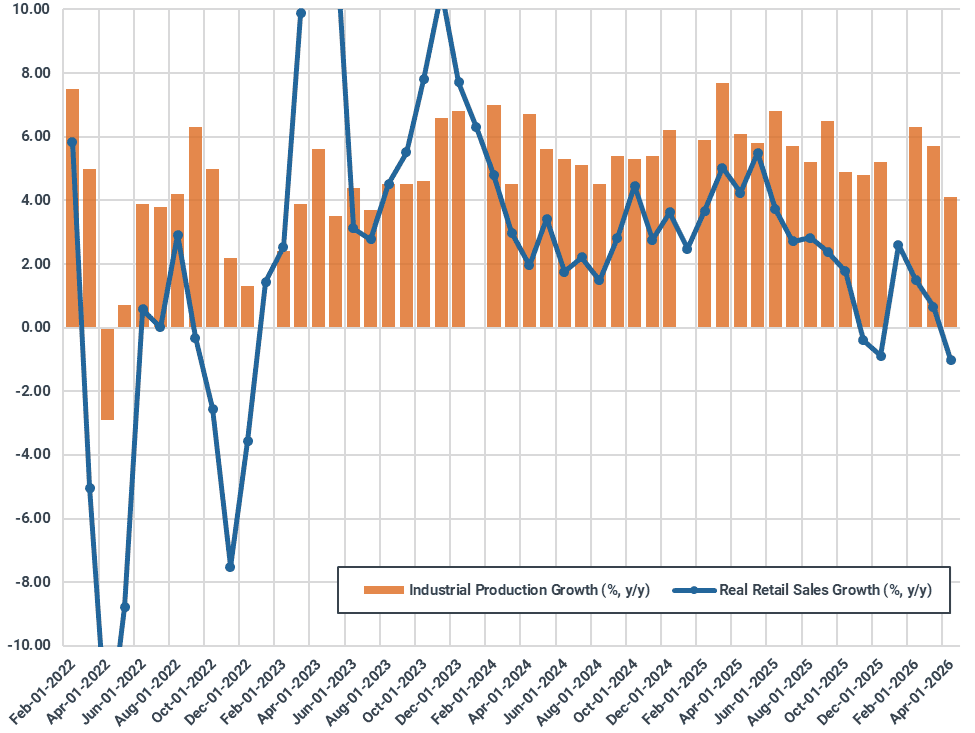
Source: NBS; Kpler calculations, Industrial production growth is reported for Jan/Feb, retail sales data is only reported for Jan/Feb but has been split equally and computed against headline inflation

See why the most successful traders and shipping experts use Kpler