

From "help Is on the way" to "let the oil flow"
A conflict that began amid discussion of regime instability and support for Iranian protesters is ending with Washington negotiating directly with Tehran over sanctions relief, oil exports, and regional integration. The signed memorandum may reduce energy-market risks in the near term, but its long-term success will depend on unresolved negotiations over Iran's nuclear program, regional security, and implementation.
Earlier this year, amid widespread unrest in Iran, President Trump urged protesters to continue demonstrating and declared that "help is on the way." Five months later, following the signing of an interim U.S.-Iran memorandum of understanding, his message was very different: "Ships of the World, start your engines" and "Let the oil flow."
Whether one views that evolution as strategic success, pragmatic diplomacy, or simply geopolitical reality, it captures how dramatically the conversation has changed. A conflict that once featured discussion of regime instability and support for Iranian protesters is now centered on reopening shipping lanes, restoring oil exports, easing sanctions, and integrating Iran back into the regional economy.
The agreement has already drawn criticism from Republican lawmakers and long-time Iran hawks. Senator John Kennedy of Louisiana summarized the skepticism bluntly:
"Unless you were homeschooled by a day drinker, no one's confident that Iran is going to do anything."
The remark may be colorful, but it captures the central challenge facing the agreement. While the memorandum has been signed, many of its most consequential provisions remain dependent on future negotiations and future compliance.
The roots of the current confrontation stretch back to the U.S. withdrawal from the 2015 Joint Comprehensive Plan of Action (JCPOA). Nearly a decade later, Washington and Tehran once again find themselves negotiating over many of the same issues: sanctions, nuclear restrictions, economic access, and Iran's role in the Middle East.
One of the most significant developments during the conflict has been Iran's demonstrated ability to threaten traffic through the Strait of Hormuz, one of the world's most important energy chokepoints. While Tehran has long viewed the Strait as a strategic deterrent, recent events reminded policymakers and markets alike that Iran retains substantial leverage over a critical artery of global trade. The reopening of the Strait and restoration of commercial shipping are now central components of the memorandum.
The current framework differs substantially from the original JCPOA. The 2015 agreement was a highly technical nuclear accord built around enrichment limits, stockpile restrictions, inspections, verification procedures, and clearly defined compliance mechanisms. The new memorandum is a broader political framework focused on ending hostilities, restoring trade and shipping, providing sanctions relief, and creating a roadmap for future negotiations.
President Trump's remarks at the G7 underscore how much the negotiations have evolved. Defending the memorandum, Trump argued that it would be "a little bit unfair" to prevent Iran from possessing ballistic missiles while other countries in the region maintain similar capabilities, adding that missiles, unlike nuclear weapons, "don't blow up the planet." The remarks suggest that the administration's primary objective has narrowed to preventing a nuclear weapon rather than eliminating Iran's broader military capabilities.
That shift is unlikely to be welcomed in Jerusalem. Israeli officials have long argued that Iran's missile program, regional proxy network, and nuclear ambitions cannot be treated as separate issues. The emerging framework appears to place greater emphasis on preventing a nuclear weapon while leaving several broader security questions to future negotiations. Israeli leaders have continued to signal resistance to elements of the emerging regional framework and have described ongoing discussions with Washington over southern Lebanon as "stubborn negotiations," while emphasizing that Israel has no intention of backing down from its positions. As a result, Israel remains one of the most important potential spoilers to the agreement's long-term implementation.
At the same time, the economic incentives being discussed could ultimately exceed those offered under the JCPOA. The framework reportedly includes access to frozen Iranian assets, oil-export waivers, sanctions relief tied to future compliance, and a proposed $300 billion economic development initiative backed by regional partners. Unlike the JCPOA, which primarily restored access to previously frozen funds, the current framework contemplates substantial new investment if a final agreement is reached.
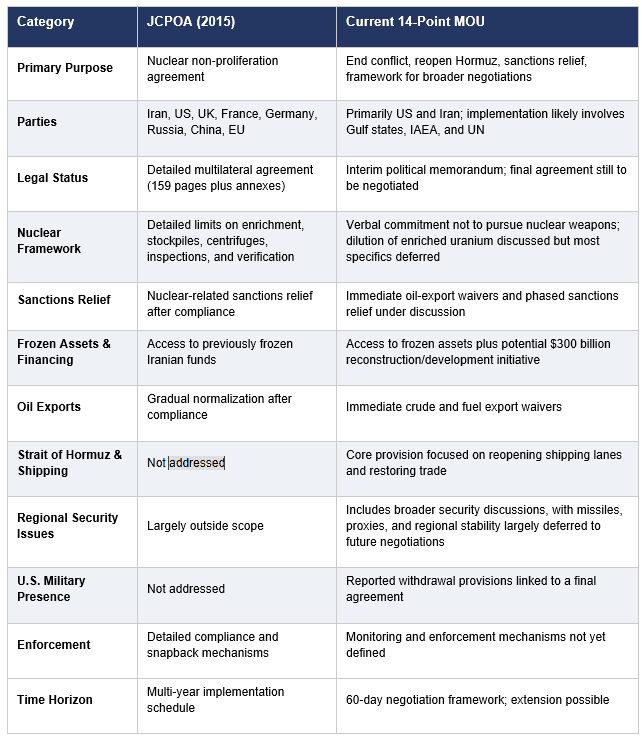
The immediate impact on energy markets has been significant. The memorandum allows Iran to resume oil exports under temporary waivers, restoring billions of dollars in annual revenue while reducing concerns about disruptions to global shipping and energy flows.
The more important question is not whether the current memorandum resembles the JCPOA, but whether it ultimately leads to a similar destination. After years of sanctions, military pressure, and conflict, the United States once again finds itself discussing sanctions relief, economic incentives, and Iranian nuclear restraint. The difference is that these negotiations are taking place in a very different regional environment. Iran's government remains in power, its ability to influence global energy markets has been demonstrated, and Gulf Arab states may now play a direct role in its economic reintegration.
Perhaps most notably, a conflict that began amid widespread discussion of regime instability and public support for Iranian protesters is ending with Washington negotiating directly with the same government it once sought to isolate. Whether that outcome represents strategic success, strategic failure, or simply geopolitical reality will likely be debated long after the details of this agreement are forgotten.
Even if Washington and Tehran reach a final accord, implementation will depend on a broader coalition that includes Gulf Arab states, international institutions, the IAEA, and regional actors whose interests do not always align.
For now, the memorandum should be viewed as what it is: an interim political framework rather than a final settlement. The agreement includes immediate measures related to oil exports, shipping, and sanctions relief, but many of the most consequential questions—including the final nuclear framework, verification procedures, enforcement mechanisms, and broader regional security arrangements—remain unresolved.
The agreement has been signed. Whether it becomes a durable regional settlement—or simply another chapter in the long history of U.S.-Iran negotiations—remains an open question.

See why the most successful traders and shipping experts use Kpler